BPC-157 vs IGF-1 LR3 for injury repair
BPC-157 vs IGF-1 LR3: both are animal-only for injury repair, but BPC-157 has closer tendon evidence while IGF-1 LR3 carries broader growth risks.
BPC-157 vs IGF-1 LR3 is not a choice between two validated injury drugs: neither has controlled human injury-repair evidence, and no trial has compared them directly. BPC-157 has the closer animal tendon-and-ligament case and the less alarming known risk signal; IGF-1 LR3 offers broader growth signaling with materially sharper glucose and mitogenic concerns.
Which peptide fits which injury goal?
BPC-157 fits the narrower tendon-or-ligament research question; IGF-1 LR3 fits direct growth-factor biology, not a demonstrated human repair outcome. That is a by-goal distinction, not a universal winner. The full BPC-157 profile and IGF-1 LR3 profile show why the shared animal-only badge hides a meaningful risk asymmetry.
BPC-157 improved healing after surgically transected medial collateral ligaments in rats. The same study saw effects with local cream, intraperitoneal dosing and drinking-water dosing. That makes BPC-157 the closer preclinical match for a stubborn tendon or ligament injury, while also warning against a neat “inject beside the pain, act only there” story.
IGF-1 LR3 activates the IGF-1 receptor, a broad growth signal. That mechanism makes sense for laboratory questions about anabolism or cell proliferation. It does not supply a human injury result, and guinea-pig infusion experiments enlarged the adrenals, gut, kidneys and spleen without increasing overall growth. A growth signal does not read the label on your sore elbow.
Does a site injection peptide stay local?
A site injection peptide should not be assumed to stay at the injection site. Neither compound has human distribution data showing that an injection beside an injury concentrates the effect there while sparing the rest of the body. For BPC-157, systemic and oral routes worked in rat injury models; for IGF-1 LR3, circulating peptide crossed into rat wound fluid and also distributed beyond the wound.
The LR3 wound study is especially useful because researchers tracked radiolabeled peptide after an intravenous dose. More intact LR3 reached wound fluid than native IGF-1, but only 0.08% of the administered amount was recovered per milliliter of wound fluid at 240 minutes. LR3 was also removed from circulation faster than native IGF-1. That is distribution to a wound, not proof of local confinement.
This is where vendor shorthand goes off the rails. “Long R3” describes the engineered molecule, including its added amino-acid extension; it is not evidence for the commonly quoted 20–30-hour human half-life. The rat injection literature reports faster clearance than native IGF-1 because weak binding to IGF-binding proteins leaves less peptide parked in the circulating reservoir.
What does the injury evidence actually show?
The local healing peptide comparison favors BPC-157 on relevance, but both remain animal-only for efficacy. BPC-157 has repeated rat tendon, ligament and muscle findings plus a recruiting Phase 2 hamstring-strain study. IGF-1 LR3 has animal and cell evidence for growth signaling, not a completed human injury trial and not a direct comparison against BPC-157.
The BPC-157 trial plans to enroll 120 participants and compare 14 days of subcutaneous BPC-157 with placebo alongside standardized rehabilitation. Its primary outcomes include return-to-sport time and MRI-measured injury volume. No results are posted, so the trial is a reason to watch, not evidence that the peptide works in people today.
IGF-1 LR3 remains farther from that question. Animal studies show that weak binding-protein affinity can make LR3 more potent than native IGF-1 for several systemic actions, yet one rat comparison found it barely equal to native IGF-1 for reversing carcass-muscle loss. Potent signaling and useful injury repair are different claims.
Are the risk profiles equivalent?
BPC-157 and IGF-1 LR3 do not carry equivalent known risks. BPC-157 has little human safety evidence, but animal work has not produced the same obvious glucose-lowering and organ-growth warnings. IGF-1 LR3 has no molecule-specific human safety trial, while its intended receptor activity makes hypoglycemia and unwanted cell or tissue growth credible concerns rather than generic disclaimers.
The cleanest human warning comes from mecasermin, FDA-approved native recombinant IGF-1—not LR3. Its label reports insulin-like hypoglycemic effects, including severe episodes and seizures, and contraindicates use with malignant neoplasia. Those events cannot be assigned numerically to IGF-1 LR3, but ignoring them would require pretending LR3 activates an unrelated pathway. It does not.
BPC-157 deserves restraint too. FDA says compounded BPC-157 may present immunogenicity, impurity and active-ingredient-characterization problems, and that safety information for proposed human routes is limited. “No loud toxicity signal yet” is not the same sentence as “safe.” Research-chemical sterility and dose accuracy add another unknown to either choice.
Is IGF-1 LR3 worth it for injury repair?
Is IGF-1 LR3 worth it for injury repair? The current evidence cannot show a human benefit large enough to justify its sharper theoretical and class-based risks. IGF-1 LR3 may be worth studying as an anabolic research tool, but BPC-157 is the more evidence-aligned preclinical pick for tendon or ligament repair. Neither is a validated treatment.
That conclusion is narrower than the typical “stack them for synergy” answer. No controlled study has tested the pair together, no study has shown that a near-injury LR3 injection stays local, and no validated human LR3 dose exists. Readers comparing options for a cranky joint can also see the broader peptides for joint pain guide, which separates human evidence from animal and anecdotal claims.
For injury repair, bpc-157 vs igf-1 lr3 therefore comes down to a closer preclinical match with fewer obvious class hazards versus a broader growth signal carrying more consequential unknowns.
What is their regulatory status in 2026?
BPC-157 and IGF-1 LR3 are not FDA-approved drugs as of July 16, 2026. BPC-157-related bulk substances are scheduled for FDA Pharmacy Compounding Advisory Committee review on July 23; the committee will consider possible inclusion on the 503A Bulks List, and its recommendation will be advisory rather than a prewritten approval. IGF-1 LR3 remains a research or cell-culture reagent.
Mecasermin can cause confusion here. FDA approval covers native recombinant IGF-1 for specific pediatric growth-failure indications, not the 83-amino-acid LR3 analogue. In sport, the 2026 WADA Prohibited List places BPC-157 under S0 and IGF-1 analogues under S2, both prohibited at all times. Regulatory labels are a poor place for wishful reading.
BPC-157 vs IGF-1 LR3 for injury repair, point by point
Every dimension side by side — the honest differences, not a scoreboard.
| Dimension | BPC-157 | IGF-1 LR3 for injury repair |
|---|---|---|
| Best-supported research target | Tendon, ligament and muscle repair in rat injury models. | IGF-1 receptor signaling, cell growth and systemic tissue growth in animal and cell models. |
| Human injury evidence | No completed efficacy trial; a 120-person Phase 2 hamstring-strain trial is recruiting with no results posted. | No human injury-repair trial identified. |
| Does injection near the injury prove local action? | No. Rat healing effects were reported after local, intraperitoneal and oral administration. | No. Circulating LR3 reached rat wound fluid and produced effects in multiple organs; a nearby injection has not been shown to stay nearby. |
| Binding proteins and clearance | No comparable binding-protein claim drives the injury case. | Binds IGF-binding proteins weakly, leaving more peptide free; rat studies found faster circulatory clearance than native IGF-1, not a verified 20–30-hour half-life. |
| Risk signal | Few obvious toxicity findings in animal work, but little human safety information and unresolved product-quality and immunogenicity concerns. | No LR3-specific human safety data; hypoglycemia and broad mitogenic signaling are credible class concerns, while animal studies show growth beyond skeletal muscle. |
| US regulatory status (July 2026) | Not FDA-approved; BPC-157-related bulk substances are scheduled for FDA PCAC review on July 23, 2026 for possible 503A Bulks List inclusion. | Not FDA-approved; sold as a research or cell-culture reagent. FDA-approved mecasermin is native recombinant IGF-1, not IGF-1 LR3. |
| Banned in sport | Yes — WADA S0, prohibited at all times as a non-approved substance. | Yes — IGF-1 and its analogues fall under WADA S2 and are prohibited at all times. |
- Best-supported research target: Neither compound has controlled human efficacy evidence for injury repair.
- Human injury evidence: No trial has compared BPC-157 with IGF-1 LR3 directly; this comparison weighs their separate evidence.
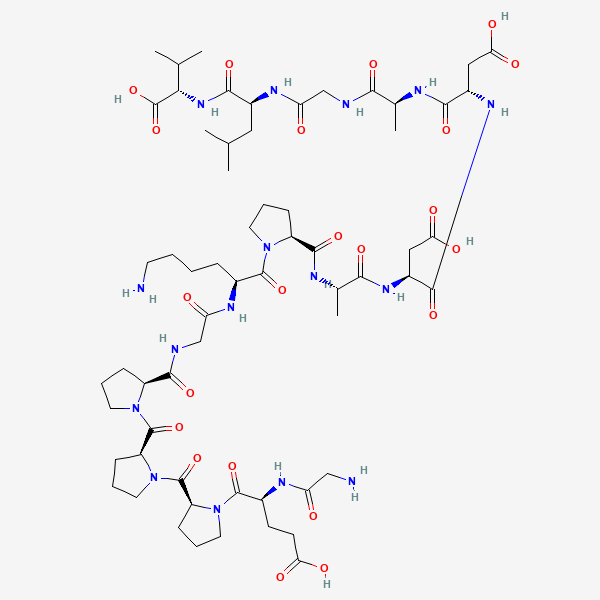
BPC-157 vs IGF-1 LR3 for injury repair: the two molecules
The 2D chemical structures, straight from PubChem — a quick way to see how similar (or not) the two actually are.
Which one fits which goal?
There's no universal winner here — the honest answer depends on what you're after. These picks are framed by goal, and each says why.
A tendon or ligament injury, judged only by the available preclinical evidence
Leans toward BPC-157
BPC-157 has the closer evidence match: repeated rat tendon and ligament models, without IGF-1 LR3's direct glucose-lowering and broad growth-signaling baggage.
Studying direct IGF-1 receptor signaling or anabolic biology in a laboratory model
Leans toward IGF-1 LR3 for injury repair
IGF-1 LR3 is the mechanistically relevant tool when the research question is IGF-1 receptor activation, not localized tendon healing. This is a laboratory fit, not evidence of human injury benefit.
Waiting for the first controlled human injury result
Leans toward BPC-157
BPC-157 is the only one of the pair with a recruiting Phase 2 injury trial, though it has no posted efficacy result yet.
References
- 1.Staresinic et al., 2010 — BPC-157 improves ligament healing in rats (PubMed)
- 2.Tomas et al., 1996 — injected LR3 IGF-I potency and faster circulatory clearance in rats (PubMed)
- 3.Bastian et al., 2000 — transport of circulating IGF-I and LR3 IGF-I to rat wound fluid
- 4.INCRELEX (mecasermin) FDA prescribing information
- 5.FDA — July 23–24, 2026 Pharmacy Compounding Advisory Committee meeting