Cerebrolysin vs Semax
Cerebrolysin vs Semax compares an injectable porcine peptide mixture with a short intranasal peptide by evidence, route, goals, and risks.
Cerebrolysin vs Semax is mainly a choice between a ready-to-use injectable mixture with more human clinical trials and a defined 7-amino-acid peptide usually delivered intranasally. Neither wins every goal, and neither has controlled proof as a nootropic in healthy adults. No trial has compared them directly; this weighs their separate evidence.
What is the main difference between Cerebrolysin and Semax?
Cerebrolysin is a porcine-derived mixture of small peptides and free amino acids, while Semax is one synthetic peptide with a known seven-amino-acid sequence. That difference shapes almost everything else: Cerebrolysin comes as liquid for injection, whereas Semax is normally used as nasal drops or spray.
Cerebrolysin was developed for neurorecovery and studied after ischemic stroke, in dementia, after brain injury, and in Alzheimer’s disease. Semax came from a fragment of adrenocorticotropic hormone, or ACTH, and is used intranasally in Russia. Both have nootropic reputations that run ahead of the evidence in healthy adults.
The useful cerebrolysin vs semax nootropic distinction is not “strong versus weak.” Cerebrolysin has more clinical research in ill or injured populations; Semax has an easier route but relies more on animal work.
Which compound has stronger human evidence?
Cerebrolysin has the stronger human evidence base, but stronger does not mean settled. Multiple randomized trials have tested Cerebrolysin for stroke, dementia, brain injury, and Alzheimer’s disease. Results are mixed, and Cochrane’s Cerebrolysin reviews raise concerns about study quality, short follow-up, and manufacturer involvement.
Semax has a real clinical history in Russia and published human research, particularly around ischemic stroke. The accessible record is smaller, often Russian-language, and not broadly replicated in large Western randomized trials. PubMed’s Semax index is the honest starting point; the existing profile grades the headline evidence as animal-only because the healthy-person cognitive claim rests mainly on preclinical work.
No direct trial answers semax vs cerebrolysin. Cerebrolysin’s patient trials cannot promise sharper focus in healthy people, and Semax’s animal findings cannot establish human performance. The evidence-grading guide explains the distinction.
How do their proposed mechanisms differ?
Cerebrolysin and Semax both have neurotrophic stories, meaning both are linked to signals that help neurons survive, adapt, and form connections. Cerebrolysin is proposed to imitate a broad set of the brain’s support signals, while Semax is linked more specifically to brain-derived neurotrophic factor (BDNF) and its TrkB receptor in animal studies.
Cerebrolysin’s mixture makes the mechanism harder to pin down. Its small peptides may act together rather than hit one known target. Cell and animal research supports neuroprotective activity, but the active components and human mechanism remain uncertain. PubMed indexes the wider Cerebrolysin evidence.
Semax offers a tidier hypothesis: animal studies connect the peptide with BDNF-related signaling in brain regions involved in learning. Whether that happens in healthy human brains or improves focus is unestablished.
Which route is easier: injection or intranasal use?
Semax has the less invasive route because nasal drops or spray avoid an injection. Cerebrolysin is a ready-to-use liquid administered by injection, commonly by intravenous infusion in trials and intramuscularly at smaller volumes. Route may decide cerebrolysin or semax for some readers before mechanism enters the conversation.
Cerebrolysin does not arrive as freeze-dried powder, so Cerebrolysin normally needs no reconstitution. The site’s reconstitution calculator is relevant arithmetic for peptides supplied as powder, including some Semax research formats, but it should not be used to invent a Cerebrolysin concentration or regimen. Ready-to-use does not mean casual: injection adds sterility, administration, and local-reaction concerns.
Semax avoids needles, but US research-use powder or solution is not an FDA-approved nasal medicine. Intranasal delivery can cause local irritation. Convenience does not prove Semax works better.
What doses and schedules have actually been studied?
Cerebrolysin trials report intravenous doses commonly around 10 to 30 mL per day over courses of roughly 10 to 20 days, with smaller volumes given intramuscularly. Those figures describe medical studies in patient populations; they are not a validated healthy-person nootropic protocol. Registered studies can be checked through ClinicalTrials.gov’s Cerebrolysin search.
Semax’s existing profile does not claim a validated study dose for healthy cognition. Few-hundred-microgram intranasal amounts appear in community use, but community practice is anecdote, not clinical validation. That boundary matters because a precise-looking number can still rest on weak evidence. This comparison does not turn either research record into personal dosing advice.
Cerebrolysin risks include injection-site reactions, dizziness, headache, flushing, agitation, and rare allergy. Semax can cause nasal irritation or headache, while rigorous long-term Western safety data remain limited.
Are Cerebrolysin or Semax FDA-approved in the United States?
Neither Cerebrolysin nor Semax is FDA-approved in the United States as of 2026, and neither is a legal dietary supplement. Cerebrolysin is an approved prescription drug in a number of other countries; Semax is an approved medicine in Russia. Foreign approval does not create FDA approval or validate US research-market products.
The regulatory details differ, but the practical US line is similar: both sit outside approved medical use. Cerebrolysin is an unapproved injectable biological preparation, while Semax is sold in the US for research use rather than as an approved nasal drug. The regulatory-status reference provides the vocabulary behind those labels.
Status claims are dated facts, not permanent properties. Readers subject to sports rules also need a current check with their governing body rather than assuming that absence from a named list equals clearance.
Which one fits which goal?
Cerebrolysin fits the goal of prioritizing the larger human clinical-trial record, especially for neurorecovery questions in patient populations. Semax fits the goal of avoiding injections or studying a short, defined peptide with a BDNF-linked animal research story. Neither choice is a universal winner, and neither has controlled proof for healthy cognitive enhancement.
For the strongest evidence footprint, Cerebrolysin gets the by-goal pick, with a large asterisk for mixed results and study-quality concerns. For route convenience, Semax gets the pick because intranasal delivery is simpler than infusion or intramuscular injection. For healthy focus, the honest answer is that both remain uncertain: Cerebrolysin’s trials do not match that population, and Semax’s human evidence is too thin to settle the claim.
The broader nootropic peptide hub puts both compounds beside other research candidates without pretending every mechanism has the same level of proof. This comparison is educational, not medical advice; the useful decision is by goal, route, and tolerance for uncertainty, not a single podium finish.
Cerebrolysin vs Semax, point by point
Every dimension side by side — the honest differences, not a scoreboard.
| Dimension | Cerebrolysin | Semax |
|---|---|---|
| What it is | A standardized mixture of low-molecular-weight peptides and free amino acids processed from purified porcine brain proteins. | A synthetic 7-amino-acid peptide derived from an ACTH fragment, with a Pro-Gly-Pro tail added for stability. |
| Form and usual route | A ready-to-use liquid given by injection, commonly by IV infusion in clinical studies and intramuscularly at smaller volumes. | An intranasal solution delivered as nasal drops or spray; research powder may be reconstituted before use. |
| Evidence base | Multiple human randomized trials in stroke, dementia, traumatic brain injury, and Alzheimer's disease, with mixed findings and important study-quality concerns. | Mostly animal research plus small Russian clinical studies and clinical use; healthy-adult cognitive benefits lack broad, replicated Western trials. |
| Nootropic evidence in healthy adults | No controlled evidence establishes better memory or focus in healthy people; the human trials involve injured or ageing brains. | Animal learning and BDNF findings support the hypothesis, but controlled human evidence for focus in healthy adults remains thin. |
| Proposed mechanism | Broad neurotrophic and neuroprotective activity from a complex peptide mixture; the precise active components and human mechanism are not established. | BDNF and TrkB signaling is implicated mainly by animal studies; the exact human mechanism is not established. |
| Doses described in the existing evidence | Clinical studies report IV courses commonly around 10 to 30 mL per day for roughly 10 to 20 days; these are study regimens, not personal dosing advice. | The profile has no validated study dose for healthy cognition; few-hundred-microgram intranasal amounts come from community reports, not clinical validation. |
| US regulatory status (2026) | Not FDA-approved for any use and not a dietary supplement; approved as a prescription drug in a number of other countries. | Not FDA-approved and not a dietary supplement; approved as a medicine in Russia but sold in the US only for research use. |
- Evidence base: No trial has compared Cerebrolysin and Semax directly; this comparison weighs their separate evidence.
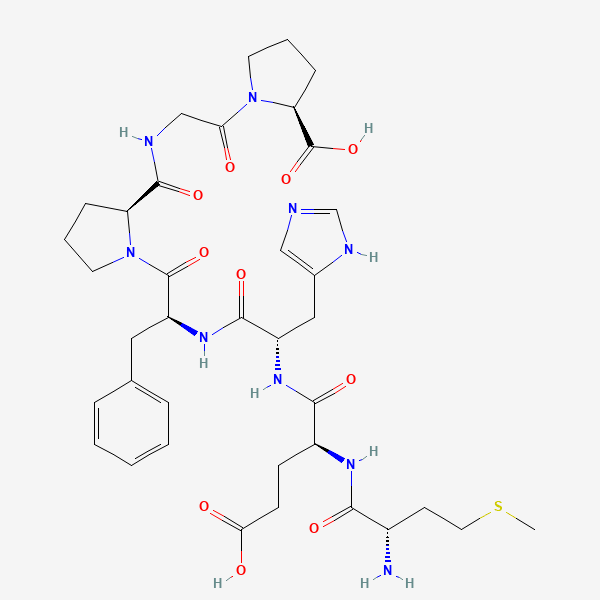
Cerebrolysin vs Semax: the two molecules
The 2D chemical structures, straight from PubChem — a quick way to see how similar (or not) the two actually are.
Which one fits which goal?
There's no universal winner here — the honest answer depends on what you're after. These picks are framed by goal, and each says why.
Prioritizing the stronger human clinical-trial record
Leans toward Cerebrolysin
Cerebrolysin has multiple randomized human trials in stroke, dementia, brain injury, and Alzheimer's disease, although the findings are mixed and do not establish healthy-person nootropic benefits.
Prioritizing an intranasal rather than injectable format
Leans toward Semax
Semax is normally delivered as nasal drops or spray, while Cerebrolysin is a ready-to-use injectable liquid. Route convenience does not prove greater effectiveness.
Choosing the compound studied more directly in neurorecovery patients
Leans toward Cerebrolysin
Cerebrolysin's human research directly includes stroke, dementia, and traumatic brain injury populations; Semax's accessible evidence is smaller and less broadly replicated.
Exploring a short, defined peptide with a BDNF-linked research story
Leans toward Semax
Semax is one defined 7-amino-acid peptide, and animal studies repeatedly connect it with BDNF and TrkB signaling. Human cognitive efficacy remains uncertain.
References
- 1.Cerebrolysin - indexed research (PubMed, National Library of Medicine)
- 2.Cochrane systematic reviews of Cerebrolysin
- 3.Cerebrolysin - registered clinical studies (ClinicalTrials.gov)
- 4.Semax - indexed research (PubMed, National Library of Medicine)
- 5.Semax - registered clinical studies (ClinicalTrials.gov)