Also known as: ACTH(4-10) analog · Met-Glu-His-Phe-Pro-Gly-Pro · MEHFPGP
Animal-onlyUnclear
On this page
- What people actually use Semax for — and what they report
- What is Semax?
- How does Semax work?
- Does Semax actually work? What the science says
- Is Semax safe? Side effects
- FDA & legal status (2026)
- How people take Semax: nasal spray vs injection, and the doses they run
- Semax vs Selank (and the pricier NASA variant)
- Frequently asked questions
- Who is Semax for — and who should be cautious?
- Evidence by outcome
- FDA & legal status
- Chemical identifiers
- References
- Related compounds
- More on Semax
If you’re weighing Semax, odds are you’ve got something heavy in front of you — a certification, a coding sprint, a wall of reading — and you’ve hit the point where more caffeine just makes you a wired version of tired. Somewhere in that search, a Russian nasal peptide keeps coming up.
Semax is a synthetic Russian nootropic peptide people run — almost always as a nasal spray — for focus, mental stamina, word-finding, and a mood lift. The most common report is a clean, non-jittery sharpening that helps you stay on task, not a stimulant jolt. The honest catch: the hard evidence is rat data plus a decades-long Russian medical track record that Western trials have barely touched. Semax isn’t FDA-approved, and there isn’t a single registered US trial.
What people actually use Semax for — and what they report
Strip out the lab talk and Semax has a fairly specific reputation among students, coders, writers, and shift workers: it’s the “focus peptide.” The usual pattern is a few hundred micrograms sprayed into the nose before a block of deep work. People reach for it for four overlapping things — locking into a task, pushing through mental fatigue, smoother word-finding, and a general mood lift. The most distinctive of those, the effect that keeps Semax’s name alive on r/Nootropics and r/Peptides, is verbal fluency: the reports that words come out easier, that the sentence you were reaching for just arrives. Neuroprotection and long-term “brain health” is the fifth, fuzzier reason the longevity crowd runs it.
What they report — the wins. The through-line is that Semax feels clean: focus and drive without the jaw-clench and crash of a stimulant, described more as “the background noise went quiet” than “I’m buzzing.” Staying on task is the single most-cited win; motivation and lower fatigue come next; a lot of people add a mood bump, sometimes an anti-anhedonia “things are interesting again” feeling. The loud end of the spectrum gets almost comic — one report that circulates is “felt like a god for twenty hours” off a first dose — which is worth reading as the ceiling, not the average.
What they report — the letdowns. This is the more useful half, and the part the sales pages skip. Three honest patterns come up over and over. First, tolerance: the sharp acute effect very commonly fades after two to three weeks of daily use — “fell off a cliff after 2.5 weeks” is a recurring phrasing — which is why so many people cycle Semax instead of running it straight. Second, non-responders: a real minority feel nothing at all, and that camp is loudest about the nasal route specifically, with reports along the lines of “never noticed a thing intranasally.” Third, the wrong kind of stimulation: push the per-dose amount up and the reports flip from “clean focus” to restless, jittery, and irritable, sometimes anxiety-tinged. Mild headaches are common and don’t seem to track with dose. And keep one thing in mind reading any of this: the people who tried Semax, felt nothing, and quietly moved on don’t come back to post a follow-up, so the online enthusiasm runs a notch hotter than the real hit rate. Set the dial to “subtle edge,” not “limitless.”
What is Semax?
Semax is a lab-made peptide — a short chain of seven amino acids (sequence MEHFPGP: Met-Glu-His-Phe-Pro-Gly-Pro) built from a fragment of ACTH, a natural hormone, with a small “Pro-Gly-Pro” tail bolted on so the molecule survives longer in the body. Chemically it’s small and water-soluble (formula C37H51N9O10S, molecular weight about 814; PubChem CID 9811102). Semax is best known two ways: as a Russian prescription nasal medicine for cognition and stroke recovery, and — everywhere else — as one of the most-searched “nootropic peptides.” In the United States it’s neither a prescribable medicine nor a legal supplement; it exists only as a research chemical.
How does Semax work?
Semax’s leading proposed mechanism, drawn mostly from rat studies, is that Semax raises BDNF — brain-derived neurotrophic factor — along with its TrkB receptor, especially in the hippocampus, the brain’s memory hub. Picture BDNF as fertilizer for brain cells: it helps existing neurons stay healthy and helps new connections take root, which is a plausible throughline for a focus-and-learning effect that builds over days rather than hitting like a stimulant. Semax also appears to slow the breakdown of the brain’s own signaling peptides and to nudge the dopamine and serotonin systems — the likely reason the mood and motivation reports cluster the way they do. The honest caveat: these are largely animal and cell findings, and exactly how Semax behaves inside a human brain hasn’t been pinned down.
Does Semax actually work? What the science says
Here’s the part worth being straight about: Semax’s evidence only makes sense if you keep two piles separate — strong, repeated rat data, and a real but hard-to-audit Russian human record. The rat pile is the backbone. In rats, Semax reliably raised BDNF and its TrkB receptor in the hippocampus and improved learning and attention measures, and that BDNF result is the most-replicated finding in the whole literature. It’s animal-tier — but the sturdy kind: consistent across labs, and mechanistically coherent.
The human pile is where the honesty has to live. Semax has a real human history in Russia, where it’s been an approved intranasal medicine for decades, used for acute ischemic stroke and cognitive complaints. That’s a genuine human track record — but it’s built mostly on small, Russian-language studies that Western randomized controlled trials have never broadly re-run. A PubMed search returns roughly 230 Semax records, about 51 tagged human and at least one tagged a randomized trial (PubMed; human-tagged), while ClinicalTrials.gov lists no registered trials at all (ClinicalTrials.gov). The most concrete Western data point is small: an fMRI study that picked up measurable brain-network changes 5 and 20 minutes after intranasal Semax — evidence it does something fast in a live human brain, though it never measured whether the person felt more focused (fMRI study).
So the read, for the thing most people actually search Semax for — a clean focus boost in a healthy adult — is animal-grade with an unknown human verdict: a coherent mechanism and one of the better-looking animal cases in the nootropic-peptide space, sitting next to a decades-long human medical history that mostly hasn’t cleared the Western trial bar. And the shape of that gap is specific to Semax. This isn’t the usual “a big trial is about to read out” story — there’s no such trial. The honest reason the Western evidence is thin is that the human work stayed inside Russian journals and never got re-run to FDA standards. The signal exists; it just hasn’t been translated into the system the rest of the world grades on.
Is Semax safe? Side effects
Semax’s honest safety answer is “reassuring but under-studied outside Russia.” It’s been used as a nasal medicine in Russia for decades and is generally reported as well tolerated, with the most common complaints minor and local: some nasal irritation from the spray, and mild headaches that show up fairly often and don’t seem to track with dose. At higher per-dose amounts — community reports put the tipping point around 600 mcg in a single dose — the profile can shift toward restlessness, jitteriness, and irritability, the overstimulation edge of an activating compound.
What’s missing is rigorous long-term Western safety data. Most controlled studies used short courses, so what daily Semax does over months or years in a healthy person simply hasn’t been well characterized. And because Semax bought outside Russia is sold as an unregulated research chemical, the real risk is often less about the molecule than about the vial: whether it actually holds what the label claims, at the purity and sterility it claims. That’s where buyer education earns its keep — a genuine third-party Certificate of Analysis, not the seller’s own word.
FDA & legal status (2026)
Semax is not FDA-approved, and it is not a legal dietary supplement either. As of July 15, 2026, in the United States Semax is sold strictly as a research chemical “for research use only.” The contrast worth knowing: Semax is a registered, approved medicine in Russia — mostly an intranasal solution for neurological indications — but that foreign approval carries no weight with the FDA, and it does not make Semax legal to sell for human use in the US (Drugs@FDA).
| Question | Status on July 15, 2026 | What that means |
|---|---|---|
| FDA approval | Not approved | No FDA-reviewed Semax indication, label, or commercial drug product exists in the US |
| Supplement status | Not a legal dietary supplement | Semax can’t be lawfully sold for human consumption in the US |
| Russia | Approved prescription medicine | A real foreign approval — with zero standing at the FDA |
| Research-chemical sales | Sold online “for research use only” | Being available doesn’t make it approved, safe, or effective for people |
Treat any status claim as dated and re-check it — regulatory status is the single thing on this page most likely to change.
How people take Semax: nasal spray vs injection, and the doses they run
Semax is taken almost entirely intranasally — as drops or a spray — and that’s not arbitrary: it’s how the Russian medicine is delivered and the route the human brain-imaging work used, so it’s the best-supported way in. A subcutaneous injectable Semax also exists in the US research market, but the two routes don’t share an evidence base, and there’s no human head-to-head showing injection beats the nose for a nootropic effect. For most people chasing focus, intranasal is the route with the receipts; injection is the smaller, less-charted camp.
On amounts, everything here is commonly reported in the community, not a validated protocol — no human trial has published a nootropic dose. Plain Semax reports cluster around 300–900 mcg per day, often split into two or three doses, with many people starting near 600 mcg and adjusting by feel; because plain Semax clears quickly (onset around 15–30 minutes, then largely gone within a couple of hours), some redose across the day. The pricier N-Acetyl Semax Amidate (NASA) is reported as more potent and longer-lasting, so people run it at roughly a third to a fifth of a plain-Semax dose. Research-grade Semax usually arrives as a freeze-dried powder that has to be reconstituted with bacteriostatic water before it’s loaded into a nasal sprayer — that part is pure arithmetic, and our reconstitution & dosing calculator turns “a 30 mg vial, 3 mL water, 600 mcg target” into the exact volume to draw, without pretending to recommend a dose. People also ask whether Semax can share a solution with other peptides; our mixing compatibility reference covers what’s commonly combined and where the honest answer is “not enough data.”
Semax vs Selank (and the pricier NASA variant)
Semax’s most common comparison is to Selank, an anti-anxiety peptide from the same Soviet-era research lineage — and the clean way to hold them apart is that Semax leans toward focus and drive while Selank leans toward calm. If the problem is a scattered, foggy, can’t-lock-in feeling, people point to Semax; if it’s a racing, anxious, can’t-settle feeling, they point to Selank — and a fair number run the two together to cover both ends at once. Semax also gets compared to Noopept and the older racetam nootropics, though the mechanisms differ. None of these has a large, replicated Western human trial base, so the useful framing is “different tools for different goals,” not “the best nootropic.” You can see where Semax sits among the compounds we cover on the nootropic peptides hub, and how we weigh preliminary evidence on our evidence-grading page.
One more thing US buyers keep tripping over: three names that look almost identical. Plain Semax is the parent MEHFPGP peptide used in the published human literature; N-Acetyl Semax adds an acetyl group at the N-terminus; and N-Acetyl Semax Amidate (NASA) adds that acetyl group plus a C-terminal amide. Sellers price NASA highest and describe it as longer-acting and more potent — a real chemical-stability claim, but not a demonstrated clinical one. A targeted PubMed search turns up no head-to-head human trial comparing these forms on pharmacokinetics or cognition, so the amidate can’t honestly be called better on human evidence — only different, and more expensive (PubMed).
Frequently asked questions
Does Semax actually work for focus?
In rats and in a lot of anecdotal human reports, yes — sharper focus and easier word-finding are the most commonly described effects, usually as a clean edge rather than a stimulant hit. In controlled Western trials, it’s unproven: no registered US trial has tested Semax for focus in healthy adults, the strong data is rat data, and the human track record is Russian and mostly un-replicated. Set expectations at “subtle, cyclable edge,” not “instant genius.”
Is Semax proven to work in humans?
Not in the strict Western sense. Semax has strong, repeated animal evidence for raising BDNF and improving learning, plus a real human clinical history in Russia for stroke and cognition. But that human evidence is mostly small, Russian-language, and not broadly replicated in Western randomized trials, and there are no US-registered trials — so for a healthy person seeking a focus boost, we grade Semax animal-only with an unknown verdict.
Nasal spray or injection — which do people use?
Overwhelmingly the nasal spray. Intranasal is how the Russian medicine is delivered and the route the human brain-imaging work used, so it’s the best-supported way to get Semax to the brain. A subcutaneous injectable version exists in the research market, but it doesn’t have a matching evidence base, and no human trial shows it works better than the nose for a nootropic effect.
Is Semax legal?
Semax is legal to possess and sell as a research chemical in the United States, but it is not an approved drug or a legal dietary supplement, and it cannot be sold for human consumption — which is why every US vendor labels it “for research use only.” In Russia, by contrast, Semax is an approved prescription medicine.
Is Semax banned in sport?
Semax is not specifically named on the current WADA Prohibited List, and because it’s an approved medicine somewhere, the “non-approved substances” catch-all doesn’t cleanly apply the way it does to pure research chemicals. That is not a guarantee of clearance — any competing athlete should confirm against the current WADA list and their federation before use.
Why do Semax’s effects fade after a few weeks?
Tolerance is the single most common community complaint: the sharp acute effect often dulls after two to three weeks of daily use. That’s why many people cycle Semax — running it for a stretch, then taking a break — rather than dosing it indefinitely. There’s no trial-validated cycling schedule, though; it’s a crowd convention, not a clinical one.
Who is Semax for — and who should be cautious?
Semax draws in people facing an intense mental stretch — an exam, a certification, a demanding sprint at work — who’ve read that it sharpens focus and want to understand it before committing. The honest framing: the animal case for a BDNF-driven cognitive effect is one of the more coherent in the nootropic-peptide space, and Semax carries a real human history in Russia — more human backing than most research peptides can claim. What it doesn’t have is proof that the healthy-adult focus benefit holds up by Western trial standards, long-term Western safety data, or any guarantee about what’s in the vial you’d actually buy.
So it fits the self-experimenter who accepts they’re the study — someone who’ll start low, cycle it, and treat the focus lift as a subtle, unproven edge rather than a sure thing. It isn’t for anyone pregnant or breastfeeding, anyone managing a neurological or psychiatric condition without a doctor in the loop, or anyone who needs certainty before they try something. The Russian record is real; the Western proof that would settle it simply hasn’t been run yet.
Evidence by outcome
Each outcome Semax has been studied for, with the honest evidence grade and what the studies actually found. A tier never stands alone — the verdict rides with it.
| Outcome | Evidence | What was found |
|---|---|---|
| Cognitive enhancement & focus (in healthy adults) | Animal-onlyUnclear | In rats, Semax improved learning and attention measures and raised BDNF. Human data in healthy people looking for a focus boost is thin and comes mostly from Russian clinical settings rather than Western randomized trials, so the size of any effect in a healthy adult is unproven. |
| BDNF / neurotrophic signaling (mechanism) | Animal-onlyHelped | In rat brains, Semax increased BDNF and its TrkB receptor, especially in the hippocampus — the most-replicated finding in the animal literature and the mechanistic reason people expect a nootropic effect. Rats are not people, so this explains the interest, it doesn't prove the human benefit. |
| Neuroprotection after ischemic stroke | Human observationalUnclear | Semax has a real human track record for acute ischemic stroke in Russia, where it is an approved medicine. That evidence is mostly small, Russian, and not widely replicated in Western randomized controlled trials, so it is a genuine human signal — not settled proof by the standards used elsewhere. |
FDA & legal status
- United States: research use only (as of Jul 2026)
Not an FDA-approved drug and not a dietary supplement — in the United States Semax is sold only as a research chemical "for research use only." Note the contrast: Semax is a registered, approved medicine in Russia (used mainly as an intranasal solution for neurological indications), but that approval has no standing with the FDA. Re-verify status periodically.
openFDA Drugs@FDA lists no approved product for Semax as of 2026-07-15.
Chemical identifiers
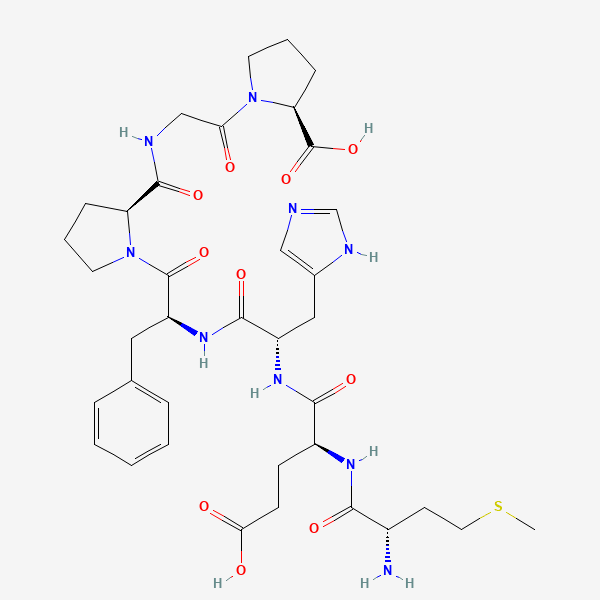
- Molecular formula
- C37H51N9O10S
- Molecular weight
- 813.9 g/mol
- IUPAC name
- (2S)-1-[2-[[(2S)-1-[(2S)-2-[[(2S)-2-[[(2S)-2-[[(2S)-2-amino-4-methylsulfanylbutanoyl]amino]-4-carboxybutanoyl]amino]-3-(1H-imidazol-5-yl)propanoyl]amino]-3-phenylpropanoyl]pyrrolidine-2-carbonyl]amino]acetyl]pyrrolidine-2-carboxylic acid
Verified external records:
References
- 1.Semax — indexed research (PubMed, National Library of Medicine)
- 2.Semax — human-tagged studies (PubMed, humans filter)
- 3.Semax (Compound CID 9811102) — chemical record, PubChem
- 4.Semax — registered clinical studies (ClinicalTrials.gov)
- 5.FDA — drug approval status (Drugs@FDA)
- 6.Effects of Semax on the Default Mode Network of the Brain
- 7.N-acetyl Semax variants — indexed human evidence search (PubMed)
More on Semax
Everything else we've written about Semax — what the community reports, the explainers that cover it, and the terms it keeps running into.
- Reddit on Semax peptide benefits: evidence checkOn Reddit
- Adamax Peptide: What It Actually Is (and Isn't)Explainer
- Do Peptides Cross the Blood-Brain Barrier?Explainer
- Peptides for anxiety: Selank & moreExplainer
- What Are Neuropeptides? Plain-English GuideExplainer
- Crossover trialGlossary
- IntranasalGlossary
- Blood-brain barrierGlossary
- NootropicGlossary