IGF-1 LR3 vs Ipamorelin
IGF-1 LR3 vs Ipamorelin: neither has human muscle-growth evidence, but LR3 bypasses pituitary feedback and brings a different risk profile.
IGF-1 LR3 vs Ipamorelin is a comparison between a direct, binding-protein-resistant IGF-1 analogue and a pituitary GH secretagogue. Neither has human efficacy data for muscle growth, and no trial has compared them directly. Ipamorelin keeps the upstream feedback loop in play; LR3 bypasses it and carries the sharper hypoglycemia and growth-signaling concerns.
What is the core difference between IGF-1 LR3 and ipamorelin?
IGF-1 LR3 supplies the downstream growth signal directly, while ipamorelin asks the pituitary to release growth hormone (GH) and lets the body make its own IGF-1 afterward. Think of ipamorelin as pressing the factory’s order button; LR3 skips the factory and drops the finished signal at the loading dock. That distinction changes both control and risk.
IGF-1 LR3 is an 83-amino-acid analogue that activates the IGF-1 receptor. Its structural changes reduce affinity for IGF-binding proteins by more than 100-fold, so those carrier proteins exert far less control over how much remains available. A receptor study confirmed the affinity change but did not show LR3 to be intrinsically stronger than native IGF-1 at every concentration (Philippou et al., 2016). “More available” and “more potent at the receptor” are not interchangeable claims.
Ipamorelin is a five-amino-acid ghrelin-receptor agonist. In healthy men, intravenous ipamorelin produced one GH episode, peaking around 0.67 hours, while the peptide’s terminal half-life was about two hours (Gobburu et al., 1999). The GH–IGF-1 feedback system still responds to that pulse. Ipamorelin nudges the axis; LR3 goes around its front desk.
Does either peptide build muscle in humans?
Neither peptide has human efficacy evidence for muscle growth, despite the confidence of many sales pages. Ipamorelin has human evidence for releasing GH, but a hormone reading is not a muscle outcome. IGF-1 LR3 has animal and cell evidence for growth signaling, but no human trial showing hypertrophy, strength, recovery, or improved body composition.
That makes ipamorelin vs igf-1 lr3 an unusually clean example of mechanism being mistaken for a result. Ipamorelin’s reasoning is indirect: GH rises, GH can increase IGF-1, and the axis affects tissue growth. LR3’s reasoning is more direct: the analogue activates IGF-1 receptors. Neither chain ends with a controlled human muscle study.
No direct head-to-head trial exists, either. The comparison therefore cannot say that one produces more lean mass, faster recovery, or better fat loss than the other. For a wider evidence map, see peptides for muscle growth compared.
Does IGF-1 LR3 stay near the injection site?
IGF-1 LR3 has no credible evidence for site-specific human muscle growth, and its known biology points toward systemic distribution rather than a peptide politely staying where the needle landed. Reduced binding to carrier proteins can increase movement from blood into tissues; it does not create a postal code for one biceps or quad.
The most relevant whole-animal experiment continuously infused LR3 into guinea pigs for seven days. The result was not selective skeletal-muscle growth: researchers reported growth in the adrenals, kidneys, spleen, stomach, and intestines, while carcass composition did not significantly change (Conlon et al., 1995). That study was not designed to test local injection, but it shows why a systemic growth factor should not be marketed as a precision tool.
The vendor claim survives mainly by repetition. No opened primary source showed that injecting LR3 beside a lagging muscle confines receptor activation or produces localized hypertrophy in humans.
Is IGF-1 LR3 safe compared with ipamorelin?
IGF-1 LR3 carries the more concerning direct risk profile, although neither compound has a long-term human safety record for physique use. The asymmetry comes from what is supplied: LR3 is the insulin-like growth factor signal itself, engineered to evade much of its normal binding-protein restraint; ipamorelin produces a brief upstream GH pulse that remains inside a feedback-regulated axis.
The answer to is igf-1 lr3 safe is therefore not available from an LR3 clinical trial—none exists. Native recombinant IGF-1 is the closest regulated comparison, not a substitute for LR3 data. Its FDA label warns of severe hypoglycemia, including seizures, and reports malignant neoplasms while saying the causal relationship is unknown (DailyMed). LR3’s cell-growth signaling and guinea-pig organ growth make hypoglycemia and mitogenic concerns reasonable hazards, not measured human incidence rates.
Ipamorelin is not cleared as safe. FDA’s compounding-risk page, current April 22, 2026, places ipamorelin acetate in category 2 under the 503B interim policy and cites aggregation, peptide-impurity, immunogenicity, and limited route-specific safety data (FDA). “Less direct IGF risk” does not mean “low risk.”
Is the reported LR3 half-life reliable?
The popular 20–30-hour IGF-1 LR3 half-life is not backed by a direct human pharmacokinetic study that could be verified here. Primary papers support reduced IGF-binding-protein affinity and altered tissue availability. They do not establish that precise duration in people. A tidy number repeated across storefronts is still not a measurement.
Ipamorelin’s roughly two-hour figure is narrower and better defined: eight healthy men at each dose level received 15-minute intravenous infusions in the published pharmacokinetic study. That number should not be silently converted into a subcutaneous half-life, but at least the species, route, and experiment are known. LR3 can fairly be called longer-acting in laboratory use; assigning a verified 20–30-hour human half-life goes beyond the evidence.
Which one fits which goal?
There is no universal winner in igf-1 lr3 vs ipamorelin. Ipamorelin is the cleaner match for studying a pituitary GH pulse, feedback, or the igf-1 vs gh secretagogue distinction. LR3 is the relevant laboratory tool when the question specifically requires direct IGF-1 receptor activation without a functioning pituitary. Neither is the evidence-based pick for proven human muscle gain.
The risk question breaks the tie differently. Someone comparing exposure rather than mechanism should recognize that LR3 brings direct IGF-like hypoglycemia and systemic growth-signaling concerns that ipamorelin does not share in the same way. Both remain unapproved for human use in the United States, and USADA lists both IGF-1 and ipamorelin as prohibited at all times in tested sport (USADA). The by-goal picks above describe research fit, not a personal protocol.
IGF-1 LR3 vs Ipamorelin, point by point
Every dimension side by side — the honest differences, not a scoreboard.
| Dimension | IGF-1 LR3 | Ipamorelin |
|---|---|---|
| Place in the GH–IGF-1 axis | A direct IGF-1 receptor agonist: the downstream growth signal is supplied from outside the body. | A ghrelin-receptor agonist: it nudges the pituitary to release a short pulse of the body's own growth hormone. |
| Human evidence for muscle growth | Mechanistic hypothesis; none in humans. Animal and cell studies show growth signaling, not human muscle gain. | Mechanistic hypothesis; none in humans. Human studies confirm a GH pulse, not muscle gain, fat loss, or recovery. |
| Direct comparison | No head-to-head trial against ipamorelin exists. | No head-to-head trial against IGF-1 LR3 exists. |
| Feedback and binding proteins | Evades IGF-binding proteins by more than 100-fold and delivers an exogenous signal that pituitary feedback cannot switch off. | Triggers endogenous GH release within an axis still restrained by somatostatin, GH, and IGF-1 feedback. |
| Verified half-life | No human pharmacokinetic half-life has been established. The widely repeated 20–30-hour figure was not traceable to a direct human LR3 study. | About 2 hours after a 15-minute intravenous infusion in healthy men; GH peaked at about 0.67 hours in that study. |
| Risk signal | The sharper concern: direct IGF-like hypoglycemia plus systemic mitogenic and organ-growth signaling. Human LR3 safety data are absent. | No long-term safety record and FDA-identified compounding concerns, but not the same direct IGF-like hypoglycemia exposure. |
| US regulatory and sport status (2026) | Not FDA-approved for human use; sold as a research reagent. IGF-1 and its analogues are prohibited at all times in tested sport. | Not FDA-approved; FDA lists ipamorelin acetate among 503B category 2 substances with potential significant safety risks. Prohibited at all times in tested sport. |
- Place in the GH–IGF-1 axis: LR3 bypasses the pituitary step; ipamorelin still depends on an intact, feedback-regulated GH axis.
- Direct comparison: This comparison weighs separate evidence; it does not infer a comparative effect size.
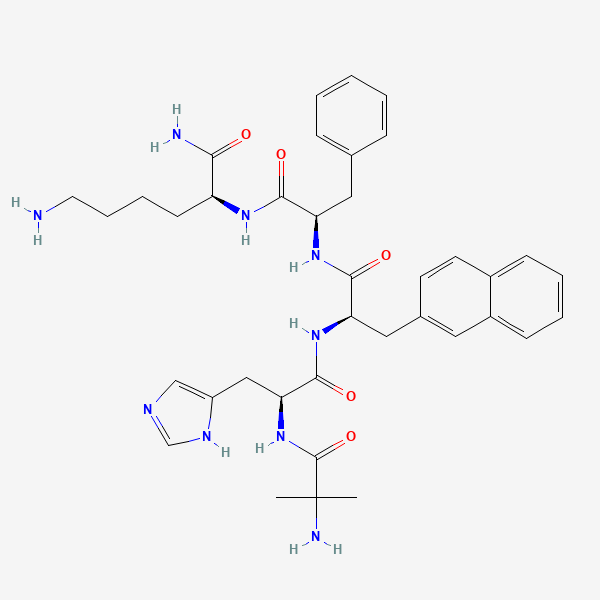
IGF-1 LR3 vs Ipamorelin: the two molecules
The 2D chemical structures, straight from PubChem — a quick way to see how similar (or not) the two actually are.
Which one fits which goal?
There's no universal winner here — the honest answer depends on what you're after. These picks are framed by goal, and each says why.
Studying a pituitary GH pulse while keeping upstream feedback in the loop
Leans toward Ipamorelin
Ipamorelin works through the ghrelin receptor and pituitary, producing a measured GH pulse rather than supplying the downstream growth factor directly.
Studying direct IGF-1 receptor signaling in cells or a non-human tissue model
Leans toward IGF-1 LR3
IGF-1 LR3 acts at the receptor without requiring a functioning pituitary or liver, which makes it the relevant laboratory tool for that narrow question.
Avoiding the specific risk of direct IGF-like hypoglycemic exposure
Leans toward Ipamorelin
Ipamorelin has its own unknowns, but it does not inject an IGF-1 analogue directly; that makes the acute risk profile meaningfully different, not risk-free.
References
- 1.Conlon et al., 1995 — Long R3 IGF-I infusion and organ growth in guinea pigs (PubMed)
- 2.Gobburu et al., 1999 — human ipamorelin pharmacokinetic/pharmacodynamic study (PubMed)
- 3.INCRELEX (mecasermin) prescribing information — hypoglycemia and neoplasia warnings (DailyMed)
- 4.FDA — bulk drug substances that may present significant safety risks
- 5.USADA — prohibited-substance screening list for IGF-1 and ipamorelin