Also known as: NNC 26-0161 · Ipamorelin acetate
MechanisticUnclear⚠ none in humans
On this page
- What people actually use ipamorelin for — and what they report
- What is ipamorelin?
- How does ipamorelin work?
- Does ipamorelin actually work? What the science says
- Is ipamorelin safe? Side effects
- Ipamorelin’s FDA & legal status (2026)
- Ipamorelin dosage: what studies actually used
- Ipamorelin vs CJC-1295, sermorelin and the other GH peptides
- Hype vs. reality
- Frequently asked questions
- Who ipamorelin is for — and who should skip it?
- Evidence by outcome
- FDA & legal status
- Registered clinical trials
- Reported side effects
- Chemical identifiers
- References
- Related compounds
- More on Ipamorelin
If you’re looking into ipamorelin, odds are you’re tired in the literal sense: your sleep is shot, leg day flattens you for most of the week, and somewhere a thread told you a “gentle” GH peptide — usually sold as “CJC and ipa” — might quietly fix both. Here’s the straight version, with nothing to sell you.
Ipamorelin is a growth-hormone secretagogue people run for better sleep, faster recovery, and slow lean-body changes — the “clean” or “gentle” one, usually stacked with CJC-1295. What’s actually human-tested is narrow but real: ipamorelin reliably sets off a short pulse of your own growth hormone. The muscle, fat-loss and recovery payoff people want it for isn’t proven in humans, it isn’t FDA-approved, and it’s banned in sport.
What people actually use ipamorelin for — and what they report
Ipamorelin has one of the steadier reputations in the peptide world, and it rests on a single word the community keeps reaching for: clean. Strip out the lab talk and people run it for four things — deeper sleep, faster recovery between hard sessions, a slow lean-out (recomposition, not dramatic fat loss), and the fuzzy-but-popular “GH optimization” that anti-aging circles love. What sets it apart from the older GH peptides, in the community’s eyes, is what it doesn’t bring: no ravenous hunger, no wired jitter, no obvious next-day cortisol slump.
Almost nobody runs it alone. The default is “CJC and ipa” — ipamorelin paired with CJC-1295, usually the short-acting no-DAC version (you’ll also see that sold as mod GRF 1-29). The community’s logic happens to match the pharmacology: CJC-1295 raises how big each growth-hormone wave is, ipamorelin sets the wave off, so together they make a bigger, more natural-looking pulse than either does solo. If you’ve seen the two sold pre-mixed in one vial, that’s why — it’s the flagship stack of this entire category.
What they report — the wins and the flat runs. Sleep is the most consistent early win: people describe dropping off faster and waking less, often inside the first week or two, which tracks with the fact that your largest natural GH surge happens in deep sleep. Faster recovery is next — legs that used to need five days feeling ready in two or three. Body-composition changes show up last and quietly, if at all: a gradual tightening over a couple of months, not a mirror transformation.
The letdowns are just as real, and the most common one isn’t dramatic — it’s water. A few days in, some people notice puffy hands and feet, a smoother face, and, mostly at higher doses, a carpal-tunnel-style tingling or numbness in the fingers overnight — that’s fluid pressing on the wrist nerve, and it eases when the dose drops or the cycle ends. A brief head-rush and a mild headache right after the shot are common in week one. And a theme worth taking seriously: plenty of people report ipamorelin did very little for them — nearly always the ones whose sleep, food, or training wasn’t already handled. Ipamorelin can raise the ceiling on your recovery; it won’t out-train four hours of sleep and a drive-thru dinner.
The doses people actually run (anecdotal — not a validated protocol): the common range is 200–300 mcg per injection subcutaneously, with the before-bed shot treated as the important one; some add a second or third dose (morning, or right after training). Most run it fasted, or at least two to three hours after eating, because a belly full of carbs blunts the GH release. Cycles cluster at 8–12 weeks on, roughly 4 weeks off — partly to rest the receptor, since GH secretagogues can lose their edge if you run them nonstop. None of these numbers come from a physique trial; they’re crowd conventions passed peer to peer, and they carry exactly that much authority.
One honest limit on all of it: the boards tilt toward the people who felt something. The person who pinned for six weeks, noticed nothing, and quietly moved on rarely comes back to post about it — so read “most people report better sleep” as “most people who bothered to post did.” The silent majority who felt nothing never shows up in the tally.
What is ipamorelin?
Ipamorelin is a lab-made pentapeptide — a chain of just five amino acids (Aib-His-D-2-Nal-D-Phe-Lys-NH2, molecular formula C38H49N9O5, molecular weight about 712). It was built in the 1990s under the code name NNC 26-0161 and belongs to a family called growth-hormone secretagogues: compounds that don’t hand you a hormone, they tell a gland to release its own. Ipamorelin is not growth hormone, and it’s not something a doctor can prescribe you — in the United States it exists only as a research chemical, neither an approved drug nor a dietary supplement.
How does ipamorelin work?
Ipamorelin works by impersonating ghrelin — the “I’m hungry” hormone that, less famously, also tells the pituitary to fire off a burst of growth hormone. Ipamorelin clicks into the same receptor (GHSR-1a) and presses that release button. The picture that actually fits: it doesn’t restock the shelf with extra GH, it walks up to your pituitary and pulls the lever on the supply you already have.
The trait that earned it the “clean” label is selectivity. Older secretagogues tend to drag up cortisol (the stress hormone) and prolactin (the milk hormone) alongside the GH; in the pharmacology that introduced ipamorelin and in recent clinical reviews, it raised GH without meaningfully moving either (Rahman et al., 2026; Mayfield et al., 2026). It also clears fast — a half-life of a couple of hours — so what you get is a brief pulse shaped like the body’s own rhythm, not a long flat elevation.
Does ipamorelin actually work? What the science says
Here’s what the pre-mixed-vial sales pages blur together: ipamorelin’s evidence sits in two piles that don’t mix. Pile one — does it raise your own growth hormone in a real person? Yes, and it’s been measured. In healthy volunteers, ipamorelin produced a clear, short-lived rise in the body’s own GH, and a pharmacokinetic study modeled that pulse directly (Gobburu et al., 1999). “It triggers a GH pulse in people” is about as solid as this corner of the peptide world gets.
Pile two — does that pulse actually deliver the muscle, the fat loss, the recovery, the anti-aging? That pile is empty. No human trial has tested ipamorelin for a single one of the physique or recovery outcomes people buy it for. The case is a chain of reasoning — ipamorelin raises GH, and GH does X, so ipamorelin should do X — which is a fair hypothesis, not a finding.
The one place ipamorelin faced real randomized human trials is a detour from the gym entirely: two completed Phase 2 studies tested it for restarting gut function after abdominal surgery (post-operative ileus), and that development program ended without FDA approval (registered trials). So the honest read, said plainly: the human-tested thing ipamorelin does — a clean GH pulse — is real and repeatable, and that’s the part worth being interested in. Everything people run it for rides on that pulse as a plausible bridge, and no one has walked across that bridge in a trial yet. The per-outcome grades sit in the evidence card.
Is ipamorelin safe? Side effects
Ipamorelin’s honest safety answer is: reassuring in the short term, unknown over the long term. In the small, short pharmacology studies where it’s been given to people, ipamorelin was generally well tolerated, and its selectivity means it tends not to spike cortisol or prolactin the way older GH peptides can.
The effects people report most are minor and pass quickly: a brief head-rush or warmth right after injecting, a mild headache, and water retention that shows up as puffiness in the hands, feet or face. At higher doses that fluid can cause a carpal-tunnel-like tingling or numbness in the fingers, and some people get mild bloating or passing joint aches. These are dose-related and reverse when the dose comes down or the cycle ends.
The bigger gaps are the ones a two-week log never shows. There is no long-term human safety data on ipamorelin at all. The open question that matters is what repeatedly raising growth hormone — and the IGF-1 it switches on downstream — does over months and years, including the theoretical worry that a steady growth signal could feed something you would not want to grow, such as an existing cancer. That concern is unproven in either direction: a reason for caution, not a documented harm.
One more risk has nothing to do with the molecule and everything to do with the vial. Ipamorelin is sold for research only, so no one is verifying that the powder you receive matches the dose on the label, is actually ipamorelin, or is sterile — that check is left entirely to the seller. People with a cancer history, active blood-sugar problems, or a pregnancy have specific reasons to be more careful still.
Ipamorelin’s FDA & legal status (2026)
Ipamorelin is not FDA-approved, is not an approved dietary ingredient, and is not part of any approved drug as of 2026. In the United States it is sold strictly as a research chemical, and the FDA’s approved-drug database lists no ipamorelin product, which matches that status. A clinical program in the late 2000s tested it for post-operative gut recovery and never reached approval, and the FDA has separately moved to restrict pharmacy compounding of many research peptides. Treat every line here as dated to 2026 and worth re-checking — this is the part most likely to shift under your feet.
| Question | Status in 2026 | What that means |
|---|---|---|
| FDA approval | Not approved | No FDA-reviewed ipamorelin indication, label, or commercial drug product exists |
| Compounding | FDA has moved to restrict compounding of many research peptides | A clinic or pharmacy offering it is not evidence it’s FDA-approved |
| Research-chemical sales | Sold online under “research use only” labels | Being available to buy doesn’t make it approved for human use, safe, or effective |
| Elite sport | Prohibited at all times under WADA S2 | Growth-hormone secretagogues are banned in and out of competition, and labs can test for it |
For a drug-tested athlete this one isn’t a gray area. Ipamorelin is a growth-hormone secretagogue, WADA prohibits the whole class at all times under S2, and anti-doping labs have published urine methods to catch it. There is no realistic therapeutic-use exemption, because it has no approved therapeutic use.
Ipamorelin dosage: what studies actually used
There is no validated human ipamorelin dose for muscle, fat loss, recovery, or sleep — full stop. The cleanest human dosing data comes from a pharmacology study that gave ipamorelin as short intravenous infusions to measure the GH pulse and how fast it cleared (Gobburu et al., 1999) — a lab measurement, not a take-home physique protocol. The subcutaneous before-bed doses people trade online are something the community arrived at on its own, not a number any trial signed off on.
| Source and question | Subjects | Reported ipamorelin exposure | What it can tell us |
|---|---|---|---|
| Gobburu et al., 1999 (human PK) | Healthy male volunteers | 15-minute IV infusions; GH pulse measured directly | That ipamorelin raises GH in people, and clears in ~2 hours |
| Phase 2 post-op ileus trials | Adults after abdominal surgery | Subcutaneous, hospital setting | Safety/efficacy for gut recovery — the program ended without approval |
| Community-reported | Lifters, biohackers | ~200–300 mcg subcutaneously, before bed, 8–12-week cycles | What people actually run — anecdotal, never clinically validated |
If you’re doing the concentration math on a reconstituted vial, the reconstitution & dosing calculator turns “5 mg vial, 2 mL water, 200 mcg target” into the exact insulin-syringe units without pretending to recommend a dose, and the half-life visualizer shows why a short-acting peptide like ipamorelin is run as timed pulses instead of one big shot. And since no study shows ipamorelin stays stable sharing a syringe with another peptide, the mixing compatibility reference keeps those pairings at “not enough data.”
Ipamorelin vs CJC-1295, sermorelin and the other GH peptides
The GH-peptide names all bleed together — half end in -relin, the rest in -morelin — so here’s the distinction that actually matters. Ipamorelin is a secretagogue: it mimics ghrelin and sets off a GH pulse. CJC-1295, sermorelin and tesamorelin are GHRH analogs — synthetic copies of the brain’s own “release growth hormone” signal. Two different buttons on the same machine.
That difference is the whole reason the flagship stack exists: pair a GHRH analog (usually CJC-1295) with ipamorelin and you press both buttons at once, for a bigger, more natural-looking pulse than either delivers alone. Sermorelin is the older, shorter-acting GHRH analog people sometimes slot in where CJC goes.
The honest asterisk over the entire family: none of them has human-trial proof for the body-composition and recovery uses people are chasing — with one exception. Tesamorelin actually has real human data, but for a narrow FDA-approved job (shrinking visceral fat in HIV-associated lipodystrophy), not general “GH optimization.” You can see where ipamorelin sits among its siblings on the growth-hormone peptides hub.
Hype vs. reality
The biggest ipamorelin claim to defuse is “it’s basically HGH without the downsides.” It isn’t. Ipamorelin nudges out a short, natural pulse of your own growth hormone; injected HGH holds levels high and flat, well above anything your pituitary would release on its own. Same hormone, completely different exposure — and none of the physique results people pin on HGH have been shown for ipamorelin in a human trial.
The second claim to retire is “clinically proven for muscle and fat loss.” The only completed human RCTs ipamorelin has were for post-surgical gut recovery — not body composition, not sleep, not recovery. “A clean, well-characterized GH pulse with a real mechanism” is the true and promising pitch. “Proven muscle-builder” is a different sentence, and ipamorelin hasn’t earned it yet.
Frequently asked questions
Does ipamorelin actually raise growth hormone?
Yes — this is the part with human data. In volunteers, ipamorelin produced a real, measurable pulse of the body’s own GH, and a human pharmacokinetic study modeled that rise directly. What’s not established in people is whether that pulse turns into the muscle, fat-loss or recovery results people are after.
Does ipamorelin build muscle, burn fat, or speed recovery?
Not proven — not in humans. No human trial has tested ipamorelin for muscle growth, fat loss, or recovery. The idea rests on the GH pulse it triggers plus what growth hormone is known to do, which is a reasonable hypothesis, not a demonstrated result. We grade that use mechanistic-hypothesis, with no human efficacy data behind it.
Why is ipamorelin stacked with CJC-1295?
Because the two press different buttons. Ipamorelin (a ghrelin-mimicking secretagogue) sets off the GH pulse; CJC-1295 (a GHRH analog) raises how much GH each pulse releases. Run together they make a larger, more natural-looking release than either alone — which is why “CJC and ipa” is the default combo and is often sold pre-mixed. The synergy is real pharmacology; the physique payoff is still unproven in humans.
How do people take ipamorelin?
In community reports it’s a subcutaneous injection, given after the freeze-dried powder is reconstituted with bacteriostatic water. Because it’s short-acting, reported protocols use small, timed doses — most importantly one before bed on a fairly empty stomach — rather than a single large shot. Reported amounts cluster around 200–300 mcg.
Is ipamorelin legal?
Ipamorelin is legal to buy and sell as a research chemical in the United States, but it is not an FDA-approved drug and not a legal dietary supplement, and it can’t be sold for human consumption. That’s why every vendor stamps the vial “for research use only.”
Is ipamorelin banned in sport?
Yes. Ipamorelin is a growth-hormone secretagogue, a class the World Anti-Doping Agency prohibits at all times, in and out of competition, under category S2. Anti-doping labs have published urine methods to detect it, so it’s both banned and testable.
Is ipamorelin safe?
In short human studies it was generally well tolerated, with only minor, short-lived effects like flushing, headache and mild water retention. But there’s no long-term human safety data, and the real unknown is what repeatedly raising GH and IGF-1 does over time. Anyone with a cancer history has a specific reason for caution.
Who ipamorelin is for — and who should skip it?
Ipamorelin tends to pull in the tired optimizer: someone training hard, sleeping badly, sick of leg day costing them half a week, who read that a “clean” GH peptide — usually “CJC and ipa” — might smooth the edges. For that person the appeal is easy to see. Ipamorelin is one of the better-characterized peptides in the category, it clearly does raise your own GH, and it does it without the stress-hormone baggage of the older options. The reasons to be interested are real; they’re just mechanism and early promise, not proof.
It’s a poor fit for anyone expecting an HGH-style transformation, anyone with a cancer history or active blood-sugar issues, anyone pregnant or breastfeeding, any drug-tested athlete, and anyone not at peace running an unregulated compound with no long-term human safety data. And it does very little for people whose sleep, diet and training aren’t already in order — ipamorelin sharpens a system that’s basically working, it doesn’t rescue one that isn’t. The mechanism is real and the pulse is clean; what’s still missing is the human trial that turns “should help” into “does.”
Evidence by outcome
Each outcome Ipamorelin has been studied for, with the honest evidence grade and what the studies actually found. A tier never stands alone — the verdict rides with it.
| Outcome | Evidence | What was found |
|---|---|---|
| Raising growth hormone (a GH pulse) | Human (controlled)Helped | In human volunteers, ipamorelin produced a clear, short-lived rise in the body's own growth hormone — the one thing it is well shown to do in people. Pharmacokinetic work in humans measured that GH pulse directly, and the pharmacology that introduced it reported the rise came without a meaningful bump in cortisol or prolactin. This grades the GH-release signal itself, not any downstream benefit. |
| Body composition, muscle & recovery | MechanisticUnclear⚠ none in humans | No human trial has tested whether ipamorelin builds muscle, cuts fat, or speeds recovery. The case for those benefits rests on the GH pulse it produces plus what growth hormone is known to do — a plausible mechanism, not a demonstrated result. This is the reason most people take it, and it's exactly the use with no human efficacy data behind it. |
| Sleep quality | AnecdotalUnclear⚠ none in humans | Deeper, more restorative sleep is one of the most common community reports, and the body's biggest natural GH surge happens during deep sleep — so the mechanism is at least coherent. But no controlled human study has measured ipamorelin's effect on sleep. These are personal reports, not trial data. |
| Post-operative gut recovery (ileus) | Human RCTUnclear | Two completed Phase 2 randomized trials tested ipamorelin for restoring gut function after abdominal surgery — a hospital use, not the physique use people search it for. The development program ended without FDA approval for that indication. See the registered-trials section below. |
FDA & legal status
- United States: research use only (as of Jul 2026)
Ipamorelin is not an FDA-approved drug and is not a legal dietary supplement — it is sold only as a research chemical ("for research use only"). A late-2000s clinical program for post-operative gut recovery did not lead to approval. The FDA has also moved to restrict compounding of many research peptides. Regulatory status can change — re-verify this line before relying on it.
openFDA Drugs@FDA lists no approved product for Ipamorelin as of 2026-07-15.
Registered clinical trials
3 registered studies mention Ipamorelin on ClinicalTrials.gov (latest update 2026-07-21). A registered trial means a study is planned or underway — not that Ipamorelin is approved or proven.
| Study | Status | Phase | Sponsor |
|---|---|---|---|
| Safety and Efficacy of Ipamorelin for Management of Post-Operative IleusNCT00672074 | completed | Phase 2 | Helsinn Therapeutics (U.S.), Inc |
| Safety and Efficacy of Ipamorelin Compared to Placebo for the Recovery of Gastrointestinal FunctionNCT01280344 | completed | Phase 2 | Helsinn Therapeutics (U.S.), Inc |
| Trifecta Research StudyNCT07717866 | active not recruiting | — | Axial Therapeutic Research |
Reported side effects
| Effect | Frequency | Severity |
|---|---|---|
| Head-rush, warmth or flushing shortly after injecting | — | usually mild and short-lived |
| Headache | — | mild, commonly reported |
| Water retention / mild puffiness | — | mild |
| Tingling or numbness (paresthesia) | — | mild, transient |
| Injection-site redness or irritation | — | mild |
| Theoretical long-term concern: repeatedly raising growth hormone and IGF-1 could affect insulin sensitivity and, in theory, feed an existing cancer — unproven in either direction, with no long-term human data | — | theoretical / long-term, not observed in short studies |
Chemical identifiers
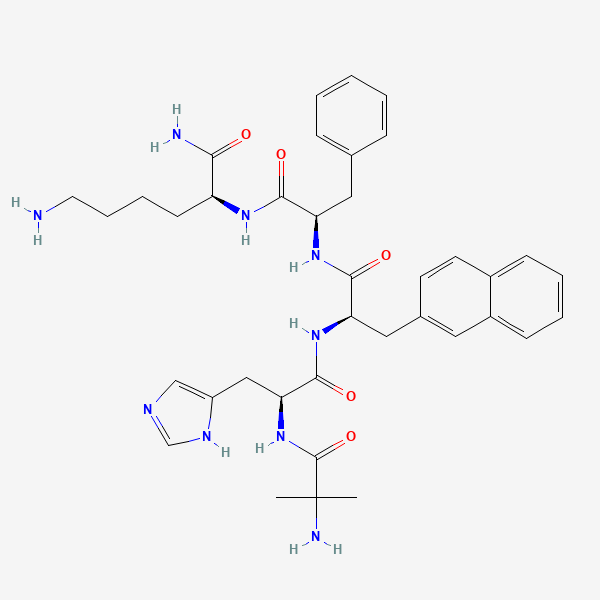
- Molecular formula
- C38H49N9O5
- Molecular weight
- 711.9 g/mol
- IUPAC name
- (2S)-6-amino-2-[[(2R)-2-[[(2R)-2-[[(2S)-2-[(2-amino-2-methylpropanoyl)amino]-3-(1H-imidazol-5-yl)propanoyl]amino]-3-naphthalen-2-ylpropanoyl]amino]-3-phenylpropanoyl]amino]hexanamide
Verified external records:
References
- 1.Gobburu et al., 1999 — Pharmacokinetic-pharmacodynamic modeling of ipamorelin in human volunteers (Pharmaceutical Research)
- 2.Ipamorelin — registered clinical studies (ClinicalTrials.gov)
- 3.Ipamorelin — indexed research (PubMed, National Library of Medicine)
- 4.Drugs@FDA — approved drug products database (no ipamorelin product listed)
- 5.WADA Prohibited List — growth-hormone secretagogues (S2), via USADA
- 6.Rahman OF et al. — Therapeutic Peptides in Orthopaedics: Applications, Challenges, and Future Directions.
- 7.Mayfield CK et al. — Injectable Peptide Therapy: A Primer for Orthopaedic and Sports Medicine Physicians.
- 8.Mendias CL et al. — Safety and Efficacy of Approved and Unapproved Peptide Therapies for Musculoskeletal Injuries and Athletic Performance.
- 9.Renke G et al. — Therapeutic Peptides in Aesthetic, Metabolic and Endocrine Conditions: Effects, Safety, Clinical Applications, and Future Perspectives.
- 10.Coutinho LFD et al. — A new era of doping? Use of peptide and peptide-analog drugs in recreational and professional sport and bodybuilding: a critical review.
More on Ipamorelin
Everything else we've written about Ipamorelin — what the community reports, the explainers that cover it, and the terms it keeps running into.
- Ipamorelin Reddit: Results, Dosing & SidesOn Reddit
- What are growth-hormone secretagogues?Explainer
- Are Peptides Safer Than Steroids? The Honest AnswerExplainer
- Can You Mix Peptides in One Syringe?Explainer
- Do Peptides Show Up on Drug Tests?Explainer
- Do You Need a Prescription for Peptides?Explainer
- Peptide Cheat Sheet & Dosing Chart (2026)Explainer
- Binding affinityGlossary
- EndogenousGlossary
- MicrogramGlossary
- Receptor selectivityGlossary
- Receptor selectivityGlossary
- Pulsatile releaseGlossary