Humanin vs nad+
Humanin vs nad+ compares a mitochondrial-derived peptide with a cellular coenzyme, including evidence tiers, legal status and by-goal picks.
Humanin vs nad+ is a comparison between a mitochondrial stress signal and a coenzyme every cell uses to make energy. Humanin is a 24-amino-acid signaling peptide; NAD+ is not a peptide at all. No trial has compared them directly, so the useful pick depends on the goal, not a universal winner.
What is the core difference between humanin and NAD+?
Humanin sends a mitochondrial message, while NAD+ helps run the cell’s machinery. Humanin is a mitochondrial-derived peptide: a short signal encoded within the mitochondrial 16S ribosomal RNA region. NAD+ is nicotinamide adenine dinucleotide, a coenzyme that carries electrons through energy metabolism and supplies enzymes involved in DNA repair and stress responses.
That category difference is the part most quick comparisons miss. Calling both “peptides” because longevity clinics discuss them together is like calling a smoke alarm and electricity the same household system. Humanin can signal a stressed cell to resist apoptosis, meaning programmed cell death. NAD+ cycles between oxidized and reduced forms as the cell transfers energy, and enzymes such as sirtuins, PARPs and CD38 consume it.
The Humanin profile covers a true peptide produced from a small open reading frame inside the mitochondrial genome. The NAD+ profile covers an endogenous dinucleotide carried in the peptide collection because readers research it beside other mitochondrial aging compounds, not because chemistry quietly changed the definition of peptide.
Which has stronger human evidence?
NAD+ has the stronger human intervention record, but mainly through oral precursors that raise NAD+ levels; Humanin remains animal-only for treatment effects. The shared badge on this page therefore uses the weaker tier: animal-only. That prevents NAD+’s randomized trials from making Humanin look human-tested when nobody has established efficacy or safety by administering Humanin in a clinical trial.
Humanin research in people is observational. Researchers measure the Humanin that bodies already produce, then examine how those levels relate to age, disease or genetics. A 2020 paper reported higher circulating Humanin in 18 children of centenarians than in 19 age-matched controls. That supports a Humanin longevity association. It does not show that Humanin created the difference, that higher levels extend life, or that injecting synthetic Humanin reproduces the association.
Humanin intervention evidence comes from cells and animals, including cytoprotection, metabolic effects and protection from several experimental injuries. That work explains why the peptide is worth following. It does not supply a human dose, a human side-effect rate or a clinical outcome.
NAD+ research has a different limitation. Randomized trials show that nicotinamide riboside and other precursors can raise NAD+ metabolism in humans and are generally tolerated over the studied periods. Raising a laboratory value is target engagement, though, not proof of more energy, slower aging or a longer life. In nad+ vs humanin terms, NAD+ wins only the narrow evidence question of whether a human intervention can raise the intended molecule. The broader anti-aging payoff remains unsettled.
Has any trial compared humanin vs nad+ directly?
No direct head-to-head trial was found, and the available studies do not support pretending that separate experiments form one. Humanin studies ask whether a mitochondrial derived peptide protects cells or changes animal physiology. NAD+ studies usually ask whether a precursor raises NAD+ and whether a specific clinical measure moves afterward. Different interventions, populations and endpoints block a clean numerical race.
The absence of a head-to-head trial also means there is no evidence-based combination claim. Search results often place these compounds in a “synergy” bucket, but no comparative study establishes that taking both produces additive mitochondrial or longevity benefits. Mechanisms can look complementary on paper and still fail to produce a useful clinical result. Biology has declined many tidy marketing diagrams.
For the closest peptide-to-peptide comparison, Humanin vs MOTS-c keeps both sides inside mitochondrial-derived peptide biology. For the broader category, the longevity and mitochondrial hub maps these compounds without flattening their evidence tiers.
Which one fits which goal?
Humanin fits questions about mitochondrial-derived signaling; NAD+ fits questions about NAD repletion. Neither earns an overall “best mitochondrial anti-aging compound” label. The structured picks above separate the goals because evidence that answers one question cannot be borrowed to answer another.
Choose Humanin as the research subject when the goal is MDP biology: how mitochondria encode peptide signals, how Humanin interacts with cell-survival pathways, or why circulating Humanin tracks with some aging phenotypes. Humanin remains the more speculative intervention because the treatment evidence stops before human dosing.
Choose NAD+ when the measurable goal is raising NAD+ with an approach that has human trial data. The strongest evidence belongs to precursors such as nicotinamide riboside, not to expensive IV wellness protocols. FDA’s 2026 enforcement record adds a practical caution: the agency said NAD+ was not eligible for section 503B bulk-compounding exemptions in a warning letter and documented sterility failures around an injectable product at that facility.
The useful conclusion is narrower than a winner’s podium. Humanin is the cleaner lens on mitochondrial peptide signaling. NAD+ is the better-supported route to NAD repletion. Neither has shown that taking it makes a healthy person live longer, and the evidence gap should stay visible rather than being filled with sales copy.
Humanin vs nad+, point by point
Every dimension side by side — the honest differences, not a scoreboard.
| Dimension | Humanin | nad+ |
|---|---|---|
| What it is | A 24-amino-acid mitochondrial-derived peptide linked to stress signaling and cytoprotection. | Nicotinamide adenine dinucleotide, an endogenous coenzyme and dinucleotide — not a peptide. |
| Mitochondrial role | A signal encoded in the mitochondrial 16S rRNA region that can tell stressed cells to resist programmed cell death. | A working cofactor that carries electrons in energy metabolism and is consumed by sirtuins, PARPs and CD38. |
| Human evidence for taking it | None. Humanin has been measured in people, but efficacy and safety studies have not administered it to people. | Randomized trials of NAD+ precursors reliably raise NAD+; clinical benefits for healthy aging remain mixed or not established. |
| Longevity evidence | Higher circulating humanin was observed in a small group of centenarians' offspring versus age-matched controls; animal experiments supply the intervention evidence. | NAD+ biology changes with age, but raising NAD+ has not been shown to reverse aging in humans. |
| Dosing evidence | No validated human dose; research-market protocols are anecdotal and animal doses do not translate directly. | Human trials mainly dose oral precursors such as nicotinamide riboside, not humanin and not wellness-clinic IV NAD+ protocols. |
| US regulatory status (2026) | Research-use-only and not FDA-approved for any indication. | NAD+ is unscheduled but not FDA-approved as an injectable drug; FDA said in January 2026 that NAD+ was not eligible for 503B bulk-compounding exemptions. |
| Sport status | Treated as prohibited under WADA S0 because it has no regulatory approval for human therapeutic use. | The substance is not listed as prohibited, but an IV infusion over 100 mL per 12 hours can violate WADA's method rule. |
- Mitochondrial role: Humanin sends a message; NAD+ helps run the underlying cellular machinery.
- Human evidence for taking it: No trial has compared humanin and NAD+ directly; this comparison weighs their separate evidence.
- Longevity evidence: The humanin finding is an association, not evidence that humanin caused longevity.
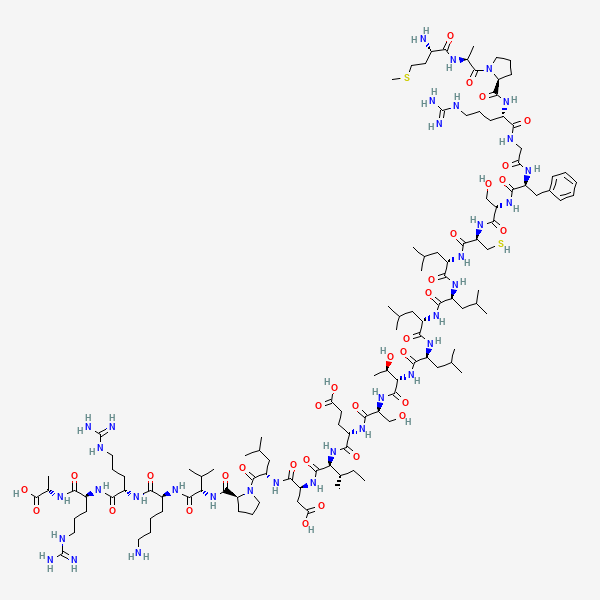
Humanin vs nad+: the two molecules
The 2D chemical structures, straight from PubChem — a quick way to see how similar (or not) the two actually are.
Which one fits which goal?
There's no universal winner here — the honest answer depends on what you're after. These picks are framed by goal, and each says why.
Studying mitochondrial-derived peptide biology
Leans toward Humanin
Humanin is the relevant pick when the question is how a mitochondrial-derived peptide signals cytoprotection, metabolism and stress resistance.
Raising NAD+ levels with human trial support
Leans toward nad+
NAD+ precursors have randomized human evidence for raising NAD+ levels, although a longevity or energy benefit does not automatically follow.
References
- 1.The mitochondrial derived peptide humanin is a regulator of lifespan and healthspan (PubMed)
- 2.Peptides derived from small mitochondrial open reading frames (PMC)
- 3.Nicotinamide riboside raises NAD+ in middle-aged and older adults (PubMed)
- 4.FDA warning letter addressing NAD+ compounding under section 503B (2026)
- 5.2026 Prohibited List