Also known as: HN · Humanin peptide · MT-RNR2-derived peptide
Animal-onlyUnclear⚠ none in humans
On this page
- What is humanin?
- How does humanin work?
- What does the research show?
- What the community reports
- Is humanin safe? Side effects
- FDA & legal status (2026)
- How is humanin used, and can it be mixed?
- Humanin and its mitochondrial cousins (MOTS-c, SS-31, Epitalon)
- Frequently asked questions
- Who is humanin for — and who should be cautious?
- Evidence by outcome
- FDA & legal status
- Registered clinical trials
- Chemical identifiers
- References
- Related compounds
- More on Humanin
Humanin is a 24-amino-acid mitochondrial-derived peptide — a survival signal your own cells make from mitochondrial DNA. In cells and animals, humanin protects neurons and improves insulin sensitivity. It is not FDA-approved, has never been given to people in a study, and sells only as a research chemical. The mechanism is mapped; the human proof is still ahead.
What is humanin?
Humanin is a small peptide — a chain of 24 amino acids (sequence MAPRGFSCLLLLTSEIDLPVKRRA) — that your cells transcribe from the mitochondrial genome, specifically the 16S rRNA (MT-RNR2) region. That origin makes humanin a mitochondrial-derived peptide (MDP): a signaling molecule written into the tiny separate genome inside your mitochondria, the compartments that power your cells. It was discovered in 2001 in the surviving neurons of an Alzheimer’s patient’s brain, named for its knack for keeping neurons alive (PubMed). Chemically, humanin has the formula C119H204N34O32S2 and a molecular weight of about 2687 g/mol (PubChem CID 16131438). It is not a medicine you can be prescribed and not a supplement you can legally buy as food — in the United States it exists only as a research chemical.
How does humanin work?
Humanin works, in the lab, as a cellular “stand-down” signal. Picture it as a distress flare the mitochondria fire when a cell is under stress: the message is don’t self-destruct yet, hold on. Concretely, in cell studies humanin blocks apoptosis — programmed cell death — by neutralizing pro-death proteins (most studied is one called Bax) and by switching on survival signaling through a three-part receptor complex on the cell surface (CNTFR/WSX-1/gp130) and the STAT3 pathway (PubMed). Researchers also built a more potent version, HNG, by swapping a single amino acid, and most of the strongest animal effects use that analog. The honest caveat: this is the mechanism as worked out in cells and rodents. How humanin behaves when injected into a living human body has not been established.
What does the research show?
Humanin’s research has a pivotal, easily-missed shape: humanin has been measured in humans, but never given to humans in a study. The human research is observational — cohort and case-series work measuring the humanin your own body already makes. In those studies, blood humanin is associated with age (levels tend to decline as people get older) and tracks with various disease states. Every registered human study of humanin does the same thing: a completed University of Tartu study measured humanin in cardiac muscle and plasma around heart surgery (NCT03431844); a Chinese study looked at plasma humanin in acute kidney injury (NCT06105229); and a recruiting 2026 study is measuring humanin and MOTS-c levels under different anesthesia types (NCT07678073). None of them administer humanin — they read it, like a gauge.
The efficacy story — humanin doing something — is entirely a cell-and-animal story so far. In cultured neurons, humanin rescued cells from amyloid-beta toxicity; in rodents it improved insulin sensitivity; in animal models of heart injury it reduced ischemia–reperfusion damage. Different tissues, the same protective direction. That is a genuine reason for interest, and it is why humanin sits in the longevity conversation. But animal-only means exactly that: promising in mice, unknown in people. The interesting part isn’t that the evidence ran out — it’s that the human testing of humanin as a treatment has barely started.
What the community reports
Outside the lab, humanin has a small following among longevity and biohacking self-experimenters, usually alongside the other mitochondrial peptides. Reported use is subcutaneous injection of the reconstituted powder, framed around anti-aging, energy and metabolic goals. These accounts are anecdotal, and they carry the None-in-humans flag: there is no human study of injected humanin to compare them against. They suffer from survivorship bias (people who feel nothing tend to go quiet), can’t separate humanin from everything else a biohacker is doing, and can’t tell you how often it does nothing. They are useful for understanding why people are curious — not as evidence that humanin works.
Is humanin safe? Side effects
Humanin’s honest safety answer is “unknown in humans.” Because humanin has never been administered to people in a study, there is no human safety data for taking it — no side-effect profile, no long-term data, nothing. Cell and animal studies have not flagged obvious toxicity, which is mildly reassuring, but animal tolerability is not human safety, and humanin’s own biology gives a reason for caution: a molecule whose main action is keeping cells from dying is worth thinking hard about in the context of cells you would not want to keep alive, such as cancerous ones — a theoretical concern, unproven in either direction. The most concrete real-world risk with humanin is the source: research-chemical vials skip the quality checks a medicine has to pass, so how pure, how strong, and how sterile any given one is stays unverified.
FDA & legal status (2026)
Humanin is not FDA-approved, and it is not a legal dietary supplement. In the United States humanin is sold strictly as a research chemical, “for research use only” — no approved humanin drug product appears in the openFDA database (FDA — Drugs). That means no manufacturing standard, no dosing label, and no quality guarantee behind what you would actually buy. Regulatory status for research peptides can shift, so treat this as dated to 2026 and re-check it. The full dated breakdown is in the FDA & legal status block above.
How is humanin used, and can it be mixed?
Humanin has no human dosing protocol, because no human study has ever dosed it — so any number you see online is community practice, not a validated dose. For context, animal and cell studies typically used the more potent HNG analog, given by injection in rodents or as a set concentration in a dish; none of that translates to a human dose. The research-market product is a lyophilized (freeze-dried) powder that has to be reconstituted with bacteriostatic water before use, and getting the concentration right is pure arithmetic — our reconstitution & dosing calculator turns a vial size, a water volume and a target amount into the exact number of insulin-syringe units. People also ask whether humanin can share a syringe with other peptides; our mixing compatibility reference covers what is commonly combined and where the honest answer is “not enough data.”
Humanin and its mitochondrial cousins (MOTS-c, SS-31, Epitalon)
Humanin is one of a small family of mitochondrial-derived peptides that the longevity & mitochondrial hub covers together — MOTS-c is its closest cousin (another peptide encoded in mitochondrial DNA, studied for metabolism and exercise), while SS-31/elamipretide targets the mitochondrial membrane and Epitalon comes from telomere and circadian research. Compared with a peptide like ARA-290 — an EPO-derived “tissue-protective” peptide that at least reached small human trials — humanin’s human record is thinner: it is measured in people but not yet given to them. If you’re mapping the longevity peptides, humanin is best understood as the founding mitochondrial survival signal, strong on mechanism and animal data, still waiting on its first human dosing study.
Frequently asked questions
Does humanin work in humans?
No human study has ever tested whether taking humanin does anything — humanin has only been measured in people, not administered. Its efficacy evidence is cell-and-animal work (neuroprotection, insulin sensitivity, heart protection). We grade humanin animal-only with a None-in-humans flag until a human dosing study reports.
Is humanin legal?
Humanin is legal to buy and sell as a research chemical in the United States, but it is not an approved drug or a legal dietary supplement, and it cannot be sold for human consumption. That is why every vendor lists it “for research use only.”
Is humanin banned in sport?
Effectively yes. Humanin is not individually named on the WADA Prohibited List, but as a substance with no regulatory approval for human use it falls under WADA’s S0 “non-approved substances” category, which is prohibited at all times for athletes under anti-doping rules.
How do people take humanin?
In community practice, humanin is reconstituted from powder with bacteriostatic water and injected subcutaneously. There is no validated human dose — the animal research mostly used the more potent HNG analog — so any protocol you find is anecdotal, not clinically established.
Is humanin the same as MOTS-c?
No. Humanin and MOTS-c are both mitochondrial-derived peptides encoded in mitochondrial DNA, and they get researched side by side, but they are different molecules with different sequences and different emphases — humanin on cell survival and neuroprotection, MOTS-c more on metabolism and exercise biology.
Is humanin safe?
Humanin’s human safety is unknown, because it has never been given to people in a study — there is no side-effect or long-term data for taking it. Animal work hasn’t shown obvious toxicity, but that isn’t human safety, and unregulated research-chemical sourcing is its own real risk.
Who is humanin for — and who should be cautious?
Humanin draws in the longevity self-researcher — the person mapping the mitochondrial peptides (humanin, MOTS-c, SS-31) and asking what’s real. The honest framing: humanin has one of the more interesting mechanism-and-animal stories in the longevity space, a survival signal your own body already makes, with a human biomarker literature behind it. But the efficacy proof for taking humanin isn’t in — no human has been dosed in a study — the safety data for administration doesn’t exist, and the product you’d actually buy is unregulated. Anyone pregnant, managing a cancer history, or unwilling to accept genuine unknowns has every reason to wait for the first human dosing studies to read out.
Evidence by outcome
Each outcome Humanin has been studied for, with the honest evidence grade and what the studies actually found. A tier never stands alone — the verdict rides with it.
| Outcome | Evidence | What was found |
|---|---|---|
| Neuroprotection (Alzheimer's-type / amyloid-beta toxicity) | Animal-onlyHelped⚠ none in humans | Humanin was discovered in 2001 for exactly this: in cultured neurons it rescued cells from amyloid-beta and other Alzheimer's-related insults, and later rodent studies reported protection in memory-impairment models. This is the compound's founding finding — but it lives in cells and mice. No human has been given humanin to test whether it protects the brain. |
| Metabolism & insulin sensitivity | Animal-onlyHelped⚠ none in humans | In rodents, humanin (and its more potent analog HNG) improved insulin sensitivity and glucose handling. The signal is consistent across animal work, which is why humanin turns up in metabolic and longevity research — but there is no controlled human trial giving humanin for metabolic effect. |
| Cardioprotection (ischemia–reperfusion) | Animal-onlyHelped⚠ none in humans | In animal models of heart and blood-vessel injury, humanin reduced damage from ischemia–reperfusion (blood flow cut off, then restored). Encouraging as a mechanism lead, but again animal-only — no human study has administered humanin to protect the heart. |
| Circulating humanin as an aging biomarker | Human observationalUnclear | This is where the human data actually is. In people, blood humanin has been measured and is associated with age (levels tend to fall as we get older) and with disease states in cohort and case-series work. These are associations with the body's own humanin — they do not show that injecting humanin does anything, and no causal benefit is established. |
FDA & legal status
- United States: research use only (as of Jul 2026)
Humanin is not an FDA-approved drug and not a dietary supplement — it is sold only as a research chemical, "for research use only." No approved humanin product exists in the openFDA drug database as of 2026. Treat any status claim as dated and re-verify.
openFDA Drugs@FDA lists no approved product for Humanin as of 2026-07-15.
Registered clinical trials
3 registered studies mention Humanin on ClinicalTrials.gov (latest update 2026-07-08). A registered trial means a study is planned or underway — not that Humanin is approved or proven.
| Study | Status | Phase | Sponsor |
|---|---|---|---|
| Comparison of the Effects of General Anesthesia and Combined Spinal-Epidural Anesthesia on Ferroptosis, Humanin and MOTS-c Levels in Renal TransplantationNCT07678073 | recruiting | NA | University of Gaziantep |
| Clinical Value of Plasma Humanin in Acute Kidney InjuryNCT06105229 | unknown | — | Guangdong Provincial People's Hospital |
| Humanin Isoforms in Cardiac Muscle and Blood Plasma and Major Complications After Cardiac OperationNCT03431844 | completed | — | University of Tartu |
Chemical identifiers
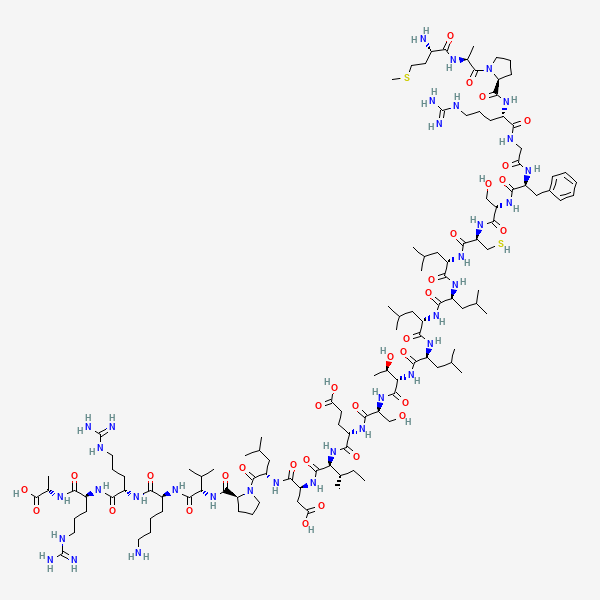
- Molecular formula
- C119H204N34O32S2
- Molecular weight
- 2687.2 g/mol
- IUPAC name
- (4S)-5-[[(2S,3S)-1-[[(2S)-1-[[(2S)-1-[(2S)-2-[[(2S)-1-[[(2S)-6-amino-1-[[(2S)-5-carbamimidamido-1-[[(2S)-5-carbamimidamido-1-[[(1S)-1-carboxyethyl]amino]-1-oxopentan-2-yl]amino]-1-oxopentan-2-yl]amino]-1-oxohexan-2-yl]amino]-3-methyl-1-oxobutan-2-yl]carbamoyl]pyrrolidin-1-yl]-4-methyl-1-oxopentan-2-yl]amino]-3-carboxy-1-oxopropan-2-yl]amino]-3-methyl-1-oxopentan-2-yl]amino]-4-[[(2S)-2-[[(2S,3R)-2-[[(2S)-2-[[(2S)-2-[[(2S)-2-[[(2S)-2-[[(2R)-2-[[(2S)-2-[[(2S)-2-[[2-[[(2S)-2-[[(2S)-1-[(2S)-2-[[(2S)-2-amino-4-methylsulfanylbutanoyl]amino]propanoyl]pyrrolidine-2-carbonyl]amino]-5-carbamimidamidopentanoyl]amino]acetyl]amino]-3-phenylpropanoyl]amino]-3-hydroxypropanoyl]amino]-3-sulfanylpropanoyl]amino]-4-methylpentanoyl]amino]-4-methylpentanoyl]amino]-4-methylpentanoyl]amino]-4-methylpentanoyl]amino]-3-hydroxybutanoyl]amino]-3-hydroxypropanoyl]amino]-5-oxopentanoic acid
Verified external records:
References
More on Humanin
Everything else we've written about Humanin — what the community reports, the explainers that cover it, and the terms it keeps running into.