Liraglutide vs Tirzepatide
Liraglutide vs Tirzepatide compares daily GLP-1 treatment with a weekly dual agonist, including trial weight loss, brands, doses, and by-goal picks.
The liraglutide vs tirzepatide choice is mainly daily single-receptor treatment versus weekly dual-receptor treatment. Both are FDA-approved prescription drugs with strong human randomized-trial evidence. Separate obesity trials reported roughly 8% average weight loss with liraglutide and 20% with tirzepatide, but those figures are not a direct head-to-head result.
What is the main difference between liraglutide and tirzepatide?
Liraglutide activates the glucagon-like peptide-1 (GLP-1) receptor, while tirzepatide activates both GLP-1 and glucose-dependent insulinotropic polypeptide (GIP) receptors. Both copy gut signals released after eating, which can reduce appetite, slow stomach emptying, and improve glucose-dependent insulin release. Tirzepatide adds a second incretin signal rather than simply delivering “stronger liraglutide.”
Liraglutide is a 31-amino-acid peptide with a roughly 13-hour half-life. Tirzepatide contains 39 amino acids and has a half-life of about five days. That pharmacology explains the clearest practical split: liraglutide is injected every day, while tirzepatide is injected once a week. Both belong in the GLP-1 and metabolic peptides hub, but they are different molecules rather than interchangeable brand versions.
Which produces more weight loss in trials?
Tirzepatide produced the larger average loss in separate obesity trials: about 20% at 72 weeks with 15 mg in SURMOUNT-1, versus roughly 8% at 56 weeks with liraglutide 3.0 mg in SCALE. That makes tirzepatide the by-goal pick for maximum average trial loss, not a promise that every individual will lose more on it.
The phrase “liraglutide vs tirzepatide weight loss” invites a neat two-column verdict, but the evidence is less tidy. SCALE and SURMOUNT-1 enrolled different groups, lasted different lengths of time, and tested each drug against placebo. Trial averages describe groups receiving lifestyle support; they do not predict one person’s result. Our peptides for weight loss guide puts both in the wider treatment landscape.
Has a trial compared liraglutide with tirzepatide directly?
Liraglutide and tirzepatide have appeared together in a randomized six-week Phase 1 study of 114 adults with overweight or obesity, but that trial focused on early energy intake, appetite, food cravings, and brain responses to food images. No long-term randomized trial has directly compared their weight-loss efficacy, so the 8% and 20% figures must stay separate.
The published Phase 1 study randomized participants to weekly tirzepatide, placebo, or open-label daily liraglutide. Tirzepatide reduced energy intake versus placebo at week three; liraglutide served as an active comparator for exploratory endpoints. That is genuine direct comparative evidence, just not the year-long contest readers usually mean by “head-to-head.” An indirect comparison can inform a choice, but it belongs below a direct efficacy trial on the evidence ladder.
How do the brands and FDA approvals differ?
Liraglutide is sold as Victoza for type 2 diabetes and Saxenda for chronic weight management. Tirzepatide is sold as Mounjaro for type 2 diabetes and Zepbound for chronic weight management; Zepbound also has an indication for moderate-to-severe obstructive sleep apnea in adults with obesity. Both are prescription medicines, not dietary supplements or research chemicals.
“Saxenda vs Zepbound” is the weight-management comparison, while “Victoza vs Mounjaro” is the diabetes-brand comparison. The molecule does not change when the brand changes; the approved use and label do. Liraglutide also carries a Victoza indication for cardiovascular risk reduction in adults with type 2 diabetes, and FDA-approved generic liraglutide is available. Tirzepatide’s US approvals began later: Mounjaro in 2022 and Zepbound in 2023.
How do dosing and side effects compare?
Liraglutide uses a daily dose ladder, reaching 3.0 mg daily for Saxenda or up to 1.8 mg daily for Victoza. Tirzepatide starts at 2.5 mg weekly and can step upward to maintenance doses of 5, 10, or 15 mg weekly. Those are label schedules reported for context, not personal dosing instructions.
Both labels center the same practical nuisance: gastrointestinal effects, especially nausea, vomiting, diarrhea, and constipation, often during dose escalation. Both also warn about pancreatitis, gallbladder problems, and low blood sugar when combined with insulin or a sulfonylurea. Each carries a boxed warning for thyroid C-cell tumors seen in rodents; human relevance is not established, and both are contraindicated with a personal or family history of medullary thyroid carcinoma or multiple endocrine neoplasia syndrome type 2.
Which one fits which goal?
Tirzepatide fits the goal of the largest average weight loss reported in obesity trials with one injection per week. Liraglutide fits the goal of using an established, daily GLP-1-only medicine with a longer approval history. Neither is the universal winner because tolerability, diagnosis, contraindications, access, coverage, and preferred dosing rhythm can change the practical answer.
For maximum trial loss plus weekly convenience, the evidence points toward tirzepatide. For someone specifically seeking an older daily GLP-1 pathway, liraglutide is the cleaner match. The honest liraglutide vs tirzepatide conclusion is therefore a pair of by-goal picks, followed by an individual prescribing decision, rather than a podium with one drug standing on top.
Liraglutide vs Tirzepatide, point by point
Every dimension side by side — the honest differences, not a scoreboard.
| Dimension | Liraglutide | Tirzepatide |
|---|---|---|
| Drug class | A GLP-1 receptor agonist that works through one incretin pathway. | A dual GIP + GLP-1 receptor agonist that works through two incretin pathways. |
| Injection schedule | Once-daily subcutaneous injection. | Once-weekly subcutaneous injection. |
| Weight loss in obesity trials | Roughly 8% mean body-weight loss with liraglutide 3.0 mg at 56 weeks in SCALE. | Roughly 20% mean body-weight loss with tirzepatide 15 mg at 72 weeks in SURMOUNT-1. |
| Brand names | Victoza for type 2 diabetes; Saxenda for chronic weight management. | Mounjaro for type 2 diabetes; Zepbound for chronic weight management and obstructive sleep apnea in adults with obesity. |
| US regulatory status (2026) | FDA-approved and prescription-only; generic liraglutide is also approved. | FDA-approved and prescription-only. |
| Direct comparative evidence | Included as the daily active comparator in a six-week randomized Phase 1 appetite study. | Compared with liraglutide on early food-intake and appetite endpoints in that Phase 1 study. |
- Weight loss in obesity trials: These are separate placebo-controlled trials with different durations and participants, not a long-term head-to-head comparison.
- Direct comparative evidence: No long-term randomized weight-loss trial has directly compared liraglutide with tirzepatide.
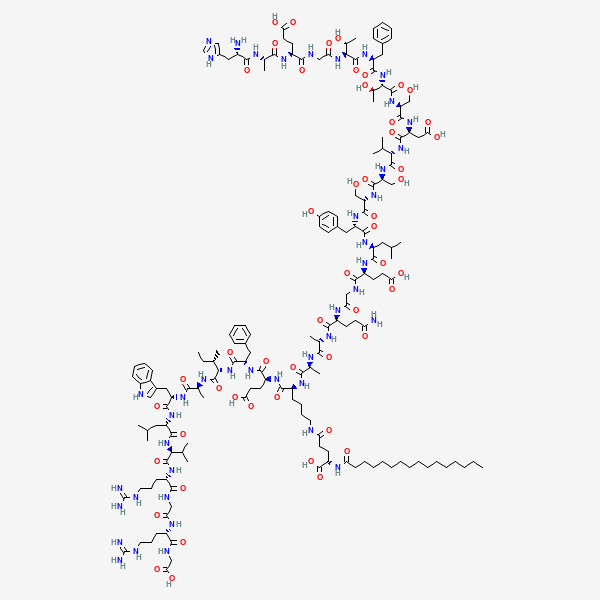
Liraglutide vs Tirzepatide: the two molecules
The 2D chemical structures, straight from PubChem — a quick way to see how similar (or not) the two actually are.
Which one fits which goal?
There's no universal winner here — the honest answer depends on what you're after. These picks are framed by goal, and each says why.
Largest average weight loss in obesity trials plus weekly dosing
Leans toward Tirzepatide
SURMOUNT-1 reported about 20% mean weight loss at the top dose, and tirzepatide is injected once weekly.
An established daily, single-pathway GLP-1 option
Leans toward Liraglutide
Liraglutide has been FDA-approved since 2010, uses GLP-1 receptor agonism alone, and has a daily dosing rhythm.