Also known as: NN9535 · NNC 0113-0217 · oral semaglutide
Human RCTHelped
On this page
- What people actually use semaglutide for — and what they report
- What is semaglutide?
- How does semaglutide work?
- Does semaglutide actually work? What the science says
- Is semaglutide safe? Side effects
- FDA & legal status (2026)
- How semaglutide is dosed: the label ladder
- Semaglutide vs tirzepatide
- Frequently asked questions
- Who semaglutide is for — and who should be cautious?
- Evidence by outcome
- FDA & legal status
- Registered clinical trials
- Reported side effects
- Chemical identifiers
- References
- Related compounds
- More on Semaglutide
If you’re reading this, someone you know probably dropped a visible chunk of weight and eventually admitted it was Ozempic — or a doctor floated Wegovy for your blood sugar or your BMI — and now you want the straight answer on whether semaglutide actually works for weight loss, how much, and what you’d really be signing up for. Here’s the plain-English version, built on the human trials and on what people actually running it report.
Semaglutide is a GLP-1 receptor agonist — the once-weekly shot sold as Ozempic and Wegovy, plus a daily pill called Rybelsus — and for weight loss it’s the rare compound on this site where the answer is a flat yes: in large randomized trials, adults with obesity lost about 15% of their body weight over 68 weeks, several times what placebo managed. It’s FDA-approved and one of the most-studied drugs in this whole reference. The catches are the honest ones the before-and-afters skip: real gut side effects, a boxed thyroid warning, and a strong pull to regain the weight once you stop.
What people actually use semaglutide for — and what they report
Semaglutide’s real-world use is simpler than most peptides here: people run it to lose weight and quiet their appetite. A large share are on Ozempic “off-label” for weight loss because it was easier to get than Wegovy, and the single most common thing they report isn’t a number on the scale — it’s the “food noise” going quiet.
The food noise thing. This is the win that comes up more than any other. Across r/Semaglutide, r/Ozempic, and r/WegovyWeightLoss the recurring line is that the constant mental chatter about food — the snack you’re already planning halfway through lunch — just switches off. People describe eating a few bites and being genuinely done, or forgetting a meal entirely, with none of the white-knuckle bargaining dieting usually demands. For a lot of them that mental quiet, more than the scale, is what sells them on it.
What the results actually look like. Reported losses cover a wide range: commonly 10 to 30-plus pounds in the first few months, with many people tracking toward that trial-grade ~15% of body weight over a year once they’re on the full dose. The ones who lose the most are almost always pairing the shot with real diet and activity changes — it curbs appetite, it doesn’t do the eating for you. And a minority, the self-described “non-responders,” say it barely touches their hunger, which is the honest flip side of the glowing posts.
The ladder people climb. Because semaglutide is a real prescription, the doses people run mostly track the label, and the community treats climbing it slowly as gospel. You start at 0.25 mg once weekly — a starter dose meant to do almost nothing except let your gut adjust — then step up roughly every four weeks: 0.5, 1.0, 1.7, up to 2.4 mg for weight management. Plenty of people find a “sweet spot” dose where appetite is handled and side effects are livable and just hold there instead of chasing the maximum; a smaller crowd deliberately microdoses below the label to keep side effects mild.
The side effects people actually hit. Nausea is near-universal, worst in the days after a dose bump and usually fading as the body settles. Close behind: constipation (a perennial thread topic), diarrhea, and the infamous “sulfur burps” — rotten-egg belches that veterans warn every newcomer about. Fatigue shows up a lot early on, especially for people eating in a deep deficit. Two longer-term complaints dominate the veteran threads: “Ozempic face,” the hollowed-out look that fast facial-fat loss can leave, and muscle loss — enough that “eat your protein and lift” has hardened into standard community advice, because a real share of the weight coming off can be lean mass, not just fat.
The letdown nobody warns you about: it comes back. The most consistent hard lesson in the community is that semaglutide behaves more like an ongoing medication than a short course. Stop it and the appetite — the food noise — tends to roar back, and many people report regaining much of what they lost within a year. The response has been the “maintenance dose”: dropping to something like 1.0 to 1.7 mg weekly to hold the loss rather than quitting cold. It reframes the whole decision. This is a lever you may be holding for a long time, not a 12-week project.
One honest caveat on all of this: dramatic before-and-afters get posted far more than quiet disappointments, so the feed tilts toward success. But semaglutide is the unusual case on this site where you don’t have to lean on the anecdotes — the community’s headline claim, that it drives real weight loss, is exactly what the randomized trials found. For once, the Reddit consensus and the NEJM data are telling the same story.
What is semaglutide?
Semaglutide is a lab-made peptide that copies GLP-1 (glucagon-like peptide-1), a hormone your gut releases when you eat. It’s a 31-amino-acid chain built on the natural GLP-1 backbone with two engineering tweaks: a swapped amino acid that resists the enzyme that would normally chew it up, and a fatty-acid chain that clips it onto blood protein so it clears slowly (molecular formula C187H291N45O59, molecular weight about 4,114 g/mol; CAS 910463-68-2). That slow clearance stretches its half-life to roughly a week, which is why the injection is once every seven days. Unlike almost everything else covered on this site, semaglutide isn’t a research chemical — it’s a fully approved prescription drug you get from a pharmacy under three brand names: Ozempic and Rybelsus for type 2 diabetes, and Wegovy for weight management.
How does semaglutide work?
Semaglutide works by impersonating a gut hormone that tells your body you’ve eaten — and then refusing to clock out. When it switches on the GLP-1 receptor, four things happen at once: the pancreas releases more insulin, but only when blood sugar is actually high (so it rarely causes lows on its own); glucagon, the hormone that pushes blood sugar up, gets dialed down; the stomach empties more slowly, so a meal sits with you longer; and appetite centers in the brain register fullness sooner, so you eat less without fighting yourself. Your own GLP-1 taps you on the shoulder after a meal and lets go within minutes. Semaglutide leaves its hand there for a week. That combined pull on blood sugar and appetite is the whole reason it moves both the diabetes numbers and the scale.
Does semaglutide actually work? What the science says
Semaglutide sits at the very top of the evidence ladder — a genuine rarity on this site, where most compounds are running on mouse data and hope. Its main uses rest on large, randomized, placebo-controlled human trials, so here the honest tier is the strong one.
For weight, the STEP program tested once-weekly semaglutide 2.4 mg in adults with obesity; over 68 weeks they lost around 15% of their body weight, versus roughly 2–3% on placebo (Wilding et al., STEP 1, NEJM 2021). For type 2 diabetes, the SUSTAIN trials showed it lowering HbA1c (a three-month blood-sugar average) and weight against both placebo and other diabetes drugs (semaglutide SUSTAIN trials, PubMed). For the heart, SELECT randomized more than 17,000 adults with existing heart disease and obesity but no diabetes, and semaglutide cut major cardiovascular events — heart attack, stroke, or cardiovascular death — by about 20% (Lincoff et al., SELECT, NEJM 2023). Intriguingly, that heart benefit wasn’t fully explained by the weight people lost, a hint the drug is doing more than shrinking waistlines.
Beyond those settled uses, the frontier is wide and moving fast: Phase 3 trials in early Alzheimer’s (EVOKE, NCT04777396), fatty-liver disease (MASH), heart failure, and chronic kidney disease are reading out around now. Those aren’t verdicts yet — they’re the next chapter mid-print, worth watching precisely because the core drug is already established. My read: this is the boring, good kind of evidence story, where the trials and the hype finally agree; what’s still unsettled is how far past weight and blood sugar semaglutide’s reach actually goes.
Is semaglutide safe? Side effects
Semaglutide’s safety profile is well mapped, because so many people have taken it under trial conditions. The common side effects are gastrointestinal — nausea, vomiting, diarrhea, and constipation — and they tend to be worst in the weeks right after a dose increase, then settle (DailyMed label). The concerns that matter more, even when they’re uncommon or rare, are acute pancreatitis and gallbladder disease (gallstones become more likely partly because rapid weight loss itself raises that risk). Rapid loss also strips some muscle along with fat, which is why protein intake and resistance training matter while you’re on it. Semaglutide additionally carries a boxed warning: in rodents, GLP-1 drugs of this class caused thyroid C-cell tumors. Whether that carries over to humans isn’t established, but out of caution semaglutide is contraindicated for anyone with a personal or family history of medullary thyroid cancer or the genetic syndrome MEN 2.
FDA & legal status (2026)
Semaglutide is FDA-approved and prescription-only in the United States, which puts it in a completely different legal category from the research peptides elsewhere on this site. As of July 20, 2026, Novo Nordisk markets three approved products: Ozempic (injectable, type 2 diabetes and cardiovascular risk), Wegovy (injectable, chronic weight management and cardiovascular risk), and Rybelsus (the oral tablet, type 2 diabetes). It’s legally obtained only with a prescription. The compounding picture has since narrowed sharply: the FDA declared the semaglutide shortage resolved in February 2025, and the windows that had let pharmacies mass-compound it closed later that year (April 22 for 503A pharmacies, May 22 for 503B outsourcing facilities) (FDA compounder guidance). As of 2026, broadly compounded semaglutide is no longer permitted, apart from a genuine patient-specific need a licensed pharmacy can document. Any “research-use- only” vials still sold outside the pharmacy are unapproved and not quality-assured.
| Question | Status on July 20, 2026 | What that means |
|---|---|---|
| FDA approval | Approved | Reviewed indications, labels, and commercial products exist (Ozempic, Wegovy, Rybelsus) |
| How you get it | Prescription only | Not an over-the-counter supplement; a prescriber titrates the dose |
| Compounded semaglutide | Largely no longer permitted | Shortage resolved Feb 2025; compounding wind-down deadlines passed in 2025 |
| “Research-use-only” vials | Unapproved gray market | Being for sale doesn’t make it quality-assured, legal for human use, or safe |
| Elite sport (WADA) | Not prohibited | GLP-1 agonists aren’t named on the current Prohibited List; re-check yearly |
How semaglutide is dosed: the label ladder
Semaglutide dosing, in the approved labeling, is deliberately slow — you start low and step up so the gut can adjust and the nausea stays manageable. Ozempic for diabetes begins at 0.25 mg once weekly for four weeks (a starter dose, not a treatment dose), then moves to 0.5 mg and can climb to a maximum of 2 mg weekly; Wegovy for weight management titrates over roughly four to five months to a target of 2.4 mg once weekly; Rybelsus is a daily tablet at 3, 7, or 14 mg taken on an empty stomach (DailyMed label). Those are the doses studied in the trials and printed on the label — information, not a personal protocol, and no substitute for the prescriber who titrates it to you. Many people later settle onto a lower maintenance dose to hold their loss rather than staying at the top. The branded pens come pre-filled, so there’s nothing to reconstitute; if you’re instead looking at compounded or research-grade powder in a vial, our reconstitution & dosing calculator handles the syringe-unit arithmetic — while noting, honestly, that unapproved supply carries purity and sterility unknowns a pharmacy product doesn’t.
| Product | Starting dose | Steps up to | Route |
|---|---|---|---|
| Ozempic (type 2 diabetes) | 0.25 mg/week × 4 weeks | 0.5 → 1 → up to 2 mg/week | Subcutaneous injection |
| Wegovy (weight management) | 0.25 mg/week | Titrated over ~4–5 months to 2.4 mg/week | Subcutaneous injection |
| Rybelsus (type 2 diabetes) | 3 mg/day × 30 days | 7 → 14 mg/day | Oral, empty stomach |
Semaglutide vs tirzepatide
Semaglutide and tirzepatide are the two names people weigh against each other, and the short version is that they’re close cousins with one key difference: semaglutide hits a single receptor (GLP-1), while tirzepatide hits two (GLP-1 and GIP). In head-to-head weight-loss trials tirzepatide has generally produced larger average weight loss, but semaglutide has the longer track record and the landmark cardiovascular-outcome data in obesity. Neither is a universal winner — it turns on the goal, how your body handles the side effects, and what you can actually get. The full breakdown, with the evidence tiers side by side, lives on the semaglutide vs tirzepatide comparison. It’s also worth seeing where both sit in the wider GLP-1 and metabolic peptides hub, alongside retatrutide and liraglutide.
Frequently asked questions
Does semaglutide actually work for weight loss?
Yes — this is one of the few compounds on this site where the answer is a clean, RCT-backed yes. In the STEP 1 trial, adults with obesity on once-weekly semaglutide 2.4 mg lost about 15% of their body weight over 68 weeks, versus roughly 2–3% on placebo. That’s human randomized-trial evidence, not an extrapolation from animals.
How much weight can you lose on semaglutide?
In the trials the average was about 15% of body weight over 68 weeks on the 2.4 mg dose, though real-world results vary widely — some people lose more, a minority lose little. The reliable pattern is that the biggest losses come when the shot is paired with genuine diet and activity changes, since it curbs appetite rather than doing the work for you.
Do you gain the weight back if you stop?
Often, yes. Semaglutide works while it’s on board; when people stop, appetite tends to return and many regain a large share of what they lost within a year. That’s why the common real-world approach is a lower maintenance dose to hold the loss, rather than treating it as a short course.
What are the worst side effects of semaglutide?
The common ones are gastrointestinal — nausea, vomiting, diarrhea, constipation, and the notorious “sulfur burps” — usually worst during dose increases. The serious but less common risks are pancreatitis and gallbladder disease, plus a boxed warning about thyroid C-cell tumors seen in rodents, which makes it off-limits for people with a personal or family history of medullary thyroid cancer or MEN 2.
Can you still get compounded semaglutide in 2026?
Mostly no. The FDA declared the shortage resolved in February 2025, and the wind-down deadlines for mass compounding passed later that year. As of 2026, a licensed pharmacy can compound it only for a documented patient-specific need — not as a cheaper stand-in for the branded pens.
Is semaglutide banned in sport?
No — GLP-1 receptor agonists such as semaglutide aren’t named on the current WADA Prohibited List. Anti-doping rules change year to year, though, so tested athletes should re-check the current list and use a medical declaration where appropriate.
Who semaglutide is for — and who should be cautious?
Semaglutide fits the person with type 2 diabetes or clinically significant excess weight — especially alongside existing heart disease — who wants a treatment whose benefits are backed by large human trials rather than hope. What’s solid: the weight loss, the blood-sugar control, and the cardiovascular protection are all human RCT findings, not animal leads. What’s still being written: the newer uses in Alzheimer’s, liver, heart-failure, and kidney disease, where trials are reading out now. Who should be cautious or steer clear: anyone with a personal or family history of medullary thyroid cancer or MEN 2 (a hard contraindication), a history of pancreatitis, or anyone tempted by unregulated “research” vials over a prescribed, quality-assured product.
So, back to the coworker who quietly dropped two sizes and the doctor who mentioned Wegovy. Semaglutide is the rare peptide on this site where the enthusiasm is earned in randomized trials, not borrowed from a rat — it genuinely takes weight off and protects the heart. The honest fine print is that the gut side effects are real, the muscle and the face are worth actively protecting, and the loss tends to fade if the drug goes away. Seen clearly, it’s a long game rather than a quick fix — which is a very different thing to sign up for than a before-and-after photo makes it look.
Evidence by outcome
Each outcome Semaglutide has been studied for, with the honest evidence grade and what the studies actually found. A tier never stands alone — the verdict rides with it.
| Outcome | Evidence | What was found |
|---|---|---|
| Chronic weight management | Human RCTHelped | In the STEP program of randomized, placebo-controlled trials, adults with obesity taking once-weekly semaglutide 2.4 mg lost roughly 15% of their body weight over 68 weeks, far more than placebo. This is human RCT evidence, not animal data — the effect on weight is well established. |
| Type 2 diabetes (glycemic control) | Human RCTHelped | Across the SUSTAIN randomized trials, semaglutide lowered HbA1c (a three-month blood-sugar average) and body weight versus placebo and versus other diabetes drugs. It is FDA-approved for type 2 diabetes on the strength of that trial program. |
| Cardiovascular event reduction | Human RCTHelped | In SELECT, a large randomized trial of adults with established heart disease and obesity but no diabetes, semaglutide cut the rate of heart attack, stroke, or cardiovascular death by about 20% versus placebo. Human RCT evidence for a hard clinical outcome. |
| Early Alzheimer's disease | Human RCTUnclear | Two large Phase 3 randomized trials (EVOKE and EVOKE Plus, NCT04777396 / NCT04777409) tested oral semaglutide in early Alzheimer's and reached primary completion in 2025. The verdict stays open until the results are reported — a readout to watch, not a settled use. |
FDA & legal status
- United States: fda approved (as of Jul 2026) — approved for Type 2 diabetes (Ozempic, Rybelsus), Chronic weight management (Wegovy), Cardiovascular risk reduction
FDA-approved and prescription-only. Novo Nordisk markets it as Ozempic (injectable, type 2 diabetes), Wegovy (injectable, weight management and cardiovascular risk), and Rybelsus (oral tablet, type 2 diabetes). Compounded and "research-use-only" semaglutide sold outside that channel is a separate, unapproved supply — re-verify the compounding situation, which has shifted as the branded shortage resolved.
openFDA Drugs@FDA lists 1 approved product as of 2026-07-15.
Registered clinical trials
790 registered studies mention Semaglutide on ClinicalTrials.gov (latest update 2026-10-26). A registered trial means a study is planned or underway — not that Semaglutide is approved or proven.
Reported side effects
| Effect | Frequency | Severity |
|---|---|---|
| Nausea | Very common | Usually mild-to-moderate, worst during dose escalation |
| Vomiting, diarrhea, constipation | Common | Usually mild-to-moderate |
| Gallbladder disease (gallstones, cholecystitis) | Uncommon | Can require surgery |
| Acute pancreatitis | Rare | Serious; stop the drug if suspected |
| Thyroid C-cell tumors (boxed warning; seen in rodents) | Not established in humans | Boxed warning — contraindicated with a personal/family history of medullary thyroid cancer or MEN 2 |
Chemical identifiers
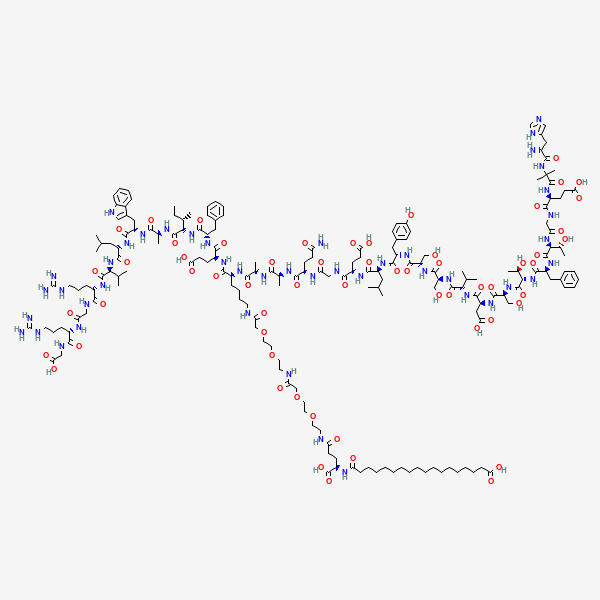
- Molecular formula
- C187H291N45O59
- Molecular weight
- 4114 g/mol
- IUPAC name
- 18-[[(1R)-4-[2-[2-[2-[2-[2-[2-[[(5S)-5-[[(2S)-2-[[(2S)-2-[[(2S)-5-amino-2-[[2-[[(2S)-2-[[(2S)-2-[[(2S)-2-[[(2S)-2-[[(2S)-2-[[(2S)-2-[[(2S)-2-[[(2S)-2-[[(2S,3R)-2-[[(2S)-2-[[(2S,3R)-2-[[2-[[(2S)-2-[[2-[[(2S)-2-amino-3-(1H-imidazol-5-yl)propanoyl]amino]-2-methylpropanoyl]amino]-4-carboxybutanoyl]amino]acetyl]amino]-3-hydroxybutanoyl]amino]-3-phenylpropanoyl]amino]-3-hydroxybutanoyl]amino]-3-hydroxypropanoyl]amino]-3-carboxypropanoyl]amino]-3-methylbutanoyl]amino]-3-hydroxypropanoyl]amino]-3-hydroxypropanoyl]amino]-3-(4-hydroxyphenyl)propanoyl]amino]-4-methylpentanoyl]amino]-4-carboxybutanoyl]amino]acetyl]amino]-5-oxopentanoyl]amino]propanoyl]amino]propanoyl]amino]-6-[[(2S)-1-[[(2S)-1-[[(2S,3S)-1-[[(2S)-1-[[(2S)-1-[[(2S)-1-[[(2S)-1-[[(2S)-5-carbamimidamido-1-[[2-[[(2S)-5-carbamimidamido-1-(carboxymethylamino)-1-oxopentan-2-yl]amino]-2-oxoethyl]amino]-1-oxopentan-2-yl]amino]-3-methyl-1-oxobutan-2-yl]amino]-4-methyl-1-oxopentan-2-yl]amino]-3-(1H-indol-3-yl)-1-oxopropan-2-yl]amino]-1-oxopropan-2-yl]amino]-3-methyl-1-oxopentan-2-yl]amino]-1-oxo-3-phenylpropan-2-yl]amino]-4-carboxy-1-oxobutan-2-yl]amino]-6-oxohexyl]amino]-2-oxoethoxy]ethoxy]ethylamino]-2-oxoethoxy]ethoxy]ethylamino]-1-carboxy-4-oxobutyl]amino]-18-oxooctadecanoic acid
Verified external records:
References
More on Semaglutide
Everything else we've written about Semaglutide — what the community reports, the explainers that cover it, and the terms it keeps running into.
- Semaglutide on Reddit: what users actually reportOn Reddit
- Are peptides covered by insurance? The honest answerExplainer
- Brain Natriuretic Peptide Normal Value & RangesExplainer
- C peptide index: Formula and What It MeansExplainer
- C peptide normal range: How to Read Your ResultExplainer
- C-Peptide vs Insulin: Why Doctors Measure BothExplainer
- Can You Travel With Peptides? Flying GuideExplainer
- Peptide acetateGlossary
- AgonistGlossary
- Analog (analogue)Glossary
- BioavailabilityGlossary
- Boxed warningGlossary
- Clinical trial endpointGlossary