Also known as: NN2211 · NN-2211 · Liraglutide (rDNA origin)
Human RCTHelped
On this page
- What is liraglutide?
- How does liraglutide work?
- What does the research show?
- Is liraglutide safe? Side effects
- FDA & legal status (2026)
- How is liraglutide dosed and used?
- Liraglutide vs semaglutide
- Frequently asked questions
- Who is liraglutide for — and who should be cautious?
- Evidence by outcome
- FDA & legal status
- Registered clinical trials
- Reported side effects
- Chemical identifiers
- References
- Related compounds
- More on Liraglutide
Liraglutide is a lab-made copy of a natural gut hormone (GLP-1) that the FDA has approved as a prescription medicine — sold as Victoza for type 2 diabetes and Saxenda for weight loss. Randomized human trials show it lowers blood sugar, drives real weight loss, and cuts cardiovascular events. This is a peptide whose proof is already in, not on the way.
What is liraglutide?
Liraglutide is a peptide drug — a 31-amino-acid analog of human GLP-1, the “glucagon-like peptide-1” your gut releases after a meal. Liraglutide shares about 97% of its sequence with the natural hormone, with two changes that make it last far longer in the body: a single amino-acid swap and a C16 fatty-acid tail that lets it cling to albumin in your blood. That engineering stretches its half-life to roughly 13 hours, so one daily injection does the job that the natural hormone (which lasts only minutes) never could. Unlike the research peptides on this site, liraglutide is a fully approved medicine (molecular formula C172H265N43O51, molecular weight ~3,751 Da) that comes in a ready-to-use prefilled pen — nothing to reconstitute.
How does liraglutide work?
Liraglutide works by switching on the GLP-1 receptor, the same receptor your own gut hormone uses to manage a meal. Think of GLP-1 as the body’s “you’ve eaten, stand down” signal. When liraglutide activates that receptor it does four useful things at once: it tells the pancreas to release insulin only when blood sugar is high (glucose-dependent, which is why it rarely causes lows on its own), it quiets glucagon (the hormone that pushes sugar up), it slows how fast the stomach empties so food stays with you longer, and it acts on appetite centers in the hypothalamus so you feel full sooner and eat less. The blood-sugar and weight-loss effects fall straight out of that mechanism, and both have been measured in randomized human trials rather than inferred from theory.
What does the research show?
Liraglutide sits at the top of our evidence scale — Human RCT — because its main uses were proven in large randomized controlled trials, the strongest kind of evidence there is. For weight management, the 56-week SCALE trial randomized 3,731 adults without diabetes and found clinically meaningful weight loss on liraglutide 3.0 mg versus placebo (Pi-Sunyer et al., 2015). For type 2 diabetes, the LEAD program of randomized trials established that liraglutide lowers HbA1c and body weight, which is what earned Victoza its 2010 approval. And for cardiovascular risk, the LEADER trial followed 9,340 higher-risk adults with type 2 diabetes for a median 3.8 years: major adverse cardiovascular events occurred in 13.0% on liraglutide versus 14.9% on placebo — a hazard ratio of 0.87 (Marso et al., 2016). That’s a rare thing for any drug: proof it doesn’t just move a lab number but changes hard outcomes. Researchers are now testing liraglutide well beyond its labels — fatty liver disease, atrial fibrillation and PCOS all have registered trials — but those uses are still being studied, so grade them separately from the proven three.
Is liraglutide safe? Side effects
Liraglutide’s safety answer is unusually well-documented for a peptide, because millions of people have used it under prescription. The most common side effects are gastrointestinal — nausea, vomiting, diarrhea and constipation — and they tend to be worst while the dose is being stepped up, then settle (Victoza label, DailyMed). Less common but more serious risks include acute pancreatitis (stop the drug if it’s suspected) and gallbladder disease, which shows up more often with larger weight loss. On its own liraglutide rarely causes low blood sugar, but the risk rises when it’s combined with insulin or a sulfonylurea. The headline caution is a boxed warning for thyroid C-cell tumors: rodents given liraglutide developed these tumors, the human relevance isn’t established, and the label contraindicates it in anyone with a personal or family history of medullary thyroid carcinoma or MEN 2. Honest bottom line — a well-characterized risk profile, not a blank one.
FDA & legal status (2026)
Liraglutide is FDA-approved and prescription-only in the United States, which puts it in a completely different legal category from the research peptides elsewhere on this site. Victoza (up to 1.8 mg) was approved for type 2 diabetes in 2010; Saxenda (the 3.0 mg weight-management dose) followed in 2014; and Victoza also carries an approval to reduce cardiovascular events in adults with type 2 diabetes. Because the original patents have lapsed, generic liraglutide is now FDA-approved too (multiple manufacturers, including Teva and Biocon), so it is no longer a single-brand product. It is not a dietary supplement, and legitimate liraglutide is dispensed by a pharmacy against a prescription — not sold “for research use only.” The dated status block below has the specifics.
How is liraglutide dosed and used?
Liraglutide is given as a once-daily subcutaneous injection from a prefilled pen, and the doses reported in its trials and labels differ by product — this is information, not a personal protocol. For Victoza (type 2 diabetes), the label starts at 0.6 mg daily for a week to blunt the nausea, then steps up to 1.2 mg and, if needed, 1.8 mg. For Saxenda (weight management), the dose is escalated weekly from 0.6 mg up to the target 3.0 mg daily (Saxenda label, DailyMed). The slow ramp isn’t red tape — it’s the single biggest lever for keeping the gut side effects tolerable. Because it ships as a ready-to-use pen, there’s no mixing or reconstitution step, which is why the research-peptide tooling on this site doesn’t apply here; the dose is dialed on the pen.
Liraglutide vs semaglutide
Liraglutide and semaglutide are both GLP-1 receptor agonists from the same maker, and the practical difference is duration and potency. Liraglutide is the older, once-daily peptide; semaglutide is once-weekly and, in head-to-head weight and glucose data, generally produces larger reductions. Neither is “better” for everyone — daily dosing, cost, insurance coverage and tolerability all factor in. The full head-to-head lives on the liraglutide vs semaglutide comparison, and if you’re weighing the newer dual-agonist, see liraglutide vs tirzepatide. Both sit in the same GLP-1 peptides hub alongside semaglutide, tirzepatide and retatrutide.
Frequently asked questions
Is liraglutide the same as Ozempic or Wegovy?
No. Liraglutide is the peptide in Victoza and Saxenda and is dosed once daily. Ozempic and Wegovy contain semaglutide, a different, longer-acting GLP-1 peptide dosed once weekly. They’re cousins in the same drug class, not the same molecule.
Does liraglutide actually cause weight loss?
Yes — and it was proven in a randomized trial, not just reported anecdotally. In the 56-week SCALE study of adults without diabetes, liraglutide 3.0 mg produced clinically meaningful weight loss versus placebo (Pi-Sunyer et al., 2015). It’s the evidence behind Saxenda’s weight-management approval.
Is liraglutide legal?
Yes, with a prescription. Liraglutide is an FDA-approved medicine, so in the United States it’s legal and dispensed by a pharmacy — not a gray-market research chemical. Generic versions are also approved.
Is liraglutide banned in sport?
No. Liraglutide is not on the WADA Prohibited List as of 2026, and GLP-1 receptor agonists are not a banned class. Athletes in tested pools should still check the current annual list to be sure.
What’s the catch with the thyroid warning?
Liraglutide carries a boxed warning because rodents developed thyroid C-cell tumors in animal studies. The human relevance hasn’t been established, but out of caution the label contraindicates it in people with a personal or family history of medullary thyroid carcinoma or MEN 2.
Who is liraglutide for — and who should be cautious?
Liraglutide fits the person who wants a proven, prescribed option for type 2 diabetes or weight management and values a long human track record over the newest molecule. Its strengths are real and well-measured: randomized-trial weight loss, better blood sugar, and a documented drop in cardiovascular events — the kind of evidence most peptides can only dream of. The trade-offs are just as concrete: daily injections, gut side effects during the ramp-up, and a handful of serious but uncommon risks (pancreatitis, gallbladder disease, the thyroid contraindication). Anyone with a personal or family history of medullary thyroid cancer or MEN 2 should not take it, and it’s a prescription decision made with a clinician — not something to source off-label. For most people choosing within the GLP-1 class, the honest question isn’t whether liraglutide works — it’s whether a once-daily peptide or a once-weekly one like semaglutide fits their life better.
Evidence by outcome
Each outcome Liraglutide has been studied for, with the honest evidence grade and what the studies actually found. A tier never stands alone — the verdict rides with it.
| Outcome | Evidence | What was found |
|---|---|---|
| Chronic weight management | Human RCTHelped | In the 56-week SCALE randomized, placebo-controlled trial of 3,731 adults without diabetes, liraglutide 3.0 mg produced clinically meaningful weight loss versus placebo. This is human RCT-grade evidence, and it is the basis for the Saxenda approval. |
| Type 2 diabetes (blood-sugar control) | Human RCTHelped | Multiple randomized trials (the LEAD program) showed liraglutide lowers HbA1c and body weight in adults with type 2 diabetes. This is the human RCT evidence behind the original Victoza approval. |
| Cardiovascular risk reduction | Human RCTHelped | In the LEADER trial (9,340 adults with type 2 diabetes at high cardiovascular risk, median 3.8 years), major adverse cardiovascular events occurred in 13.0% on liraglutide versus 14.9% on placebo (hazard ratio 0.87). A large, randomized, event-driven outcome trial. |
FDA & legal status
- United States: fda approved (as of Jul 2026) — approved for Type 2 diabetes (Victoza), Chronic weight management (Saxenda), Cardiovascular risk reduction in adults with type 2 diabetes (Victoza)
FDA-approved and prescription-only. Victoza was first approved in 2010 for type 2 diabetes; Saxenda (the 3.0 mg weight-management version) followed in 2014. Generic liraglutide has since been approved (multiple ANDAs, e.g. Teva and Biocon), so it is no longer a single-brand drug. It is not a dietary supplement and not sold "for research use only."
openFDA Drugs@FDA lists 10 approved products as of 2026-07-15.
Registered clinical trials
515 registered studies mention Liraglutide on ClinicalTrials.gov (latest update 2026-10-26). A registered trial means a study is planned or underway — not that Liraglutide is approved or proven.
Reported side effects
| Effect | Frequency | Severity |
|---|---|---|
| Nausea, vomiting, diarrhea and constipation | Common — the most frequently reported effects, usually worst during dose escalation | — |
| Hypoglycemia (low blood sugar) | Increased risk when combined with insulin or a sulfonylurea | — |
| Acute pancreatitis | Uncommon but serious; discontinue if suspected | — |
| Gallbladder disease (gallstones, cholecystitis) | Reported, more often with larger weight loss | — |
| Thyroid C-cell tumors (boxed warning) | Seen in rodents; human relevance not established — contraindicated with personal/family history of medullary thyroid carcinoma or MEN 2 | — |
Chemical identifiers
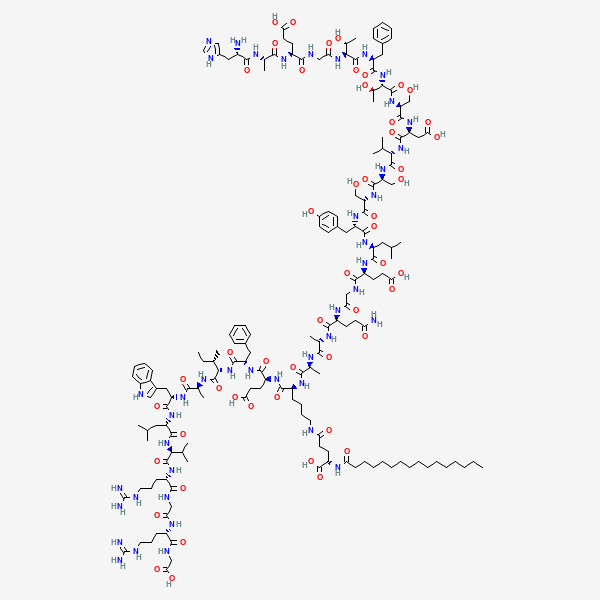
- Molecular formula
- C172H265N43O51
- Molecular weight
- 3751 g/mol
- IUPAC name
- (2S)-5-[[(5S)-5-[[(2S)-2-[[(2S)-2-[[(2S)-5-amino-2-[[2-[[(2S)-2-[[(2S)-2-[[(2S)-2-[[(2S)-2-[[(2S)-2-[[(2S)-2-[[(2S)-2-[[(2S)-2-[[(2S,3R)-2-[[(2S)-2-[[(2S,3R)-2-[[2-[[(2S)-2-[[(2S)-2-[[(2S)-2-amino-3-(1H-imidazol-5-yl)propanoyl]amino]propanoyl]amino]-4-carboxybutanoyl]amino]acetyl]amino]-3-hydroxybutanoyl]amino]-3-phenylpropanoyl]amino]-3-hydroxybutanoyl]amino]-3-hydroxypropanoyl]amino]-3-carboxypropanoyl]amino]-3-methylbutanoyl]amino]-3-hydroxypropanoyl]amino]-3-hydroxypropanoyl]amino]-3-(4-hydroxyphenyl)propanoyl]amino]-4-methylpentanoyl]amino]-4-carboxybutanoyl]amino]acetyl]amino]-5-oxopentanoyl]amino]propanoyl]amino]propanoyl]amino]-6-[[(2S)-1-[[(2S)-1-[[(2S,3S)-1-[[(2S)-1-[[(2S)-1-[[(2S)-1-[[(2S)-1-[[(2S)-5-carbamimidamido-1-[[2-[[(2S)-5-carbamimidamido-1-(carboxymethylamino)-1-oxopentan-2-yl]amino]-2-oxoethyl]amino]-1-oxopentan-2-yl]amino]-3-methyl-1-oxobutan-2-yl]amino]-4-methyl-1-oxopentan-2-yl]amino]-3-(1H-indol-3-yl)-1-oxopropan-2-yl]amino]-1-oxopropan-2-yl]amino]-3-methyl-1-oxopentan-2-yl]amino]-1-oxo-3-phenylpropan-2-yl]amino]-4-carboxy-1-oxobutan-2-yl]amino]-6-oxohexyl]amino]-2-(hexadecanoylamino)-5-oxopentanoic acid
Verified external records:
References
- 1.LEADER trial — Marso et al., liraglutide and cardiovascular outcomes in type 2 diabetes (NEJM 2016)
- 2.SCALE trial — Pi-Sunyer et al., a randomized trial of 3.0 mg liraglutide in weight management (NEJM 2015)
- 3.Victoza (liraglutide) — full FDA prescribing information
- 4.Saxenda (liraglutide 3.0 mg) — full FDA prescribing information
- 5.Liraglutide — indexed research (PubMed, National Library of Medicine)
- 6.Liraglutide — registered clinical studies (ClinicalTrials.gov)
More on Liraglutide
Everything else we've written about Liraglutide — what the community reports, the explainers that cover it, and the terms it keeps running into.
- Liraglutide reddit: Saxenda Results & Side EffectsOn Reddit
- Understanding peptide half lifeExplainer
- RecombinantGlossary