Melanotan II vs Melitane
Melanotan II vs Melitane compares an unapproved tanning injection with a topical cosmetic peptide whose human tanning evidence remains unproven.
Melanotan II vs Melitane is not a choice between equivalent tanning products: Melanotan II is an unapproved injected melanocortin agonist with small controlled human tanning studies, while Melitane is a topical cosmetic ingredient whose tanning claims rest mainly on commercial and patent evidence. No trial has compared them directly.
What is the core difference?
Melanotan II and Melitane point in the same broad pigment direction, but route, receptor reach and proof separate them. Melanotan II is a cyclic alpha-melanocyte-stimulating hormone (alpha-MSH) analog injected in early studies. Melitane, the trade name for acetyl hexapeptide-1, is sold for use in topical cosmetics. One has reached small human tanning experiments; the other remains mostly a cosmetic-ingredient proposition.
Melanotan II activates MC1R on pigment-making melanocytes and also activates MC3R and MC4R. That wider receptor activity helps explain effects outside tanning, including nausea, appetite changes and erections. Melitane is commercially described as an alpha-MSH mimetic intended to stimulate MC1R-linked melanogenesis. Patents can document that intended use; they cannot show that a finished cream reliably darkens human skin.
That distinction is missing from much of the live search landscape. Results tend to discuss Melanotan II injections or acetyl hexapeptide-1 skincare separately. Searches for melitane vs melanotan 2 often collapse “topical,” “cosmetic” and “works” into one cheerful bundle. Those are three different claims.
Which compound has better tanning evidence?
Melanotan II has the stronger efficacy record for tanning, although “stronger” is doing relative work here. A placebo-controlled phase I pilot enrolled only three men; subcutaneous Melanotan II produced measured or visible pigmentation in two, alongside mild nausea and dose-linked yawning, stretching and erections (PubMed). That supports a real human tanning effect, not long-term safety.
Melitane has no isolated human trial showing a tan. A 2023 study tested a cosmetic essence containing 0.02% acetyl hexapeptide-1 plus 0.1% retinol in 32 women, but it examined photoaging outcomes, had no Melitane-only arm and came from a cosmetics-company research center (PubMed). The result cannot tell us whether acetyl hexapeptide-1 increased pigmentation—or contributed anything independently.
Melitane therefore sets the shared evidence badge at mechanistic hypothesis, the weaker tier. Calling supplier-generated or patent-based performance data “human proof” would turn a product brief into a clinical trial by changing the font. No direct Melanotan II vs Melitane trial appears in PubMed or ClinicalTrials.gov.
Is Melitane a legal Melanotan alternative?
Melitane can fit a conventional US topical cosmetic product, but “legal melanotan alternative” overstates what that means. FDA generally does not approve cosmetic ingredients before sale, apart from color additives; the marketer remains responsible for safety, labeling and avoiding drug claims (FDA). Cosmetic status is a regulatory category, not an efficacy certificate.
Melanotan II sits on the other side of that line. FDA has treated injectable Melanotan II marketed for tanning as an unapproved new drug. In April 2026, FDA also listed compounded Melanotan II among bulk substances with potential significant safety risks, citing aggregation or peptide-impurity concerns and serious published case reports (FDA). “Research use only” is not a route around drug approval for human tanning.
The honest translation: Melitane is the easier ingredient to place in a cosmetic formula. That does not make Melitane an FDA-approved tanning treatment, and it does not prove the topical tanning peptide reaches its receptor through intact skin in an effective amount.
Is the Melitane formula C43H59N13O7 or C43H59N13O?
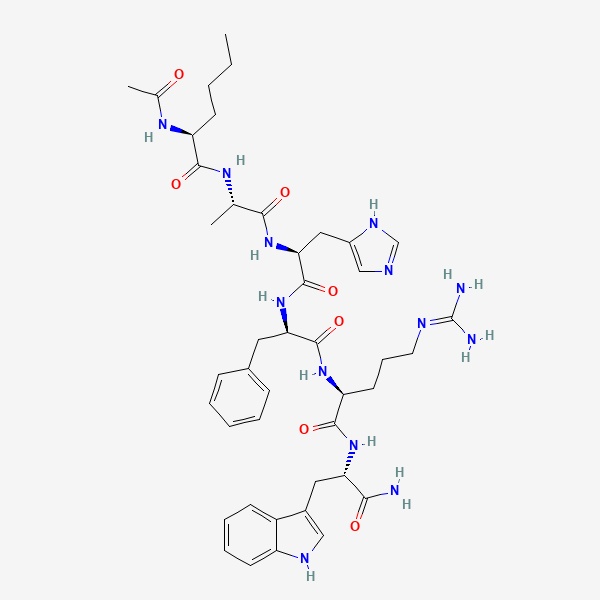
Melitane’s supported molecular formula is C43H59N13O7, not C43H59N13O. PubChem CID 10129683 gives C43H59N13O7, a molecular weight of 870.0 g/mol and the sequence Ac-Nle-Ala-His-D-Phe-Arg-Trp-NH2 (PubChem). The shorter “O” version drops six oxygen atoms and conflicts with both the recorded structure and molecular weight.
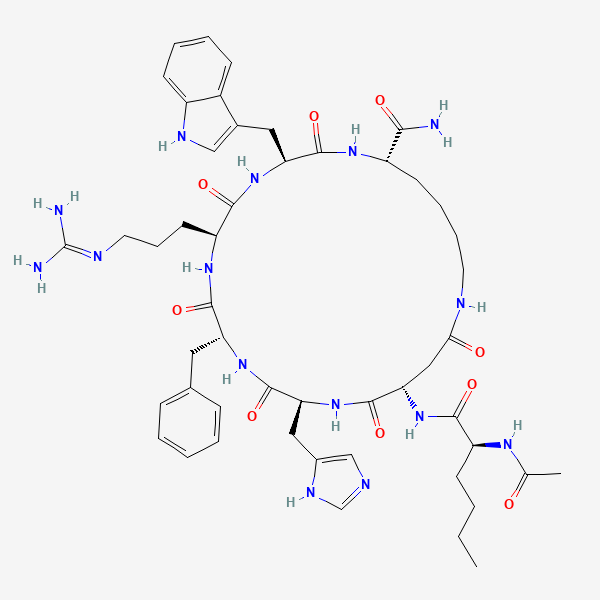
That chemistry check matters because acetyl hexapeptide-1 is not “topical Melanotan II.” Melanotan II is a cyclic heptapeptide with a different structure and multi-receptor activity. Melitane is a linear, acetylated six-residue ingredient. Shared alpha-MSH mimicry does not make the molecules interchangeable; the wider melanocortin peptide family contains several compounds with sharply different evidence and approvals.
Which option fits which goal?
Melanotan II fits the narrow goal of choosing the compound with direct human evidence of increased pigmentation; Melitane fits the different goal of avoiding injections and using a conventional topical cosmetic format. Neither pick is universal. The first carries an unapproved-drug status and meaningful adverse effects. The second carries a much quieter route—and an efficacy record too thin to promise a tan.
Melanotan II commonly causes nausea and flushing in early studies. Mole darkening and new or changing nevi also belong in the decision: case reports document changes that can complicate the distinction between a benign mole and melanoma (PubMed). Reports of melanoma do not establish that Melanotan II caused the cancer, but they are not background noise either.
Melitane avoids injection-related sterility and systemic-exposure concerns, yet “topical” is not a synonym for “proven safe.” Human data on isolated acetyl hexapeptide-1 are sparse, and irritation depends on the finished formulation. For readers comparing all tanning approaches, the peptides for tanning guide separates demonstrated pigment effects, cosmetic claims and regulatory status without selling either compound.
Melanotan II vs Melitane, point by point
Every dimension side by side — the honest differences, not a scoreboard.
| Dimension | Melanotan II | Melitane |
|---|---|---|
| What it is | A synthetic cyclic alpha-MSH analog that activates MC1R, MC3R and MC4R. | Acetyl hexapeptide-1, a synthetic alpha-MSH-mimetic cosmetic ingredient marketed for topical use. |
| Route | Subcutaneous injection in the small human tanning studies. | Applied topically as part of a finished cosmetic formula; no validated tanning dose exists. |
| Human tanning evidence | Small, controlled early studies produced measurable skin darkening. | No trial has isolated Melitane and shown that it tans human skin. |
| Evidence limitation | The tanning signal is human-controlled, but the studies were small and short. | The tanning case comes mainly from supplier claims, patents and mechanism; one human cosmetic study combined it with retinol and did not test tanning. |
| US status (2026) | An unapproved new drug; FDA also flags safety concerns around compounded Melanotan II. | A cosmetic ingredient, not an FDA-approved drug; cosmetic marketing still has to meet US safety and labeling law. |
| Main safety question | Nausea, flushing, prolonged erections, mole changes and serious case reports including melanoma; causation is not established for melanoma. | Published human safety data for the isolated topical peptide are sparse; irritation also depends on the complete formula. |
- Human tanning evidence: No trial has compared Melanotan II and Melitane directly; this comparison weighs their separate evidence.
Melanotan II vs Melitane: the two molecules
The 2D chemical structures, straight from PubChem — a quick way to see how similar (or not) the two actually are.
Which one fits which goal?
There's no universal winner here — the honest answer depends on what you're after. These picks are framed by goal, and each says why.
Choosing on evidence that skin pigmentation can increase
Leans toward Melanotan II
Melanotan II has small controlled human tanning studies; Melitane does not. That evidence advantage does not erase Melanotan II's unapproved status or risks.
Avoiding injections and staying within a conventional cosmetic format
Leans toward Melitane
Melitane is formulated for topical cosmetic use, but that route and market category do not establish that it produces a tan.