Also known as: Melanotan-II · MT-II · MT2 · Melanotan (MT)-II · Ac-Nle-cyclo[Asp-His-D-Phe-Arg-Trp-Lys]-NH2
Human (controlled)Helped
On this page
- What is Melanotan II?
- How does Melanotan II work?
- What does the research show?
- What the community reports
- Is Melanotan II safe? Side effects
- FDA & legal status (2026)
- How is Melanotan II used, and can it be mixed?
- Melanotan II vs PT-141 (bremelanotide)
- Frequently asked questions
- Who is Melanotan II for — and who should be cautious?
- Evidence by outcome
- FDA & legal status
- Registered clinical trials
- Reported side effects
- Chemical identifiers
- References
- Related compounds
- More on Melanotan II
Melanotan II is a synthetic melanocortin peptide — a cyclic copy of the hormone that tells skin to make pigment — best known for producing a deep tan. Melanotan II was tested in people and the tan is real, but it also darkens moles and carries safety unknowns. It is not FDA-approved and is sold only as a research chemical.
What is Melanotan II?
Melanotan II is a lab-made peptide, built as a cyclic seven-residue analog of alpha-melanocyte-stimulating hormone (α-MSH) — the signal your body uses to switch on pigment production. Chemically it is a compact molecule (formula C50H69N15O9, molecular weight about 1,024 g/mol, CAS 121062-08-6, PubChem CID 92432), stable enough to be freeze-dried, shipped and reconstituted at home. Developed originally at the University of Arizona as a “sunless tanning” agent, Melanotan II is not a medicine you can be prescribed in the United States and not a legal supplement — it exists here only as a research chemical. It is the more potent, non-selective cousin of Melanotan I (afamelanotide), and it sits in the same melanocortin family as PT-141 (bremelanotide) and setmelanotide, which you can read about on the melanocortin peptides hub.
How does Melanotan II work?
Melanotan II works by imitating α-MSH and switching on melanocortin receptors throughout the body. The headline effect runs through MC1R on your pigment cells (melanocytes): activate it and the cells crank out more eumelanin, the brown pigment, so skin darkens even without much sun. Think of MC1R as the dimmer switch for your tan — Melanotan II holds it up. Because Melanotan II is non-selective, it also hits MC3R and MC4R in the brain, which is why the same injection that tans your skin can blunt appetite and trigger sexual arousal. That “one peptide, several receptors” design is the whole story of Melanotan II: the tan and the side effects come from the same mechanism, not from separate ingredients (human research on melanotan II, PubMed).
What does the research show?
Melanotan II is unusual among research peptides because it was actually studied in humans, not just rodents. The small early clinical studies that developed Melanotan II documented its two most-searched effects directly: subcutaneous dosing produced visible, dose-dependent skin darkening, and in studies of men it produced spontaneous erections — an effect so consistent that a related molecule, bremelanotide (PT-141), was carved out of the same research program and eventually FDA-approved for a different indication. The honest framing (evidence tier Human (controlled), verdict helped for tanning): these were small, short, early-phase studies, Melanotan II itself was never approved, and there is no long-term human safety data (human-tagged records, PubMed). The newest human work is a Phase 2 trial pairing Melanotan II with narrow-band UVB light for vitiligo repigmentation — that use is graded mechanistic-hypothesis · none-in-humans because the trial only began recruiting in 2026 and has no results yet (NCT07437560, ClinicalTrials.gov).
What the community reports
Melanotan II has a big word-of-mouth following, mostly among people who tan poorly and want colour without hours in the sun. The commonly reported pattern is a “loading” phase of small daily subcutaneous injections until the desired shade is reached, then occasional maintenance doses, usually paired with some real UV exposure to trigger the tan. Melanotan II users also routinely mention the nausea, the appetite drop and the libido effect as a package deal. These accounts are anecdotal — they aren’t controlled data, they skew toward people happy enough to post, and they can’t tell you how often a mole change turns out to matter. They’re useful for understanding why people try Melanotan II, not for proving it’s safe.
Is Melanotan II safe? Side effects
Melanotan II’s honest safety answer is “the tan is real, and so are the risks.” The common, mostly-benign effects are nausea and facial flushing (worst in the first few doses), a dip in appetite, and yawning or stretching right after an injection. In men, spontaneous erections are common — a direct melanocortin effect, occasionally severe enough to count as priapism, which is a medical emergency. The effect that deserves the most weight is on the skin itself: Melanotan II darkens existing moles and can bring out new moles and freckles, which is exactly the kind of change dermatologists watch for — so it can mask an early warning sign at the worst possible moment. Published case reports link Melanotan II to melanoma and to changes in atypical moles; causation isn’t established, but the signal is why mole monitoring isn’t optional. There is no long-term human safety data, and the vials themselves are unregulated research chemicals whose purity and sterility vary from vendor to vendor. Anyone with a personal or family history of melanoma, or lots of atypical moles, has every reason to steer clear.
FDA & legal status (2026)
Melanotan II is not FDA-approved for any use, and it is not a legal dietary supplement or cosmetic ingredient in the United States — it is sold strictly as a research chemical labelled “not for human consumption.” Other countries are stricter: medicines regulators in the UK and Australia, among others, have publicly warned against unlicensed Melanotan II and treat it as an unapproved medicine. This status is worth re-checking, because enforcement around injectable research peptides is an active area. The full dated breakdown is in the regulatory-status block below.
How is Melanotan II used, and can it be mixed?
Melanotan II ships as a lyophilized (freeze-dried) powder that has to be reconstituted with bacteriostatic water before use, then injected subcutaneously. Getting the concentration right is pure arithmetic — our reconstitution & dosing calculator turns “10 mg vial, 2 mL water, 250 mcg target” into the exact number of insulin-syringe units to draw. On dosing, we report information, not a protocol: the doses commonly reported in the community run from roughly 250 mcg up toward 1 mg per injection, but those are not clinically validated figures and none of them make Melanotan II a legal or tested medicine. People also ask whether Melanotan II can share a syringe with other peptides; our mixing compatibility reference covers what is commonly combined and where the honest answer is “not enough data.”
Melanotan II vs PT-141 (bremelanotide)
Melanotan II and PT-141 come from the same research and are constantly confused, so here’s the clean split. Melanotan II is the non-selective melanocortin agonist — it tans skin (MC1R) and raises arousal (MC3R/MC4R), which is why it does both. PT-141 (bremelanotide) is a more MC4R-focused relative developed specifically for sexual function, and unlike Melanotan II it is FDA-approved — as Vyleesi, for hypoactive sexual desire disorder in premenopausal women. The key honesty point: PT-141’s approval does not transfer to Melanotan II. They are different molecules with different evidence and different legal status. Both sit in the melanocortin peptide family.
Frequently asked questions
Does Melanotan II actually work for tanning?
Yes — for tanning, Melanotan II has real human evidence. Small early clinical studies showed dose-dependent skin darkening, and it works best paired with some UV exposure. We grade the tanning use Human (controlled) · helped, with the caveat that the studies were small and short and it was never approved as a drug.
Is Melanotan II legal?
Melanotan II is legal to sell and possess as a research chemical in the United States, but it is not an approved drug, supplement or cosmetic and cannot be sold for human use. Some other countries, including the UK and Australia, restrict it more tightly as an unlicensed medicine.
Is Melanotan II dangerous for moles?
Melanotan II darkens existing moles and can trigger new ones, and case reports have linked it to melanoma and to changes in atypical moles. That doesn’t prove Melanotan II causes skin cancer, but it does mean the drug can hide the very changes used to catch it early — so mole monitoring (ideally with a dermatologist) matters, and a melanoma history is a reason to avoid it.
Is Melanotan II banned in sport?
Most likely, yes. Melanotan II isn’t named on the WADA Prohibited List, but as a substance with no approval for human therapeutic use it falls under the S0 “non-approved substances” category, which is prohibited at all times. Athletes should confirm current status on GlobalDRO.
How is Melanotan II taken?
Melanotan II is almost always injected subcutaneously after being reconstituted with bacteriostatic water, usually as a short loading course followed by occasional maintenance. Nasal-spray versions are marketed too, but the injectable form is what the human studies used.
Who is Melanotan II for — and who should be cautious?
Melanotan II draws in people who tan badly and are tired of burning — the palest person on the beach who wants colour without frying under the sun. The honest framing: unlike most research peptides, Melanotan II’s headline effect is documented in humans, so the tan is not a hope, it’s a result. But that comes bundled with nausea, an unmistakable libido effect, and — most importantly — a real impact on your moles that overlaps with the earliest signs of skin cancer, plus zero long-term safety data and an unregulated supply. Anyone with a melanoma history, many atypical moles, or who is pregnant has a clear reason to skip Melanotan II. Everyone else who is tempted should at minimum photograph their moles first and know they’re trading a known cosmetic effect for genuine unknowns.
Evidence by outcome
Each outcome Melanotan II has been studied for, with the honest evidence grade and what the studies actually found. A tier never stands alone — the verdict rides with it.
| Outcome | Evidence | What was found |
|---|---|---|
| Skin tanning / pigmentation | Human (controlled)Helped | Melanotan II is one of the few research peptides tested in people — PubMed indexes dozens of human-tagged records. The small early human studies that first developed it consistently produced visible skin darkening after subcutaneous dosing. The honest limits: those studies were small and short, Melanotan II was never approved as a drug, and there is no long-term human safety data. |
| Sexual arousal / erectile function | Human (controlled)Helped | Melanotan II reliably produced spontaneous erections in small early human studies of men — an effect consistent enough that researchers spun a related molecule, bremelanotide (PT-141), out of the same work and took it all the way to FDA approval for a different indication. For Melanotan II itself the human arousal data are small and early, not large trials. |
| Vitiligo repigmentation | MechanisticUnclear⚠ none in humans | Melanotan II for vitiligo rests on a plausible mechanism — drive MC1R, make more pigment in depigmented skin — and a Phase 2 trial (NCT07437560) pairing it with narrow-band UVB phototherapy began recruiting in 2026. No results exist yet, so this use is a reasonable hypothesis under test, not a proven benefit. |
FDA & legal status
- United States: research use only (as of Jul 2026)
Melanotan II is not an FDA-approved drug and is not a lawful dietary supplement or cosmetic ingredient — in the US it is sold only as a research chemical, "not for human consumption." Several other countries (including the UK and Australia) treat unlicensed Melanotan II more strictly and medicines regulators there have publicly warned against it. Re-verify status, as enforcement around injectable research peptides is an active area.
openFDA Drugs@FDA lists no approved product for melanotan II as of 2026-07-15.
Registered clinical trials
One registered study mention Melanotan II on ClinicalTrials.gov (latest update 2026-02-27). A registered trial means a study is planned or underway — not that Melanotan II is approved or proven.
| Study | Status | Phase | Sponsor |
|---|---|---|---|
| Melanotan II (MT-II) as an Adjunct to NB-UVB Phototherapy for Repigmentation in Stable Nonsegmental VitiligoNCT07437560 | recruiting | Phase 2 | Hudson Biotech |
Reported side effects
| Effect | Frequency | Severity |
|---|---|---|
| Nausea and facial flushing | Common, especially with the first few doses | Usually mild and short-lived |
| Darkening of existing moles and appearance of new moles (nevi) and freckles | Reported; a hallmark effect of melanocortin stimulation | Serious concern — obscures the mole changes that matter for skin-cancer screening |
| Spontaneous erections / priapism (in men) | Common — a direct melanocortin effect, not a side quirk | Usually benign; a prolonged, painful erection is a medical emergency |
| Decreased appetite, yawning and stretching after dosing | Reported | Mild |
| Melanoma and changes in atypical/dysplastic moles | Rare, in published case reports | Serious — causation is not established, but the signal is why mole monitoring matters |
Chemical identifiers
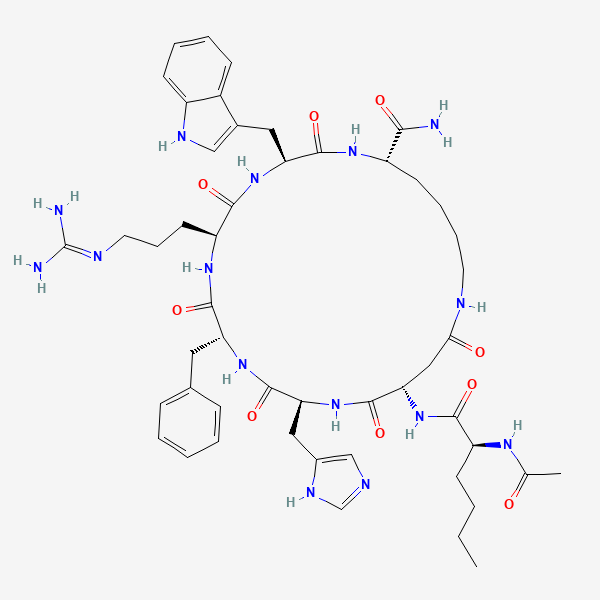
- Molecular formula
- C50H69N15O9
- Molecular weight
- 1024.2 g/mol
- IUPAC name
- (3S,6S,9R,12S,15S,23S)-15-[[(2S)-2-acetamidohexanoyl]amino]-9-benzyl-6-[3-(diaminomethylideneamino)propyl]-12-(1H-imidazol-5-ylmethyl)-3-(1H-indol-3-ylmethyl)-2,5,8,11,14,17-hexaoxo-1,4,7,10,13,18-hexazacyclotricosane-23-carboxamide
Verified external records:
References
- 1.Melanotan II (CID 92432) — compound record, PubChem (National Library of Medicine)
- 2.Melanotan II — human-tagged research (PubMed, National Library of Medicine)
- 3.Melanotan II (MT-II) as an adjunct to NB-UVB phototherapy for vitiligo (NCT07437560) — ClinicalTrials.gov
- 4.FDA — Drugs (approval status & unapproved-drug information)
- 5.Global Drug Reference Online (GlobalDRO) — prohibited-substance status in sport
More on Melanotan II
Everything else we've written about Melanotan II — what the community reports, the explainers that cover it, and the terms it keeps running into.