Also known as: Acetyl hexapeptide-1 · Melitane GL 200 · N-Acetyl-norleucyl-alanyl-histidyl-D-phenylalanyl-arginyl-tryptophanamide
MechanisticUnclear⚠ none in humans
On this page
- What is Melitane?
- How does Melitane work?
- What does the research show?
- Is Melitane a skin brightener?
- Is Melitane safe? Side effects
- FDA and legal status (2026)
- How is Melitane used?
- Melitane vs melanocortin tanning peptides
- Frequently asked questions
- Who is Melitane for, and who should be cautious?
- Evidence by outcome
- FDA & legal status
- Chemical identifiers
- References
- Related compounds
- More on Melitane
Melitane is acetyl hexapeptide-1, a topical cosmetic peptide marketed to increase melanin and support a gradual tan. It mimics alpha-MSH and activates MC1R, the pigment receptor on melanocytes. That direction is clear in cell research, patents, and manufacturer documents, but a controlled human tanning trial isolating Melitane has not been retrieved. It is not an FDA-approved drug or sunscreen.
What is Melitane?
Melitane is the trade name for acetyl hexapeptide-1, a synthetic chain of six amino acids with the sequence Ac-Nle-Ala-His-D-Phe-Arg-Trp-NH2. Its molecular formula is C43H59N13O7 and its molecular weight is about 870. Cosmetic formulas usually list the INCI name Acetyl Hexapeptide-1, often delivered in a glycerin, water, and dextran solution.
The European ingredient listing gives acetyl hexapeptide-1 the broad cosmetic function skin conditioning (COSMILE Europe). That INCI function describes its role in cosmetics; it does not settle receptor pharmacology or prove a tanning result. For that, the more useful records are the functional research and patents.
How does Melitane work?
Melitane acts on the tanning side of melanocortin signaling. Alpha-melanocyte- stimulating hormone (alpha-MSH) normally binds the melanocortin-1 receptor (MC1R) on melanocytes and sends a “make pigment” signal. Melitane mimics that signal as an MC1R agonist rather than blocking it.
The sequence explains why. Its His-D-Phe-Arg-Trp core is a melanocortin activation motif, and the Nle and D-Phe substitutions are familiar from potent alpha-MSH agonists. In a peer-reviewed MC1R cell assay, researchers used Melitane as a patented alpha-MSH agonist benchmark and measured receptor-driven cyclic AMP signaling (Dubs et al., 2007). A patent on pigmenting compositions likewise calls acetyl hexapeptide-1 a melanotropic MC1R ligand and places it among melanogenesis activators (WO2014177406A1).
Lucas Meyer Cosmetics is even more explicit: its Melitane GL page calls the ingredient an MC1R agonist that stimulates tyrosinase activity, melanin synthesis, and melanocyte dendricity. Those are manufacturer claims, not clinical proof, but they remove any doubt about which direction the ingredient was designed to push (Lucas Meyer Cosmetics).
What does the research show?
Melitane has a coherent pro-pigment mechanism, but its human tanning evidence is still thin. The accessible evidence located for this review consists mainly of a functional cell paper, patents, and manufacturer documentation. No retrievable controlled human trial was found that isolates topical Melitane and measures how much it changes skin pigmentation or how long that change lasts.
That distinction matters. The cell paper supports receptor agonism; the patent states that topical acetyl hexapeptide-1 stimulates MC1R, tyrosinase, and melanogenesis (US20100021401A1); and the supplier markets it for sun care and sunless tanning. Together they confirm the direction of action. They do not establish a reliable tanning effect size in people.
The fair evidence grade therefore remains mechanistic hypothesis, unknown in humans. The biology is not the weak link here. The missing piece is a controlled study of the actual topical ingredient against its vehicle, with pigmentation and safety measured over time.
Is Melitane a skin brightener?
No. Melitane is not the alpha-MSH-blocking brightening peptide. It is the MC1R-agonist, melanogenesis-stimulating ingredient marketed to enhance pigmentation. Calling it a depigmenting agent reverses its intended mechanism.
The likely source of confusion is Nonapeptide-1, sold as Melanostatine-5. That is a different peptide with a different sequence. Clariant describes Melanostatine-5 as an alpha-MSH antagonist that prevents excess melanin production and is used for complexion brightening (Clariant). The names are easy to blend together; the receptor directions are opposites.
Is Melitane safe? Side effects
Melitane does not have a published standalone human safety program that defines common or rare adverse effects. In a finished topical product, the practical risks include redness, irritation, or allergic contact reactions, and the rest of the formula may matter more than the peptide itself. For anyone buying raw acetyl hexapeptide-1 powder to blend their own serum, unknown concentration and quality control add another layer of uncertainty.
One safety boundary needs to be plain: more melanin is not a license for more ultraviolet exposure. Melitane is not an approved UV filter and should not be described as a substitute for sunscreen. Manufacturer claims about natural photoprotection or UV-damage responses remain formulation and supplier claims until independent human studies test them.
FDA and legal status (2026)
Melitane is an unscheduled cosmetic ingredient, not an FDA-approved drug or sunscreen active. FDA generally does not pre-approve cosmetic products or their ingredients, apart from some color additives; companies remain responsible for safety and labeling (FDA).
That status does not validate tanning efficacy, and it does not authorize medical claims. A topical product can be marketed to alter appearance, while claims to treat pigment disease or prevent UV injury may place it in drug territory.
How is Melitane used?
Melitane is formulated into leave-on creams, lotions, serums, and sun-care products at low concentrations. It is topical, not an injectable tanning peptide, and there is no reconstitution or injection protocol to report. Supplier use levels describe formulation practice, not a clinically validated dose.
It also differs from a dye-based sunless tanner. Dihydroxyacetone (DHA) colors the outer skin through a chemical reaction; Melitane is intended to signal living melanocytes to make more melanin. Whether a particular finished product produces a visible result depends on delivery, concentration, formulation, and the user’s pigment biology.
Melitane vs melanocortin tanning peptides
Melitane shares MC1R agonism with Melanotan I and Melanotan II, but it is not a topical version of either. Melitane is a linear six-residue cosmetic ingredient. Melanotan I is a 13-residue alpha-MSH analog associated with afamelanotide, while Melanotan II is a cyclic heptapeptide with activity at several melanocortin receptors.
The shared receptor explains the shared pigment direction, not interchangeable dosing, delivery, evidence, or risk. The melanocortin peptide hub maps that wider family, while the cosmetic peptide hub places Melitane among topical ingredients rather than injectable research compounds.
Frequently asked questions
Does Melitane make skin darker?
Melitane is designed and marketed to increase melanin production through MC1R agonism, so darker or more tanned-looking skin is the intended direction. A controlled human trial isolating the ingredient has not established how large or consistent that visible effect is.
Is Melitane the same as Melanostatine-5?
No. Melitane is acetyl hexapeptide-1, an MC1R agonist on the tanning side. Melanostatine-5 is nonapeptide-1, an alpha-MSH antagonist on the brightening side. They are different ingredients with opposite intended effects on pigment signaling.
Is Melitane a sunless tanner?
Melitane is marketed for sunless-tanning and tan-enhancing formulas, but it does not stain the surface like DHA. Its proposed effect depends on stimulating the skin’s own melanin pathway, and the standalone human evidence remains unconfirmed.
Does Melitane replace sunscreen?
No. Melitane is not an approved sunscreen active. Even if a formula increases melanin, that does not establish an SPF or justify extra UV exposure.
Is Melitane FDA-approved?
No. Melitane is sold as a topical cosmetic ingredient, not an FDA-approved drug. That is common for cosmetic ingredients, but it also means FDA has not reviewed it as a treatment for a pigment disorder or as protection from UV injury.
Who is Melitane for, and who should be cautious?
Melitane is aimed at people looking for a gradual tan or a pigment-supporting cosmetic rather than a skin lightener. Anyone trying to fade melasma, dark spots, or post-inflammatory hyperpigmentation should recognize that its intended direction is the opposite of that goal.
People with pigment disorders, a history of skin reactions, or products that invite extra sun exposure have a reason to be cautious. The receptor mechanism is clear; the standalone human efficacy and long-term safety record are not. That is the honest line between a well-supported biological direction and a clinically demonstrated cosmetic result.
Evidence by outcome
Each outcome Melitane has been studied for, with the honest evidence grade and what the studies actually found. A tier never stands alone — the verdict rides with it.
| Outcome | Evidence | What was found |
|---|---|---|
| Increased melanogenesis / gradual tanning | MechanisticUnclear⚠ none in humans | MC1R agonism points toward increased tyrosinase activity, melanin synthesis, and pigmentation. Functional cell research describes Melitane as an alpha-MSH agonist, while patents and the ingredient manufacturer position it as a melanogenesis stimulator. No retrievable controlled human trial was found that isolates topical Melitane and measures its tanning effect, so the cosmetic outcome remains unconfirmed in humans. |
FDA & legal status
- United States: unscheduled (as of Jul 2026)
Melitane is not an FDA-approved drug or an approved sunscreen active. It is sold as a topical cosmetic ingredient. FDA generally does not pre-approve cosmetic products or ingredients, except some color additives, and has not evaluated Melitane for treating a medical condition or preventing UV injury.
openFDA Drugs@FDA lists no approved product for acetyl hexapeptide-1 as of 2026-07-15.
Chemical identifiers
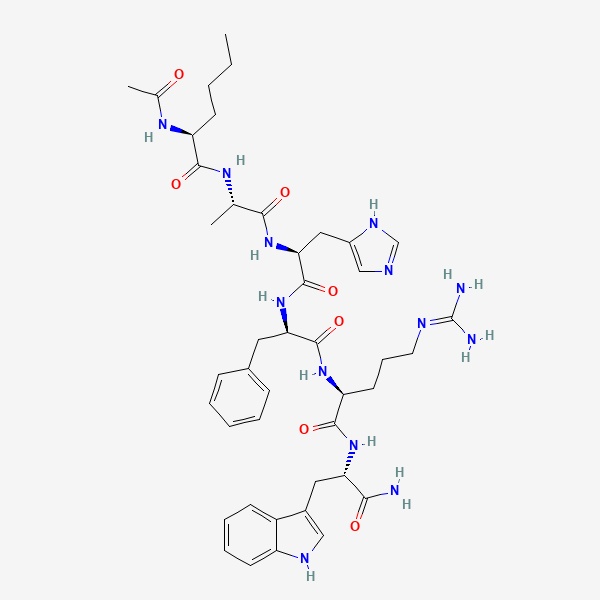
- Molecular formula
- C43H59N13O7
- Molecular weight
- 870 g/mol
- IUPAC name
- (2S)-2-acetamido-N-[(2S)-1-[[(2S)-1-[[(2R)-1-[[(2S)-1-[[(2S)-1-amino-3-(1H-indol-3-yl)-1-oxopropan-2-yl]amino]-5-(diaminomethylideneamino)-1-oxopentan-2-yl]amino]-1-oxo-3-phenylpropan-2-yl]amino]-3-(1H-imidazol-5-yl)-1-oxopropan-2-yl]amino]-1-oxopropan-2-yl]hexanamide
Verified external records:
References
- 1.Lucas Meyer Cosmetics - Melitane GL product information and mechanism
- 2.COSMILE Europe - Acetyl Hexapeptide-1 INCI function
- 3.Dubs et al., 2007 - MC1R activity of alpha-MSH analogues compared with Melitane (PMID 17896820)
- 4.WO2014177406A1 - Melitane as a melanotropic MC1R ligand in pigmenting compositions
- 5.US20100021401A1 - Acetyl hexapeptide-1 stimulation of MC1R, tyrosinase, and melanogenesis
- 6.Clariant - Melanostatine 5 BG (Nonapeptide-1), the lightening-side alpha-MSH antagonist
- 7.FDA - Cosmetics and U.S. law
More on Melitane
Everything else we've written about Melitane — what the community reports, the explainers that cover it, and the terms it keeps running into.