Semaglutide vs Tirzepatide
Semaglutide vs tirzepatide: tirzepatide led on weight in the SURMOUNT-5 head-to-head, but semaglutide has an oral option and the longer track record.
Maybe you’re a few months into semaglutide, the scale has quietly stopped moving, and someone in a forum swore tirzepatide would break the stall. Or you haven’t started either one and you’re just trying to pick the right needle before you commit a year of your life to it. Either way, the honest headline is the same: which of these is “better” depends entirely on what you’re optimizing for, and anyone who hands you a single winner is selling something.
Here’s the straight version. Both semaglutide and tirzepatide are FDA-approved, both are once-weekly injections, and both ride on real human trials, not the animal-data-and-anecdote most of the compounds we cover are still working with. The one time the two went head-to-head for weight loss, tirzepatide posted the bigger number: about 20% average body-weight loss to semaglutide’s ~14%. That doesn’t crown it, though. Semaglutide is the one you can take as a daily pill instead of a shot, and it’s been in wide use longer, with more years of real-world data behind it. Which one comes out ahead depends on your goal, and the by-goal picks lower down lay out the honest trade-offs.
What people pick each one for — and what they report
Two pretty different crowds are comparing these drugs, and it’s worth knowing which one you’re in. There are the prescription patients running Ozempic or Wegovy (semaglutide) and Mounjaro or Zepbound (tirzepatide) through a doctor. And there’s this site’s other half: the people buying “sema” and “tirz” as reconstitute-it-yourself vials from compounders and the gray market. Both crowds are loud, both keep meticulous notes, and their reports mostly rhyme.
The thing nearly everyone describes, on either drug, is the same: the “food noise” goes quiet. That’s the community’s own term for the constant background chatter about the next snack, and when it switches off, people describe eating like someone who simply forgets to be hungry. Tirzepatide users tend to report that quieting as more complete and the loss as faster, which lines up with the trial data. Semaglutide’s crowd is the larger, older one, and the reports there are every bit as real; they’ve just had more years to pile up.
The single most common story in these forums is a switch. Someone loses well on semaglutide for a while, plateaus, and moves to tirzepatide chasing more. It runs the other way too, usually over cost, insurance, or an appetite that got knocked down so hard that eating turned into a chore. Neither switch is a plug-and-play swap, which earns its own section below.
And because a page that prints only the wins is a sales page, here’s the rest of the mix people report: plenty of non-responders who felt almost nothing, brutal opening weeks of nausea and constipation while the dose climbs, the hollowed-out look the internet calls “Ozempic face” (it’s just fast fat loss in the cheeks, and it hits both drugs), genuine worry about shedding muscle along with the fat, and the part nobody enjoys hearing, that the weight tends to come back when the drug stops. All of that is anecdotal, and label it that way: these are self-reports, not a study, and we hear loudest from the people motivated enough to post.
Does one actually beat the other? What the trials show
On the evidence tier this match-up is unusual: both compounds are graded Human RCT, and for once that badge is earned outright for each, not a courtesy. These two are among the most heavily trialed peptides in existence. So the question isn’t “is there proof,” it’s “what did the head-to-heads actually find.”
The one that matters most for weight loss is SURMOUNT-5, the first trial to put the two drugs directly against each other in adults with obesity and no diabetes. Over 72 weeks, tirzepatide averaged about 20% body-weight loss versus semaglutide’s ~14%, and roughly 1 in 5 tirzepatide users dropped at least 30% of their body weight, against about 1 in 15 on semaglutide. That’s a real, clean edge for tirzepatide on the outcome most people are actually chasing. The honest asterisks: it was open-label (everyone knew which drug they were on), it’s a single trial, and semaglutide’s ~14% here even landed a hair under its own STEP-trial average of roughly 15%.
Back that up with the earlier head-to-head in type 2 diabetes, SURPASS-2, and the direction holds: tirzepatide beat semaglutide on both blood-sugar control and weight. One fair-fight caveat there too, though, because that trial used semaglutide’s 1 mg diabetes dose, not the higher 2.4 mg dose people use for weight management.
So does tirzepatide “win”? On the weight number, in the data we have, it has the edge, and we’re not going to fudge that to sound even-handed. But “more average pounds in a trial” is not the same as “the right drug for you.” Semaglutide’s counterweights are real: the daily-pill option, the longer stretch of real-world use, and a deep bench of accumulated experience managing it. And the whole class is sprinting forward regardless. Retatrutide, cagrilintide, and the oral orforglipron are all deep in trials, so today’s ranking is a snapshot, not a finish line. (How we grade any of this: our evidence-grading method.)
How people take them — and how they switch
This is reference, not a protocol, and the golden rule on both drugs is one the labels and the forums fully agree on: start low and climb slowly, because that’s what keeps the nausea survivable.
Semaglutide for weight (Wegovy) steps up over months toward a 2.4 mg weekly injection, and there’s also the daily oral tablet (Rybelsus) if you’d rather swallow a pill than pin a shot, which is semaglutide’s advantage alone in this pair. Tirzepatide (Zepbound, Mounjaro) works up its own weekly schedule toward as much as 15 mg. Those are the studied, label doses, given here as information, not a nudge to run them.
About that switch: moving from semaglutide to tirzepatide is not a dose-for-dose swap. You don’t take your 2.4 mg of one and jump to the “equivalent” of the other, because the tirzepatide products restart their own slow climb, which the plateau-chasers on the forums sometimes learn the hard way. If you’re on the vial-and-syringe side of this world, the arithmetic of turning milligrams and water into syringe units is exactly what our reconstitution calculator handles, and it’s worth remembering that a compounded or gray-market vial is only as good as its testing, so a real certificate of analysis matters more than a slick label.
Is one safer than the other?
Neither is “safer” in a tidy way, because they share almost the entire safety profile; it’s a class thing. Both most commonly cause gastrointestinal side effects, nausea, vomiting, diarrhea, and constipation, worst while the dose is being raised and usually easing with time. Both carry the same boxed warning about thyroid C-cell tumors seen in rodents (the human relevance is unknown), and both are tied to risks of pancreatitis, gallbladder problems, and low blood sugar when combined with insulin or sulfonylureas.
Community reports on which one is “gentler” are genuinely split, and the trial data has the two looking broadly comparable on side effects, so this lands on the individual, not the molecule. The muscle-loss concern and the facial-volume “Ozempic face” apply to both, because they follow from losing weight fast, not from one drug’s chemistry. Both are prescription medicines meant to be used with medical supervision and monitoring, and every regulatory and safety line here is current as of July 2026, worth re-checking on our dated regulatory-status reference before you act on it.
Which one fits which goal?
There’s no universal winner here, so the useful question is which one fits your goal, and the honest answers pull in different directions.
If your single priority is the largest average weight loss in the evidence we have, tirzepatide is the pick; that’s what SURMOUNT-5 and SURPASS-2 both point to. If you want to avoid needles, semaglutide is the only one of the two with a daily-pill option (Rybelsus). And if you value the longest real-world track record and the biggest pile of accumulated experience, semaglutide’s earlier approval gives it the edge.
None of those cancels the others out, they’re just different questions. For the wider field, our roundup of peptides studied for weight loss and the GLP-1 and metabolic peptide hub set both of these next to the newer challengers coming up behind them.
Semaglutide vs Tirzepatide, point by point
Every dimension side by side — the honest differences, not a scoreboard.
| Dimension | Semaglutide | Tirzepatide |
|---|---|---|
| Drug class | A GLP-1 receptor agonist (single incretin pathway). | A dual GIP + GLP-1 receptor agonist (two incretin pathways). |
| Brand names | Ozempic and Rybelsus (type 2 diabetes), Wegovy (weight management). | Mounjaro (type 2 diabetes), Zepbound (weight management). |
| US regulatory status (2026) | FDA-approved for type 2 diabetes and for chronic weight management. | FDA-approved for type 2 diabetes and for chronic weight management. |
| Evidence base | Multiple Phase 3 RCTs (SUSTAIN, STEP programs). | Multiple Phase 3 RCTs (SURPASS, SURMOUNT programs); the head-to-head SURPASS-2 trial favored tirzepatide on A1c and weight. |
| Typical format | Once-weekly subcutaneous injection; an oral daily tablet (Rybelsus) also exists. | Once-weekly subcutaneous injection. |
| Average weight change in trials | Roughly 15% mean body-weight reduction at the top dose in the STEP obesity trials. | Roughly 20–22% mean body-weight reduction at the top dose in SURMOUNT-1. |
- Evidence base: Both have strong human RCT evidence; the direct comparison comes mainly from SURPASS-2 in type 2 diabetes.
- Average weight change in trials: Trial averages, not guarantees — individual response varies, and these come from different study populations.
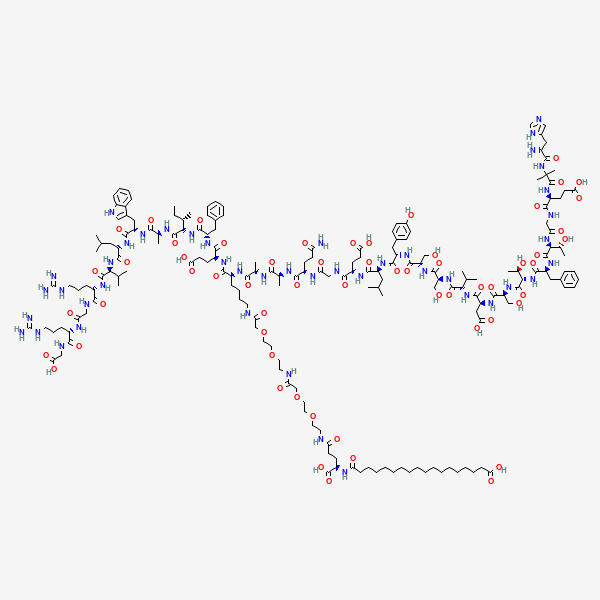
Semaglutide vs Tirzepatide: the two molecules
The 2D chemical structures, straight from PubChem — a quick way to see how similar (or not) the two actually are.
Which one fits which goal?
There's no universal winner here — the honest answer depends on what you're after. These picks are framed by goal, and each says why.
Largest average weight loss in trials
Leans toward Tirzepatide
Its dual-agonist trials reported larger mean reductions, and the head-to-head SURPASS-2 trial favored tirzepatide on weight and A1c.
Wanting a non-injection option
Leans toward Semaglutide
Semaglutide is the one with an oral daily tablet (Rybelsus) — tirzepatide is injectable only.
Longest real-world track record
Leans toward Semaglutide
Semaglutide was approved earlier and has a larger cumulative body of real-world use to draw on.