Also known as: LY3502970 · LY-3502970 · OWL833
Note: Orforglipron is not a peptide — it's covered here because people research it right alongside peptides.
Human RCTHelped
On this page
- What is orforglipron?
- How does orforglipron work?
- What does the research show?
- Is orforglipron safe? Side effects
- FDA & legal status (2026)
- How is orforglipron taken?
- Orforglipron vs semaglutide
- Frequently asked questions
- Who is orforglipron for — and who should be cautious?
- Evidence by outcome
- FDA & legal status
- Registered clinical trials
- Reported side effects
- Chemical identifiers
- References
- Related compounds
- More on Orforglipron
Orforglipron is a once-daily oral GLP-1 receptor agonist — a small-molecule pill, not a peptide — developed by Eli Lilly and sold as Foundayo. Unlike injectable GLP-1 drugs, you swallow it. Orforglipron is FDA-approved for chronic weight management and backed by a large human-trial program, with a completed Phase 3 type 2 diabetes program alongside it.
What is orforglipron?
Orforglipron is a non-peptide GLP-1 receptor agonist: a lab-made small molecule (chemical formula C48H48F2N10O5, molecular weight about 883 g/mol, CAS 2212020-52-3) that mimics the gut hormone GLP-1. That “non-peptide” part is the whole story. Semaglutide and tirzepatide are peptides — fragile protein-like chains that stomach enzymes would shred, which is why they’re injected. Orforglipron is built from ordinary drug chemistry, so it survives digestion and works as a plain daily tablet. It was developed by Eli Lilly (research code LY3502970) and is FDA-approved as a prescription medicine under the brand name Foundayo.
How does orforglipron work?
Orforglipron works by switching on the GLP-1 receptor, the same target the body uses when it releases the hormone GLP-1 after a meal. Think of the receptor as a light switch for “I’ve eaten”: flip it and the pancreas releases more insulin when blood sugar is high, the stomach empties more slowly, and the brain dials down hunger. Injectable GLP-1 drugs flip that switch with a peptide; orforglipron flips it with a small molecule that happens to fit the same slot. The practical payoff of the small-molecule design is that orforglipron doesn’t need a needle or refrigeration the way the peptide drugs do — it’s a pill you take once a day.
What does the research show?
Orforglipron has something almost nothing else on this site has: a deep bench of human evidence. A PubMed search returns roughly 113 records — about 62 tagged as human research and 14 tagged as randomized controlled trials — and ClinicalTrials.gov lists 48 registered studies, 25 of them Phase 3 and 31 already completed. The weight-management case is what the FDA approval rests on: the Phase 3 obesity program (the ATTAIN trials, e.g. NCT06584916) is largely complete, and as a GLP-1 receptor agonist orforglipron reduces appetite and body weight. Running alongside it is an equally deep type 2 diabetes program: completed Phase 3 randomized trials tested orforglipron in adults with type 2 diabetes, both on its own (NCT05971940) and head-to-head against semaglutide (NCT06045221), dapagliflozin (NCT06192108) and insulin glargine (NCT05803421) — strong human evidence for blood-sugar control, though that diabetes indication isn’t part of the current approval. A long-term cardiovascular-outcomes trial (ATTAIN-Outcomes, NCT07241390) is still recruiting, with results years out. Grade it honestly: Human RCT, with the actual effect sizes sitting in those registered records — see how we grade evidence.
Is orforglipron safe? Side effects
Orforglipron is one of the few compounds we cover that actually cleared FDA safety review, so it has a genuine human safety record rather than a shrug. Its side effects are the well-worn GLP-1 pattern, and they’re mostly in the gut: nausea, diarrhea, vomiting and constipation, plus the reduced appetite that’s partly the point. These effects are usually mild to moderate and tend to ease as the body adjusts, which is why this class is typically started low and stepped up slowly. “Approved” is not the same as “risk-free,” though — orforglipron is a young drug in a young class, so long-term, real-world safety data are still being gathered, and anyone considering it should have that conversation with a prescribing doctor rather than a message board.
FDA & legal status (2026)
Orforglipron is FDA-approved for chronic weight management. It is marketed as a prescription medicine under the brand name Foundayo (Eli Lilly, NDA 220934), which puts it in a completely different legal category from the research-chemical peptides elsewhere on this site — it’s a real, regulated drug you get from a pharmacy, not a “for research use only” vial. Per the FDA label, the approved use is to reduce excess body weight and keep it off in adults with obesity, or overweight plus at least one weight-related condition. A large Phase 3 type 2 diabetes program is also complete but is not part of the current approval, and cardiovascular/kidney, sleep-apnea and hypertension trials are still in progress. Regulatory status in the GLP-1 space moves quickly, so treat any indication claim as dated and check the current FDA label. The full dated breakdown is in the FDA & legal status block below.
How is orforglipron taken?
Orforglipron is taken as a once-daily oral tablet — no injection, no reconstitution, no bacteriostatic water, no insulin syringe. That alone sets it apart from every injectable GLP-1 drug and from the peptides we cover, which is also why our reconstitution calculator and mixing-compatibility reference simply don’t apply here: there’s nothing to mix. Like the rest of its class, orforglipron is generally started at a low dose and increased in steps to limit the gut side effects. We don’t publish a personalized titration schedule — the exact strengths and steps belong to the FDA-approved label and your prescriber, not a reference page.
Orforglipron vs semaglutide
Orforglipron and semaglutide both switch on the GLP-1 receptor, but they get there differently: semaglutide is an injectable (or specially formulated oral) peptide, while orforglipron is a small-molecule pill built to survive digestion on its own. The headline difference is convenience — a plain daily tablet versus a weekly injection or a peptide that needs careful oral formulation. Both are backed by human randomized trials for blood-sugar control, and orforglipron’s Phase 3 program tested it directly against semaglutide. For the full head-to-head — mechanism, evidence and trade-offs — see orforglipron vs semaglutide, and the broader GLP-1 category hub for how it sits next to semaglutide, tirzepatide and retatrutide.
Frequently asked questions
Is orforglipron proven to work in humans?
Yes. Orforglipron is FDA-approved for chronic weight management and has completed Phase 3 randomized controlled trials — in obesity, and in a separate type 2 diabetes program — that’s a far higher bar than the animal-only research peptides elsewhere on this site. We grade its human evidence Human RCT; the exact numbers are in the registered trial records.
Is orforglipron a peptide?
No. Orforglipron is a non-peptide small molecule that happens to hit the same GLP-1 receptor as peptide drugs like semaglutide. That chemistry is exactly what lets it work as a swallowable once-daily pill instead of an injection.
Is orforglipron legal?
Yes. Orforglipron is an FDA-approved prescription medicine sold as Foundayo, so it’s obtained through a pharmacy with a prescription — not a “research use only” research chemical.
How is orforglipron taken?
Orforglipron is a once-daily oral tablet. There’s no injecting, mixing or reconstituting. As with other GLP-1 drugs, the dose is usually started low and increased gradually to reduce nausea and other gut effects.
Is orforglipron banned in sport?
GLP-1 receptor agonists as a class are not on the WADA Prohibited List as of 2026, so orforglipron is not currently banned in sport. The list is updated every year, so athletes should re-check the current version.
Who is orforglipron for — and who should be cautious?
Orforglipron is approved for adults with obesity, or overweight plus a weight-related condition, who want the appetite and weight effects of a GLP-1 drug without a weekly injection — a real draw for anyone who dreads needles, and one backed by randomized trials rather than hope. The honest framing: this is the rare compound on this site whose human evidence is strong and whose legal status is settled. But it’s still a prescription drug with real gut side effects, it’s young enough that long-term data are thin, and its approved use today is weight management — the blood-sugar, heart and kidney questions have a completed or running trial program but aren’t part of the current label. Anyone pregnant, managing other GI or pancreatic conditions, or hoping to use it off-label should work through it with a doctor, not around one.
Evidence by outcome
Each outcome Orforglipron has been studied for, with the honest evidence grade and what the studies actually found. A tier never stands alone — the verdict rides with it.
| Outcome | Evidence | What was found |
|---|---|---|
| Weight loss / obesity (chronic weight management) | Human RCTHelped | Chronic weight management is orforglipron's FDA-approved use. It was tested for obesity in a Phase 3 program (the ATTAIN trials), several of which are complete, and as a GLP-1 receptor agonist it reduces appetite and body weight. Those obesity readouts are what the Foundayo approval rests on; the specific effect sizes live in the registered trial records linked below. |
| Type 2 diabetes (blood-sugar control) | Human RCTHelped | Orforglipron also has a large, completed Phase 3 randomized program in adults with type 2 diabetes — including monotherapy trials and head-to-head comparisons against semaglutide, dapagliflozin and insulin glargine. That's a deep bench of human evidence for blood-sugar control, though this diabetes indication isn't part of the current FDA approval. The specific effect sizes live in the registered trial records linked below. |
FDA & legal status
- United States: fda approved (as of Jul 2026) — approved for Chronic weight management
FDA-approved and marketed as a prescription medicine under the brand name Foundayo (Eli Lilly, NDA 220934). Its approved indication is chronic weight management — reducing excess body weight and keeping it off in adults with obesity, or overweight plus at least one weight-related condition. A large Phase 3 type 2 diabetes program is also complete but is not part of the current approval; cardiovascular/kidney and other trials are still running. Approvals move fast in this class, so re-verify the current FDA label for the exact approved indications.
openFDA Drugs@FDA lists 1 approved product as of 2026-07-15.
Registered clinical trials
53 registered studies mention Orforglipron on ClinicalTrials.gov (latest update 2026-10-21). A registered trial means a study is planned or underway — not that Orforglipron is approved or proven.
Reported side effects
| Effect | Frequency | Severity |
|---|---|---|
| Nausea | — | Usually mild to moderate; often eases over the first weeks |
| Diarrhea | — | — |
| Vomiting | — | — |
| Constipation | — | — |
| Decreased appetite | — | — |
Chemical identifiers
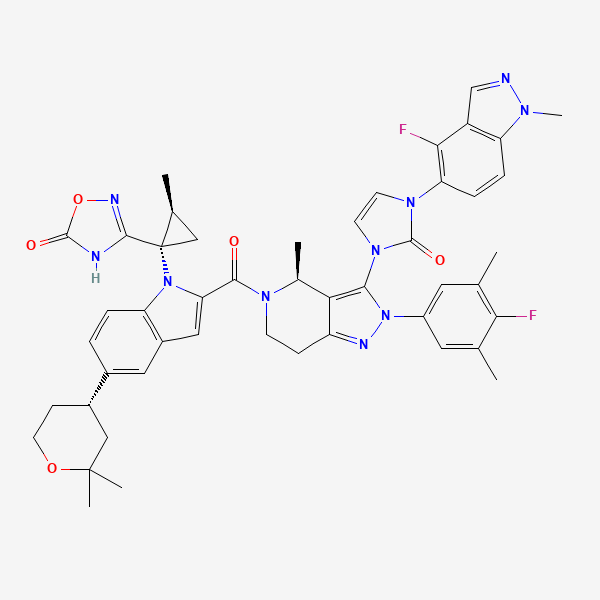
- Molecular formula
- C48H48F2N10O5
- Molecular weight
- 883 g/mol
- IUPAC name
- 3-[(1S,2S)-1-[5-[(4S)-2,2-dimethyloxan-4-yl]-2-[(4S)-2-(4-fluoro-3,5-dimethylphenyl)-3-[3-(4-fluoro-1-methylindazol-5-yl)-2-oxoimidazol-1-yl]-4-methyl-6,7-dihydro-4H-pyrazolo[4,3-c]pyridine-5-carbonyl]indol-1-yl]-2-methylcyclopropyl]-4H-1,2,4-oxadiazol-5-one
Verified external records:
References
More on Orforglipron
Everything else we've written about Orforglipron — what the community reports, the explainers that cover it, and the terms it keeps running into.