Also known as: AEDP · Ala-Glu-Asp-Pro · H-Ala-Glu-Asp-Pro-OH
Animal-onlyUnclear⚠ none in humans
On this page
- What is Cortagen?
- How might the AEDP peptide work?
- What does the Cortagen evidence actually show?
- Is Cortagen safe? What are the risks?
- What Cortagen dosage has research used?
- Cortagen vs Cortexin: are they the same?
- Is Cortagen FDA-approved or banned in sport?
- Where does Cortagen fit among longevity peptides?
- Evidence by outcome
- FDA & legal status
- Chemical identifiers
- References
- Related compounds
Cortagen is a synthetic four-amino-acid peptide studied for nerve repair and cellular regulation. A rat experiment found faster sciatic-nerve regeneration, but no controlled trial has shown a benefit in people. Cortagen is not FDA-approved, and its human dosing, side effects, and long-term risks remain undefined.
Key facts
- What it is: Ala-Glu-Asp-Pro, also called the AEDP peptide
- Evidence tier: Animal-only for nerve regeneration; no administered human trial found
- U.S. status (July 2026): Unapproved; sold as research-use-only material
- Research dose: 10 micrograms/kg intramuscularly for 10 days in rats, not a human protocol
- Main risk: Human safety and product quality are both uncharacterized
- Sport: Not named on WADA’s 2026 list; its S0 catch-all may cover unapproved pharmacological substances
What is Cortagen?
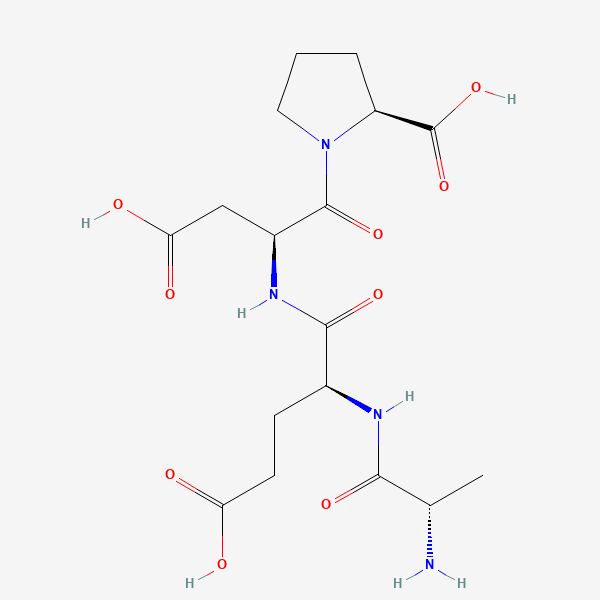
Cortagen is the synthetic tetrapeptide Ala-Glu-Asp-Pro: four amino acids, abbreviated AEDP. PubChem identifies the exact molecule as CID 18439621, with formula C17H26N4O9 and molecular weight 430.4 g/mol. That verified record does not list a CAS number. Online catalogs give conflicting CAS values, so attaching one would create false precision.
Cortagen belongs to the Khavinson short-peptide research program and is often called a brain bioregulator peptide. The 2004 mouse-heart paper says AEDP was designed from amino-acid analysis of Cortexin, a natural peptide mixture from brain cortex. That origin story does not prove Cortagen selectively reaches or repairs the human cerebral cortex.
How might the AEDP peptide work?
The AEDP peptide has changed nerve growth, gene expression, and chromatin packing in preclinical experiments, but no validated receptor or complete mechanism explains those findings. Think of gene-expression results as seeing several switches move inside a laboratory model: the switches moved, but the experiment did not show that memory, recovery, or lifespan improved.
In one study, researchers gave Cortagen to mice for five days and then examined 15,247 transcripts in pooled heart samples. They reported altered expression in 234 clones matching 110 known genes (Anisimov et al., 2004). That was a mouse-heart experiment, not evidence that Cortagen rejuvenates a human brain.
What does the Cortagen evidence actually show?
Cortagen has one clear whole-animal signal: faster early regeneration after a
rat sciatic nerve was cut and surgically repaired. Rats received 10 micrograms
per kilogram by intramuscular injection daily for ten days. Fiber growth rate
rose 27%, and conduction velocity rose 40%
(Turchaninova et al., 2000, PMID 11276314).
The DOI is 10.1023/A:1017532001908.
Those numbers describe rats after a controlled nerve injury. They do not show better memory, stroke recovery, neuropathy relief, or anti-aging effects in people. The literature also includes cultured lymphocytes taken from adults aged 75–88; several short peptides, including Cortagen, changed measures of chromatin packing (Khavinson et al., 2004). Human cells in a dish are not a human treatment trial. A targeted ClinicalTrials.gov search returns no registered Cortagen intervention study.
That distinction is the page’s bottom line: Cortagen is not evidence-free, but its evidence has not crossed from animal and cell biology into clinical proof. The evidence-grading guide explains why the headline tier stays animal-only.
Is Cortagen safe? What are the risks?
Cortagen does not have a usable human safety profile. No controlled administered human trial establishes common side effects, serious adverse events, drug interactions, contraindications, or long-term risk. A short sequence made from familiar amino acids is not automatically harmless; dose, formulation, contaminants, and immune reactions still matter.
Research-market vials add a second problem: the label cannot establish that the powder contains the right sequence at the stated amount or that an injectable product is sterile. Cortagen’s absence from human trials also means claims such as “well tolerated” cannot be given a meaningful frequency. The honest adverse- event list is empty because nobody has measured it properly, not because adverse events have been ruled out.
What Cortagen dosage has research used?
The only Cortagen dosage that can be tied cleanly to the headline result is the rat regimen: 10 micrograms/kg intramuscularly once daily for ten days after sciatic-nerve transection and repair. That is study context, not a conversion table for people. Scaling it by body weight would manufacture a human protocol that the paper never tested.
Online schedules commonly skip the awkward facts: no established human dose, no pharmacokinetic study showing how long intact AEDP remains in human blood, and no trial-defined treatment window. “Research use only” is a regulatory and quality boundary, not dosing guidance; the plain-English distinction is covered in what research use only means.
Cortagen vs Cortexin: are they the same?
Cortagen vs Cortexin is a molecule-versus-mixture comparison, not two names for the same drug. Cortagen is the defined synthetic AEDP tetrapeptide. Cortexin is a tissue-derived mixture of peptides. The Cortagen paper describes directed synthesis based on Cortexin’s amino-acid analysis; it does not establish that every Cortexin result belongs to AEDP alone.
This matters because human Cortexin studies cannot be quietly relabeled as human Cortagen studies. Mixtures may contain many active components, and their doses, manufacturing, and biological effects are not interchangeable. There is no local Cortexin profile to link yet, so the safer next stop is the broader longevity-peptide hub.
Is Cortagen FDA-approved or banned in sport?
Cortagen is not FDA-approved in the United States as of July 16, 2026. Searches of Drugs@FDA and DailyMed found no Cortagen product or label. U.S. listings that say “research use only” are not approved medicines and cannot borrow approval from Cortexin or any other peptide preparation. See the site’s dated regulatory status reference for the wider framework.
Cortagen is not named individually on the 2026 WADA Prohibited List. WADA’s S0 category can still prohibit pharmacological substances that lack current approval for human therapeutic use. Because WADA does not publish a Cortagen-specific ruling, athletes should not read “not named” as “cleared.”
Where does Cortagen fit among longevity peptides?
Cortagen fits the experimental edge of the longevity category: a compact, chemically defined peptide with measurable laboratory effects and no clinical outcome trial. The interesting next step is straightforward—administered human research that measures exposure, safety, and a patient-centered endpoint rather than another gene-expression snapshot.
For context, Epitalon is another Khavinson-associated short peptide, but its sequence and evidence record are separate. The longevity-peptide reference keeps those compounds together without pretending that evidence for one transfers to another.
Evidence by outcome
Each outcome Cortagen has been studied for, with the honest evidence grade and what the studies actually found. A tier never stands alone — the verdict rides with it.
| Outcome | Evidence | What was found |
|---|---|---|
| Peripheral nerve regeneration | Animal-onlyHelped⚠ none in humans | One rat sciatic-nerve transection study reported faster fiber growth and conduction after Cortagen. No controlled human trial has tested whether that result translates to nerve healing in people. |
| Gene-expression and chromatin effects | In-vitroUnclear⚠ none in humans | Mouse-heart and cultured human-lymphocyte experiments found changes in gene expression or chromatin structure. Those are laboratory biomarkers, not evidence of better cognition, slower aging, or clinical recovery. |
| Cognitive or anti-aging benefits | MechanisticUnclear⚠ none in humans | No controlled human trial was located for cognition, dementia, healthy aging, or any other patient-centered outcome from Cortagen itself. |
FDA & legal status
- United States: research use only (as of Jul 2026)
No Cortagen product appears in Drugs@FDA or DailyMed, and it has no FDA-approved indication. Research-use-only labeling does not authorize sale or use as a human drug.
Chemical identifiers
References
- 1.PubChem — H-Ala-Glu-Asp-Pro-OH, CID 18439621
- 2.Turchaninova et al., 2000 — Cortagen and rat sciatic-nerve regeneration (PMID 11276314)
- 3.Anisimov et al., 2004 — Cortagen and gene expression in mouse heart (PMID 15159690)
- 4.Khavinson et al., 2004 — Short peptides and cultured human lymphocyte chromatin (PMID 15085253)
- 5.ClinicalTrials.gov — Cortagen intervention search
- 6.Drugs@FDA — FDA-approved drug database
- 7.WADA — 2026 Prohibited List