Also known as: Epithalon · Epithalone · AEDG peptide · Ala-Glu-Asp-Gly · AE-0 peptide
Animal-onlyUnclear⚠ none in humans
On this page
- What is Epitalon?
- How does Epitalon work?
- What does the research show?
- What the community reports
- Is Epitalon safe? Side effects
- FDA & legal status (2026)
- How is Epitalon used, and can it be mixed?
- Epitalon and the other longevity peptides
- Frequently asked questions
- Who is Epitalon for — and who should be cautious?
- Evidence by outcome
- FDA & legal status
- Registered clinical trials
- Chemical identifiers
- References
- Related compounds
- More on Epitalon
Epitalon is a synthetic four-amino-acid peptide (Ala-Glu-Asp-Gly) modeled on a pineal-gland extract, studied for telomere maintenance and longevity. Epitalon switched on telomerase in human cells and extended lifespan in mice — but no human trial has ever tested the synthetic peptide itself. It is not FDA-approved and is sold only as a research chemical.
If you went down the longevity rabbit hole and came out holding a vial of epitalon, you probably want the same three things: what it actually is, whether the telomere talk holds up, and what you’re risking. Here’s the honest version — the mechanism is real, and the part everyone skips is that the strongest human claims lean on a different preparation than the peptide you’d actually buy.
What is Epitalon?
Epitalon is a lab-made peptide — a short chain of just four amino acids (Ala-Glu-Asp-Gly, molecular formula C14H22N4O9, about 390 daltons). It was designed by Vladimir Khavinson’s group in St. Petersburg as a simplified synthetic copy of epithalamin, a peptide extract from the pineal gland (the tiny brain structure that makes melatonin). The distinction matters more than it sounds: a lot of the most dramatic longevity claims come from studies on the extract, epithalamin, while epitalon is the four-amino-acid stand-in. Epitalon is not a medicine you can be prescribed and not a legal supplement — in the United States it exists only as a research chemical.
How does Epitalon work?
Epitalon’s proposed mechanism centers on telomeres — the protective caps on the ends of your chromosomes that shorten every time a cell divides, a bit like the plastic tips fraying off a shoelace. In cultured human cells, epitalon switches the telomerase gene (hTERT) back on; telomerase is the enzyme that rebuilds those caps, and most adult cells keep it switched off (Khavinson et al., 2003). A separate line of animal work suggests epitalon also nudges the pineal gland’s melatonin output and circadian timing, which is where the “reset your body clock” framing comes from. The honest caveat: switching an enzyme back on in a dish, or shifting melatonin in a rodent, is a long way from proof that any of it reshapes aging in a living human.
What does the research show?
The epitalon evidence sits firmly in the lab, and it’s split across two settings. In cultured human cells, epitalon reactivated telomerase and lengthened telomeres — first shown in 2003 and then independently reproduced in a 2025 study, which found the effect ran through telomerase in normal cells and a backup pathway (ALT) in cancer cells (Al-dulaimi et al., 2025). In mice, epitalon given from mid-life slowed several aging markers, cut spontaneous tumor rates and modestly extended lifespan (Anisimov et al., 2003). Now the part the supplement pages gloss over: the famous human “1.6-to-2-fold lower mortality” numbers come from a six-to-eight-year cohort of elderly patients given epithalamin, the pineal extract — not the synthetic epitalon peptide (Khavinson & Morozov, 2003). Almost all of this work traces back to a single research group, which is a real replication caveat, and a recent independent review frames epitalon as promising but still short on human data (Araj et al., 2025). So the forward-looking read is fair: the mechanism keeps holding up in fresh hands — the human testing of the peptide itself is what hasn’t happened yet.
What the community reports
Outside the lab, epitalon has a devoted following in longevity and biohacking circles, usually run as short “courses” rather than daily forever. The commonly reported pattern is a subcutaneous injection of roughly 5–10 mg per day for a 10-to-20-day stretch, done once or twice a year, aimed at sleep quality, a general “reset,” and the hope of slower aging. These accounts are anecdotal — they are not controlled data, they carry heavy survivorship bias (people chasing an anti-aging effect are primed to notice one), and no posted log can tell you what epitalon does to a biological outcome you can’t feel, like a telomere. They explain why people are interested; they don’t show that it works.
Is Epitalon safe? Side effects
Epitalon’s honest safety answer is “we don’t really know in humans.” There is no published human safety trial of the synthetic peptide and no long-term human data at all. Animal studies reported few obvious toxic effects at the small doses used, and epitalon’s short amino-acid chain is chemically unremarkable — both reassuring, neither a guarantee. The most-discussed theoretical concern follows straight from the mechanism: a compound that can switch telomerase back on raises the fair question of whether it could also help a cell you wouldn’t want to keep dividing. That concern is unproven in either direction. As with every research peptide, the nearest real-world risk is the source rather than the molecule — unregulated vials vary in purity, dose accuracy and sterility from vendor to vendor.
FDA & legal status (2026)
Epitalon is not FDA-approved, and it is not a legal dietary supplement either. In the United States it is sold strictly as a research chemical, labeled “for research use only,” and no epitalon product has cleared FDA review for any use. Because it has no approval for human use, epitalon also falls under WADA’s S0 “non-approved substances” category, which means it is banned at all times for athletes under anti-doping rules. Regulatory attention on research peptides is active right now, so treat any status claim as dated — the full dated breakdown is in the FDA & legal status block above.
How is Epitalon used, and can it be mixed?
Epitalon comes as a lyophilized (freeze-dried) powder that has to be reconstituted with bacteriostatic water before use — our reconstitution & dosing calculator turns “10 mg vial, 2 mL water, 5 mg target” into the exact number of insulin-syringe units to draw. Reported community use skews toward short cycles (a couple of weeks, once or twice a year) rather than continuous dosing, which fits the idea that its proposed effects play out slowly. People also ask whether epitalon can share a syringe with other peptides; our mixing compatibility reference covers what is commonly combined and where the honest answer is “not enough data.” Whatever the doses floating around forums, remember they are community-reported, not validated in a human study.
Epitalon and the other longevity peptides
Epitalon is the most-searched name in a small, speculative cluster of “longevity peptides,” and it helps to see where it sits. Epitalon works on telomere and circadian biology, while its neighbors target different aging machinery — mitochondrial peptides like MOTS-c and SS-31 aim at cellular energy, and copper peptides like GHK-Cu are studied for skin and tissue repair. The thymus-peptide side of Khavinson’s own work links it loosely to thymosin beta-4, and growth-hormone secretagogues such as ipamorelin get pulled into the same anti-aging conversation. None of these has human RCT proof for slowing aging — epitalon included. You can see the whole set on the longevity peptides hub.
Frequently asked questions
Does epitalon actually work?
For slowing aging in a human: unproven. Epitalon has real in-cell evidence for switching on telomerase and real mouse evidence for a longer lifespan, but no human trial of the synthetic peptide has ever been run. It’s a compound with a promising mechanism whose human testing hasn’t happened yet — we grade its longevity claim animal-only, with no human study data.
Does epitalon really lengthen telomeres?
In cultured human cells, yes — epitalon reactivated telomerase and lengthened telomeres, and that was reproduced independently in 2025. But a cell in a dish is not a person. No study has shown epitalon measurably lengthens telomeres in a living human, so treat “it lengthens your telomeres” as a mechanism, not a demonstrated result.
Is epitalon legal?
Epitalon is legal to possess and sell as a research chemical in the United States, but it is not an approved drug or a legal dietary supplement, and it cannot be sold for human consumption. That’s why every vendor lists it “for research use only.”
Is epitalon banned in sport?
Yes. Because epitalon has no current regulatory approval for human use, it falls under WADA’s S0 “non-approved substances” category and is prohibited at all times for athletes subject to anti-doping rules.
How do people take epitalon?
In the research and community literature epitalon is almost always injected subcutaneously after being reconstituted with bacteriostatic water, run as a short course (commonly around 5–10 mg a day for 10–20 days) rather than daily indefinitely. Oral and nasal forms are marketed too, but injection is the route the anecdotes mostly describe.
Who is Epitalon for — and who should be cautious?
Epitalon draws in the longevity-curious — people who’ve read about telomeres and want to understand epitalon before deciding, not chase a fountain of youth. The honest framing: the mechanism — switching a silenced enzyme back on to rebuild telomeres — keeps holding up in fresh lab hands, including a 2025 replication. But the human efficacy proof isn’t in, the long-term safety data doesn’t exist, the strongest human numbers you’ll see online are really about a different preparation (epithalamin), and the product you’d actually buy is unregulated. Anyone pregnant, managing a cancer history, or unwilling to sit with genuine unknowns has every reason to wait for real human data before putting a telomerase switch in their body.
Evidence by outcome
Each outcome Epitalon has been studied for, with the honest evidence grade and what the studies actually found. A tier never stands alone — the verdict rides with it.
| Outcome | Evidence | What was found |
|---|---|---|
| Anti-aging & lifespan extension | Animal-onlyHelped⚠ none in humans | In mice, epitalon given from mid-life slowed several aging markers, lowered spontaneous tumor rates and modestly extended lifespan. No human trial has ever tested the synthetic peptide for lifespan or aging — the widely-cited human "mortality" data used epithalamin, the pineal extract, not epitalon itself. |
| Telomerase activation & telomere length | In-vitroHelped⚠ none in humans | In cultured human cells, epitalon switched on telomerase and lengthened telomeres — first reported in 2003 and reproduced in an independent 2025 study. This is a dish, not a person: it shows a plausible mechanism, not that epitalon lengthens telomeres in a living human body. |
| Sleep & circadian / melatonin regulation | Animal-onlyUnclear⚠ none in humans | Animal work suggests epitalon nudges melatonin output and circadian rhythm, which is the mechanistic basis for the sleep claims. There is no controlled human study of epitalon for sleep — the human reports are anecdotal. |
FDA & legal status
- United States: research use only (as of Jul 2026)
Not an FDA-approved drug and not a dietary supplement — epitalon is sold only as a research chemical labeled "for research use only." No epitalon product has cleared FDA review for any use. The research-peptide category is under active regulatory attention, so treat this status as dated and re-verify it.
openFDA Drugs@FDA lists no approved product for Epitalon as of 2026-07-15.
Registered clinical trials
One registered study mention Epitalon on ClinicalTrials.gov (latest update 2026-10-22). A registered trial means a study is planned or underway — not that Epitalon is approved or proven.
| Study | Status | Phase | Sponsor |
|---|---|---|---|
| Systemic and Topical Geroprotective Rejuvenation Assessed by START/REST Aging ClocksNCT07888595 | enrolling by invitation | EARLY_Phase 1 | Frontiers in Bioscience Research Institute and Aging |
Chemical identifiers
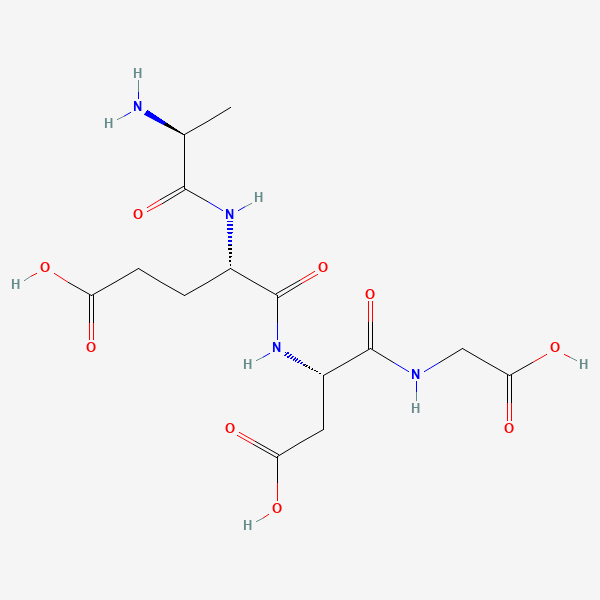
- Molecular formula
- C14H22N4O9
- Molecular weight
- 390.35 g/mol
- IUPAC name
- (4S)-4-[[(2S)-2-aminopropanoyl]amino]-5-[[(2S)-3-carboxy-1-(carboxymethylamino)-1-oxopropan-2-yl]amino]-5-oxopentanoic acid
Verified external records:
References
- 1.Khavinson et al. 2003 — epitalon induces telomerase & telomere elongation in human cells (PubMed)
- 2.Al-dulaimi et al. 2025 — epitalon increases telomere length in human cell lines (PubMed)
- 3.Anisimov et al. 2003 — epitalon, lifespan & tumor incidence in SHR mice (PubMed)
- 4.Khavinson & Morozov 2003 — pineal & thymus peptides (epithalamin) and human life (PubMed)
- 5.Araj et al. 2025 — overview review of epitalon (PubMed)
- 6.Epitalon — registered clinical studies (ClinicalTrials.gov)
- 7.FDA — approved drug products database (Drugs@FDA)
More on Epitalon
Everything else we've written about Epitalon — what the community reports, the explainers that cover it, and the terms it keeps running into.