Also known as: XW003 · XW-003
Human RCTHelped
On this page
- What is ecnoglutide (XW003)?
- How does cAMP-biased GLP-1 signaling work?
- What did the SLIMMER trial find for weight loss?
- What ecnoglutide dosage was studied?
- Is ecnoglutide safer or better tolerated than semaglutide?
- What are the risks and side effects?
- Is ecnoglutide FDA-approved or legal in 2026?
- Evidence by outcome
- FDA & legal status
- Reported side effects
- Chemical identifiers
- References
- Related compounds
Ecnoglutide is a once-weekly, cAMP-biased GLP-1 receptor agonist with human randomized-trial evidence for weight loss and blood-sugar control. The highest dose in SLIMMER produced 15.4% mean weight loss at 48 weeks. China approved it in 2026; the United States has not, and online research vials are not approved medicines.
Key facts: Human RCT evidence · FDA status: unapproved as of July 16, 2026 · studied as a weekly injection · common risks: nausea, diarrhea, decreased appetite · currently permitted in sport, with WADA monitoring GLP-1 drugs.
What is ecnoglutide (XW003)?
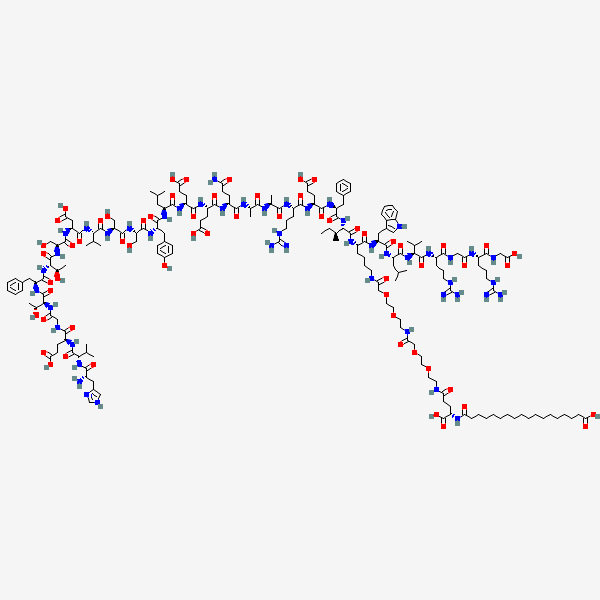
Ecnoglutide is Sciwind Biosciences’ long-acting synthetic analog of GLP-1, the gut hormone that helps control appetite and blood sugar after a meal. XW003 is the development code for the injectable form. PubChem records the formula as C194H304N48O61, molecular weight about 4,285 g/mol, and CAS 2459531-73-6 (PubChem CID 162625103).
The molecule carries a C18 fatty-acid attachment that slows clearance. A Phase 1 study measured a steady-state half-life of 124–138 hours, long enough for weekly dosing (Guo et al., 2023). That is a human pharmacokinetic result, not a guess borrowed from rodents.
How does cAMP-biased GLP-1 signaling work?
Ecnoglutide favors one message from the GLP-1 receptor: the cAMP pathway that helps drive insulin release and appetite effects. Many receptor agonists also recruit beta-arrestin, which helps pull activated receptors inside the cell. Picture a doorbell that keeps working instead of being taken off the wall after repeated rings; cAMP bias is meant to preserve more signaling at the surface.
The important distinction is between what is measured and what is marketed. Laboratory assays found strong cAMP activity with little receptor internalization, but the claim that this design causes less nausea remains a hypothesis. Nausea still appeared in Phase 1, and later trials described nausea and diarrhea among the most common gastrointestinal events. Biased signaling may improve the balance between effect and tolerability; the existing human data do not isolate the bias and prove that it does.
What did the SLIMMER trial find for weight loss?
The SLIMMER trial found clear, dose-dependent ecnoglutide weight loss in 664 Chinese adults with overweight or obesity and without diabetes. Participants received weekly subcutaneous doses of 1.2, 1.8, or 2.4 mg, or placebo, for 48 weeks after dose escalation (NCT05813795).
At week 48, mean weight loss ranged from 9.9% to 15.4% across ecnoglutide doses. In the 2.4 mg group, 155 of 167 participants—92.8%—lost at least 5% of baseline weight; the placebo-adjusted mean difference was 15.1 percentage points. The peer-reviewed SLIMMER paper supports a human-RCT “helped” verdict. Limits still matter: the study ran only in China, lasted under a year, and was funded by Sciwind.
What ecnoglutide dosage was studied?
Ecnoglutide dosage in SLIMMER was 1.2, 1.8, or 2.4 mg once weekly by subcutaneous injection, with an escalation period. Diabetes trials studied lower weekly maintenance doses, including 0.6 and 1.2 mg. These are research and China-label contexts, not a U.S. dosing recommendation.
An online vial changes the problem entirely. A milligram claim on a research-product label does not establish identity, concentration, sterility, or a safe titration schedule. The trial used manufactured injector pens and clinical monitoring, not a loose powder sold with a wink and a “not for human use” footer.
Is ecnoglutide safer or better tolerated than semaglutide?
Ecnoglutide has not yet proved a nausea advantage over semaglutide in a full, peer-reviewed head-to-head paper. A registered Phase 2 study, SLIMMER-UP-SWITCH, directly compares the two in Chinese adults with obesity (NCT07073417). Until complete results and detailed adverse-event tables are published, ecnoglutide vs semaglutide is an open comparison rather than a settled win.
Semaglutide also has a much larger evidence base, including cardiovascular-outcome data and years of regulated use. Ecnoglutide has strong weight-loss and glucose signals, but less exposure time and fewer populations studied. See the semaglutide profile and the wider GLP-1 peptide hub for that evidence gap in context.
What are the risks and side effects?
Ecnoglutide most often causes the familiar GLP-1 gut effects: nausea, diarrhea, decreased appetite, and related gastrointestinal complaints. In SLIMMER, 93% of participants in each ecnoglutide group reported a treatment-emergent adverse event, versus 84% on placebo; most common events were mild or moderate gastrointestinal problems, and ten ecnoglutide participants stopped because of adverse events.
The unknowns are rarer harms and long-term outcomes. Ecnoglutide does not yet have semaglutide-scale evidence for heart attacks, strokes, kidney outcomes, pregnancy, or years of routine use. Gray-market supply adds risks the trials cannot answer: the vial may not contain the stated molecule or dose, and contamination or poor sterility can injure someone even if the active drug works exactly as advertised.
Is ecnoglutide FDA-approved or legal in 2026?
Ecnoglutide is not FDA-approved and has no U.S. prescribing label as of July 16, 2026. FDA’s substance database assigns it UNII KM6YM7L8LH, but the agency explicitly notes that a UNII record does not imply regulatory review or approval (FDA GSRS). A listing on a U.S. research-chemical menu is therefore not a pharmacy approval in disguise.
China’s status moved quickly: ecnoglutide was approved for adult type 2 diabetes in January 2026 and for chronic weight management in March 2026, according to Sciwind’s NMPA approval announcement. For sport, USADA says GLP-1 agonists are currently permitted while WADA monitors the class. Approval, evidence, and online availability are three different things; ecnoglutide happens to make that distinction unusually visible.
Evidence by outcome
Each outcome Ecnoglutide has been studied for, with the honest evidence grade and what the studies actually found. A tier never stands alone — the verdict rides with it.
| Outcome | Evidence | What was found |
|---|---|---|
| Chronic weight management | Human RCTHelped | In the 664-participant randomized Phase 3 SLIMMER trial, once-weekly ecnoglutide produced dose-dependent weight loss versus placebo over 48 weeks. The highest-dose group lost a mean 15.4% from baseline, and 92.8% lost at least 5%; the trial was conducted only in Chinese adults without diabetes. |
| Type 2 diabetes | Human RCTHelped | Randomized Phase 2 and Phase 3 trials in Chinese adults found that ecnoglutide lowered HbA1c and body weight versus placebo. China approved the injection for adult type 2 diabetes in January 2026, but it is not FDA-approved in the United States. |
FDA & legal status
- United States: investigational (as of Jul 2026)
Ecnoglutide is not FDA-approved and has no U.S. prescribing label. China approved the injection for adult type 2 diabetes in January 2026 and chronic weight management in March 2026; those approvals do not authorize U.S. sales for human use.
Reported side effects
| Effect | Frequency | Severity |
|---|---|---|
| Nausea and diarrhea | Among the most commonly reported gastrointestinal events | Usually mild to moderate in trials |
| Decreased appetite | — | Usually mild to moderate in trials |
Chemical identifiers
References
- 1.Ji et al., 2025 — Phase 3 SLIMMER trial (PMID 40555243)
- 2.SLIMMER Phase 3 registration — NCT05813795
- 3.Guo et al., 2023 — discovery and Phase 1 study (PMID 37364710)
- 4.Zhu et al., 2026 — Phase 3 EECOH-1 trial
- 5.Ecnoglutide — PubChem CID 162625103
- 6.FDA GSRS — ecnoglutide UNII KM6YM7L8LH
- 7.Sciwind — China approval for chronic weight management
- 8.USADA — weight-loss drugs and GLP-1 agonists in sport