Also known as: AOD9604 · AOD 9604 · Tyr-hGH fragment 177-191 · AOD9604 acetate
Human (controlled)Mixed
On this page
- What is AOD-9604?
- How does AOD-9604 work?
- What does the research show?
- What the community reports
- Is AOD-9604 safe? Side effects
- FDA & legal status (2026)
- How is AOD-9604 used, and can it be mixed?
- AOD-9604 vs Fragment 176-191
- Frequently asked questions
- Who is AOD-9604 for — and who should be cautious?
- Evidence by outcome
- FDA & legal status
- Chemical identifiers
- References
- Related compounds
- More on AOD-9604
AOD-9604 is a synthetic fragment of human growth hormone, built to switch on fat-burning without raising blood sugar or IGF-1. Unlike most research peptides, AOD-9604 was actually tested in human weight-loss trials — where it was well tolerated but did not produce the fat loss its early data hinted at. It is not FDA-approved.
What is AOD-9604?
AOD-9604 is a lab-made peptide — a 16-amino-acid piece copied from the tail end of human growth hormone (roughly amino acids 176–191), with a tyrosine added to help it hold together. Chemically it is a mid-sized peptide: formula C78H123N23O23S2, molecular weight about 1,815 daltons, CAS number 221231-10-3 (PubChem CID 71300630). The name is short for “anti-obesity drug 9604,” which tells you exactly what it was designed to be. AOD-9604 is not a medicine you can be prescribed and not a legal supplement — in the United States it exists only as a research chemical.
How does AOD-9604 work?
AOD-9604 works by copying only the fat-burning part of growth hormone and leaving the rest behind. Whole growth hormone does several jobs at once — it drives tissue growth, raises IGF-1, and can push blood sugar up — but its ability to break down fat lives mostly in that C-terminal tail. AOD-9604 is essentially that tail, snipped off and stabilized: keep the key that opens the fat-burning lock, throw away the parts that raise blood sugar and drive growth. In lab and animal studies AOD-9604 stimulates lipolysis (the breakdown of stored fat) and dampens lipogenesis (the making of new fat), reportedly acting through beta-3 adrenergic signaling in fat cells. The honest caveat: exactly how AOD-9604 behaves in a living human body has not been pinned down.
What does the research show?
AOD-9604’s evidence is unusual, and worth reading carefully. Most research peptides have only rat data; AOD-9604 was actually taken into human clinical trials by its developer as an oral anti-obesity drug. In those placebo-controlled trials AOD-9604 was safe and, importantly, did not disturb blood sugar or IGF-1 — but the larger study did not show meaningful weight loss over placebo, obesity development was discontinued, and it was never approved. A search of PubMed returns 16 records, 13 tagged human and 6 of them reviews, with none flagged as a randomized controlled trial — and ClinicalTrials.gov shows no active registered study. The animal side is more encouraging: in obese rodents AOD-9604 reduced body fat and increased fat breakdown. Here’s the read: the mechanism is clean and the human safety data held up — no jump in blood sugar or IGF-1 across the trials — but the weight-loss result people are hoping for is the one part the human trials didn’t deliver, and the injectable form sold now was never the version tested.
What the community reports
Outside the clinic, AOD-9604 has a steady following among lifters and dieters chasing that last bit of stubborn fat, usually late in a cut. The commonly reported pattern is a subcutaneous injection of roughly 250–300 micrograms a day, often fasted before cardio, run for several weeks. These accounts are anecdotal — they are not controlled data, they lean heavily on people who were already dieting hard, and they suffer from survivorship bias, since the folks who saw nothing tend to stop posting. AOD-9604’s community reports are useful for understanding why people try it, not for proving it burns fat.
Is AOD-9604 safe? Side effects
AOD-9604’s safety story is its strongest suit. In human obesity trials AOD-9604 was well tolerated and, unlike whole growth hormone, did not meaningfully raise blood sugar or IGF-1 — the two effects that make GH itself risky for casual use. That is a real point in its favor and part of why it drew interest as a “gentler” fat-loss tool. The honest limits: long-term human safety data are thin, and the biggest real-world risk isn’t the molecule but the source — AOD-9604 sold as a research chemical answers to no regulator, so how pure it is, how much is actually in the vial, and whether it’s sterile all ride on whoever filled it. Anyone injecting it is also taking on the ordinary risks of any self-injection (irritation, bruising, infection if technique or sterility slips).
FDA & legal status (2026)
AOD-9604 is not FDA-approved, and it is not a legal dietary supplement either. In the United States AOD-9604 is sold strictly as a research chemical. It was developed as an anti-obesity drug and carried through human trials, but it never reached approval, and there is no marketed AOD-9604 medicine (FDA). Treat any legal-status claim as dated: enforcement around research peptides is an active area, so re-check before relying on it. The full dated breakdown is in the FDA & legal status block below.
How is AOD-9604 used, and can it be mixed?
AOD-9604 typically comes as a lyophilized (freeze-dried) powder that has to be reconstituted with bacteriostatic water before use. Getting the concentration right is pure arithmetic — our reconstitution & dosing calculator turns “5 mg vial, 2 mL water, 300 mcg target” into the exact number of insulin-syringe units to draw, and the cost-per-dose tool shows what a vial actually works out to per shot. People also ask whether AOD-9604 can share a syringe with other fat-loss or GH peptides; our mixing compatibility reference covers what is commonly combined and where the honest answer is “not enough data.” None of this is a personal protocol — it’s reference math for information only.
AOD-9604 vs Fragment 176-191
AOD-9604 and Fragment 176-191 are close cousins and constantly confused. In short: Fragment 176-191 is the raw C-terminal piece of growth hormone, while AOD-9604 is that same region modified (a tyrosine added) to make it more stable and drug-like. Both are pitched for fat loss and both act on the same lipolytic pathway; AOD-9604 is the one that actually went through human trials, though those trials came up short on weight loss. The full head-to-head — chemistry, evidence tiers, and who each one is discussed for — lives on the AOD-9604 vs Fragment 176-191 comparison. You can also see how it stacks up against the metabolic and fat-loss peptides in the incretin & metabolic hub.
Frequently asked questions
Does AOD-9604 actually work for weight loss?
Not in the way the marketing implies. AOD-9604 was tested in human obesity trials and did not produce significant weight loss over placebo, which is why it was never approved. Animal studies did show fat loss, and the mechanism is real — but for a person, AOD-9604’s fat-loss benefit is unproven, especially the injected form, which was never the version trialed.
Is AOD-9604 legal?
AOD-9604 is legal to buy and sell as a research chemical in the United States, but it is not an approved drug and not a lawful dietary supplement, and it can’t be sold for human consumption. That’s why every vendor labels it “for research use only.”
Is AOD-9604 banned in sport?
Yes. AOD-9604 is named on the WADA Prohibited List as a growth-hormone fragment (S2 — peptide hormones and growth factors) and is prohibited at all times for athletes under anti-doping rules. You can confirm current status through GlobalDRO.
How do people take AOD-9604?
The human trials used an oral formulation from the developer. The research-chemical version sold today is usually reconstituted with bacteriostatic water and injected subcutaneously, with community protocols commonly reporting a few hundred micrograms a day — an approach that has never been tested in a trial.
Does AOD-9604 raise blood sugar or IGF-1 like growth hormone?
No — and that’s the point of it. In human studies AOD-9604 did not meaningfully raise blood sugar or IGF-1, which is exactly what separates it from whole growth hormone. That cleaner profile is a genuine advantage; it just didn’t come with the weight-loss payoff people wanted.
Who is AOD-9604 for — and who should be cautious?
AOD-9604 tends to draw in people deep into a cut who want to nudge one stubborn area and like that it doesn’t touch blood sugar or IGF-1 the way growth hormone does. The honest framing: AOD-9604’s human safety record is one of the better ones in the research-peptide space, and its mechanism is well mapped — but the human trials didn’t show the weight loss the hype promises, the injectable form was never trial-tested, and the product you’d actually buy is unregulated. Anyone expecting a dramatic fat-loss drug, or unwilling to accept that the efficacy question is still open, has good reason to keep expectations low and treat AOD-9604 as an experiment rather than a settled tool.
Evidence by outcome
Each outcome AOD-9604 has been studied for, with the honest evidence grade and what the studies actually found. A tier never stands alone — the verdict rides with it.
| Outcome | Evidence | What was found |
|---|---|---|
| Weight & fat loss (obesity) | Human (controlled)Mixed | AOD-9604 is one of the few research peptides actually tested in people. The developer ran placebo-controlled human obesity trials, and the peptide came out safe and free of growth hormone's blood-sugar and IGF-1 effects — but the larger trial did not show meaningful weight loss over placebo, and it was never approved. Animal studies did show fat loss. |
| Fat loss from the injected / topical forms sold today | Animal-onlyUnclear⚠ none in humans | In animals, AOD-9604 reduced body fat and increased lipolysis. But the human trials used the developer's oral formulation — the research-chemical injectable and topical versions people buy now have no human efficacy trial, so for someone injecting it the fat-loss benefit is a hope grounded in mechanism and animal data, not a tested result. |
FDA & legal status
- United States: research use only (as of Jul 2026)
Not an FDA-approved drug and not a lawful dietary supplement — sold in the US only as a research chemical. Developed for obesity but never approved after clinical trials; re-verify status, as enforcement around research peptides is an active area.
openFDA Drugs@FDA lists no approved product for AOD-9604 as of 2026-07-15.
Chemical identifiers
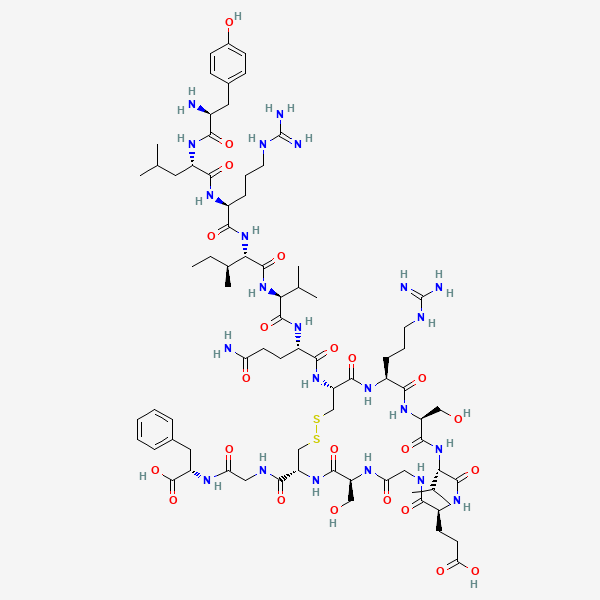
- Molecular formula
- C78H123N23O23S2
- Molecular weight
- 1815.1 g/mol
- IUPAC name
- (2S)-2-[[2-[[(4R,7S,13S,16S,19S,22S,25R)-25-[[(2S)-5-amino-2-[[(2S)-2-[[(2S,3S)-2-[[(2S)-2-[[(2S)-2-[[(2S)-2-amino-3-(4-hydroxyphenyl)propanoyl]amino]-4-methylpentanoyl]amino]-5-carbamimidamidopentanoyl]amino]-3-methylpentanoyl]amino]-3-methylbutanoyl]amino]-5-oxopentanoyl]amino]-22-(3-carbamimidamidopropyl)-13-(2-carboxyethyl)-7,19-bis(hydroxymethyl)-6,9,12,15,18,21,24-heptaoxo-16-propan-2-yl-1,2-dithia-5,8,11,14,17,20,23-heptazacyclohexacosane-4-carbonyl]amino]acetyl]amino]-3-phenylpropanoic acid
Verified external records:
References
- 1.AOD-9604 (CID 71300630) — compound record, PubChem (National Library of Medicine)
- 2.AOD-9604 — indexed research (PubMed, National Library of Medicine)
- 3.AOD-9604 — registered clinical studies (ClinicalTrials.gov)
- 4.FDA — Drugs (approval status & compounding information)
- 5.Global Drug Reference Online (GlobalDRO) — prohibited-substance status in sport
More on AOD-9604
Everything else we've written about AOD-9604 — what the community reports, the explainers that cover it, and the terms it keeps running into.
- Aod9604 peptide Reddit: fat loss and the evidenceOn Reddit
- 5 amino 1mq peptide: Benefits and EvidenceExplainer
- TolerabilityGlossary