Also known as: KEDA · KEDA peptide · Lys-Glu-Asp-Ala · H-Lys-Glu-Asp-Ala-OH
In-vitroUnclear⚠ none in humans
On this page
- What is Livagen?
- How is the Livagen peptide supposed to work?
- What does the Livagen evidence actually show?
- Is Livagen a proven liver bioregulator?
- What Livagen dosage has been studied?
- Is Livagen safe? Side effects and unknowns
- Is Livagen FDA-approved or legal in 2026?
- Frequently asked questions
- Evidence by outcome
- FDA & legal status
- Chemical identifiers
- References
- Related compounds
Livagen is a synthetic four-amino-acid peptide sold as a liver bioregulator, but its published evidence does not show better liver health in people. Researchers have reported chromatin changes in cultured human cells and effects in liver-culture models. Livagen remains unapproved, has no registered human trial, and lacks a clinically tested dose or safety profile.
Key facts
- What it is: KEDA, the tetrapeptide Lys-Glu-Asp-Ala
- Studied for: chromatin activity and liver-cell models
- Evidence tier: in-vitro; none in humans
- U.S. status (July 2026): unapproved; sold as research use only
- Livagen dosage: no clinically validated human dose
- Main risk: human adverse effects and long-term safety are unknown
- Sport: prohibited at all times under WADA’s S0 catch-all
What is Livagen?
Livagen is KEDA, a synthetic chain of lysine, glutamic acid, aspartic acid, and alanine developed within Vladimir Khavinson’s family of short peptide bioregulators. The PubChem record lists H-Lys-Glu-Asp-Ala-OH as CID 87919683, with formula C18H31N5O9 and molecular weight 461.5 g/mol.
Some commercial pages call Livagen a tripeptide; KEDA has four residues. They also copy conflicting CAS numbers, so this profile omits the CAS rather than risk identifying a different chemical.
Livagen belongs beside Epitalon in the Khavinson research family and under the longevity peptides hub. “Liver bioregulator” describes a theory and sales category, not a demonstrated clinical effect.
How is the Livagen peptide supposed to work?
The Livagen peptide is proposed to loosen chromatin, the packaging that controls which stretches of DNA are accessible to the cell. Picture a reference book clamped shut: decondensation loosens the clamp, making some pages readable again. That analogy explains the laboratory hypothesis, not a rejuvenation result in a person.
In the 2002 Khavinson and Lezhava paper, cultured lymphocytes from older people showed ribosomal-gene activation, chromatin decondensation, and release of genes repressed by age-related condensation. The cells were human; the experiment was not. No one received Livagen, and the outcome was chromosome structure rather than liver function, symptoms, or lifespan.
What does the Livagen evidence actually show?
Livagen has in-vitro evidence, not evidence that it treats liver disease or slows aging in people. A dish can answer “does something happen here?” A clinical trial must ask whether that change helps a person and at what cost. Livagen has not crossed that bridge.
The direct liver paper is a 2002 organotypic culture study. Its abstract reports structural stability and regeneration-related changes in liver-cell populations. Organotypic culture preserves more tissue structure than isolated cells, but it is not a living human liver.
A 2020 review describes KEDA findings in animal hepatitis and fibrosis models and in-vitro experiments. Those models justify more study, not claims about liver enzymes, fibrosis, symptoms, or survival in people. ClinicalTrials.gov returned no registered Livagen or KEDA study as of July 16, 2026.
Is Livagen a proven liver bioregulator?
Livagen is marketed as a liver bioregulator, but “liver-targeted” and “liver-proven” are two different claims. The published liver work concerns cultured tissue and animal pathology models. No controlled human study has reported a liver outcome. A vendor can put a liver icon on a vial; the icon is not an endpoint.
Chromatin decondensation in cultured lymphocytes is a real laboratory observation. Claims about detoxification, liver regeneration, immune resilience, or anti-aging require evidence that has not been published. The right tier is in-vitro, none in humans.
What Livagen dosage has been studied?
No clinically validated Livagen dosage exists because no registered human dosing trial was found. Online protocols publish milligram schedules, cycle lengths, routes, and stacks, but those numbers are not traceable to a controlled human Livagen study.
Cell-culture exposure cannot be converted into an oral or injected regimen. Human absorption, distribution, breakdown, and clearance have not been characterized. “Four amino acids” sounds simple; pharmacokinetics does not grade on peptide length.
Is Livagen safe? Side effects and unknowns
Livagen’s human safety profile is unknown. There is no controlled trial from which to calculate common side effects, serious-event rates, interactions, contraindications, or long-term risk. The absence of a published adverse-event list is missing data, not evidence of a clean list.
Research products add uncertainty around identity, amount, and sterility. The FDA explains that even compounded drugs are not FDA-approved or reviewed for safety, effectiveness, and quality before marketing. A research vial sits farther from an approved medicine.
Is Livagen FDA-approved or legal in 2026?
Livagen is not FDA-approved for any indication in the United States as of July 16, 2026. “Research use only” presents the material for laboratory work; it does not authorize human use or turn Livagen into a prescription or compounded medicine.
Livagen is also prohibited for tested athletes under the 2026 WADA S0 rule. The peptide is not named individually, but S0 covers pharmacological substances without current approval for human therapeutic use and applies in and out of competition. The site’s regulatory-status reference explains why approval, compounding, possession, and sports rules are separate questions.
Frequently asked questions
Livagen questions mainly concern identity, liver claims, dosing, and whether cultured human cells count as human evidence. The short answers keep those lanes separate.
Is KEDA peptide the same as Livagen?
Yes. KEDA abbreviates the four-residue sequence Lys-Glu-Asp-Ala. The sequence, formula, molecular weight, and PubChem CID are verifiable; a reliable CAS number was not, so none is supplied.
Was Livagen tested in humans?
No. Researchers collected lymphocytes from older people and exposed the cells in culture. Under the site’s evidence-grading system, that is in-vitro evidence and noneInHumans: true.
Does Livagen repair the liver?
No human trial shows that Livagen repairs a liver. Liver-culture and animal-model findings support a research hypothesis, but they cannot establish improved liver tests, fibrosis, symptoms, or clinical recovery in a person.
Can Livagen be stacked with Epitalon?
No controlled study has tested a Livagen–Epitalon stack for efficacy, safety, or compatibility. Both appear in Khavinson-peptide marketing and laboratory literature, but association is not combination evidence. The guide to what “research use only” means is more useful than an unsourced stack recipe.
Livagen produced measurable chromatin changes in cultured cells, and liver models provide a concrete lead. The next milestone is a registered human study with liver outcomes, dose finding, pharmacokinetics, and adverse-event reporting. Until then, the liver promise remains a laboratory lead, not a treatment result.
Evidence by outcome
Each outcome Livagen has been studied for, with the honest evidence grade and what the studies actually found. A tier never stands alone — the verdict rides with it.
| Outcome | Evidence | What was found |
|---|---|---|
| Chromatin decondensation and ribosomal-gene activation | In-vitroHelped⚠ none in humans | Cultured lymphocytes from older donors showed decondensation of chromatin and activation of ribosomal genes after Livagen exposure. The cells came from people, but the intervention happened in a dish; no participant received Livagen and no health outcome was measured. |
| Liver protection or regeneration | In-vitroUnclear⚠ none in humans | An organotypic liver-culture study reported changes consistent with structural stability and cellular regeneration. Later reviews describe liver findings from animal and in-vitro models. No controlled human trial has shown that Livagen improves liver enzymes, symptoms, fibrosis, or clinical outcomes. |
FDA & legal status
- United States: research use only (as of Jul 2026)
Livagen is not an FDA-approved drug for any indication. “Research use only” describes how laboratory-material sellers label it; the phrase is not FDA authorization for human use, prescribing, or compounding.
Chemical identifiers
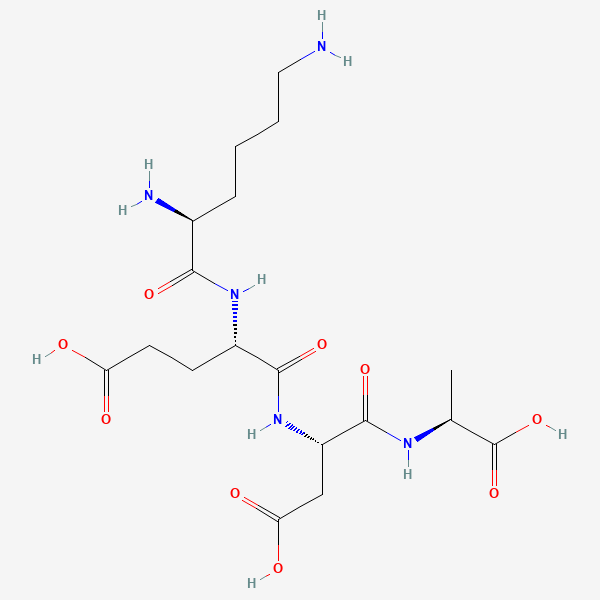
References
- 1.Khavinson et al. 2002 — Livagen and chromatin activation in cultured lymphocytes (PubMed PMID 12533768)
- 2.Riadnova et al. 2002 — organotypic liver culture exposed to Livagen (PubMed PMID 12577697)
- 3.Kuznik et al. 2020 — review of KEDA liver models (PubMed PMID 32362099)
- 4.PubChem CID 87919683 — H-Lys-Glu-Asp-Ala-OH
- 5.Livagen and KEDA — registered clinical-study search
- 6.FDA — Compounding and the FDA: Questions and Answers
- 7.WADA — 2026 Prohibited List