Also known as: Vezugen · KED peptide · Lys-Glu-Asp · T-38
In-vitroUnclear
On this page
- What is vesugen?
- How is vesugen supposed to work?
- What does the vesugen evidence actually show?
- Is vesugen safe? Side effects and unknowns
- What is the FDA and legal status in 2026?
- Is there a validated vesugen dosage?
- Is vesugen banned in sport?
- Where does vesugen fit among longevity peptides?
- Evidence by outcome
- FDA & legal status
- Chemical identifiers
- References
- Related compounds
The vesugen peptide is KED (Lys-Glu-Asp), a three-amino-acid compound pitched as a vascular bioregulator for healthier aging. Cell experiments offer a plausible research lead, but human evidence is limited to small, uncontrolled Russian reports. Vesugen is not FDA-approved, has no established dosage, and lacks a dependable long-term safety record.
What is vesugen?
Vesugen is a synthetic tripeptide: lysine, glutamic acid, and aspartic acid joined in the sequence KED. PubChem lists lysyl-glutamyl-aspartic acid as CID 87571363, with formula C15H26N4O8, molecular weight 390.39 g/mol, and CAS 204271-66-9. Three residues make this peptide unusually small; they do not make its biological claims unusually certain.
The vesugen bioregulator belongs to the Khavinson family of short peptides developed around the idea that particular sequences can influence particular tissues. Vesugen is associated with blood vessels and the endothelium, the single-cell lining inside them. Our guide to bioregulator peptides explains that broader theory and its evidence problems.
How is vesugen supposed to work?
Vesugen is proposed to alter gene and protein activity in aging vascular cells, not to activate a well-established drug receptor. In a cell-culture paper, the T-38 tripeptide increased Ki-67, a marker associated with cell division, while reducing p53 and E-selectin synthesis. E-selectin helps inflammatory cells stick to endothelium, which gives the experiment an anti-atherosclerosis angle (Khavinson et al., 2014).
That is a mechanism signal, not a clinical result. Think of it as seeing dashboard lights change while the car sits on a test bench: researchers learned that KED can move selected markers, but not whether it prevents heart attacks, improves circulation, or extends life. No validated human target or receptor closes that gap.
What does the vesugen evidence actually show?
Vesugen has in-vitro evidence for its headline vascular claim and two small human reports that cannot establish efficacy. Search counts are easy to inflate because “KED” and the three amino-acid names appear inside unrelated protein sequences. A focused PubMed search found a modest literature concentrated around the peptide’s originating research network, not a broad field of independent replication.
The best-known human report followed 41 men with vasculogenic erectile dysfunction before and after Vezugen monotherapy. The abstract reports improved clinical measures and blood flow in the main penile arteries, but describes no placebo group, random assignment, or blinding (Kitachev et al., 2014). Calling that an RCT would be fiction. It is an uncontrolled before-and-after signal.
A second report involved 32 people with chronic illness and organic brain syndrome. The authors attributed favorable “biological age” changes to Vesugen and Pinealon, while also reporting pro-oxidant activity and reduced circulating CD34-positive cells (Meshchaninov et al., 2015). The abstract does not describe randomization or a placebo control. Combining peptides also makes Vesugen’s individual contribution hard to isolate.
ClinicalTrials.gov returned no Vesugen records when checked on July 16, 2026. The useful conclusion is narrow: KED can affect laboratory markers, and early human observations justify better testing. They do not show that Vesugen protects arteries, treats erectile dysfunction, or slows aging. That distinction is the difference between a lead and a medicine.
Is vesugen safe? Side effects and unknowns
Vesugen does not have enough controlled human data to calculate side-effect rates or define long-term safety. The published abstracts do not provide the sort of adverse-event tables, laboratory monitoring, interaction data, or follow-up expected from a modern drug program. “No known side effects” would therefore mean “not adequately measured,” which is a very different sentence.
The 2015 report’s pro-oxidant finding and fall in circulating CD34-positive cells deserve follow-up, but their clinical meaning is unclear. Research-market products add separate risks involving identity, purity, dose accuracy, and sterility. Pregnancy, cancer, cardiovascular disease, medication interactions, and organ impairment have not been studied well enough to support confident contraindication lists.
What is the FDA and legal status in 2026?
Vesugen is not an FDA-approved drug in the United States and has no approved indication or prescribing label as of July 16, 2026. The FDA explains that approval requires evidence for a specific finished drug and intended use; registration or marketing language does not substitute for that review. A vial marked “research use only” is laboratory material, not quiet approval for self-treatment.
That puts the KED peptide in the research-use-only lane covered in the site’s longevity peptide hub. Online availability does not establish pharmaceutical quality, lawful human marketing, or clinical effectiveness. The label describes the seller’s stated market, not a completed FDA review.
Is there a validated vesugen dosage?
No validated vesugen dosage exists for treating vascular disease, erectile dysfunction, or aging. The opened PubMed abstracts do not provide enough regimen detail to build a reproducible, evidence-based dose, and there is no FDA label to supply one. Vendor schedules are sales material, not clinical validation, so this page does not turn them into a protocol.
That omission matters. Route, formulation, treatment length, absorption, and exposure can all change what a peptide does. Without controlled dose-ranging studies, a number copied from a capsule box or research vial would look precise while answering none of those questions.
Is vesugen banned in sport?
Vesugen falls under WADA’s S0 non-approved-substances rule and is prohibited at all times for tested athletes. The 2026 list covers pharmacological substances without current approval for human therapeutic use, even when the substance is not named individually. Athletes should confirm the status with their anti-doping organization before relying on a product label.
Where does vesugen fit among longevity peptides?
Vesugen fits beside other Khavinson peptides as an early research hypothesis, not a clinically established longevity treatment. Epitalon is the better-known sibling, aimed at pineal and aging biology rather than vascular tissue, but it carries the same central question: can intriguing laboratory effects survive independent, controlled human testing?
Vesugen’s case is interesting precisely because the claim is testable. Researchers could preregister a randomized trial, specify a defined product and dose, measure endothelial function and patient outcomes, and publish adverse events. Until that happens, the honest evidence tier stays in-vitro for the headline vascular claim, with small uncontrolled human observations kept in their proper lane.
Evidence by outcome
Each outcome Vesugen has been studied for, with the honest evidence grade and what the studies actually found. A tier never stands alone — the verdict rides with it.
| Outcome | Evidence | What was found |
|---|---|---|
| Endothelial and vascular-cell aging | In-vitroHelped⚠ none in humans | In cultured vascular cells, T-38 increased Ki-67 expression and reduced p53 and E-selectin synthesis. These are laboratory markers, not evidence that Vesugen prevents atherosclerosis or improves human cardiovascular outcomes. |
| Vasculogenic erectile dysfunction | Human observationalUnclear | A Russian-language report described improved symptoms and penile-artery blood flow after Vesugen monotherapy in 41 men. The abstract describes a before-and-after analysis without a randomized control group, so causation and effect size remain uncertain. |
| Biological-aging markers | Human observationalMixed | A small Russian report in chronically ill adults attributed favorable biological-age changes to Vesugen and Pinealon, but also reported pro-oxidant activity and lower circulating CD34-positive cells. The abstract does not describe a randomized or placebo-controlled design. |
FDA & legal status
- United States: research use only (as of Jul 2026)
Vesugen is not an FDA-approved drug and has no FDA-approved indication or prescribing label. Research-use-only labeling does not make a product an approved medicine for human use.
Chemical identifiers
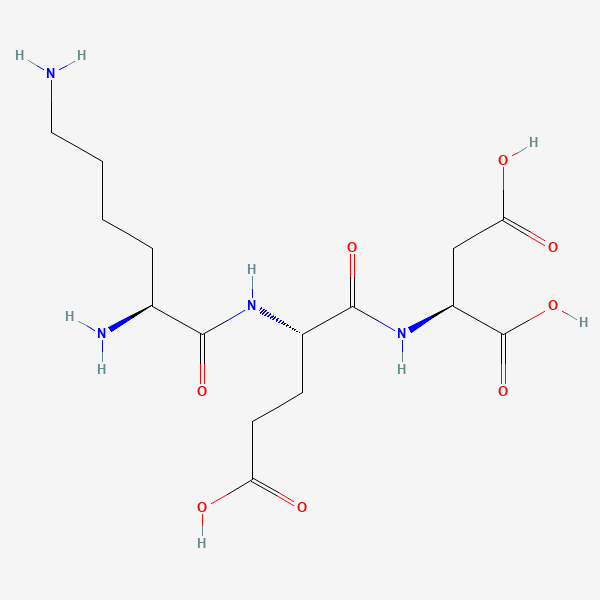
References
- 1.Lysyl-glutamyl-aspartic acid — PubChem CID 87571363
- 2.Khavinson et al., 2014 — molecular aspects of short-peptide vascular effects (PMID 25408528)
- 3.Kitachev et al., 2014 — Vezugen in vasculogenic erectile dysfunction (PMID 25051774)
- 4.Meshchaninov et al., 2015 — Vesugen, Pinealon, and biological-aging markers (PMID 26390612)
- 5.ClinicalTrials.gov — Vesugen search
- 6.2026 WADA Prohibited List