P21 vs Selank
P021 vs Selank compares an animal-only CNTF-derived neurogenesis compound with a tuftsin analog backed by a small Russian anxiety trial.
P21 vs Selank is not a contest between two versions of the same nootropic: P021 is a CNTF-derived neurotrophic mimetic studied for hippocampal neurogenesis in rodents, while Selank is a tuftsin analog with a small Russian human trial for anxiety. No trial has compared them directly; this page weighs their separate evidence by goal.
What is the real difference in p21 vs selank?
P021 and Selank were built for different jobs. P021 is a synthetic, brain-penetrant peptidomimetic developed from an active region of ciliary neurotrophic factor (CNTF). Selank is a synthetic seven-amino-acid analog of tuftsin, a natural immune-signaling peptide, developed mainly as an anxiolytic, meaning an anxiety-reducing compound.
That distinction matters more than any potency chart. P021 belongs in research on neurogenesis, synaptic plasticity and Alzheimer-type pathology. Selank belongs in the anxiety and stress conversation. Calling P021 a “Cerebrolysin fragment” is wrong: Cerebrolysin is a separate porcine-brain peptide mixture. The Iqbal group’s P021 work describes a CNTF-derived compound, including a 12-month mouse study that reported improvements in cognition, neurogenesis and synaptic plasticity (PubMed).
Which compound has stronger human evidence?
Selank has the stronger human evidence, but only for its anxiety-related use. P021 remains animal-only. A 2008 Russian randomized comparator study included 62 patients with generalized anxiety disorder or neurasthenia: 30 received Selank and 32 received medazepam. The paper reported similar anxiolytic effects, but one small single-country trial is a starting point, not a settled clinical record (PubMed).
P021 has no human efficacy or safety trial. Its published results come from rats, mice and laboratory models. This is why the comparison carries the weaker animal-only badge: one shared badge must not make P021 look human-tested simply because Selank has a human study. Search results that label P021 “Phase 3 or FDA-approved” reverse the evidence. No direct selank vs p21 trial exists, so claims that one produces better cognition than the other are unsupported.
How do their proposed mechanisms differ?
P021 is aimed at the brain’s growth-support machinery; Selank is aimed more at stress-linked neurotransmission. In rodent work, P021 inhibits leukemia inhibitory factor (LIF) signaling and increases brain-derived neurotrophic factor (BDNF), a protein involved in neuron survival, plasticity and the maturation of new neurons. Think nursery rather than accelerator: the research asks whether the hippocampus can better support new cells and connections.
Selank’s mechanism is less neatly pinned down. The human comparator study measured changes in enkephalin activity, while rat research found altered expression of genes involved in gamma-aminobutyric acid (GABA) signaling (PMC). GABA is the brain’s main inhibitory messenger, essentially part of its braking system. Serotonin-related effects also appear in preclinical work, but they should not be promoted into a confirmed human mechanism.
Which fits anxiety or stress research better?
Selank is the evidence-aligned pick for anxiety or stress because that is where its human study sits. P021 has no clinical anxiety program and no basis for borrowing Selank’s result. Readers comparing calming peptides can use the broader peptides for anxiety guide or the separate Selank versus Semax comparison, where the choice is calming versus a more activation-and-focus-oriented research profile.
Selank still does not equal an FDA-approved anxiety treatment in the United States. The trial was small, Russian-language and compared Selank with medazepam rather than with placebo. Those limits do not erase the result; they define how far the result can travel. For the narrow question “which one has human anxiety data?”, Selank is the straightforward answer.
Which fits hippocampal neurogenesis research better?
P021 is the by-goal pick for hippocampal neurogenesis models because that is the center of its animal research. The published program reports higher BDNF expression, more dentate-gyrus neurogenesis, improved synaptic markers and better memory-task performance in rodent models. A review from the same research program also describes LIF-pathway inhibition and reduced abnormal tau phosphorylation (PMC).
The word “models” is doing necessary work. P021 has not been shown to grow neurons, improve memory or slow neurodegeneration in people. Selank also has preclinical BDNF findings, but that does not make Selank and P021 interchangeable. Within the nootropic peptide hub, P021 is the earlier neurogenesis lead; Selank is the more clinically grounded anxiety lead.
Is N-acetyl Selank vs P21 the same comparison?
N-acetyl Selank vs P21 is not evidence-equivalent to Selank versus P021. Adding an acetyl modification creates a different research product, and the cited 62-person Selank trial does not validate N-acetyl Selank. The same caution applies to amidated or otherwise modified versions sold under similar names: a familiar root name does not transfer pharmacokinetics, safety or clinical results.
That is also why this nootropic peptide comparison does not rank doses. P021 has no validated human dose, while Selank’s human literature cannot establish an equivalent dose against a compound never given to people. Any p021 vs selank chart that converts rodent P021 dosing into a human protocol is performing an extrapolation, not reporting a trial.
What is their US regulatory status in 2026?
Neither P021 nor Selank is FDA-approved for any indication in the United States; both profiles are therefore marked research-use-only. FDA compounding rules do not turn an unapproved peptide into an approved medicine. An FDA warning letter specifically named Selank among substances that failed the conditions for 503A compounding exemptions at the inspected pharmacy (FDA).
Selank’s reported medical use in Russia does not carry over as US approval. P021 has not entered human clinical development. “Research use only” describes the US market category seen for these products; it is not an FDA finding that a vial is safe, sterile or effective for personal use. Different jobs, different evidence, and no honest universal winner—that is the p21 vs selank answer.
P21 vs Selank, point by point
Every dimension side by side — the honest differences, not a scoreboard.
| Dimension | P21 | Selank |
|---|---|---|
| What it is | P021, a synthetic peptidomimetic derived from an active region of ciliary neurotrophic factor (CNTF). | A synthetic seven-amino-acid analog of tuftsin, an immune-signaling peptide. |
| Primary research job | Hippocampal neurogenesis, synaptic support and Alzheimer-type pathology in rodent models. | Anxiety and stress symptoms, with additional preclinical work on neurotransmitter signaling. |
| Headline evidence | Animal-only, none in humans. | A small randomized human comparator trial for anxiety, plus animal and cell studies for mechanism. |
| Proposed mechanism | Inhibits LIF signaling, increases BDNF expression and supports neurogenesis in rodent hippocampal models. | Influences enkephalin activity and GABA-linked signaling; serotonin-related findings are mainly preclinical. |
| Direct head-to-head evidence | No direct trial against Selank. | No direct trial against P021. |
| Human dose evidence | None; published dosing is from animal studies. | Intranasal use appears in the Russian human literature, but there is no dose equivalence with P021. |
| US regulatory status (2026) | Research-use-only; not FDA-approved for any indication. | Research-use-only in the US; not FDA-approved for any indication. |
- What it is: P021 is CNTF-derived; it is not a Cerebrolysin fragment.
- Headline evidence: The shared badge uses P021's weaker animal-only tier so Selank's human evidence is not projected onto P021.
- Direct head-to-head evidence: This comparison weighs separate research programs, not comparative efficacy.
- US regulatory status (2026): Foreign use of Selank does not create US approval, and research sale is not proof of an approved human use.
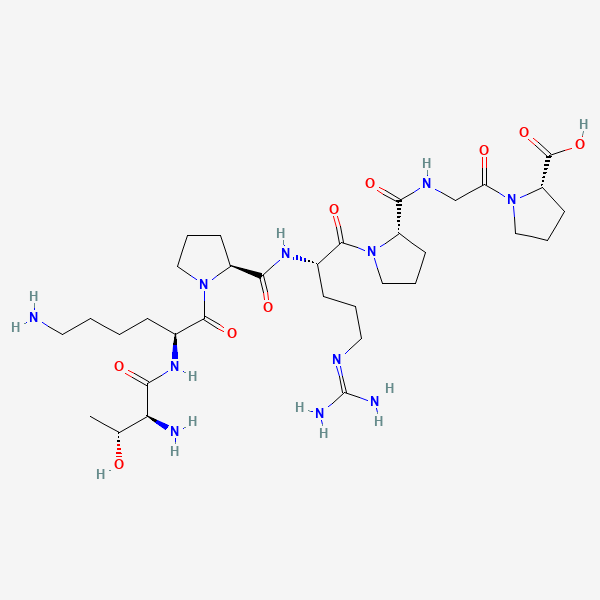
P21 vs Selank: the two molecules
The 2D chemical structures, straight from PubChem — a quick way to see how similar (or not) the two actually are.
Which one fits which goal?
There's no universal winner here — the honest answer depends on what you're after. These picks are framed by goal, and each says why.
Anxiety or stress symptoms
Leans toward Selank
Selank is the only one of the pair with a randomized human comparator trial aimed at anxiety-related disorders.
Hippocampal neurogenesis research
Leans toward P21
P021 was built for neurotrophic research and has rodent evidence involving hippocampal neurogenesis, BDNF and synaptic plasticity.
Choosing the compound with human efficacy data
Leans toward Selank
P021 has no human efficacy trial; Selank has limited but real human comparator data for its anxiety use.
References
- 1.Disease-modifying effect of chronic oral P021 in a 3xTg-AD mouse model (PubMed)
- 2.P021 neuroregeneration and synaptic-repair review (PMC)
- 3.Selank versus medazepam in generalized anxiety disorder and neurasthenia (PubMed)
- 4.Selank and GABAergic gene expression in rat cortex (PMC)
- 5.FDA warning letter naming Selank among ineligible compounded bulk substances