Also known as: TP-7 · Threonyl-lysyl-prolyl-arginyl-prolyl-glycyl-proline
Human RCTHelped
On this page
- What people actually use Selank for — and what they report
- What is Selank?
- How does Selank work?
- Does Selank actually work? What the science says
- Is Selank safe? Side effects
- FDA & legal status (2026)
- How people use Selank: doses, routes, and mixing
- Selank vs Semax
- Frequently asked questions
- Who Selank is for — and who should be cautious
- Evidence by outcome
- FDA & legal status
- Registered clinical trials
- Reported side effects
- Chemical identifiers
- References
- Related compounds
- More on Selank
If you’re here, your heart probably starts pounding before the thing — the meeting, the date, the room full of people — and you went looking for something that takes the edge off without turning your head to cotton wool. That’s the exact itch Selank is famous for scratching.
Selank is a Russian anti-anxiety peptide that people spray up the nose — or inject under the skin — for calm, steadier nerves, and the kind of clear-headed focus that gets it filed as a nootropic. Small human trials, nearly all of them Russian, found it eased everyday anxiety about as well as a benzodiazepine, minus the drowsiness, the memory fog, and the dependence. It’s a prescription medicine in Russia and a research chemical in the US, not FDA-approved for anything.
On the anxiety question, the community verdict is fairly steady: a real, functional calm you can usually feel inside half an hour — the anxious static drops a few bars, but you stay sharp instead of sedated. The honest catch is that it’s a light touch, not a heavy one. It’s subtle, it wears off in a few hours, and the human trials behind it are small and stuck behind a language barrier — strong for a research peptide, thin next to an actual approved anxiety drug.
What people actually use Selank for — and what they report
Strip away the lab talk and Selank’s street reputation is unusually consistent for a peptide most Americans can’t pronounce. People reach for it to blunt anxiety — social nerves, presentation panic, the low daily hum of overthinking — and to get a calm that leaves them alert rather than sleepy. The word that comes up over and over on r/Nootropics and r/Peptides is “functional”: quieter in the head, less white-knuckling, but still able to think, talk, and work. A big slice of users treat it as a situational tool — a spray before the stressful thing — rather than an every-single-day medication.
Nasal vs injected — the debate people actually have. This is the fork most newcomers get stuck on, and Selank is unusual here. The original Russian medicine is a nasal solution, and nasal stays the default for a good reason: Selank is a tiny peptide (molecular weight about 751), small enough to cross the nasal lining and reach the bloodstream far better than most peptides manage through the nose. Nasal fans like that it’s needle-free, comes on fast (community reports put the calm at roughly 15–30 minutes), and heads more or less straight for the brain. The gripes are real too: absorption swings with how congested you are and how good your technique is, a lot of the spray feels “wasted,” and the doses run higher to make up for it. The injected (subcutaneous) crowd flips those trade-offs — a smaller, more predictable dose that doesn’t care whether your sinuses are cooperating — at the cost of, well, sticking yourself with a needle for something people mostly want before a meeting. No human trial has ever raced the two routes head-to-head, so the honest answer is that it’s preference and practicality, and the nasal route is the one with the actual clinical pedigree behind it.
The doses people actually run (anecdotal — not a validated protocol): for calming anxiety, the number that comes up most is around 250–300 mcg per use, which regulars call the sweet spot where the edge comes off without any heaviness. Nasal users often go a bit higher across a day (roughly 250–750 mcg, sometimes split over two or three sprays when they’re dosing daily), while the inject-it crowd tends to sit lower, around 250–500 mcg a day. Most people run it in bursts — a couple of weeks on, then a break — rather than forever. None of these numbers come from a human dosing trial; they’re crowd conventions handed peer to peer, and they carry exactly the reliability that implies.
The wins and the letdowns — the honest mix. The wins people describe are specific and they repeat: acute anxiety relief without the benzo fog or hangover, no next-day grogginess, and — the structural one — no dependence and no withdrawal, which is the whole reason a lot of people go looking for a benzo alternative in the first place. Some also report smoother focus and easier words in social situations, which reads less like a nootropic superpower and more like the knock-on effect of simply being less wound up. But the reports are honestly mixed, and that’s the useful part. The single most common letdown is expectation mismatch: people who wanted a benzo-strength off-switch find Selank too gentle and conclude it “did nothing.” A real minority feel very little at all. The effect is short — hours, not a day — so it’s a situational tool, not a fix that stays on. And the nasal route brings its own small annoyances: a brief odd taste or a drip down the throat, some nostril irritation, and once in a while a bit of fatigue or a mild headache. One honest limit on any of this: the people who post are the people who felt something worth writing up, so “most people report calm” really means “most people who bother to post report calm” — a quieter, smaller claim than it looks at first.
What is Selank?
Selank is a lab-made peptide — a short chain of seven amino acids (sequence Thr-Lys-Pro-Arg-Pro-Gly-Pro) — developed by Russian researchers at the Institute of Molecular Genetics. They took tuftsin, a natural four-amino-acid peptide the body uses for immune signaling, and bolted on a Pro-Gly-Pro “tail” so it survives long enough in the body to be useful. The result is a compound built to do one specific job: calm anxiety without sedating you. In Russia it’s a registered anti-anxiety medicine; in the United States it’s neither an approved drug nor a legal supplement, and it’s sold only as a research chemical (PubChem compound record).
How does Selank work?
Selank calms you down by a gentler route than a benzodiazepine, which is the whole point of it. A benzo floods your GABA system — the brain’s main “turn the volume down” signal — which is why it works fast, and also why it leaves you foggy and, over weeks, dependent. Selank doesn’t pull that lever. Its leading proposed mechanism is that it slows the enzymes that chew up your enkephalins — the body’s own calm-down peptides — so the soothing signal you already make hangs around longer instead of being cleared in seconds. On top of that, animal studies report Selank nudging up BDNF (think of it as fertilizer for brain cells, a growth-and-repair signal tied to mood and learning) and shifting how the brain handles serotonin and dopamine, plus some immune-signaling effects that nod back to its tuftsin roots (Selank research indexed on PubMed). The honest caveat: most of that wiring diagram was drawn in rodents and cells, and exactly how it plays out in a human brain isn’t fully pinned down.
Does Selank actually work? What the science says
Here’s the split that makes Selank’s evidence make sense: keep the anxiety pile separate from everything else, because they sit at very different tiers. The anxiety pile has actual human trials — a real rarity for a research peptide. The rest is mechanism and animal work.
On anxiety, small randomized human studies — largely run by Russian groups — reported Selank easing generalized-anxiety symptoms about as effectively as benzodiazepines like medazepam, while leaving people clear-headed rather than sedated and without the dependence risk (human studies indexed on PubMed). That earns a Human-RCT tier for the headline use, which is more than almost anything else on this site can claim. But a high tier isn’t a settled case: the trials are small, they cluster in one country, most were published in Russian and never independently replicated by Western teams, and much of the work comes from the same research world that developed the drug. Real evidence — with an asterisk about reach and independence, not about whether it exists at all.
For everyday cognitive enhancement in healthy people, the focus reputation runs ahead of the proof. It rests on the biology — the BDNF and monoamine effects seen in animals — not on a controlled human trial, which simply hasn’t been run. And the neuroprotection and immune claims trace back to Selank’s tuftsin heritage but sit at the animal-and-cell level so far. So the map is lopsided on purpose: the anxiety corner is actually filled in, while the cognition and neuroprotection corners are promising biology still waiting on human tests. The thing that would change the picture isn’t a new theory — it’s one decent-sized trial run somewhere outside Russia. That’s a gap a research team can close, not a wall.
Is Selank safe? Side effects
Selank’s safety picture is unusually reassuring for a research peptide, with clear limits. Its years of prescription use in Russia describe it as well tolerated and non-sedating, and — the point people care about most — free of the dependence and withdrawal that make benzodiazepines hard to stop. Reported side effects are mild and uncommon: some nasal irritation or a brief odd taste from the spray, and less often mild fatigue or lightheadedness.
The caveats are about the evidence, not an alarming signal. The human safety data is short-term, comes mostly from one country, and lacks long-term independent follow-up, and no one has established safety in pregnancy or breastfeeding. There is also a risk that has nothing to do with the molecule and everything to do with the bottle: US research-grade Selank isn’t made to any medical quality standard, so what’s actually in a given vial — the true amount of peptide, its purity, whether it’s sterile — rests entirely on a seller you are mostly trusting on faith. Treat “for research use only” as a legal shield for that seller, not a promise about what you are spraying.
FDA & legal status (2026)
Selank is not FDA-approved, is not a legal dietary supplement, and is not part of any approved drug in the US as of July 15, 2026. It is sold strictly as a research chemical, “for research use only.” The wrinkle that sets it apart from most research peptides: Selank is a registered, prescribed anti-anxiety medicine in Russia (and a few neighboring countries), sold there as a 0.15% nasal solution (FDA drug approval status). That foreign approval is real, and it is unusual — but it does not make Selank legal to sell or use as a medicine in the United States.
| Question | Status on July 15, 2026 | What that means |
|---|---|---|
| FDA approval | Not approved | No FDA-reviewed Selank indication, label, or commercial drug product exists in the US |
| Legal to sell as | Research chemical only | Sold “for research use only”; not lawful to sell for human consumption |
| Approved abroad | Yes — prescription in Russia (0.15% nasal solution) | A foreign approval; it does not transfer to US law |
| Elite sport | Not individually listed by WADA | Likely caught by the S0 “non-approved substances” catch-all — confirm with your federation |
On sport specifically: Selank is not named on the WADA Prohibited List, but because it has no regulatory approval across most of the world, an athlete under anti-doping rules should assume it could fall under the S0 “non-approved substances” category and confirm with their federation before using it.
How people use Selank: doses, routes, and mixing
Selank is used intranasally — as drops or a spray — or subcutaneously by injection; it is never swallowed, because the gut would break the peptide down before it did anything. Research-grade Selank usually ships as a freeze-dried powder that is reconstituted with bacteriostatic water; the Russian pharmaceutical version arrives ready-made as a 0.15% nasal solution. Doses reported in cited studies and in the community cluster around 250–300 mcg before a stressful event, with nasal users often running a bit higher across a day and the injection route a bit lower — reported figures, not a protocol we are prescribing. If you are working a concentration out from a powder, our reconstitution & dosing calculator turns “vial size, water volume, target dose” into exact numbers, and because Selank is typically used on its own rather than blended into a shared syringe, our mixing compatibility reference keeps it flagged accordingly.
Selank vs Semax
Selank and Semax are the two most-searched Russian intranasal “brain” peptides, and people constantly mix them up. The short version: Selank leans calming — its headline use is anxiety, through those enkephalin and monoamine effects — while Semax leans stimulating and pro-focus, built from a fragment of the ACTH hormone and studied more for attention, stroke recovery, and mental workload. Some people even run them for different jobs on different days. Neither has a large Western trial base, both are research chemicals in the US, and you will find the rest of this family — including Noopept — on the nootropic peptides hub.
Frequently asked questions
Does Selank actually work for anxiety?
For anxiety, Selank has better human evidence than most research peptides: small randomized Russian trials reported it easing generalized anxiety about as well as a benzodiazepine, without the sedation or dependence. That part is real. The catch is scale and reach — the trials are small, mostly Russian-language, and haven’t been independently replicated in the West — so it is a promising, early case rather than a closed one. Set expectations at “takes the edge off,” not “switches anxiety off.”
Selank nasal spray or injection — which is better?
Neither has been shown better than the other in a human trial, so it comes down to practicality. Nasal is the original clinical form and works well because Selank is small enough to absorb through the nose; it is needle-free and fast, but absorption varies with congestion and technique, so doses run higher. Subcutaneous injection gives a smaller, more consistent dose that ignores your sinuses, at the cost of using a needle. Most people who want it before an event pick the spray.
How fast does Selank work, and how long does it last?
Community reports put the calming effect at roughly 15–30 minutes after an intranasal dose, which is why people use it right before a stressful event. The flip side is that a single dose is relatively short-lived — a matter of hours — so it behaves like a situational tool rather than an all-day medication. Any cognitive or mood effects are reported to build gradually over days of repeated use.
Is Selank legal in the US?
Selank is legal to buy, possess, and sell as a research chemical in the United States, but it is not an FDA-approved drug or a legal dietary supplement, and it cannot be sold for human consumption. That is why every US vendor stamps it “for research use only,” even though the same molecule is a prescription anxiety medicine in Russia.
Does Selank make you tired or high?
No — the whole appeal of Selank is that it is described as non-sedating. Users and the Russian clinical literature report a calm-but-alert effect rather than the drowsiness of a sedative, and it is not an opioid or any kind of controlled “high,” even though it indirectly leans on the body’s own enkephalin system.
Is Selank banned in sport?
Selank is not specifically listed on the WADA Prohibited List, but it also has no regulatory approval across most of the world. Athletes under anti-doping rules should assume it could be caught by WADA’s S0 “non-approved substances” category and check with their federation before using it.
Who Selank is for — and who should be cautious
Selank tends to draw in people who want to take the edge off anxiety — the pre-presentation shakes, the social dread, the low hum of daily stress — without the fog, the dependence, or the crash of a sedative, and who like that they can reach for it situationally. On the evidence, that is a fair place to be curious: for anxiety it has some of the better human data in the whole research-peptide world, and the non-sedating, non-addictive profile is a real draw rather than a marketing line.
It is a poorer fit for anyone hoping for a benzo-strength knockout — Selank is a light touch by design — and it is not for people who are pregnant or breastfeeding, or who are not comfortable accepting real unknowns about long-term safety and about what is actually in an unregulated vial. So, back to that pounding heart before the meeting: the honest read is that Selank is one of the more promising calm-without-fog options out there, its anxiety evidence is real if narrow, and the one thing that would turn “promising” into “proven” is simply a good trial run outside Russia — a gap waiting to be closed, with your expectations set to “takes the edge off.”
Evidence by outcome
Each outcome Selank has been studied for, with the honest evidence grade and what the studies actually found. A tier never stands alone — the verdict rides with it.
| Outcome | Evidence | What was found |
|---|---|---|
| Anxiety / generalized anxiety disorder | Human RCTHelped | Small randomized human trials, most of them run by Russian groups, reported that Selank eased generalized-anxiety symptoms about as well as benzodiazepines such as medazepam — but without the sedation, memory fog or withdrawal. The honest catch is scale and reach: the trials are small and largely from one country, and Western teams have not replicated them, so the human proof is real but early. |
| Cognitive enhancement in healthy people | MechanisticUnclear⚠ none in humans | Selank's reputation as a focus aid rests more on its biology than on hard human trials. In animals it raises BDNF (a protein tied to learning) and shifts serotonin and dopamine handling, a plausible route to sharper attention — but a controlled trial of Selank for everyday cognition in healthy people is not there yet. |
| Neuroprotection and immune modulation | Animal-onlyUnclear⚠ none in humans | Because Selank is derived from tuftsin, an immune-signaling peptide, animal work has probed effects on inflammation, interferon activity and neuroprotection. Those results are in rodents and cells; no human trial has confirmed a neuroprotective or immune benefit, so treat it as a lead, not a result. |
FDA & legal status
- United States: research use only (as of Jul 2026)
Not FDA-approved for any use and not a legal dietary supplement — in the US, Selank is sold only as a research chemical. It is registered and prescribed as an anti-anxiety medicine in Russia (and a few nearby countries), which is unusual for a research peptide, but that foreign approval does not carry over to the United States. Re-verify annually.
openFDA Drugs@FDA lists no approved product for Selank as of 2026-07-15.
Registered clinical trials
2 registered studies mention Selank on ClinicalTrials.gov (latest update 2023-09-15). A registered trial means a study is planned or underway — not that Selank is approved or proven.
| Study | Status | Phase | Sponsor |
|---|---|---|---|
| Comparing the Efficacy of tDCS and tRNS to Improve Reading Skills in Children and Adolescents With DyslexiaNCT05832060 | unknown | NA | Bambino Gesù Hospital and Research Institute |
| Effects of Transcranial Magnetic Stimulation on Object RecognitionNCT01747200 | completed | NA | National Institute of Neurological Disorders and Stroke (NINDS) |
Reported side effects
| Effect | Frequency | Severity |
|---|---|---|
| Nasal irritation or a brief unpleasant taste after intranasal use | uncommon (anecdotal) | — |
| Mild fatigue or lightheadedness | rare (anecdotal) | — |
Chemical identifiers
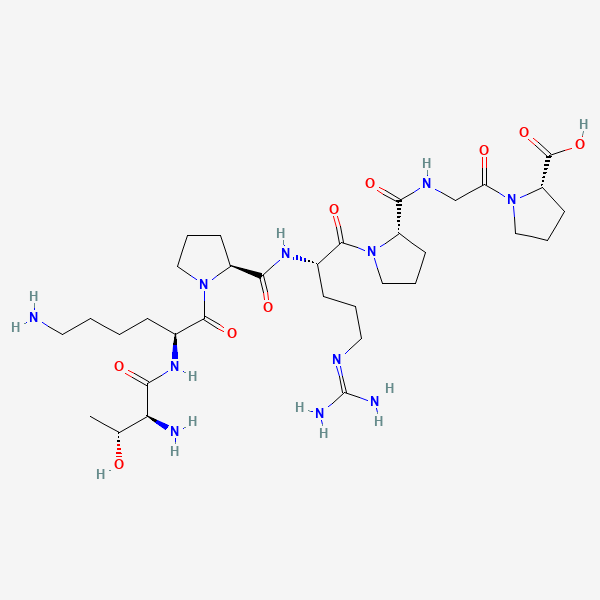
- Molecular formula
- C33H57N11O9
- Molecular weight
- 751.9 g/mol
- IUPAC name
- (2S)-1-[2-[[(2S)-1-[(2S)-2-[[(2S)-1-[(2S)-6-amino-2-[[(2S,3R)-2-amino-3-hydroxybutanoyl]amino]hexanoyl]pyrrolidine-2-carbonyl]amino]-5-(diaminomethylideneamino)pentanoyl]pyrrolidine-2-carbonyl]amino]acetyl]pyrrolidine-2-carboxylic acid
Verified external records:
References
More on Selank
Everything else we've written about Selank — what the community reports, the explainers that cover it, and the terms it keeps running into.