Also known as: PF-06882961 · PF06882961
Human RCTMixed
On this page
- What is danuglipron?
- Did danuglipron work in human trials?
- Why was danuglipron discontinued?
- What do the danuglipron liver findings actually show?
- Is danuglipron safe? What were the side effects?
- Is danuglipron FDA-approved or legal in 2026?
- How was danuglipron dosed in studies?
- Danuglipron vs orforglipron: why did one survive?
- Evidence by outcome
- FDA & legal status
- Reported side effects
- Chemical identifiers
- References
- Related compounds
- More on Danuglipron
Pfizer’s danuglipron was an oral small-molecule GLP-1 drug, not a peptide, that lowered weight and blood sugar in randomized human trials. Pfizer discontinued development in April 2025 after one asymptomatic case of potential drug-induced liver injury resolved off-drug. The result is useful evidence, but no approved medicine and no comeback program as of 2026.
- What it was: PF-06882961, a swallowable GLP-1 receptor agonist
- Evidence: Human randomized controlled trials; efficacy helped, overall verdict mixed
- U.S. status (July 2026): Development discontinued; never FDA-approved
- Study dosing: Oral, twice daily in the published efficacy trials
- Main risks: Nausea, vomiting, diarrhea, high discontinuation rates, and one potential liver-injury case
- Sport: Prohibited at all times under WADA S0 because it is an unapproved, discontinued drug
What is danuglipron?
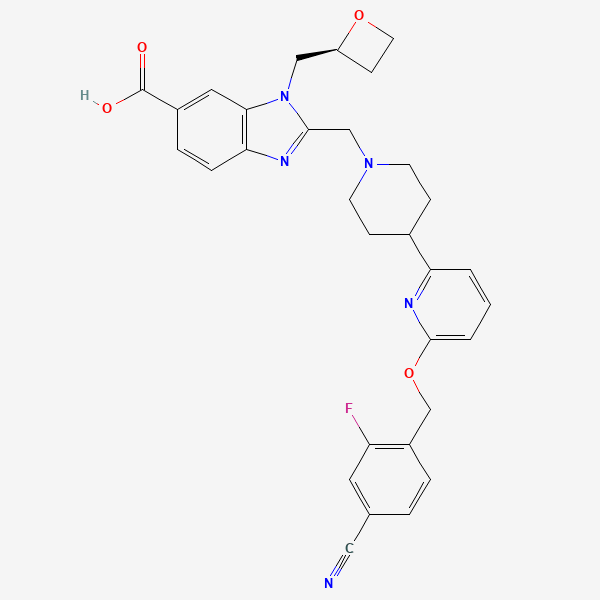
Danuglipron is a synthetic small molecule that activates the GLP-1 receptor, the same target used by peptide drugs such as semaglutide. Danuglipron is not itself a peptide. Its formula is C31H30FN5O4, its molecular weight is 555.6 g/mol, and its CAS number is 2230198-02-2 (PubChem). Pfizer developed PF-06882961 as an oral treatment for type 2 diabetes and obesity.
Danuglipron fit the receptor with ordinary drug chemistry rather than an amino-acid chain: two keys cut from different materials opening the same lock. The broader guide to how GLP-1 drugs work explains why activating that target can move both blood sugar and body weight.
Did danuglipron work in human trials?
Danuglipron worked on the outcomes Pfizer designed the main trials to measure: blood sugar and body weight. That earns a Human RCT evidence tier, not a mechanistic shrug. The catch is that efficacy was paired with enough tolerability trouble—and later a liver-safety case—that the drug never became a product.
In a 411-person randomized Phase 2b diabetes trial, every tested dose lowered HbA1c and fasting glucose versus placebo at 16 weeks. The placebo-adjusted weight difference reached 4.17 kg at 120 mg twice daily (Saxena et al., 2023).
Pfizer’s obesity program reported placebo-adjusted mean weight reductions of 5% to 9.5% at 26 weeks and 8% to 13% at 32 weeks. Discontinuation exceeded 50% across doses, versus about 40% with placebo (Pfizer’s 2023 results). A drug can work and still be a poor drug candidate.
Why was danuglipron discontinued?
Danuglipron was discontinued because one participant in a once-daily dose-optimization study developed a possible drug-induced liver injury. The participant had no symptoms, and the problem resolved after danuglipron was stopped. After reviewing all clinical data and regulator feedback, Pfizer ended the entire molecule’s development on April 14, 2025 (Pfizer’s discontinuation notice).
That was the final stop, not the first warning light. Pfizer had already declined to move the twice-daily version into Phase 3 after high gastrointestinal-event and dropout rates. Its once-daily dose-optimization studies met their pharmacokinetic goals; the liver case arrived before larger testing.
What do the danuglipron liver findings actually show?
The danuglipron liver record shows why safety decisions are not decided by averages alone. Pfizer said liver-enzyme elevation rates across more than 1,400 participants were in line with approved GLP-1 agents. Pfizer also reported one potential drug-induced liver injury serious enough to end the program. Both facts belong in the same sentence; dropping either one distorts the post-mortem.
The case does not prove every person taking danuglipron would face liver damage, nor does the class-level enzyme comparison erase the case. Late-stage obesity trials expose thousands of people, and an unpredictable injury can become a much larger problem at prescription scale. The honest verdict is mixed efficacy with harmful safety implications for development, not “the drug failed to work” and not “Pfizer panicked over nothing.”
Is danuglipron safe? What were the side effects?
Danuglipron cannot be called safe for use because development ended before approval and no prescribing label defines a tested benefit-risk balance. In the 16-week diabetes trial, nausea affected 7% to 33% of danuglipron groups, diarrhea 4% to 18%, and vomiting up to 25%; discontinuations due to adverse events rose with dose.
The obesity study looked rougher: nausea reached 73%, vomiting 47%, and diarrhea 25%. Most events were mild, but “mild” repeated often enough still makes people quit. There is no approved dose, long-term marketed safety record, or legitimate danuglipron Pfizer product to prescribe.
Is danuglipron FDA-approved or legal in 2026?
Danuglipron is not FDA-approved and Pfizer’s development program remains discontinued as of July 2026. The drug has no approved indication, brand, prescribing information, or pharmacy product in the United States. Calling an online product an oral GLP-1 pill does not turn it into the medicine Pfizer studied.
For sport, danuglipron falls under WADA’s S0 category. The 2026 Prohibited List bans pharmacological substances without current governmental approval for human treatment—including discontinued drugs—at all times. The reason is its unapproved status, not a blanket ban on every drug in the GLP-1 category.
How was danuglipron dosed in studies?
Danuglipron was taken orally twice daily in the published efficacy trials; those research doses are history, not a usable protocol. The diabetes Phase 2b trial tested 2.5, 10, 40, 80, and 120 mg twice daily for 16 weeks, with dose escalation for groups at 40 mg or higher. The obesity program escalated toward 40 to 200 mg twice daily over 26 or 32 weeks.
The later once-daily dose-optimization studies did not produce an approved regimen. Repeating a discontinued trial schedule outside a trial would discard the monitoring while keeping the risks—the least clever part of the experiment.
Danuglipron vs orforglipron: why did one survive?
Danuglipron vs orforglipron is not a verdict on whether small-molecule GLP-1 drugs work; it is a lesson that each molecule must clear its own safety and tolerability bar. Both are non-peptide oral GLP-1 agonists. Danuglipron stopped before Phase 3, while orforglipron advanced through Phase 3 and became FDA-approved as Foundayo for chronic weight management.
The Pfizer trials proved the oral small-molecule idea could lower glucose and weight, but also exposed high dropouts and one potential liver injury. Orforglipron’s success does not rehabilitate danuglipron, and the cancellation does not condemn orforglipron. One patient can end a program when a signal is severe, unpredictable, and about to be tested at much larger scale—the context “danuglipron discontinued” usually leaves out.
Evidence by outcome
Each outcome Danuglipron has been studied for, with the honest evidence grade and what the studies actually found. A tier never stands alone — the verdict rides with it.
| Outcome | Evidence | What was found |
|---|---|---|
| Weight loss in adults with obesity | Human RCTHelped | A randomized Phase 2b study found statistically significant weight loss with twice-daily danuglipron. Pfizer reported placebo-adjusted mean losses of 5% to 9.5% at 26 weeks and 8% to 13% at 32 weeks, but more than half of participants discontinued across treatment groups. |
| Blood-sugar control in type 2 diabetes | Human RCTHelped | In a 411-participant randomized Phase 2b trial, danuglipron lowered HbA1c and fasting glucose at every tested dose versus placebo over 16 weeks. Higher doses also reduced body weight. |
| Safety and tolerability | Human RCTHarmful | Nausea, diarrhea, vomiting, and treatment discontinuation increased with dose in trials. Pfizer later reported one asymptomatic case of potential drug-induced liver injury that resolved after withdrawal and ended the development program. |
FDA & legal status
- United States: withdrawn (as of Jul 2026)
Pfizer discontinued development in April 2025 before seeking or receiving FDA approval. Danuglipron has no approved indication, marketed product, or prescribing label in the United States.
Reported side effects
| Effect | Frequency | Severity |
|---|---|---|
| Nausea | Up to 73% in Pfizer's Phase 2b obesity study | Mostly mild, but part of a high gastrointestinal adverse-event burden |
| Vomiting | Up to 47% in Pfizer's Phase 2b obesity study | Mostly mild, with higher rates at higher doses |
| Potential drug-induced liver injury | One asymptomatic case reported in a safety database of more than 1,400 participants | Resolved after discontinuation; prompted Pfizer to end development |
Chemical identifiers
References
More on Danuglipron
Everything else we've written about Danuglipron — what the community reports, the explainers that cover it, and the terms it keeps running into.