Also known as: NAP · NAP peptide · NAPVSIPQ peptide · AL-108 · CP201
Human RCTNo effect
On this page
- Davunetide at a glance
- What is davunetide?
- How does davunetide work?
- What did the davunetide PSP trial find?
- Does davunetide improve memory or cognition?
- Did davunetide work better in women?
- Is davunetide safe?
- What dose was used in the davunetide trial?
- Is davunetide FDA-approved in 2026?
- What is the honest verdict on davunetide?
- Evidence by outcome
- FDA & legal status
- Reported side effects
- Chemical identifiers
- References
- Related compounds
The nootropic peptide davunetide is an eight-amino-acid drug candidate designed to protect neurons, but its best human test was negative. In 313 people with progressive supranuclear palsy (PSP), a year of intranasal treatment did not slow disability. Davunetide is not FDA-approved, and no human trial proves a benefit in healthy nootropic users.
Davunetide at a glance
Davunetide has human randomized-trial evidence, but its headline verdict is no effect. Researchers studied the synthetic NAP peptide for PSP and cognition, using intranasal dosing rather than injection. The pivotal trial found more nasal side effects but similar serious-event counts. Davunetide remains unapproved and is prohibited in tested sport under WADA S0.
- Evidence tier: Human RCT; no effect for PSP
- Research dose: 30 mg intranasally twice daily for 52 weeks
- U.S. status (July 2026): Investigational, not FDA-approved
- Key risks: Nasal congestion, discomfort, runny nose, and nosebleeds
- Banned in sport: Yes, under the S0 non-approved-substances category
What is davunetide?
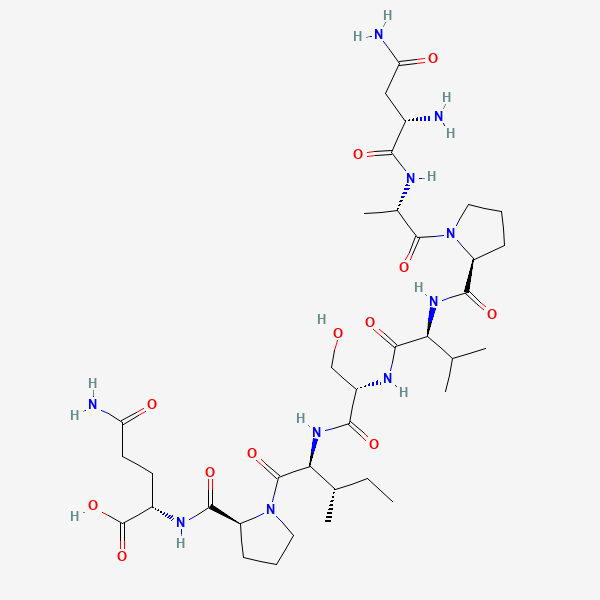
Davunetide is a synthetic copy of an eight-amino-acid segment of activity-dependent neuroprotective protein (ADNP), a protein involved in brain development and cell protection. The peptide is also called NAP, the NAP peptide, NAPVSIPQ, AL-108, and CP201. Its sequence is NAPVSIPQ, molecular weight is 824.9 g/mol, and verified PubChem CID is 9832404.
Davunetide sits in the nootropic peptide category, but no human trial demonstrates a focus or memory boost in healthy people.
How does davunetide work?
Davunetide was designed to stabilize microtubules, the internal rails that give neurons structure and help move cargo through the cell. Preclinical work also found less abnormal tau phosphorylation, a chemical change linked to tau clumping. The theory was tidy: protect the rails, reduce damaging tau changes, and preserve brain-cell function.
The pivotal researchers did not measure central-nervous-system drug concentrations or have a validated marker showing target engagement. A plausible mechanism explains why a trial was worth running; it cannot replace the result.
What did the davunetide PSP trial find?
The davunetide PSP trial found no clinical benefit. Boxer and colleagues randomized 313 people at 48 centers to placebo or 30 mg intranasal davunetide twice daily for 52 weeks. Treatment did not improve either co-primary endpoint: the Progressive Supranuclear Palsy Rating Scale (PSPRS) or the Schwab and England Activities of Daily Living scale (SEADL).
The full Lancet Neurology report found no advantage on secondary or exploratory outcomes, including clinical global change, brain atrophy, cognitive tests, MRI measures, and sampled biomarkers. Davunetide reached the rung that many research peptides never reach, then failed there. Our guide to reading peptide evidence explains why that outweighs a promising mechanism.
Does davunetide improve memory or cognition?
Davunetide has not shown a reliable general cognitive benefit. In 144 people with amnestic mild cognitive impairment, a 12-week randomized trial found no significant difference on its composite memory score, although individual attention and memory tasks produced exploratory signals. In 63 people with schizophrenia, the main cognitive battery also showed no significant benefit, while one functional-capacity measure favored treatment.
Those smaller results are mixed, not a green light for healthy-person use. Multiple measures create many chances for an encouraging number to appear. Davunetide has human cognition trials, but none establishes sharper memory or focus in healthy adults.
Did davunetide work better in women?
The reported female-subgroup benefit is a post-hoc reanalysis, not proof that davunetide works in women. The original PSP trial was not designed around a prespecified women-only efficacy claim and its overall co-primary outcomes were negative. A 2026 reanalysis split the old dataset by sex and reported signals on selected functional, motor, and cognitive measures.
That signal can justify a new trial with sex stratification written into the protocol before enrollment. It cannot turn a failed overall trial positive, especially because the reanalysis involved the peptide’s inventor, who is also an executive of the current licensee. Prospective confirmation is the dividing line.
Is davunetide safe?
Davunetide was generally tolerated for 52 weeks in PSP, but the nasal route caused local problems. Serious adverse events numbered 54 in each group. Nasal congestion occurred in 11.5% of the davunetide group versus 1.9% with placebo, nasal discomfort in 9.6% versus 0.6%, and nosebleeds in 11.5% versus 8.3%. More treated participants stopped study drug because of adverse events, mostly nosebleeds or congestion.
Those data describe older adults with severe disease using a metered trial product. They do not establish long-term safety in healthy users or verify an online product. “Safe as a consumer nootropic” has not been tested.
What dose was used in the davunetide trial?
The pivotal study used 30 mg of intranasal davunetide twice daily for 52 weeks, delivered as two 0.1 mL sprays per nostril at each dose. Researchers described 30 mg as the maximum feasible amount for that route. The dose did not produce a benefit on PSPRS or SEADL.
That is a reported research dose, not a personal protocol. The trial used a controlled formulation and matching device; outside products do not inherit that quality.
Is davunetide FDA-approved in 2026?
Davunetide is not FDA-approved for PSP, ADNP syndrome, cognitive enhancement, or any other use as of July 2026. FDA records list orphan-drug designations for PSP and ADNP syndrome, but both records explicitly say “Not FDA Approved for Orphan Indication.” Orphan designation offers development incentives; it is not permission to market a medicine.
The original PSP program stopped after the negative phase 2/3 result, and its European orphan designation was withdrawn in 2013. ExoNavis later licensed the technology, so the PSP program halted, but the molecule was not abandoned. The regulatory-status reference explains the distinction.
Davunetide also falls under the 2026 World Anti-Doping Agency S0 category for non-approved pharmacological substances, which is prohibited at all times. Davunetide is not named separately; the status follows from the S0 catch-all and its unapproved status.
What is the honest verdict on davunetide?
Davunetide is a rare nootropic peptide with enough human research to support a firm answer: it did not slow PSP in a large, year-long randomized trial, and smaller cognition studies did not establish a dependable memory benefit. The peptide may still deserve carefully designed research in narrower groups, including a prospectively defined female cohort.
Davunetide belongs at human RCT / no effect for PSP, with post-hoc subgroup findings labeled as hypotheses. The evidence-grading framework keeps those statements in the same room.
Evidence by outcome
Each outcome Davunetide has been studied for, with the honest evidence grade and what the studies actually found. A tier never stands alone — the verdict rides with it.
| Outcome | Evidence | What was found |
|---|---|---|
| Progressive supranuclear palsy | Human RCTNo effect | A 313-person randomized phase 2/3 trial found no benefit from 30 mg intranasal davunetide twice daily for 52 weeks on either co-primary outcome, the PSP Rating Scale or Schwab and England Activities of Daily Living scale. |
| Memory and cognition in amnestic mild cognitive impairment | Human RCTMixed | A 144-person randomized trial found no significant difference on its composite cognitive memory score. Signals on individual attention and memory tests, and later sex-split reanalyses, are exploratory rather than proof of a nootropic benefit. |
| Cognition in schizophrenia | Human RCTMixed | A 63-person randomized trial found no significant benefit on its main cognitive battery, although one functional-capacity measure favored davunetide. The result was not a broad cognitive win. |
FDA & legal status
- United States: investigational (as of Jul 2026)
Davunetide is not FDA-approved. FDA records show orphan designations for PSP and ADNP syndrome, both explicitly listed as not approved for their orphan indications. The original PSP program stopped after the negative pivotal trial; the technology was later licensed to ExoNavis Therapeutics.
Reported side effects
| Effect | Frequency | Severity |
|---|---|---|
| Nasal congestion | 11.5% with davunetide vs 1.9% with placebo in the PSP trial | Usually mild to moderate; contributed to treatment discontinuation |
| Nasal discomfort | 9.6% with davunetide vs 0.6% with placebo in the PSP trial | Usually mild to moderate |
| Nosebleed (epistaxis) | 11.5% with davunetide vs 8.3% with placebo in the PSP trial | Usually mild to moderate; contributed to treatment discontinuation |
Chemical identifiers
References
- 1.Boxer et al., 2014 — davunetide in progressive supranuclear palsy (PMID 24873720; PMCID PMC4129545)
- 2.Morimoto et al., 2013 — AL-108 in amnestic mild cognitive impairment (PMID 23594991)
- 3.Javitt et al., 2012 — davunetide in schizophrenia (PMID 22169248)
- 4.PubChem — Davunetide, CID 9832404
- 5.FDA orphan designation record — davunetide for ADNP syndrome
- 6.Shapira et al., 2026 — sex-stratified reanalysis of the PSP davunetide trial
- 7.WADA 2026 Prohibited List