Also known as: PNB-0408 · ATH-1001 · N-hexanoic-Tyr-Ile-(6)-aminohexanoic amide
Animal-onlyUnclear⚠ none in humans
On this page
- What is dihexa?
- How does dihexa work?
- What does the research show?
- What the community reports
- Is dihexa safe? Side effects
- FDA & legal status (2026)
- How is dihexa used, and can it be mixed?
- Hype vs. reality
- Frequently asked questions
- Who dihexa is for — and who should be cautious?
- Evidence by outcome
- FDA & legal status
- Chemical identifiers
- References
- Related compounds
- More on Dihexa
Dihexa is a synthetic, orally active analog of angiotensin IV that gets into the brain and, in rats and mice, sharpened memory and helped build new synapses. It is not FDA-approved, has never been tested in a human trial, and is sold only as a research chemical. The animal signal is interesting; the human proof simply hasn’t started yet.
What is dihexa?
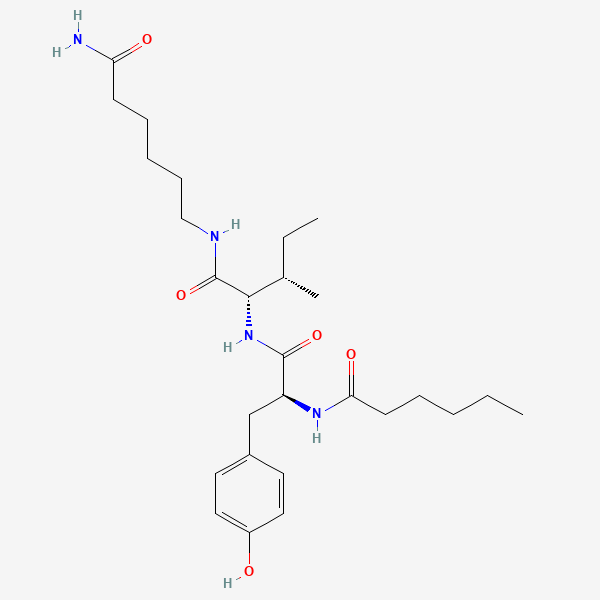
Dihexa is a lab-made molecule (chemical formula C27H44N4O5, molecular weight ~504.7) built from the tail end of angiotensin IV, a small peptide your body already makes. Chemists at Washington State University capped and stabilized that fragment so it survives digestion, can be taken by mouth, and crosses the blood-brain barrier — the tight filter that keeps most molecules out of the brain. You’ll see dihexa under development codes PNB-0408 and ATH-1001, and its formal name, N-hexanoic-Tyr-Ile-(6)-aminohexanoic amide, is a mouthful nobody uses in conversation. In the United States dihexa is not a medicine you can be prescribed and not a legal supplement — it exists only as a research chemical.
How does dihexa work?
Dihexa’s proposed mechanism runs through the HGF/c-Met system — hepatocyte growth factor (a signal that tells cells to grow, move and repair) and its docking port, the c-Met receptor. Think of HGF as a “grow and rebuild” text message and c-Met as the phone that receives it; dihexa acts like a signal booster that lets a faint message get through and ring the phone. In animal and cell studies that boost pushes neurons in the hippocampus — the brain’s memory hub — to sprout new synapses, the tiny junctions where one brain cell passes a signal to the next (Wright & Harding, 2015). More working synapses is the plausible throughline for a memory effect. The honest caveat: this wiring has been mapped in rodents and dishes, never confirmed in a human brain.
What does the research show?
Dihexa’s evidence is animal and in-vitro evidence, and it points in a hopeful direction. In rats, oral dihexa (around 2 mg/kg per day) improved Morris water-maze learning in aged animals and reversed a scopolamine-induced memory deficit — the foundational report from the Harding group (McCoy et al., 2013, a paper that now carries a journal expression of concern, so its specifics deserve extra skepticism). A separate group later found dihexa rescued memory measures in the APP/PS1 Alzheimer’s-model mouse by engaging the PI3K/AKT survival pathway (Sun et al., 2021) — useful because it’s independent replication of the general “helps cognition in rodents” theme. A systematic review of angiotensin IV-based compounds reaches the same summary: a consistent procognitive signal in preclinical models, and essentially no human data (Ho & Nation, 2018). In people, the picture is blunt: ClinicalTrials.gov lists no registered dihexa trial, and there is no published human study of the compound. The forward read: the rodent case is worth taking seriously, and the human testing is a step that hasn’t been taken — not one that was taken and failed.
What the community reports
Outside the lab, dihexa has a following among nootropics hobbyists chasing memory, focus and “neural repair,” usually taking it orally or applied to the skin at a few milligrams a day for short runs. These accounts are anecdotal and they are not human study data: no control group, no blinding, no dosing accuracy, and a heavy survivorship bias (people who feel nothing rarely post). They’re useful for understanding why dihexa gets searched, not for judging whether it works. Treat the glowing “smartest I’ve ever felt” posts and the “felt nothing” posts as equally unproven — that’s what the evidence-grading scale is for.
Is dihexa safe? Side effects
Dihexa’s honest safety answer is “unknown in humans.” There is no published human toxicology, no long-term human record, and the animal work was built around efficacy, not safety screening. The most-discussed theoretical concern is baked into how it works: dihexa amplifies HGF/c-Met signaling, and an over-active c-Met pathway is implicated in the growth and spread of several cancers. The same “grow and rebuild” push that might help a neuron is a reasonable thing to be cautious about, and that concern is unproven in either direction for dihexa specifically. The practical, here-and-now risk is the source: dihexa is sold strictly as a research chemical, so no one stands behind its purity, the actual dose in the vial, or its sterility, with no oversight.
FDA & legal status (2026)
Dihexa is not FDA-approved and is not a legal dietary supplement. openFDA’s Drugs@FDA database lists no approved dihexa product, and ClinicalTrials.gov shows no registered human trial as of July 2026 — so in the United States dihexa is sold only as a research chemical, “for research use only,” a liability label rather than a safety or quality guarantee. Because this is an unapproved compound with no clinical footing, its status is stable in one sense (nobody is close to approving it) and worth re-checking in another (a development program could file a trial). The dated breakdown is in the FDA & legal status block below.
How is dihexa used, and can it be mixed?
Dihexa is used in research as an oral or, less often, an injectable/topical preparation; the rat studies dosed it by mouth, which is unusual for a brain peptide and one of the reasons it drew attention. Because we publish information, not a protocol, the only dose figure worth stating is the cited one — roughly 2 mg/kg per day in rats (McCoy et al., 2013) — which does not translate to a human dose and was never validated in people. If you’re researching an injectable form, the arithmetic of turning a powder into a measured solution is what our reconstitution calculator handles, and the mixing-compatibility reference covers what people combine in a syringe and where the honest answer is “no data.” Dihexa sits in the broader nootropic & mental-health peptides cluster, alongside the brain compounds the big health sites skip.
Hype vs. reality
The claim that made dihexa famous is that it is “seven orders of magnitude more potent than BDNF” (brain-derived neurotrophic factor, the body’s own synapse-growth signal) at driving synaptogenesis. That number is real in the sense that it appears in the literature — but it comes from in-vitro assays in the same research lineage whose key synaptogenesis paper was later retracted and whose lead rat paper carries an expression of concern. A dramatic potency figure measured in a dish, from work with reliability flags, is exactly the kind of headline to hold loosely. The grounded version is more modest and still interesting: in animals, dihexa repeatedly nudged cognition in the right direction, and the mechanism is specific and testable. That’s a promising lead worth a real trial — not a proven brain upgrade.
Frequently asked questions
Is dihexa proven to work in humans?
No. Dihexa has never been studied in a human trial — ClinicalTrials.gov lists none — so every efficacy claim rests on rats, mice and cell work. We grade dihexa animal-only, none-in-humans for cognition: a real preclinical signal, zero human confirmation.
Is dihexa legal?
Dihexa is legal to buy and sell as a research chemical in the United States, but it is not an approved drug or a legal dietary supplement and cannot be sold for human consumption. That’s why every vendor labels it “for research use only.”
Is dihexa banned in sport?
Effectively yes. Dihexa isn’t named on the WADA Prohibited List, but WADA’s S0 category bans any substance without regulatory approval for human use at all times. Dihexa has no such approval, so athletes under anti-doping rules should treat it as prohibited.
How is dihexa taken?
In the rodent research it was given orally, which is part of what makes it unusual; the community also reports oral, topical and injectable use. None of these routes has a validated human dose, and the study figures are animal doses that don’t transfer to people.
What does dihexa actually do to the brain?
In animals, dihexa boosts the HGF/c-Met system and prompts hippocampal neurons to form new synapses, which tracks with the memory improvements seen in those studies. Whether it does the same in a human brain is untested.
Who dihexa is for — and who should be cautious?
Dihexa draws in the memory-and-cognition crowd — people reading about Alzheimer’s research, or hoping to sharpen focus and learning — who want to understand it before deciding. The honest framing: the preclinical case is real and specific, dihexa is oral and brain-penetrant (rare and useful traits), and the mechanism is concrete enough to test. But there is no human efficacy data, no human safety data, a real theoretical cancer-pathway concern, and reliability flags on the foundational papers. Anyone with a personal or family cancer history, anyone pregnant, and anyone who wants proof rather than a promising rodent lead has every reason to wait for actual human trials to begin.
Evidence by outcome
Each outcome Dihexa has been studied for, with the honest evidence grade and what the studies actually found. A tier never stands alone — the verdict rides with it.
| Outcome | Evidence | What was found |
|---|---|---|
| Cognitive enhancement & memory | Animal-onlyHelped⚠ none in humans | In rats, oral dihexa improved maze-learning and reversed a drug-induced memory deficit. That's the headline finding, but it is rodent data — there is no human trial, and the flagship rat paper now carries a journal expression of concern, so read the effect as a promising lead, not proof. |
| Alzheimer's disease & dementia | Animal-onlyHelped⚠ none in humans | In an Alzheimer's-model mouse (APP/PS1), dihexa rescued memory measures and engaged the PI3K/AKT survival pathway. Encouraging in a dish-and-cage sense, but no person with dementia has been studied in a controlled dihexa trial. |
| Neuroprotection & neural repair | In-vitroMixed⚠ none in humans | In cell and tissue work, dihexa acts as an HGF/c-Met mimetic that can protect or regrow neural connections. This maps a plausible mechanism only; it says nothing about whether the effect happens, or is safe, in a living human. |
FDA & legal status
- United States: research use only (as of Jul 2026)
Not an FDA-approved drug and not a dietary supplement — sold only as a research chemical. openFDA lists no approved dihexa product, and ClinicalTrials.gov shows no registered human trial as of July 2026. Treat any status claim as dated and re-verify.
openFDA Drugs@FDA lists no approved product for Dihexa as of 2026-07-15.
Chemical identifiers
- Molecular formula
- C27H44N4O5
- Molecular weight
- 504.7 g/mol
- IUPAC name
- (2S,3S)-N-(6-amino-6-oxohexyl)-2-[[(2S)-2-(hexanoylamino)-3-(4-hydroxyphenyl)propanoyl]amino]-3-methylpentanamide
Verified external records:
References
- 1.Dihexa — indexed research (PubMed, National Library of Medicine)
- 2.McCoy et al., 2013 — Evaluation of metabolically stabilized angiotensin IV analogs as procognitive/antidementia agents (J Pharmacol Exp Ther) — the foundational rat study
- 3.Notice of Concern (2021) for McCoy et al., 2013 (J Pharmacol Exp Ther)
- 4.Retraction (2025) of Benoist et al., 2014 — the angiotensin IV / HGF-c-Met synaptogenesis paper (J Pharmacol Exp Ther)
- 5.Wright & Harding, 2015 — small-molecule angiotensin IV analogs for Alzheimer's and Parkinson's (Prog Neurobiol)
- 6.Sun et al., 2021 — Dihexa rescues cognition in the APP/PS1 Alzheimer's mouse (Brain Sci)
- 7.Ho & Nation, 2018 — Cognitive benefits of angiotensin IV and angiotensin-(1-7): a systematic review (Neurosci Biobehav Rev)
- 8.Dihexa — registered clinical studies (ClinicalTrials.gov)
- 9.FDA — Drugs@FDA (no approved dihexa product)
More on Dihexa
Everything else we've written about Dihexa — what the community reports, the explainers that cover it, and the terms it keeps running into.