Also known as: NA-Semax-Amidate · NA Semax Amidate · Ac-Semax-NH2
MechanisticUnclear⚠ none in humans
On this page
- What is N-Acetyl Semax Amidate?
- How is NA semax amidate vs semax different?
- What does the research actually show?
- Is acetylated Semax more stable or more potent?
- Is there a semax amidate dosage from studies?
- Is N-Acetyl Semax Amidate safe?
- What is its FDA, legal, and WADA status in 2026?
- What is the honest bottom line?
- Evidence by outcome
- FDA & legal status
- Chemical identifiers
- References
- Related compounds
N-Acetyl Semax Amidate is a seven-amino-acid Semax analog capped at both ends: acetylated at the N-terminus and amidated at the C-terminus. No published human trial has tested this exact molecule, so claims of greater potency, duration, or safety remain chemistry-based hypotheses, not measured clinical results.
Key facts
- What it is: Ac-MEHFPGP-NH2, a dual-modified version of Semax
- Evidence tier: Mechanistic hypothesis; none in humans
- U.S. status (July 2026): Not FDA-approved; sold as research use only
- Doses reported in research: None for this exact molecule
- Known risks: No molecule-specific safety profile; identity, purity, and nasal formulation are additional unknowns
- Sport: Prohibited at all times under WADA S0 because the form lacks human therapeutic approval
What is N-Acetyl Semax Amidate?
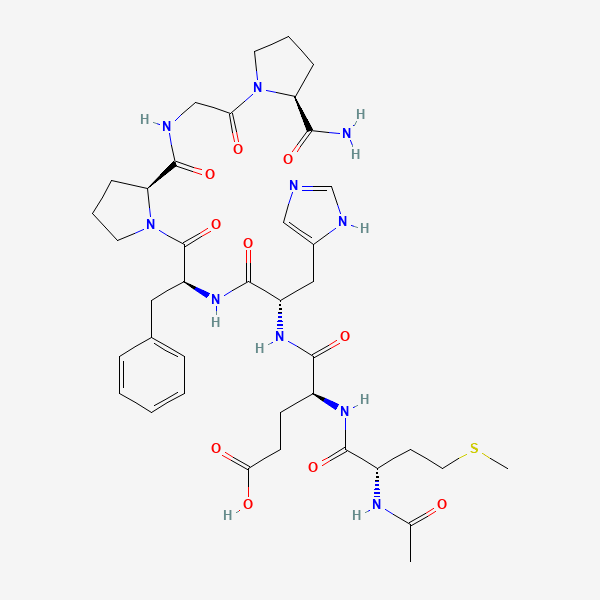
N-Acetyl Semax Amidate is a chemically distinct Semax analog, not another spelling for standard Semax. PubChem records CID 172638603 with formula C39H54N10O10S and molecular weight 855.0 g/mol. Its seven-residue backbone is Met-Glu-His-Phe-Pro-Gly-Pro (MEHFPGP), with an acetyl cap at the amino end and an amide at the carboxyl end: Ac-MEHFPGP-NH2.
Those two caps are the entire reason this page exists. The clinical, animal, and mechanism research on the unmodified peptide belongs on the canonical Semax evidence profile. Borrowing those results without qualification would quietly swap one molecule for another.
How is NA semax amidate vs semax different?
NA semax amidate vs semax comes down to terminal chemistry: Semax is H-MEHFPGP-OH, while the modified analog is Ac-MEHFPGP-NH2. The backbone stays the same, but its charge and exposed ends do not. That can affect enzyme handling, metal binding, formulation, and biological activity; “same sequence” does not mean “same drug.”
FDA made the broader principle unusually clear in its 2026 Semax compounding review: distinct active moieties can have different physical, pharmacokinetic, safety, and efficacy profiles and are not interchangeable. That review evaluated Semax free base and Semax acetate. It did not evaluate N-Acetyl Semax Amidate.
What does the research actually show?
N-Acetyl Semax Amidate has no direct published efficacy or safety study in humans or animals that could be located. The exact-name PubMed search returns no indexed record, and ClinicalTrials.gov lists no registered study. That makes the honest tier mechanistic hypothesis, with none in humans.
There is one useful neighboring experiment, but it tested only acetylated Semax, not the C-terminally amidated molecule. Magri and colleagues found that N-terminal acetylation changed Semax’s copper coordination and did not reproduce one cell-protection result seen with parent Semax. The lesson is modest but important: a cap can change biology as well as chemistry.
Is acetylated Semax more stable or more potent?
Acetylated Semax may resist some N-terminal enzyme attack, but “N-Acetyl Semax Amidate lasts longer and hits harder” has not been measured for this molecule. Terminal capping is a real medicinal-chemistry strategy, yet its effect is sequence- and assay-specific. A review of peptide engineering notes that C-terminal amidation can increase stability in some peptides and make little difference in others.
The top search results mostly turn that design rationale into a result: more stable, longer half-life, better bioavailability, stronger effect. No direct degradation assay, pharmacokinetic study, or head-to-head trial was found to support that ladder for this analog. The caps are plausible armor; nobody has tested the armor on this peptide.
Is there a semax amidate dosage from studies?
No semax amidate dosage has been established in a published study of N-Acetyl Semax Amidate. Numbers sold as protocols are extrapolated from standard Semax, copied from community use, or supplied by sellers. None qualifies as a dose measured for the dual-modified molecule, and no human pharmacokinetic data show how often it would need to be given.
That gap matters because a claimed stability change would be a reason to test dosing again, not a reason to recycle the parent’s schedule. Until a study measures exposure, duration, and tolerability together, a precise regimen would be precision theater. The peptide-evidence guide explains why a dose claim cannot outrun the molecule actually studied.
Is N-Acetyl Semax Amidate safe?
N-Acetyl Semax Amidate has no established human safety profile, which means adverse-event frequency, interactions, contraindications, and long-term effects are unknown. Absence of reported harms is not reassuring when there is no controlled exposure record to report from. Parent Semax experience cannot settle the safety of a modified active moiety.
The product adds a second layer of uncertainty. Research-market nasal sprays and powders are not FDA-reviewed finished drugs, so concentration, identity, impurities, microbial quality, aggregation, and spray delivery can vary. FDA’s Semax review flags these formulation and characterization issues even for the parent forms. The dual-modified form has less evidence, not a regulatory shortcut.
What is its FDA, legal, and WADA status in 2026?
N-Acetyl Semax Amidate is not FDA-approved and has no approved U.S. indication as of July 16, 2026. FDA is scheduled to discuss Semax free base and Semax acetate for possible 503A compounding-list inclusion on July 24, 2026, but that pending discussion is not approval and does not include the N-acetylated, amidated molecule. See the site’s dated regulatory-status reference for the surrounding framework.
The 2026 WADA Prohibited List does not name NA-Semax-Amidate individually. Its S0 rule nevertheless prohibits pharmacological substances lacking current human therapeutic approval by a governmental health authority, at all times. No such approval was identified for this distinct form. Readers comparing the broader family can find parent evidence and status on the Semax page and related compounds on the nootropic peptide hub.
What is the honest bottom line?
N-Acetyl Semax Amidate is a defined molecule with a verified chemical record and an unverified performance story. The modifications give researchers a sensible hypothesis to test: do two terminal caps change degradation, exposure, or activity compared with Semax? They do not supply the answer. The next useful evidence is a direct stability assay, followed by animal pharmacokinetics and controlled human safety work.
That distinction leaves room for scientific interest without borrowing certainty. For established Semax findings, use the canonical Semax evidence home. For this analog, “more stable” remains a testable chemistry inference, “more potent” remains unmeasured, and a confident clinical protocol remains ahead of the data.
Evidence by outcome
Each outcome N-Acetyl Semax Amidate has been studied for, with the honest evidence grade and what the studies actually found. A tier never stands alone — the verdict rides with it.
| Outcome | Evidence | What was found |
|---|---|---|
| Resistance to enzymatic breakdown | MechanisticUnclear⚠ none in humans | N-terminal acetylation and C-terminal amidation are established peptide-design strategies, but no published experiment has measured whether the two changes extend the stability or duration of N-Acetyl Semax Amidate itself. |
| Cognition, focus, or neuroprotection | MechanisticUnclear⚠ none in humans | No human or animal efficacy study was found for the dual-modified molecule. Findings from parent Semax cannot establish an effect for a chemically distinct analog. |
FDA & legal status
- United States: research use only (as of Jul 2026)
No FDA-approved drug containing this dual-modified active moiety was found. FDA's July 2026 compounding review covers Semax free base and Semax acetate, not N-Acetyl Semax Amidate; consideration of the parent forms does not confer approval or compounding eligibility on this distinct molecule.
Chemical identifiers
References
- 1.N-acetyl semax amidate (PubChem Compound CID 172638603)
- 2.N-Acetyl Semax Amidate exact-name literature search (PubMed)
- 3.N-Acetyl Semax Amidate registered-study search (ClinicalTrials.gov)
- 4.Magri et al., 2016 - N-terminal acetylation changes Semax chemistry (PMID 27586814)
- 5.FDA 2026 briefing document - Semax-related bulk drug substances
- 6.2026 Prohibited List