Human (controlled)No effect
On this page
Aspartic acid is a non-essential amino acid that works at two of the body’s most important supply lines: it helps the urea cycle package up nitrogen for disposal, and it hands over pieces used to build DNA and RNA. It sits right where energy metabolism meets amino-acid metabolism, and your body makes plenty of it from everyday fuel.
What is Aspartic acid?
Aspartic acid is a non-essential proteinogenic amino acid with an acidic side chain — a second carboxyl group that carries a negative charge at body pH, which is why its charged form is called aspartate. That charge makes it a nimble donor and acceptor in metabolic reactions. It’s non-essential because the body builds it easily from oxaloacetate, a hub molecule of the energy cycle. You’ll see it abbreviated Asp or D. One clarification worth making early: the D-aspartic acid sold as a testosterone booster is a mirror-image isomer, not this standard L form.
What does Aspartic acid do in the body?
Aspartic acid is a metabolic connector. In the urea cycle it donates a nitrogen atom that gets built into urea, the safe form in which the body flushes out excess nitrogen — a job it shares with arginine. It’s also a raw material for making nucleotides, the individual letters that spell out DNA and RNA, so it’s quietly essential to cells copying themselves. And because it’s made from and converts back to oxaloacetate, it ferries carbon and nitrogen in and out of the citric acid cycle that powers your cells. Think of it as a switchboard linking waste disposal, genetic building blocks and energy.
Where do you get Aspartic acid?
Aspartic acid is common across protein foods — meat, poultry, fish, eggs, dairy, soy, legumes and sprouting seeds — and it’s one of the two amino acids that make up the sweetener aspartame. On top of dietary intake, your body synthesizes it constantly from a central energy-cycle intermediate, so a normal diet keeps you comfortably supplied.
What does the research show?
The most useful thing to know is a distinction. The mirror-image isomer D-aspartic acid has been marketed to raise testosterone, but controlled human trials have mostly found no lasting effect, particularly in trained men — a case where the supplement hype outran the human data. Standard L-aspartic acid, the one in your food and proteins, has clear and important metabolic roles, but little human evidence supports supplementing it for any benefit in well-fed people who already make and eat plenty. The interesting biology is inside the cell; the marketed testosterone angle is a different molecule that largely didn’t deliver.
Is Aspartic acid safe?
L-aspartic acid is safe as part of a normal diet, where it’s abundant and continuously produced by your own metabolism. The main thing to keep straight is that the D-aspartic acid sold for testosterone is a distinct isomer with underwhelming human results — not the everyday dietary L form, which needs no special dosing beyond eating enough protein.
Evidence by outcome
Each outcome Aspartic acid has been studied for, with the honest evidence grade and what the studies actually found. A tier never stands alone — the verdict rides with it.
| Outcome | Evidence | What was found |
|---|---|---|
| D-aspartic acid for testosterone (a separate isomer) | Human (controlled)No effect | The mirror-image isomer D-aspartic acid has been sold to raise testosterone, but controlled human trials have mostly found no lasting benefit, especially in trained men. This is a separate molecule from the L-aspartic acid that builds your proteins — worth separating clearly. |
| L-aspartic acid supplement benefits | MechanisticUnclear | Standard L-aspartic acid has well-defined metabolic roles, but there's little human evidence that supplementing it does anything useful in well-fed people, who already produce and consume plenty. |
FDA & legal status
- United States: dietary supplement / food (as of Jul 2026)
A proteinogenic amino acid found in dietary protein and sold as a supplement. Not an FDA-approved drug; supplements are regulated as food, not medicine.
Chemical identifiers
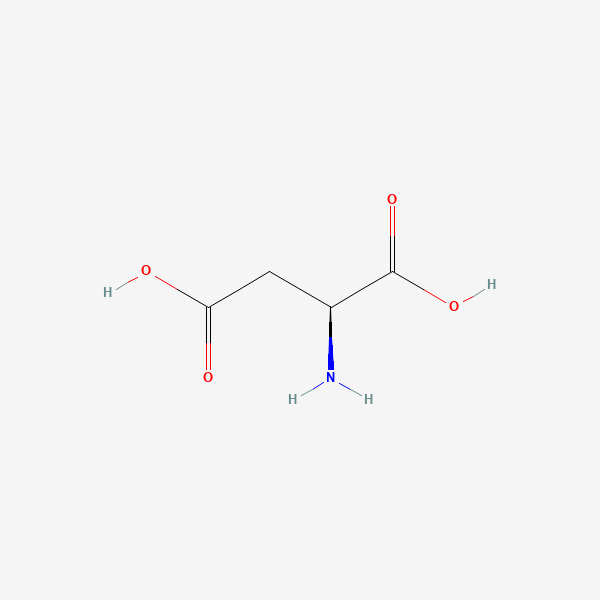
- Molecular formula
- C4H7NO4
- Molecular weight
- 133.1 g/mol
- IUPAC name
- (2S)-2-aminobutanedioic acid
Verified external records: