Pentadeca Arginate vs TB-500
Pentadeca Arginate vs TB-500 compares PDA's untested stability pitch with TB-500's animal evidence, mechanisms, reported use, and risks.
Pentadeca Arginate vs TB-500 is not a contest with a human-proven winner: PDA is an unstudied arginate form marketed as a more stable BPC-157-style peptide, while TB-500 is a Thymosin Beta-4 fragment with animal and cell evidence. No trial has compared them directly; this comparison weighs their separate evidence and reported recovery use.
What is the core difference between PDA and TB-500?
Pentadeca arginate and TB-500 start from different peptide families and arrive at the recovery scene by different routes. Pentadeca arginate, or PDA, is sold as an arginine-bound version of the BPC-157 pentadecapeptide. TB-500 is a synthetic seven-amino-acid fragment from the actin-binding region of thymosin beta-4. One is a marketed reformulation; the other has a defined fragment sequence and direct preclinical study.
PDA is often described as “next-generation BPC,” with the arginate form pitched as more stable or longer-lasting. That description is a marketing position, not a published finding. TB-500 is usually framed as a systemic repair signal because thymosin beta-4 biology involves cell movement and tissue remodeling. Neither framing establishes that the compound heals human injuries.
Which peptide has stronger healing evidence?
TB-500 has the stronger direct evidence, but that evidence remains preclinical. Animal and cell work on TB-500 and related metabolites supports wound-repair activity and a plausible tissue-repair mechanism. PDA has no published human, animal, or laboratory study under its own name. For PDA, the direct tier is anecdotal, and the page-level badge uses that weaker anecdotal tier on purpose—so TB-500’s animal grade is not quietly lent to a compound with no studies of its own.
That distinction matters in any pda vs tb-500 discussion. TB-500 has not cleared the human bar: no completed human randomized controlled trial has shown that TB-500 heals tendons, muscle, ligaments, or wounds. PDA sits one rung lower because even its animal story is borrowed from BPC-157. A PubMed or ClinicalTrials.gov search is not a dramatic flourish here; the empty PDA record is the finding.
How do their mechanisms and stability claims differ?
Pentadeca arginate has no demonstrated mechanism or verified stability advantage of its own. Its proposed angiogenesis and growth-factor effects are carried over from BPC-157 rodent studies. TB-500 has a more direct preclinical rationale: the fragment binds actin, part of a cell’s internal scaffolding, and is studied for cell migration, new blood-vessel growth, and tissue remodeling. The precise human effect of either compound remains unestablished.
The plain-English version is that TB-500 has a proposed job description backed by animal and cell experiments. PDA has a claimed packaging upgrade whose biological consequences have not been tested. Pairing a peptide with arginine may sound chemically tidy, but “more stable” needs comparative measurements before it becomes a fact. The BPC-157 vs pentadeca arginate comparison examines that narrower claim.
How are pentadeca arginate and TB-500 reported to be used?
Both compounds are reported as subcutaneous research peptides for systemic recovery, yet neither has a validated human healing dose. PDA accounts commonly describe a few hundred micrograms daily for several weeks. TB-500 accounts commonly describe a loading phase of a couple of milligrams several times per week, sometimes followed by lower maintenance use. Those numbers document community practice; they do not prescribe a protocol or prove efficacy.
The phrase pentadeca arginate vs tb 500 often hides this scale difference: PDA is discussed in micrograms, while TB-500 is discussed in milligrams. Anyone checking vial concentration can use the reconstitution calculator for arithmetic, but the calculator cannot turn an anecdotal amount into a clinically tested dose. The separate BPC-157 vs TB-500 comparison explains why TB-500 became the systemic half of that better-known pairing.
What risks and regulatory limits do they share?
Pentadeca arginate and TB-500 share more regulatory certainty than medical certainty: neither is FDA-approved, neither is a legal dietary supplement, and both are sold as research-use-only chemicals in the United States as of July 2026. Both are treated as prohibited non-approved substances under WADA S0 for tested sport. Human long-term safety data are absent, so adverse-event frequency cannot be stated honestly.
Both also share product-level risks that animal mechanisms cannot answer. Research-chemical vials are not approved medicines, leaving purity, dose accuracy, and sterility as practical unknowns. Angiogenesis—the formation of new blood vessels—is part of the proposed repair story for both, which creates a theoretical concern about unwanted growth. That concern has not been proved or ruled out for either compound. The healing peptides hub keeps these evidence tiers visible instead of blending all “recovery peptides” together.
Which one fits which research goal?
TB-500 fits a comparison led by direct preclinical evidence or a systemic cell-migration rationale; PDA fits only the narrower goal of examining the arginate BPC-style formulation itself. That is not a clinical recommendation, and it does not make TB-500 human-proven. It means the choice changes with the research question, while the certainty stays low for both.
For tb-500 vs pda healing evidence, TB-500 is the defensible pick because an animal and cell record exists. For a project specifically asking whether the arginate formulation differs from ordinary BPC-157, PDA is the relevant subject—but the honest result today is that the claimed stability advantage has not been published. There is no universal winner, no direct comparative trial, and no human healing RCT to break the tie by clinical outcomes.
What is the bottom line on pentadeca arginate vs tb-500?
Pentadeca arginate vs tb-500 comes down to direct preclinical evidence versus an untested formulation claim. TB-500 has animal and cell support for a repair hypothesis; PDA has anecdotes and borrowed BPC-157 biology. Both remain research-use-only, both lack human healing RCT proof, and neither earns a blanket win. The useful pick depends on the question being studied, not a promise of recovery.
Pentadeca Arginate vs TB-500, point by point
Every dimension side by side — the honest differences, not a scoreboard.
| Dimension | Pentadeca Arginate | TB-500 |
|---|---|---|
| What it is | An arginate form of the BPC-157 pentadecapeptide, marketed as a more-stable next-generation version. | A synthetic 7-amino-acid fragment from the actin-binding region of thymosin beta-4. |
| Direct evidence | Anecdotal: no published human, animal, or laboratory study has tested pentadeca arginate itself. | Animal and cell evidence supports a tissue-repair hypothesis, but no completed human efficacy trial has shown healing. |
| Proposed mechanism | Uncharacterized; angiogenesis and growth-factor signaling are borrowed from BPC-157 rodent research. | Actin binding, cell migration, angiogenesis, and tissue remodeling in preclinical models. |
| Stability | Marketed as more stable because the peptide is paired with arginine, but that advantage has not been published or tested. | Not marketed as an arginate-stabilized BPC-157 form; the comparison profiles it as a thymosin beta-4 fragment. |
| Reported recovery use | Community reports describe systemic recovery use, often a few hundred micrograms subcutaneously per day for several weeks. | Community reports describe systemic recovery use, often a couple of milligrams subcutaneously a few times weekly during a loading phase. |
| US regulatory status (2026) | Research-use-only; not FDA-approved and not a legal dietary supplement. | Research-use-only; not FDA-approved and not a legal dietary supplement. |
| Banned in sport | Yes; treated under WADA S0 for non-approved substances. | Yes; treated under WADA S0 for non-approved substances. |
- Direct evidence: No trial has compared the two compounds directly; this comparison weighs their separate evidence.
- Proposed mechanism: Neither mechanism is established as a healing treatment in humans.
- Reported recovery use: These are anecdotal patterns, not validated human doses or personal protocols.
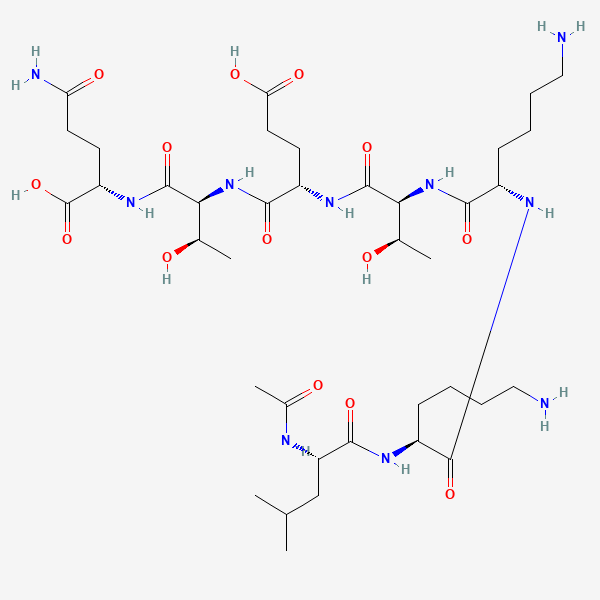
Pentadeca Arginate vs TB-500: the two molecules
The 2D chemical structures, straight from PubChem — a quick way to see how similar (or not) the two actually are.
Which one fits which goal?
There's no universal winner here — the honest answer depends on what you're after. These picks are framed by goal, and each says why.
Choosing by direct preclinical evidence
Leans toward TB-500
TB-500 has direct animal and cell research, while pentadeca arginate has no published study of its own.
Studying the arginate version of a BPC-style peptide
Leans toward Pentadeca Arginate
PDA is the option defined by that formulation question, although its claimed stability advantage and healing effects remain untested.
Matching the stronger systemic-recovery rationale
Leans toward TB-500
TB-500's actin and cell-migration rationale directly supports its systemic framing in preclinical research; PDA's systemic use comes from anecdotes.
References
- 1.Pentadecapeptide arginate — indexed research (PubMed, National Library of Medicine)
- 2.Pentadecapeptide arginate — registered clinical studies (ClinicalTrials.gov)
- 3.TB-500 — indexed research (PubMed, National Library of Medicine)
- 4.Rahaman et al. (2024) — TB-500 metabolites and in-vitro wound-healing activity
- 5.FDA — drug approval and compounding information