Also known as: TB500 · TB 500 · Thymosin Beta-4 fragment · TB-500 acetate
Animal-onlyUnclear⚠ none in humans
On this page
- What people actually use TB-500 for — and what they report
- What is TB-500?
- How does TB-500 work?
- Does TB-500 actually work? What the science says
- Is TB-500 safe? Side effects
- FDA & legal status (2026)
- TB-500 dosage: what studies and the community report
- TB-500 vs BPC-157
- Frequently asked questions
- Who is TB-500 for — and who should be cautious?
- Evidence by outcome
- FDA & legal status
- Registered clinical trials
- Chemical identifiers
- References
- Related compounds
- More on TB-500
If you’re here, odds are something never fully came back — a knee that clicks, a shoulder that barks on press day, an Achilles you’ve quietly stopped trusting — and TB-500 keeps turning up, usually right next to BPC-157 in the “Wolverine stack.” So here’s the straight version, no sales pitch.
TB-500 is a synthetic peptide people inject to heal stubborn tendon, joint, and soft-tissue injuries — most often stacked with BPC-157 as the “Wolverine stack.” In animals it speeds soft-tissue and wound repair through a mechanism researchers have mapped in real detail. But no completed human trial has tested TB-500 for healing, it isn’t FDA-approved, and it’s banned in sport.
What people actually use TB-500 for — and what they report
Strip away the lab talk and TB-500 has a strikingly consistent reputation in recovery circles: it’s the systemic healing peptide — the one people reach for when the problem isn’t a single sore spot but a whole body that’s stopped bouncing back. The uses cluster tight: chronic tendon complaints (patellar, Achilles, rotator cuff), old joint injuries that plateaued after surgery or rehab, and the accumulated micro-damage of people who train hard and heal slow. Its single most common appearance is paired with BPC-157 as the Wolverine stack: the theory people pass around is that BPC-157 does close-range repair while TB-500 circulates everywhere, so the pair blankets the whole body in healing signals. For most people, TB-500 is the stack — running it solo is the exception, not the rule.
What they report — the wins and the flat runs. The best reports are about stubborn, multi-site stuff finally moving: a knee that clicks less, an ache that fades from sharp to background, two or three nagging joints calming down at once rather than one at a time. People describe it as feeling “systemic” in exactly that way — less a targeted patch, more a body-wide dial-down of low-grade inflammation. The honest other half: “ran a full loading phase, felt nothing” is a recurring post, and a slice of users hit a rough first few days instead of a benefit — a head-rush or dull headache an hour or two after a shot, a flat, faintly flu-ish, tired day, injection-site redness or a bruise. And a pattern nearly everyone converges on: TB-500 seems to support rehab, not replace it. The people who pair it with actual loading and physio report the best outcomes; the ones hoping to skip the work tend to be the “felt nothing” crowd.
The doses people actually run (anecdotal — not a validated human protocol): the common convention is a loading phase of roughly 2–2.5 mg subcutaneously, twice a week, for about 4–6 weeks, then a maintenance dose of ~2–2.5 mg once a week or every other week. Some run more aggressive loads of 4–8 mg split across the week; in the Wolverine stack, that TB-500 schedule sits alongside BPC-157 at a few hundred micrograms a day near the injury. None of these numbers trace back to a human trial — they’re crowd conventions handed peer to peer, and they carry exactly the reliability that implies.
Worth holding in mind while you read any of this: a full TB-500 run isn’t cheap or quick — weeks of twice-weekly shots — and the person who spends all that and feels nothing is precisely the one least likely to come back and write it up. So the online picture tilts toward the wins by default. “Most people say it worked” is really “most people who posted said it worked,” and those aren’t the same crowd.
What is TB-500?
TB-500 is a lab-made peptide — a 7-amino-acid chain, sequence Ac-LKKTETQ — copied out of thymosin beta-4, a natural protein your body already uses to patch up damaged tissue. Specifically it’s residues 17 to 23 of that parent protein: the exact stretch that grabs onto actin, sold on its own as the “business end” of the healing molecule. Chemically it’s small (molecular weight about 889 Da, formula C38H68N10O14) and dissolves easily in water, which is part of why researchers found it convenient to work with. In the US, TB-500 is neither a prescription medicine nor a legal supplement — it exists only as a research chemical.
How does TB-500 work?
TB-500’s proposed mechanism runs through actin — the protein that builds a cell’s internal scaffolding and the tracks it crawls along to move. Because TB-500 is the actin-binding piece of thymosin beta-4, animal and cell studies suggest it helps repair cells migrate into injured tissue, encourages new blood-vessel growth (angiogenesis), and quiets inflammation (Rahaman et al., 2024). Picture an injury as a construction site that’s short on both workers and roads: TB-500 is proposed to lay down more supply routes and wave the repair crews in sooner, so the site actually gets worked on. Recent sports-medicine reviews file it in the same drawer — a biologically plausible healing signal that still hasn’t had its real clinical test (Mayfield et al., 2026). The honest catch worth repeating: this whole picture is drawn from animals and cell cultures. How the fragment actually behaves once it’s inside a person hasn’t been pinned down.
Does TB-500 actually work? What the science says
Here’s the part the sales pages blur: TB-500’s evidence splits into two piles, and only the smaller, thinner one is about humans. Keep them separate and the real picture snaps into focus.
The animal-and-veterinary pile is the stronger one. In rodents and cultured cells, TB-500 and its breakdown products showed wound-healing activity (Rahaman et al., 2024), and the compound is used off-label in racehorses and other veterinary settings for soft-tissue recovery. That’s real signal — it’s just not human signal.
The human pile is nearly empty of the thing people actually want. A PubMed search returns human-tagged TB-500 papers, but read them and they’re overwhelmingly anti-doping analytical work — studies of how to detect TB-500 in an athlete’s sample, not whether it heals anything (Thevis & Schänzer, 2014; Judák et al., 2017). The whole point of that literature is to catch the peptide, which tells you nothing about whether it works.
One honesty point does a lot of quiet work online: TB-500 is a fragment of thymosin beta-4, and the two get treated as the same thing constantly. Human research on the full 43-amino-acid thymosin beta-4 protein gets borrowed to make the little 7-amino-acid fragment sound proven. They’re related molecules, not identical ones, and a study of one is not a study of the other.
So where does the healing question land? The mechanism is coherent, the animal and veterinary results point the same direction, and thymosin beta-4 biology is real science rather than marketing. What’s missing is the one experiment that would settle it: a completed trial testing the actual TB-500 fragment for actual tendon or muscle healing in actual people. That trial doesn’t exist. The first human study of the fragment only began in 2026 — and it’s measuring cardiovascular biomarkers, not tendon-and-muscle repair (NCT07487363), so even it won’t answer the question people are searching for. My read: TB-500 is one of the more biologically plausible healing peptides in the research pool, held back not by a failed test but by a healing test nobody has run yet in humans. Promising in animals, open in people — and the specific proof is still un-generated, not disproven.
Is TB-500 safe? Side effects
TB-500’s honest safety answer is: we barely know, in humans. There is no long-term human safety data and no controlled trial measuring its side effects for healing — the human literature is mostly about detecting TB-500 in doping tests, not studying whether it’s safe. The reassuring line you’ll see everywhere, that it’s “based on a peptide your body already makes,” is true of the parent protein and beside the point: making something naturally tells you nothing about the safety of injecting extra of a synthetic fragment.
The most-discussed theoretical concern is the flip side of the mechanism. Because TB-500 promotes new blood-vessel growth, people reasonably ask whether it could also feed something you would not want to grow, such as an existing tumor. That concern is unproven in either direction — there is no human evidence that it happens, and none that rules it out.
Commonly reported side effects (Anecdotal). Community accounts most often mention injection-site redness, minor swelling or bruising; a transient head-rush or mild headache in the hours after a shot; a flat, tired or faintly flu-like day or two, usually early in a course; and nausea at higher doses, around 5 mg or more per injection. This is uncontrolled online reporting, not adverse-event data from a trial, and it cannot tell you how often TB-500 actually caused any of it. FDA’s 2026 review found no published human exposure studies and no documented human adverse-event cases for these bulk substances, so this list sits alongside the “no human safety data” reality, not in place of it (FDA briefing document).
The most concrete real-world risk is the least exotic one: what’s in the vial. Because TB-500 is sold as an unregulated research chemical, the true purity, the actual milligrams of peptide, and the sterility all depend on a supplier you’re largely trusting on faith — a “for research use only” label is a legal position for the seller, not a spec sheet for the buyer.
When to stop. Stop injecting and seek prompt medical care if injection-site pain keeps worsening past the normal 24–48 hour settling window, especially with heat, redness or spreading swelling, since that can signal infection (UHCW NHS Trust). Stop immediately and seek urgent care for any sign of an allergic reaction (Kent Community Health NHS Foundation Trust). If cancer is diagnosed, discontinue and tell the oncology team about the exposure — a precaution grounded in the unresolved angiogenesis question and the absence of TB-500 carcinogenicity studies, not evidence that TB-500 causes cancer (FDA briefing document).
FDA & legal status (2026)
TB-500 is not FDA-approved, is not a legal dietary supplement, and is not part of any approved drug as of July 15, 2026. In the United States it is sold strictly as a research chemical, “for research use only,” which is why no vendor can lawfully market it for human use. The FDA has also moved to restrict several research peptides in this class from pharmacy compounding, so a compound that was quietly obtainable through some channels can get harder to reach (FDA briefing document).
| Question | Status on July 15, 2026 | What that means |
|---|---|---|
| FDA approval | Not approved | No FDA-reviewed TB-500 indication, label, or commercial drug product exists |
| Dietary supplement | Not a legal supplement | It cannot be lawfully sold as a supplement or food for human consumption |
| Compounding | FDA moving to restrict this peptide class from 503A compounding | Availability through compounding pharmacies is narrowing, not expanding |
| Research-chemical sales | Sold online with “research use only” labels | Being available doesn’t make it approved, safe, or effective for people |
| Elite sport | Prohibited at all times under WADA S0 | Banned as a non-approved substance, in and out of competition |
TB-500 has no regulatory approval for human use, so anti-doping bodies treat it under WADA’s S0 category — the catch-all for substances with no approval from any health authority. For a tested athlete that isn’t a gray area; it’s a hard no, all year round. Regulatory status in this class moves quickly, so treat any status claim as dated and re-check it against a primary source before relying on it.
TB-500 dosage: what studies and the community report
There is no validated human TB-500 dose for healing — full stop. No completed trial has established one, and the single human study now running is aimed at cardiovascular biomarkers rather than tissue repair. Everything below is either a community convention (anecdotal) or a fact about the product itself, not a clinical dosing chart, and none of it is a personal protocol.
| Source | Who / what | Reported TB-500 amount | What it can tell us |
|---|---|---|---|
| Community “loading” convention | Lifters, athletes (anecdotal) | ~2–2.5 mg SC, twice a week, ~4–6 weeks | A crowd pattern, not a tested dose |
| Community “maintenance” convention | Same (anecdotal) | ~2–2.5 mg SC, once a week or every other week | Peer-to-peer habit with no trial behind it |
| First human trial (NCT07487363) | Adults, Phase 1/2, began 2026 | Dose tied to cardiovascular-biomarker endpoints | The first controlled human data — not a healing dose |
| Commercial vials (Esposito et al., 2012) | Sealed products analyzed in a lab | ~10 mg powder per vial, shipped with saline | What’s actually in the box people buy |
In practice, TB-500 arrives as a lyophilized (freeze-dried) powder that has to be reconstituted before it can be injected subcutaneously — usually with sterile or bacteriostatic water, though some analyzed commercial kits shipped with physiological saline instead. Getting the concentration right is pure arithmetic, and our reconstitution & dosing calculator turns “10 mg vial, 2 mL water, 2.5 mg target” into the exact number of insulin-syringe units without pretending to recommend a dose. Because TB-500 is the systemic half of the Wolverine stack, people also ask whether it can share a syringe with BPC-157 — our mixing compatibility reference covers what’s commonly combined and where the honest answer is still “not enough data.”
TB-500 vs BPC-157
TB-500 and BPC-157 are the two most-searched healing peptides, and they’re almost never mentioned apart. The short version: TB-500 (a fragment of thymosin beta-4) is framed as a systemic healing signal that circulates through the whole body, while BPC-157 is studied more for localized tendon, ligament and gut repair — which is exactly why people run them together and call it the Wolverine stack. Neither has human RCT proof for healing yet, and both are sold only as research chemicals; BPC-157 has the deeper animal record and a human trial further along, while TB-500 leans more on veterinary use and mechanism. Both live in the same healing-peptides family. The full head-to-head — mechanisms, evidence tiers, and who each one is discussed for — is on the BPC-157 vs TB-500 comparison.
Frequently asked questions
Does TB-500 actually work for healing in humans?
Not proven — not in the strict sense. TB-500 has animal, veterinary and cell evidence for tissue repair, plus a lot of anecdotal use, but no completed human efficacy trial. Its first human study, which began in 2026, is measuring cardiovascular biomarkers rather than tendon or muscle healing. We grade TB-500 animal-only with a None-in-humans flag until a controlled human healing trial reports.
Is TB-500 the same as thymosin beta-4?
Not quite. TB-500 is a synthetic 7-amino-acid fragment (residues 17–23) of thymosin beta-4 — the actin-binding piece — not the full 43-amino-acid protein. Because they share a name and a mechanism, human research on the parent protein is routinely used online to make the fragment sound more proven than it is. Treat “TB-500” and “thymosin beta-4” as claims about two related but different molecules.
Is TB-500 legal?
TB-500 is legal to sell and possess as a research chemical in the United States, but it is not an approved drug or a legal dietary supplement and cannot be sold for human consumption — which is why every vendor lists it “for research use only.” As of July 15, 2026 it has no FDA approval, and the FDA has moved to restrict this peptide class from pharmacy compounding.
Is TB-500 banned in sport?
Yes. TB-500 has no regulatory approval for human use and is treated as a doping-relevant peptide, so it falls under WADA’s S0 “non-approved substances” category and is prohibited at all times for athletes subject to anti-doping rules. There is no therapeutic-use exemption for a substance with no approved therapeutic use.
How do people take TB-500 — and do they stack it with BPC-157?
In community and veterinary practice, TB-500 is almost always reconstituted and injected subcutaneously, typically with a higher “loading” stretch followed by lower maintenance dosing. Stacking it with BPC-157 is the norm rather than the exception — that pairing is the Wolverine stack, run for a mix of systemic and localized healing. Those are reported patterns, not a validated clinical protocol.
Who is TB-500 for — and who should be cautious?
TB-500 tends to pull in people with a whole-body or multi-joint recovery problem: the achy knee that never came back, the endurance athlete collecting micro-injuries, the lifter who wants a circulating healing signal rather than a single-site patch. The animal and veterinary case for soft-tissue repair is real and repeatable, the mechanism holds together, and after years of the two being talked about interchangeably, the actual fragment finally has a human trial running — worth genuine optimism, as long as you hold it at its true weight.
It’s not for anyone pregnant or breastfeeding, tested athletes, people managing a cancer history, or anyone unwilling to accept a genuinely unknown human dose and unknown long-term risk from an unregulated product. So, back to that clicking knee or that shoulder that barks on press day: the honest state of play is animal-strong, human-open, with the first fragment trial finally underway — but pointed at heart biomarkers, so the tendon-and-muscle answer people actually want is still a trial or two away, not settled. Real momentum, with the proof still being built rather than already in the bank.
Evidence by outcome
Each outcome TB-500 has been studied for, with the honest evidence grade and what the studies actually found. A tier never stands alone — the verdict rides with it.
| Outcome | Evidence | What was found |
|---|---|---|
| Muscle & soft-tissue healing | Animal-onlyUnclear⚠ none in humans | In animal models, the thymosin beta-4 fragment sold as TB-500 has been linked to faster soft-tissue and muscle repair. No controlled human trial has tested TB-500 for healing, so the size of any human effect is unknown. |
| Tendon & ligament repair | Animal-onlyUnclear⚠ none in humans | Preclinical and veterinary reports describe improved tendon and ligament healing, and TB-500 is widely used off-label in racehorses. There is no human efficacy trial confirming this for people. |
| Wound healing | In-vitroMixed⚠ none in humans | In cultured cells and rats, TB-500 and its metabolites showed wound-healing activity in a 2024 analytical study. That is a possible mechanism in a dish and in rodents — not evidence that it heals wounds in a human body. |
FDA & legal status
- United States: research use only (as of Jul 2026)
TB-500 is not an FDA-approved drug and is not a legal dietary supplement — it is sold only as a research chemical. The FDA has moved to restrict several research peptides in this class from pharmacy compounding, and the status of these compounds is volatile — re-verify before relying on it.
openFDA Drugs@FDA lists no approved product for TB-500 as of 2026-07-15.
Registered clinical trials
One registered study mention TB-500 on ClinicalTrials.gov (latest update 2026-03-23). A registered trial means a study is planned or underway — not that TB-500 is approved or proven.
| Study | Status | Phase | Sponsor |
|---|---|---|---|
| TB-500 (Thymosin Beta 4 17-23 Fragment) for Cardiovascular Biomarkers in Stable ASCVDNCT07487363 | recruiting | Phase 1, PHASE2 | Hudson Biotech |
Chemical identifiers
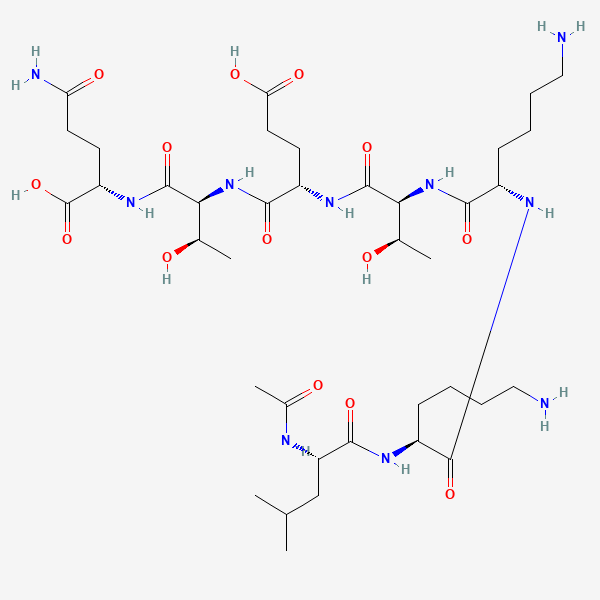
- Molecular formula
- C38H68N10O14
- Molecular weight
- 889 g/mol
- IUPAC name
- (2S)-2-[[(2S,3R)-2-[[(2S)-2-[[(2S,3R)-2-[[(2S)-2-[[(2S)-2-[[(2S)-2-acetamido-4-methylpentanoyl]amino]-6-aminohexanoyl]amino]-6-aminohexanoyl]amino]-3-hydroxybutanoyl]amino]-4-carboxybutanoyl]amino]-3-hydroxybutanoyl]amino]-5-amino-5-oxopentanoic acid
Verified external records:
References
- 1.TB-500 — indexed research (PubMed, National Library of Medicine)
- 2.TB-500 (thymosin beta-4 17–23 fragment) cardiovascular-biomarker trial — NCT07487363 (ClinicalTrials.gov)
- 3.Rahaman et al. (2024) — TB-500 metabolites and in-vitro wound-healing activity
- 4.Mayfield et al. (2026) — injectable peptide therapy: a primer for orthopaedic and sports-medicine physicians
- 5.Judák et al. (2017) — TB-500 among doping-relevant peptides in anti-doping analysis
- 6.FDA — drug approval and compounding information
- 7.FDA (2026) — briefing document for TB-500-related bulk drug substances
- 8.University Hospitals Coventry and Warwickshire NHS Trust — injection aftercare
- 9.Kent Community Health NHS Foundation Trust — injection reactions and infection warning signs
- 10.Rahman OF et al. — Therapeutic Peptides in Orthopaedics: Applications, Challenges, and Future Directions.
- 11.Mendias CL et al. — Safety and Efficacy of Approved and Unapproved Peptide Therapies for Musculoskeletal Injuries and Athletic Performance.
- 12.Moiz A et al. — Dangers of Injectable Peptides and Other Unregulated "Biohacking" Drugs.
More on TB-500
Everything else we've written about TB-500 — what the community reports, the explainers that cover it, and the terms it keeps running into.
- TB-500 on Reddit: what users actually reportOn Reddit
- Bacteriostatic waterGlossary
- Lyophilized (freeze-dried)Glossary
- WADA Prohibited List peptidesGlossary