Also known as: Thymosin β4 · Tβ4 · TB4 · Thymosin beta 4 acetate
Animal-onlyUnclear⚠ none in humans
On this page
- What is thymosin beta-4?
- How does thymosin beta-4 work?
- What does the research show?
- Thymosin beta-4 vs TB-500 — the fragment people actually buy
- What the community reports
- Is thymosin beta-4 safe? Side effects
- FDA & legal status (2026)
- How is thymosin beta-4 used, and can it be mixed?
- Frequently asked questions
- Who is thymosin beta-4 for — and who should be cautious?
- Evidence by outcome
- FDA & legal status
- Registered clinical trials
- Chemical identifiers
- References
- Related compounds
- More on Thymosin Beta-4
Thymosin beta-4 is a natural 43-amino-acid peptide your own cells make to rebuild damaged tissue, and it is one of the few research peptides with genuine human trials behind it — for dry eye and heart-attack recovery. The catch: the muscle-and-tendon healing people inject thymosin beta-4 for still rests on animal data. Thymosin beta-4 is not FDA-approved.
What is thymosin beta-4?
Thymosin beta-4 is a small protein — a chain of 43 amino acids (sequence SDKPDMAEIEKFDKSKLKKTETQEKNPLPSKETIEQEKQAGES, molecular weight about 4,963 daltons) — that nearly every cell in your body already produces. It is not a foreign drug in the way most research peptides are; it is one of the most abundant peptides in human cells, where its day job is managing a building material called actin. People injecting it are adding more of a molecule the body makes on its own. In the United States thymosin beta-4 is not a prescription medicine and not a supplement — it is sold as a research chemical, while its most developed medical form is a topical eye drop still working through trials.
How does thymosin beta-4 work?
Thymosin beta-4 works mainly by controlling actin, the scaffolding cells build and rebuild every time they need to move. Picture a repair cell crawling into a fresh wound: to move, it has to keep assembling and disassembling that scaffold at its leading edge. Thymosin beta-4 is the cell’s actin quartermaster — it holds a reserve of loose actin building blocks (called G-actin) and hands them out where they are needed. Through that role, thymosin beta-4 is linked to three things that matter for healing: cells migrating into damaged tissue, new blood vessels sprouting toward an injury (angiogenesis), and inflammation settling down. That is the plausible throughline for why researchers keep testing it in wounds, eyes and hearts. The honest caveat: the actin biology is well established in the lab, but how much of the healing effect that produces in a living human body — outside the eye studies — is not settled.
What does the research show?
Thymosin beta-4 sits in an unusual spot for a research peptide: it has real human trials, but mostly for conditions the biohacker crowd never searches for. Here is the honest split, by use.
The eye (strongest human evidence). As the topical drop RGN-259, thymosin beta-4 has been through several completed randomized Phase 2 and Phase 3 trials for dry eye disease (for example the ARISE-2 and ARISE-3 Phase 3 studies, NCT02974907 and NCT03937882), with a Phase 3 trial in neurotrophic keratitis, SEER-2, currently recruiting (NCT05555589). This is genuine human-RCT territory — but the dry-eye results have been mixed across endpoints, and thymosin beta-4 is not FDA-approved for any eye condition yet.
The heart and skin (early human trials). Thymosin beta-4 has been tested in completed Phase 2 trials for acute myocardial infarction — the recovery period after a heart attack — in China (NCT05485818, NCT05984134), with another Phase 2 registered to start in 2026. Earlier, it ran through Phase 2 wound-healing trials in pressure ulcers and venous stasis ulcers. These programs produced signals worth following, but none has crossed into approval, so both remain unproven in people.
Muscle, tendon and systemic recovery (the community use). This is the reason most people look up thymosin beta-4 — and it is exactly where the human evidence runs out. The tissue-repair story for tendons, muscle and whole-body recovery rests on rodent and cell studies; no human trial has tested thymosin beta-4 for musculoskeletal healing. In the tier we use on this site, that use is animal-only, with no human data — promising in rodents, unknown in humans. Framed forward: the human testing that already exists for the eye and heart shows this molecule can reach a clinic; the muscle question simply has not been asked in a trial yet. Indexed research on thymosin beta-4 runs to hundreds of human-tagged papers, but they cluster around the eye, heart and basic biology — not the injury recovery it is sold for.
Thymosin beta-4 vs TB-500 — the fragment people actually buy
Thymosin beta-4 and TB-500 get used as if they were the same thing, and they are close but not identical. TB-500, the peptide sold across the research-chemical market for injury recovery, is commonly a fragment or synthetic analog of thymosin beta-4 — built around the short actin-binding stretch of the full molecule (a recruiting trial literally describes TB-500 as the “Thymosin Beta 4 17-23 Fragment,” NCT07487363). So thymosin beta-4 is the full 43-amino-acid natural peptide with the real clinical program behind it; TB-500 is the shorter, cheaper version most people actually inject. Neither has a human trial for the tendon-and-muscle use they share. For the full head-to-head on the fragment, see the BPC-157 vs TB-500 comparison and the TB-500 page; thymosin beta-4 also sits alongside BPC-157 in the healing peptides hub.
What the community reports
Thymosin beta-4 has a real word-of-mouth following, though most of it flies under the name TB-500. The commonly reported pattern is subcutaneous injections of a few milligrams a week for several weeks, aimed at stubborn tendon, joint and muscle injuries, often stacked with BPC-157 (the “Wolverine stack”). These accounts are anecdotal, and there is no human study behind the recovery use — they carry survivorship bias (people who feel nothing tend to stop posting), no dosing accuracy, and no way to separate the peptide from rest and time. They are useful for understanding why people are interested, not for proving thymosin beta-4 works for injuries.
Is thymosin beta-4 safe? Side effects
Thymosin beta-4’s honest safety answer is “reassuring so far, but thin.” In the small completed human trials — topical eye drops and early systemic studies — thymosin beta-4 was generally well tolerated, with no major safety signal reported. That is encouraging, but those trials were small and short, and there is no long-term human safety data for the injected muscle-recovery use. The most-discussed theoretical concern is the flip side of its mechanism: a peptide that drives cell migration and new blood-vessel growth raises the reasonable, unproven question of whether it could feed something you would not want to grow, such as an existing tumor. That concern is unsettled in either direction. The most concrete real-world risk is the same one that applies to every research-chemical vial: purity, dose accuracy and sterility vary from vendor to vendor, and nobody is checking the label for you.
FDA & legal status (2026)
Thymosin beta-4 is not FDA-approved for any use, and it is not a legal dietary supplement — in the United States it is sold strictly as a research chemical. Its most advanced medical form is the topical eye drop RGN-259, still in clinical trials rather than on pharmacy shelves. For athletes, thymosin beta-4 matters in a different way: it and its fragment TB-500 are treated by anti-doping authorities as prohibited growth factors affecting tissue regeneration, banned at all times in sport. This status is current as of 2026 and worth re-checking — the eye program is the one to watch for any change. The full dated breakdown is in the regulatory block below.
How is thymosin beta-4 used, and can it be mixed?
Thymosin beta-4 comes as a lyophilized (freeze-dried) powder that has to be reconstituted with bacteriostatic water before injection; in the eye program it is a topical solution instead (the neurotrophic-keratitis trial uses a 0.1% RGN-259 drop). Getting an injectable concentration right is pure arithmetic — our reconstitution & dosing calculator turns a vial size, a water volume and a target dose into the exact number of syringe units to draw. People also ask whether thymosin beta-4 (or TB-500) can share a syringe with other peptides like BPC-157; our mixing compatibility reference covers what is commonly combined and where the honest answer is still “not enough data.” Note that every dose figure here is what is reported in trials or the community — not a protocol we are handing you.
Frequently asked questions
Is thymosin beta-4 proven to work in humans?
Thymosin beta-4 has real human trials — but for dry eye, neurotrophic keratitis, heart recovery and wound healing, not for the muscle-and-tendon use it is sold for. None of those programs has led to an FDA approval yet, and the injury-recovery use has no human trial at all. So the honest answer is: tested in humans for some conditions, unproven overall, and animal-only for the reason most people are asking.
Is thymosin beta-4 the same as TB-500?
Not quite. Thymosin beta-4 is the full, natural 43-amino-acid peptide. TB-500 is the shorter fragment or analog sold across the research-peptide market — built around thymosin beta-4’s actin-binding region. People use the names interchangeably, but the molecule in a “TB-500” vial is usually not the complete thymosin beta-4 that went through the clinical trials.
Is thymosin beta-4 legal?
Thymosin beta-4 is legal to buy and sell in the United States as a research chemical, but it is not an approved drug and not a legal dietary supplement, and it cannot be sold for human consumption. That is why every vendor lists it “for research use only.”
Is thymosin beta-4 banned in sport?
Yes. Thymosin beta-4 and TB-500 are treated as prohibited growth factors affecting tissue regeneration and are banned at all times for athletes under anti-doping rules — this is one of the better-known peptides in doping cases.
How do people take thymosin beta-4?
In the research and community setting, thymosin beta-4 (usually as TB-500) is injected subcutaneously after being reconstituted with bacteriostatic water, commonly a few milligrams per week. In the clinical eye program it is a topical drop instead. The injectable route is what community reports describe; none of it is a validated protocol.
Who is thymosin beta-4 for — and who should be cautious?
Thymosin beta-4 draws in two very different crowds: patients in eye and cardiac trials, and lifters chasing recovery from a tendon or joint that will not heal. The honest framing for the second group: thymosin beta-4 is one of the more interesting healing peptides precisely because it has already reached real human trials — so it is not pure speculation the way some research peptides are — but those trials are for other conditions, and the injury-recovery use you are here for has no human data behind it yet. The long-term safety of injecting it is unknown, and the product you would buy is unregulated. Anyone pregnant, managing a cancer history, or unwilling to sit with genuine unknowns has every reason to wait for better human evidence.
Evidence by outcome
Each outcome Thymosin Beta-4 has been studied for, with the honest evidence grade and what the studies actually found. A tier never stands alone — the verdict rides with it.
| Outcome | Evidence | What was found |
|---|---|---|
| Ocular surface repair (dry eye, neurotrophic keratitis) | Human RCTMixed | Thymosin beta-4, as the topical eye drop RGN-259, has been through several completed randomized Phase 2 and Phase 3 trials for dry eye disease, and a Phase 3 trial in neurotrophic keratitis is recruiting. Results across the dry-eye program have been mixed on primary endpoints, and thymosin beta-4 is not FDA-approved for any eye condition yet. |
| Cardiac repair after heart attack | Human (controlled)Unclear | Thymosin beta-4 has been tested in completed Phase 2 trials in China for acute myocardial infarction, with another Phase 2 study registered for 2026. Whether thymosin beta-4 measurably improves heart recovery in people is still an open question — the program is early and no approval has followed. |
| Dermal wound healing (pressure & venous ulcers) | Human (controlled)Mixed | Thymosin beta-4 ran through Phase 2 wound-healing trials in pressure ulcers and venous stasis ulcers, plus a terminated study in the skin-blistering disease epidermolysis bullosa. The dermal program produced signals but did not advance to approval, so the human wound-healing case remains unproven. |
| Soft-tissue & musculoskeletal recovery (the community use) | Animal-onlyUnclear⚠ none in humans | The tendon, muscle and systemic-recovery use that drives most searches for thymosin beta-4 rests on animal and cell studies — no human trial has tested thymosin beta-4 for musculoskeletal healing. Promising in rodents, unknown in humans. |
FDA & legal status
- United States: research use only (as of Jul 2026)
Thymosin beta-4 is not an FDA-approved drug and not a dietary supplement — in the United States it is sold only as a research chemical. Its most advanced human program is the topical eye drop RGN-259 (dry eye / neurotrophic keratitis), which is still in trials. Status is dated; re-verify against ClinicalTrials.gov and FDA.
openFDA Drugs@FDA lists no approved product for thymosin beta-4 as of 2026-07-15.
Registered clinical trials
18 registered studies mention Thymosin Beta-4 on ClinicalTrials.gov (latest update 2026-10-21). A registered trial means a study is planned or underway — not that Thymosin Beta-4 is approved or proven.
Chemical identifiers
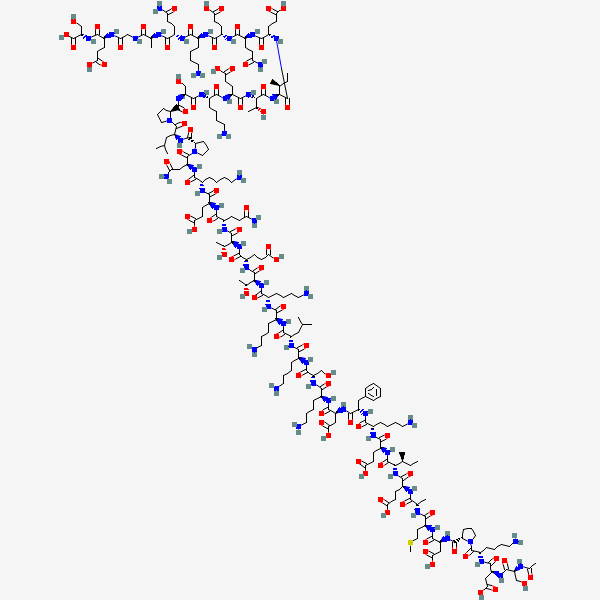
- Molecular formula
- C212H350N56O78S
- Molecular weight
- 4963 g/mol
- IUPAC name
- 4-[[2-[2-[[2-[[2-[[2-[[2-[[2-[[2-[[2-[[2-[[2-[[2-[[1-[2-[[1-[2-[[2-[[2-[[2-[[2-[[2-[[2-[[2-[[2-[[2-[[2-[[2-[[2-[[2-[[2-[[2-[[2-[[2-[[2-[2-[[2-[[2-[[1-[2-[[2-[(2-acetamido-3-hydroxypropanoyl)amino]-3-carboxypropanoyl]amino]-6-aminohexanoyl]pyrrolidine-2-carbonyl]amino]-3-carboxypropanoyl]amino]-4-methylsulfanylbutanoyl]amino]propanoylamino]-4-carboxybutanoyl]amino]-3-methylpentanoyl]amino]-4-carboxybutanoyl]amino]-6-aminohexanoyl]amino]-3-phenylpropanoyl]amino]-3-carboxypropanoyl]amino]-6-aminohexanoyl]amino]-3-hydroxypropanoyl]amino]-6-aminohexanoyl]amino]-4-methylpentanoyl]amino]-6-aminohexanoyl]amino]-6-aminohexanoyl]amino]-3-hydroxybutanoyl]amino]-4-carboxybutanoyl]amino]-3-hydroxybutanoyl]amino]-5-amino-5-oxopentanoyl]amino]-4-carboxybutanoyl]amino]-6-aminohexanoyl]amino]-4-amino-4-oxobutanoyl]pyrrolidine-2-carbonyl]amino]-4-methylpentanoyl]pyrrolidine-2-carbonyl]amino]-3-hydroxypropanoyl]amino]-6-aminohexanoyl]amino]-4-carboxybutanoyl]amino]-3-hydroxybutanoyl]amino]-3-methylpentanoyl]amino]-4-carboxybutanoyl]amino]-5-amino-5-oxopentanoyl]amino]-4-carboxybutanoyl]amino]-6-aminohexanoyl]amino]-5-amino-5-oxopentanoyl]amino]propanoylamino]acetyl]amino]-5-[(1-carboxy-2-hydroxyethyl)amino]-5-oxopentanoic acid
Verified external records:
References
- 1.Thymosin beta-4 — indexed research (PubMed, National Library of Medicine)
- 2.Thymosin beta-4 — registered clinical studies (ClinicalTrials.gov)
- 3.RGN-259 (thymosin beta-4) dry-eye Phase 3 trial ARISE-3 (ClinicalTrials.gov NCT03937882)
- 4.FDA — Drugs (approval status lookup)
- 5.USADA — Prohibited List (peptide hormones & growth factors)
More on Thymosin Beta-4
Everything else we've written about Thymosin Beta-4 — what the community reports, the explainers that cover it, and the terms it keeps running into.