Also known as: Eyeseryl · N-acetyl-beta-alanyl-L-histidyl-L-seryl-L-histidine · Ac-beta-Ala-His-Ser-His-OH
AnecdotalUnclear
On this page
- What is acetyl tetrapeptide-5?
- How is Eyeseryl supposed to work?
- Does acetyl tetrapeptide-5 work for eye bags?
- Can acetyl tetrapeptide 5 help dark circles?
- Is acetyl tetrapeptide-5 safe?
- Is acetyl tetrapeptide-5 FDA-approved or legal in 2026?
- Evidence by outcome
- FDA & legal status
- Chemical identifiers
- References
- Related compounds
Topical acetyl tetrapeptide-5 (Eyeseryl) is sold for under-eye puffiness and dark circles, but the evidence is mostly lab work plus a small supplier study. The peptide may affect ACE activity, vascular permeability, and glycation. Independent clinical proof is not there yet, and FDA has not approved it as a drug.
Key facts
- Evidence tier: Anecdotal for eye bags; in-vitro for mechanism
- Studied for: Puffiness, eye-bag appearance, and dark circles
- U.S. status (2026): Legal cosmetic ingredient; not an FDA-approved drug
- How it is used: Topically in finished eye creams and serums, not injected
- Main unknown: Whether the peptide itself beats the cream base in people
What is acetyl tetrapeptide-5?
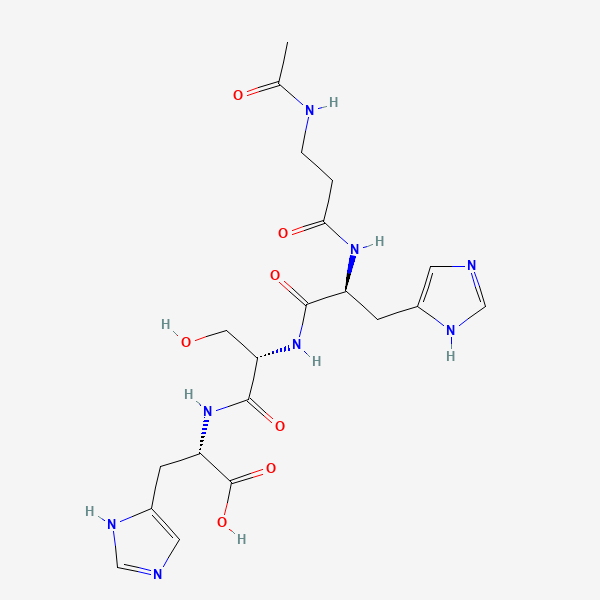
Acetyl tetrapeptide-5 is a synthetic four-residue peptide developed for topical eye-area cosmetics and sold under the trade name Eyeseryl. PubChem identifies it as Ac-βAla-His-Ser-His-OH, with molecular formula C20H28N8O7, molecular weight 492.5 g/mol, CAS 820959-17-9, and PubChem CID 11620163.
The first residue is beta-alanine, so a standard four-letter protein sequence would be misleading. The chemically useful sequence includes the acetyl cap and reads Ac-beta-Ala-His-Ser-His-OH. Acetyl tetrapeptide 5 is an INCI cosmetic ingredient, not a medicine or an injectable research peptide. It belongs with other cosmetic peptides, though its evidence rung is much lower than some neighbors.
How is Eyeseryl supposed to work?
Eyeseryl is proposed to tackle fluid-related puffiness through three connected lab mechanisms: inhibiting angiotensin-converting enzyme 1 (ACE1), reducing leakage across small blood vessels, and limiting glycation, the sugar-driven cross-linking that makes structural proteins less flexible. Picture a leaky garden hose under thin fabric: less seepage could mean less visible swelling, but only if leakage is the actual cause.
A peer-reviewed human-skin-fibroblast study found an ACE1-related activity signal for acetyl tetrapeptide-5 at 100 micrograms per milliliter. A mixture containing the peptide also improved several antioxidant and matrix markers in cells. That was a dish experiment using a blend, not a topical eye-puffiness trial. Cells do not have tear troughs.
That makes it an eye puffiness peptide in marketing copy, not a proven treatment for every kind of under-eye bag.
Does acetyl tetrapeptide-5 work for eye bags?
Acetyl tetrapeptide-5 has a plausible lab story and a weak human story. A 2025 review found only one 20-person evaluation, graded the ingredient’s evidence low, and called for larger, better-stratified clinical studies. An exact-name ClinicalTrials.gov search on July 16, 2026 returned no registered study. That is why the headline verdict remains unknown, not “clinically proven.”
The famous supplier number deserves a closer look. The Eyeseryl supplier sheet opened for this review describes 20 women using one formulation for 60 days and a separate 17-person test in which 70% had reduced eye bags after 28 days. That is not the web’s widely copied “70% improved by day 15” line. The sheet does not report the kind of randomization, blinding, vehicle control, or peer-reviewed methods needed to turn a before-and-after result into reliable independent evidence.
The 2017 MDPI review of topical peptides lists acetyl tetrapeptide-5 but says little in-vivo efficacy data was available across many cosmetic peptides and warns that blended formulations often prevent researchers from assigning an effect to one ingredient. That caveat carries more weight than a percentage copied from sales material. No bottle is being sold here, which makes saying so pleasantly uncomplicated.
Can acetyl tetrapeptide 5 help dark circles?
Acetyl tetrapeptide 5 dark circles claims are even less settled than puffiness claims because “dark circles” describes several different problems. Fluid retention and visible vessels may respond differently from melanin pigmentation, thin skin, shadowing from a deep tear trough, or protruding fat. One ingredient is unlikely to fix all five merely because the label says “eye serum.”
The 2025 MDPI review reports proposed improvements in edema and dark-circle appearance through ACE inhibition, hydration, and elasticity, but again traces the human evidence to a single small study. Acetyl tetrapeptide-5 eye bags caused mainly by temporary fluid buildup are the most biologically plausible target. Structural bags and pigment-driven darkness are different jobs.
Is acetyl tetrapeptide-5 safe?
Acetyl tetrapeptide-5 has not produced a clear safety alarm in the small topical tests, but ingredient-specific long-term human safety data are thin. Eye creams are multi-ingredient products, so redness, stinging, watering, or contact irritation can come from preservatives, fragrance, solvents, or another active rather than the peptide itself.
That uncertainty is ordinary for cosmetics, but it should not be edited into “100% safe.” Keep finished products out of the eye itself and treat persistent irritation as a reason to stop using the product. The available literature supports topical cosmetic discussion only; it provides no basis for injection, reconstitution, or systemic dosing.
Is acetyl tetrapeptide-5 FDA-approved or legal in 2026?
Acetyl tetrapeptide-5 is legally marketed in U.S. cosmetics, but it is not an FDA-approved drug and has no approved medical indication. FDA explains that cosmetic ingredients generally do not receive premarket approval, apart from certain color additives. Companies must instead substantiate safety, label products correctly, list products as required, and comply with the Modernization of Cosmetics Regulation Act.
That distinction matters. “Not FDA-approved” does not make an eye cream illegal; “used in legal cosmetics” does not mean FDA verified that it reduces edema. Appearance claims keep a product in the cosmetic lane. Claims to treat a disease or alter body function can move it into drug territory. For the wider category, see peptides for skin; for a cosmetic peptide with stronger human wrinkle data, compare Argireline.
Evidence by outcome
Each outcome Acetyl Tetrapeptide-5 has been studied for, with the honest evidence grade and what the studies actually found. A tier never stands alone — the verdict rides with it.
| Outcome | Evidence | What was found |
|---|---|---|
| Under-eye puffiness and eye-bag appearance | AnecdotalUnclear | A small supplier study in human volunteers reports improvement, but no robust independent randomized trial has isolated acetyl tetrapeptide-5 against a vehicle control. The human signal is therefore marketing-adjacent and remains unconfirmed. |
| ACE1 activity and anti-aging effects in skin cells | In-vitroHelped⚠ none in humans | A peer-reviewed cell study found ACE1 activity at 100 micrograms per milliliter and favorable antioxidant markers in a multi-peptide mixture. It did not test topical eye bags in people or isolate the peptide's clinical effect. |
FDA & legal status
- United States: unscheduled (as of Jul 2026)
Acetyl tetrapeptide-5 is sold in topical cosmetics, not as an FDA-approved drug. FDA does not pre-approve cosmetic ingredients other than certain color additives; cosmetic firms remain responsible for safety substantiation, labeling, and compliance with MoCRA.
Chemical identifiers
References
- 1.Acetyl tetrapeptide-5 — PubChem CID 11620163
- 2.Advancements in Cosmetic Science — acetyl tetrapeptide-5 evidence review
- 3.Wu et al., 2021 — cosmeceutical peptide mixtures in human skin fibroblasts (PMID 33849044)
- 4.Topical Peptide Treatments with Effective Anti-Aging Results — evidence limitations review
- 5.FDA — Cosmetics & U.S. Law