Also known as: Acetyl hexapeptide-8 · Acetyl hexapeptide-3 · AH8 · Acetyl-glu-glu-met-gln-arg-arg-amide
Human RCTMixed
On this page
- What is argireline?
- How does argireline work?
- What does the research on argireline show?
- What the community reports
- Is argireline safe? Side effects
- FDA & legal status (2026)
- How is argireline used?
- Argireline vs Botox and injectables
- Frequently asked questions
- Who is argireline for — and who should skip it?
- Evidence by outcome
- FDA & legal status
- Registered clinical trials
- Reported side effects
- Chemical identifiers
- References
- Related compounds
- More on Argireline
Argireline (acetyl hexapeptide-8) is a synthetic six-amino-acid peptide used in topical anti-aging skincare to soften expression lines. Unlike most research peptides, argireline has actually been through small human trials — and they show a modest, real reduction in wrinkle depth, not the needle-free Botox some marketing promises. Argireline is a legal cosmetic ingredient, not an FDA-approved drug.
What is argireline?
Argireline is the trade name for acetyl hexapeptide-8 (older label: acetyl hexapeptide-3), a lab-made peptide built from six amino acids — sequence Ac-EEMQRR-NH₂ (glutamic acid, glutamic acid, methionine, glutamine, arginine, arginine, capped with an acetyl group at one end and an amide at the other). Chemically it is a single small molecule, formula C₃₅H₆₂N₁₄O₁₁S, weighing roughly 887 daltons (PubChem CID 71587772). Its whole reason for existing is cosmetic: argireline is one of the most widely used “peptide” ingredients in leave-on serums and creams sold for fine lines around the eyes and forehead. You can see its building blocks on their own pages — arginine, glutamic acid and methionine — and it sits in our cosmetic peptides hub.
How does argireline work?
Argireline works by imitating a protein your nerves use to tell facial muscles to contract. That signal — the neurotransmitter acetylcholine — is released when a set of proteins called the SNARE complex snap together and let a vesicle dock and dump its cargo at the nerve-muscle junction. One of those SNARE proteins is SNAP-25, and argireline is a copy of the very tip of SNAP-25. The idea is that argireline acts as a decoy: it competes for a spot in the SNARE machinery, so the docking is slightly less efficient and the muscle gets a quieter “contract” message. Do that day after day and the repeated creasing that etches expression lines is supposed to ease off.
The everyday version: think of the SNARE complex as a dock crew that unloads a delivery boat. SNAP-25 is one specific worker. Argireline is a look-alike stand-in who keeps stepping into that worker’s spot and slowing the unloading — cargo still gets off the boat, just less of it, less often. That is the same broad target botulinum toxin (Botox) hits, which is why argireline gets called a “topical Botox peptide.” The honest caveat: botulinum toxin is injected and blocks the machinery hard; argireline is rubbed on the skin and nudges it gently, and a real open question is how much of an ~887-dalton peptide even crosses the outer skin barrier to reach the muscle.
What does the research on argireline show?
Argireline is one of the rare cosmetic peptides with genuine human data behind it, and that is the most important thing to know about it. Small human trials — including a registered Phase 3 study of periorbital (around-the-eye) wrinkles and later cosmetic studies of an eye serum — report modest improvements in the depth and appearance of expression lines with regular topical use. Across the literature, acetyl hexapeptide-8 shows up in dozens of records, a meaningful share of them human (indexed on PubMed). We grade the headline wrinkle use Human RCT · verdict: mixed — human-tested, but the effect is modest and several trials are small and industry-adjacent (see how we grade evidence at /evidence-grading).
The picture beyond wrinkles is thinner. Argireline has also been put through a small study of oily-skin appearance and registered NIH trials for blepharospasm (involuntary eyelid spasm) — one completed, one terminated early — where no clear benefit is established, so the honest verdict there is unknown, not positive. None of this is animal-only guesswork: argireline has been in front of real people. What it hasn’t done is match an injectable, and the size of its cosmetic effect is best described as “smoother-looking, not erased.”
What the community reports
Argireline has a large following in the skincare community, where it is a staple in DIY and drugstore “peptide serum” routines aimed at forehead and eye lines. The commonly reported pattern is a leave-on serum applied once or twice daily for several weeks, with users describing softer-looking fine lines rather than a dramatic change. These accounts are anecdotal — no control group, no standardized measurement, and a strong dose of “you notice what you’re looking for.” They are useful for understanding why argireline is popular, not for proving how well it works; the human trials above are what carry that weight.
Is argireline safe? Side effects
Argireline is generally well tolerated, which is a large part of its appeal. Because argireline is applied topically rather than injected, systemic exposure is expected to be low, and the small human cosmetic studies have not surfaced serious safety signals. The most commonly reported issues are mild, transient skin irritation or redness at the application site, and — as with any leave-on cosmetic — the occasional contact sensitivity or allergic reaction to the peptide or to other ingredients in the product. Long-term safety data are limited, and “well tolerated in short cosmetic studies” is not the same as “studied for years.” As always with skincare, patch-testing a new product and checking the full ingredient list is the sensible move; anyone with a known allergy to the peptide or formulation should skip it.
FDA & legal status (2026)
Argireline is legal to buy and sell in the United States as a cosmetic ingredient, and it is not an FDA-approved drug. Under its INCI name “Acetyl Hexapeptide-8,” it appears in over-the-counter serums and creams that are regulated as cosmetics — a category the FDA does not pre-approve the way it approves drugs (FDA cosmetics law). That means a company can legally sell an argireline serum, but it cannot legally make drug-style claims (that it treats a disease or works like botulinum toxin) without crossing into drug territory. The full dated breakdown is in the regulatory-status block below; treat any “clinically proven” marketing language with the usual skepticism.
How is argireline used?
Argireline is used topically — this is a peptide you put on your skin, not one you reconstitute and inject, so our injection tools don’t apply to it. In practice it is formulated into leave-on serums and moisturizers and applied to clean skin, usually once or twice a day, on the areas where expression lines form (around the eyes, the forehead, between the brows). In cosmetic products it is commonly formulated at concentrations reported in the low-single-digit to ~10% range, though the finished product’s formulation — how well it’s delivered through the skin barrier — matters at least as much as the number on the label. We present that as information about how the ingredient is used, not as a personalized routine: there’s no “dose” to prescribe for a cosmetic you smooth onto your face.
Argireline vs Botox and injectables
Argireline and Botox get compared constantly because they aim at the same underlying machinery — the SNARE complex and SNAP-25 — but they are not in the same weight class. Botox (botulinum toxin) is a prescription drug injected into a specific muscle, where it blocks acetylcholine release strongly enough to relax that muscle for months. Argireline is a cosmetic peptide rubbed onto the skin surface that nudges the same pathway far more gently, if and when it penetrates. So argireline can soften the look of fine expression lines with consistent use, but it does not, and cannot, reproduce the effect of an injectable neuromodulator. If the honest goal is “a gentle, needle-free ingredient that may soften fine lines,” argireline fits; if it’s “eliminate a deep frown line,” it doesn’t.
Frequently asked questions
Does argireline actually work?
Argireline has real human trials behind it — more than almost any other cosmetic peptide — and they report a modest reduction in the appearance of fine expression lines with regular topical use. It works in the “smoother-looking” sense, not the “wrinkles erased” sense, and several studies are small and industry-linked, so we grade it Human RCT with a mixed verdict.
Is argireline the same as Botox?
No. Argireline targets the same SNARE/SNAP-25 machinery that botulinum toxin does, but argireline is a topical cosmetic peptide that nudges the pathway gently, while Botox is an injected prescription drug that blocks it strongly. Argireline cannot match the effect of an injectable.
Is argireline legal?
Yes. Argireline (acetyl hexapeptide-8) is legally sold in the United States as a cosmetic ingredient in over-the-counter skincare. It is not an FDA-approved drug, and products can’t legally make drug-style medical claims about it.
Is argireline safe to use on your face?
Argireline is generally well tolerated in cosmetic use, with mild, transient irritation or redness being the most commonly reported issue. Long-term data are limited, and patch-testing a new product is sensible — but it does not carry the risk profile of an injectable.
How long does argireline take to work?
In the cosmetic studies and community reports, argireline is used for several weeks of consistent daily application before any softening of fine lines is described. It is a gradual, use-it-continuously ingredient, not an overnight change, and the effect fades if you stop.
Who is argireline for — and who should skip it?
Argireline suits someone who wants a gentle, needle-free ingredient that may soften the look of fine expression lines, and who is comfortable with a modest, gradual effect rather than a dramatic one. Its honest strengths are that it’s actually been tested in humans (rare for a peptide), it’s well tolerated, and it’s a legal, easy-to-buy cosmetic. Its honest limits: the effect is modest, skin penetration of a large peptide is debated, and it is not a substitute for an injectable neuromodulator. Anyone chasing the erasure of deep, set-in wrinkles — or expecting “topical Botox” to mean literal Botox — is likely to be disappointed, and anyone with a known sensitivity to the peptide or a product’s other ingredients should pass.
Evidence by outcome
Each outcome Argireline has been studied for, with the honest evidence grade and what the studies actually found. A tier never stands alone — the verdict rides with it.
| Outcome | Evidence | What was found |
|---|---|---|
| Facial wrinkle reduction (topical) | Human RCTMixed | Unlike most research peptides, argireline has been tested in humans — small randomized and controlled cosmetic trials, including a registered Phase 3 periorbital-wrinkle study. They report modest reductions in the depth and appearance of expression lines, not the dramatic smoothing of an injectable. Several studies are small and industry-adjacent, and skin-penetration of an ~887-dalton peptide remains a live question — so the honest read is "a real but modest effect." |
| Blepharospasm (eyelid spasm) | Human (controlled)Unclear | Argireline has been studied in registered human trials for blepharospasm (involuntary eyelid spasm), sponsored by the NIH's NINDS. One completed and one was terminated early, and no clear efficacy result is established for this medical use — so the verdict here is unknown, not positive. |
FDA & legal status
- United States: unscheduled (as of Jul 2026)
Argireline (INCI name "Acetyl Hexapeptide-8") is legally sold as an ingredient in over-the-counter cosmetic skincare. It is not an FDA-approved drug and makes no approved medical claim. Cosmetics are not pre-approved by the FDA — the ingredient is regulated under cosmetic law rather than the drug-approval pathway. Re-verify if a product markets it with drug-like anti-aging claims.
openFDA Drugs@FDA lists no approved product for Acetyl hexapeptide-8 as of 2026-07-15.
Registered clinical trials
7 registered studies mention Argireline on ClinicalTrials.gov (latest update 2026-10-19). A registered trial means a study is planned or underway — not that Argireline is approved or proven.
| Study | Status | Phase | Sponsor |
|---|---|---|---|
| Argireline in Treatment of Periorbital WrinklesNCT01381484 | completed | Phase 3 | Mahidol University |
| Acetyl Hexapeptide-8 for BlepharospasmNCT01750346 | terminated | Phase 2 | National Institute of Neurological Disorders and Stroke (NINDS) |
| Investigating the Wrinkle Reduction Potential of a Novel Compounded Skin Care CreamNCT03878381 | completed | EARLY_Phase 1 | Wayne State University |
| A Study of Acetyl Hexapeptide-8 (AH8) in Treatment of BlepharospasmNCT00942851 | completed | Phase 1, PHASE2 | National Institute of Neurological Disorders and Stroke (NINDS) |
| AI-Personalized Skincare Regimen for Facial Photoaging in WomenNCT07879833 | completed | NA | MDalgorithms Inc. |
| A Clinical Trial to Evaluate the Effects of an Eye Serum on Improving the Appearance of the Periorbital AreaNCT06143033 | completed | NA | Dime Beauty Co. |
| Topical Acetyl Hexapeptide-8 and the Cosmetic Appearance of Oily SkinNCT02597777 | completed | NA | University of California, Davis |
Reported side effects
| Effect | Frequency | Severity |
|---|---|---|
| Mild, transient skin irritation or redness at the application site | — | mild |
| Contact sensitivity / allergic reaction to the peptide or formulation (uncommon) | — | mild |
Chemical identifiers
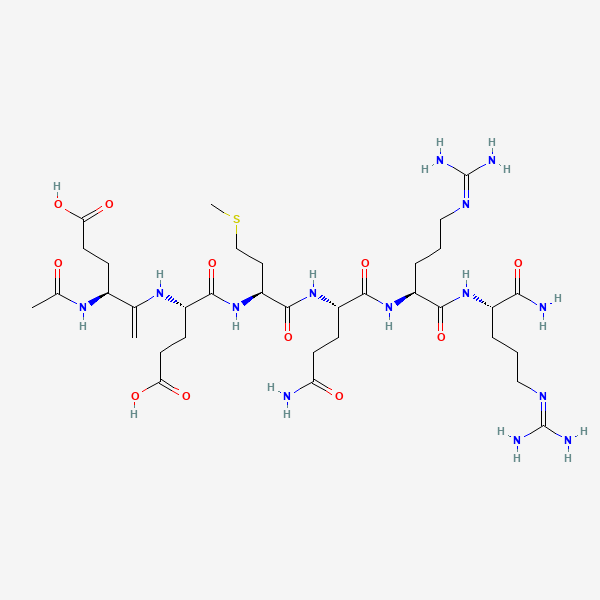
- Molecular formula
- C35H62N14O11S
- Molecular weight
- 887 g/mol
- IUPAC name
- (4S)-4-acetamido-5-[[(2S)-1-[[(2S)-1-[[(2S)-5-amino-1-[[(2S)-1-[[(2S)-1-amino-5-(diaminomethylideneamino)-1-oxopentan-2-yl]amino]-5-(diaminomethylideneamino)-1-oxopentan-2-yl]amino]-1,5-dioxopentan-2-yl]amino]-4-methylsulfanyl-1-oxobutan-2-yl]amino]-4-carboxy-1-oxobutan-2-yl]amino]hex-5-enoic acid
Verified external records:
References
- 1.Argireline in the Treatment of Periorbital Wrinkles — registered Phase 3 trial (ClinicalTrials.gov, NCT01381484)
- 2.Topical Acetyl Hexapeptide-8 and the Cosmetic Appearance of Oily Skin (ClinicalTrials.gov, NCT02597777)
- 3.Eye-serum periorbital-appearance study (ClinicalTrials.gov, NCT06143033)
- 4.Acetyl hexapeptide-8 — indexed research (PubMed, National Library of Medicine)
- 5.Acetyl hexapeptide-8 — compound record (PubChem CID 71587772)
- 6.FDA — Cosmetics & U.S. Law
More on Argireline
Everything else we've written about Argireline — what the community reports, the explainers that cover it, and the terms it keeps running into.
- Argireline reddit: Does It Work on Wrinkles?On Reddit
- Do Peptides Penetrate Skin? What Serums Really DoExplainer
- What Is a Biomimetic Peptide? Plain EnglishExplainer
- Peptide Alternatives to Botox: Do They Work?Explainer
- acetylationGlossary
- N-terminus and C-terminusGlossary
- PotencyGlossary