Also known as: Lumixyl · P4 · DA-52389
Human (controlled)Helped
On this page
- What is decapeptide-12?
- How does decapeptide-12 work?
- Does decapeptide-12 work for melasma?
- Is decapeptide-12 really 17 times stronger than hydroquinone?
- What does the post-inflammatory hyperpigmentation study show?
- Is decapeptide-12 safe? Side effects
- Is decapeptide-12 FDA-approved or banned in sport?
- Evidence by outcome
- FDA & legal status
- Chemical identifiers
- References
- Related compounds
Decapeptide-12 is a synthetic tyrosinase inhibitor used in topical skin-brightening products such as Lumixyl. A five-person split-face trial found improvement in stubborn melasma, but later studies were small and mostly open-label or combined several products. The evidence signal is human-controlled; the certainty and long-term safety picture remain limited.
Key facts
- What it is: a synthetic 10-amino-acid cosmetic peptide
- Studied for: melasma, sun-related discoloration, and post-inflammatory hyperpigmentation
- Evidence tier: human-controlled, based on one very small split-face trial
- U.S. status (2026): cosmetic ingredient; not an FDA-approved drug
- Reported topical use: 0.01% cream, usually twice daily in published studies
- Main uncertainty: uncommon reactions and long-term safety have not been measured well
- Sport: not named on the 2026 WADA Prohibited List
What is decapeptide-12?
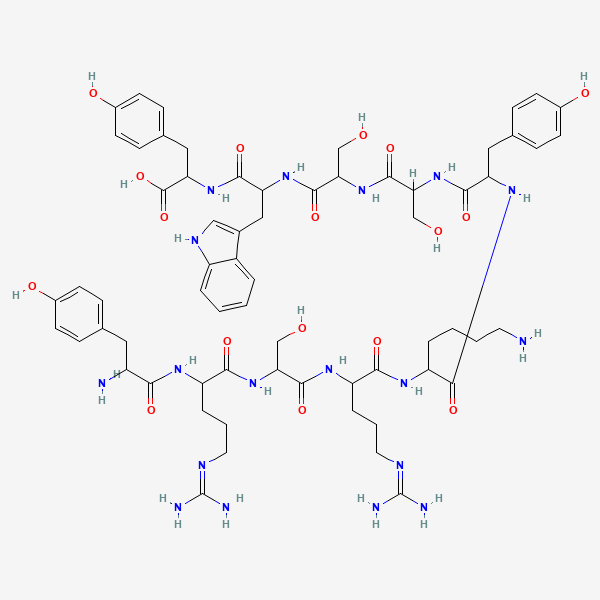
Decapeptide-12 is a lab-made chain of 10 amino acids with the sequence YRSRKYSSWY. PubChem lists CAS 137665-91-9, molecular formula C65H90N18O17, and molecular weight 1,395.5 g/mol. The peptide appeared in cosmetic products under the Lumixyl name and is sometimes called P4 in the laboratory paper that identified it.
The intended job is narrow: slow pigment production rather than bleach pigment already sitting in the skin. That places decapeptide-12 in the cosmetic peptide category, alongside ingredients that target wrinkles, texture, or uneven tone through different mechanisms.
How does decapeptide-12 work?
Decapeptide-12 competitively inhibits tyrosinase, meaning the peptide gets in the enzyme’s way while tyrosinase tries to make melanin. Tyrosinase is a copper-containing enzyme that handles early steps in pigment production. Think of it as a worker at the front of an assembly line: slowing that station can reduce what comes off the other end.
In the 2009 laboratory study, the 10-amino-acid peptide had an IC50 of 40 micromolar against mushroom tyrosinase, compared with 680 micromolar for hydroquinone. At 100 micromolar, it inhibited human tyrosinase by 25–35% and reduced melanin content in cultured melanocytes by 43% after seven days without reducing cell proliferation.
Those are useful mechanism results. They do not tell us how much peptide crosses living skin, how a finished product behaves, or whether the same numerical advantage appears on human faces.
Does decapeptide-12 work for melasma?
Decapeptide-12 has a positive controlled human signal for melasma, but the trial was tiny. The randomized, double-blind, split-face study enrolled five women with Fitzpatrick skin type IV and moderate melasma that had resisted earlier treatment. Each used 0.01% peptide cream and placebo on opposite sides of the face twice daily for 16 weeks. All five improved on the treatment side, with no visible irritation or allergy reported.
That design controls for differences between people because every participant supplies her own placebo side. Five participants, however, leave plenty of statistical wobble. The study supports a human-controlled tier, not a broad claim that decapeptide-12 melasma treatment is established.
Later studies were larger but weaker for isolating the peptide. A 2012 open-label study followed 15 women using a system that also contained an antioxidant cleanser, glycolic-acid moisturizer, and sunscreen; 13 finished. A 2013 study of 33 Hispanic women tested another multi-product routine containing 20% glycolic acid and SPF 30. Pigmentation improved, but sunscreen and glycolic acid are not decorative extras. The peptide cannot claim the whole result.
Is decapeptide-12 really 17 times stronger than hydroquinone?
The “17 times stronger” line describes an in-vitro enzyme calculation, not a head-to-head clinical result. Researchers divided hydroquinone’s 680-micromolar IC50 by the peptide’s 40-micromolar IC50 in a mushroom tyrosinase assay. The arithmetic is 17. The clinical conclusion is not “17 times better skin lightening.”
Decapeptide 12 skin brightening claims often drop the words “mushroom enzyme assay,” which do most of the honest work. The original paper also tested human tyrosinase and cultured human pigment cells, but no trial has randomized people to decapeptide-12 versus hydroquinone and shown a 17-fold clinical advantage. Enzymes are not faces, and micromolar potency is not a before-and-after photograph.
What does the post-inflammatory hyperpigmentation study show?
The post-inflammatory hyperpigmentation paper is a one-person case report, not a trial. The participant received four diamond-tip dermalinfusion procedures two weeks apart, 0.01% decapeptide-12 during those procedures, twice-daily Lumixyl cream between visits, and daily SPF 30 or higher. The report described faster clearing in skin of color.
That 2014 JDD report cannot separate the peptide from exfoliation, enhanced delivery, sunscreen, or time. It also disclosed that senior author Basil Hantash held stock in and served as vice chairman of the device maker. The case is a research lead, not a clean answer about the peptide alone.
Is decapeptide-12 safe? Side effects
Decapeptide-12 looked well tolerated in the small published studies, but the safety sample is too small to catch uncommon problems. The five-person controlled pilot reported no visible irritation or allergy. Open-label combination studies also described generally good tolerability, though other active ingredients muddy attribution.
The practical risks are irritation or contact allergy from the finished formula, plus worsening pigmentation if an irritating routine inflames the skin. Long-term studies, pregnancy-specific studies, and large surveillance datasets are missing. “No events in five people” is reassuring as a start; it is not the same as a mapped safety profile.
Is decapeptide-12 FDA-approved or banned in sport?
Decapeptide-12 is not an FDA-approved drug, and that is normal for a cosmetic ingredient. As of July 2026, FDA explains that cosmetic products and ingredients generally are not pre-approved, except for certain color additives. Companies remain responsible for safety substantiation and lawful labeling, while claims to treat disease can push a product into drug territory.
The 2026 WADA Prohibited List does not name decapeptide-12. That absence matters less here than it would for an injectable performance peptide: Lumixyl was developed as a topical cosmetic, not a performance drug. Athletes dealing with a specific product should still check the full ingredient list rather than treating one unlisted ingredient as clearance for the bottle.
Decapeptide-12 has more human evidence than many cosmetic peptides, but almost all of it fits on a very small table. For context, Melitane targets pigment signaling through a different proposed route and has thinner published human support. The broader guide to peptides for skin shows where both fit without turning a promising ingredient into a prescription.
Evidence by outcome
Each outcome Decapeptide-12 has been studied for, with the honest evidence grade and what the studies actually found. A tier never stands alone — the verdict rides with it.
| Outcome | Evidence | What was found |
|---|---|---|
| Melasma | Human (controlled)Helped | A randomized, double-blind, split-face pilot study in five women found that 0.01% decapeptide-12 improved recalcitrant melasma versus placebo over 16 weeks. The controlled design is useful, but five participants cannot provide a precise effect estimate or settle long-term safety. |
| Facial hyperpigmentation and photodamage | Human observationalHelped | Small open-label studies reported improvement with skin-brightening systems containing decapeptide-12. Those regimens also included glycolic acid, cleanser, moisturizer, or sunscreen, so the peptide's independent effect cannot be separated from the rest of the routine. |
| Post-inflammatory hyperpigmentation | Human observationalUnclear | One published case combined 0.01% decapeptide-12 cream, sunscreen, and four dermalinfusion procedures. Improvement in one person under a combined regimen is a lead for future testing, not proof that the peptide works by itself. |
FDA & legal status
- United States: unscheduled (as of Jul 2026)
Decapeptide-12 is sold as a topical cosmetic ingredient, not an FDA-approved drug. FDA generally does not pre-approve cosmetic products or ingredients, apart from certain color additives. Disease-treatment claims can change how a product is regulated.
Chemical identifiers
References
- 1.Decapeptide-12 compound record — PubChem CID 25087629
- 2.Abu Ubeid et al., 2009 — short-sequence oligopeptides and tyrosinase
- 3.Hantash and Jimenez, 2009 — randomized split-face melasma pilot
- 4.Kassim et al., 2012 — open-label skin-brightening study
- 5.Ramírez et al., 2013 — open-label melasma brightening-system study
- 6.Bhatia et al., 2014 — dermalinfusion and post-inflammatory hyperpigmentation
- 7.FDA — Cosmetics and U.S. law
- 8.WADA — 2026 Prohibited List