Also known as: Ac-KGHK · Ac-Lys-Gly-His-Lys-NH2 · Folixyl · Kollaren 6
In-vitroUnclear⚠ none in humans
On this page
- What are the key facts?
- What is acetyl tetrapeptide-3?
- Does acetyl tetrapeptide-3 hair research show growth?
- What does the Capixyl evidence actually prove?
- Is red clover doing part of the work?
- How might acetyl tetrapeptide-3 work?
- Is acetyl tetrapeptide-3 safe?
- Is acetyl tetrapeptide-3 FDA-approved in 2026?
- Evidence by outcome
- FDA & legal status
- Chemical identifiers
- References
- Related compounds
Acetyl Tetrapeptide-3 is a synthetic cosmetic peptide marketed for stronger hair anchoring and fuller-looking hair. The peptide alone has laboratory evidence, not a human hair-growth trial. Human results come from Capixyl or larger blends containing red clover extract, so they cannot show that acetyl tetrapeptide-3 caused the improvement.
What are the key facts?
Acetyl tetrapeptide-3 is best treated as an in-vitro hair active with an unresolved clinical effect. The chemistry is well identified; the leap from cultured follicles to more hair on a living scalp has not been tested cleanly. That distinction matters before reading product claims.
- What it is: Ac-Lys-Gly-His-Lys-NH2, a synthetic four-amino-acid peptide
- Studied for: follicle anchoring, hair density, and androgenetic alopecia
- Evidence tier: in-vitro for the peptide alone; human blend studies do not change that tier
- U.S. status (2026): cosmetic ingredient, not an FDA-approved hair-loss drug
- How it is used: topically in leave-on scalp serums and lotions
- Main risk: isolated long-term human safety is unknown; finished formulas may irritate
- Banned in sport: no peptide-specific WADA listing was verified; athletes still need to check the complete product
What is acetyl tetrapeptide-3?
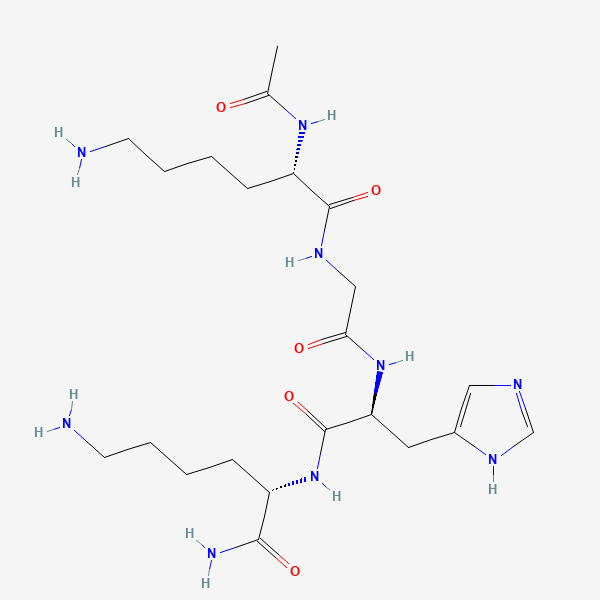
Acetyl tetrapeptide-3 is the modified sequence KGHK: lysine, glycine, histidine, and lysine, with an acetyl group at one end and an amide at the other. The PubChem record identifies CID 11752568, formula C22H39N9O5, molecular weight 509.6 g/mol, and CAS 827306-88-7. The often-repeated figure of roughly 487.55 does not match that record.
The acetyl cap is a chemical modification, not a fifth amino acid. Ac-KGHK is synthetic and belongs with other cosmetic peptides, where short sequences are used as signals in skin or hair formulations.
Does acetyl tetrapeptide-3 hair research show growth?
Acetyl tetrapeptide-3 hair research does not show that the isolated peptide regrows hair in people. The direct work comes from manufacturer cell assays, skin explants, and cultured human follicles. Those experiments reported more extracellular-matrix proteins and longer follicles, but none measured hair count on a person using the peptide alone.
The FDA’s laboratory report on cosmetic hair ingredients is unusually blunt: the effects of acetyl tetrapeptide-3 alone on hair growth are unknown. That is the useful evidence tier. Cultured tissue can show that a biological idea is possible; it cannot tell us how much serum reaches a scalp follicle or whether visible density changes.
What does the Capixyl evidence actually prove?
Capixyl evidence supports a blend, not acetyl tetrapeptide-3 by itself. Capixyl combines the peptide with red clover extract rich in biochanin A. Calling a Capixyl result “acetyl tetrapeptide 3 hair growth” gives one ingredient credit for a two-person job. The trial design makes that limit unavoidable.
The verified four-month study randomized 30 volunteers to the peptide–red-clover mixture or placebo and reported a 46% rise in the anagen-to-telogen ratio in the treatment group. The PubMed record identifies every author with Lucas Meyer Cosmetics, the ingredient’s developer. This was not an acetyl tetrapeptide-3-only arm.
A later 24-week trial randomized 32 people to a formula containing acetyl tetrapeptide-3, biochanin A, ginseng, sage oil, and other ingredients or 3% minoxidil. Terminal hair counts rose 8.3% and 8.7%, respectively, with no significant between-group difference (PMID 33584955). The authors reported no funding or conflicts, but the formula still prevents ingredient-level credit. A 2025 topical hair-loss review reaches the same practical problem: the evidence is mostly for combined formulations.
Is red clover doing part of the work?
Red clover could plausibly contribute because its biochanin A inhibits 5-alpha-reductase in laboratory models. That enzyme converts testosterone to dihydrotestosterone (DHT), which helps miniaturize susceptible follicles in androgenetic alopecia. The manufacturer’s own work assigns that anti-androgen mechanism to biochanin A, not to the peptide.
Acetyl tetrapeptide-3 is sometimes called a red clover peptide, but that label muddies the formula. The peptide is synthetic; red clover is a separate botanical component of Capixyl. The proposed division of labor is peptide for the follicle’s surrounding matrix, biochanin A for 5-alpha-reductase. Human blend trials cannot tell us whether one component, both, or the vehicle produced the result.
How might acetyl tetrapeptide-3 work?
Acetyl tetrapeptide-3 is proposed to increase collagen III, collagen VII, and laminin around the dermal papilla, the small structure at the base of a hair follicle. Picture those extracellular-matrix proteins as the follicle’s mooring lines: changing them might improve anchoring, but stronger-looking ropes in a laboratory do not prove that more ships stay in harbor.
The 2013 paper also reported inflammatory and follicle-growth findings for the combined product. Because its authors worked for Lucas Meyer Cosmetics and several experiments used the blend, the clean conclusion stays narrow: the mechanism is plausible, commercially generated, and ready for independent replication.
Is acetyl tetrapeptide-3 safe?
Acetyl tetrapeptide-3 does not have enough isolated human testing for a confident long-term safety estimate. The 32-person blend trial reported no local reactions in its combination group, but that result covers one finished formula for 24 weeks, not the pure peptide across products and years.
FDA laboratory testing found lower viability in cultured dermal papilla cells and normal human epidermal keratinocytes after longer exposure to higher concentrations. Cell toxicity is a warning flag for formulation work, not proof that a retail serum damages a scalp. Alcohol, fragrance, preservatives, and companion actives may also cause redness, itching, or eczema. Product-level tolerability matters more than a clean-sounding peptide name.
Is acetyl tetrapeptide-3 FDA-approved in 2026?
Acetyl tetrapeptide-3 is not FDA-approved as a hair-loss drug. FDA explains that cosmetics and their ingredients generally do not receive premarket approval, apart from color additives. A cosmetic can be sold without proving hair-regrowth efficacy to the standard required for a drug.
Claims change the legal lane. FDA says a claim to restore hair growth can make a product a drug based on intended use, even when the bottle calls itself a cosmetic. The ingredient’s FDA UNII identifies the substance; it does not approve it. The dated regulatory-status reference covers that distinction.
The honest read is early but specific: acetyl tetrapeptide-3 has a testable follicle-anchoring mechanism, while Capixyl has small human blend studies. What is missing is simple to describe and valuable to run—a vehicle-controlled human trial of the peptide alone, with hair counts, tolerability, and durability measured. Until then, the hair-growth peptide guide and evidence-grading framework keep the blend result in the right box.
Evidence by outcome
Each outcome Acetyl Tetrapeptide-3 has been studied for, with the honest evidence grade and what the studies actually found. A tier never stands alone — the verdict rides with it.
| Outcome | Evidence | What was found |
|---|---|---|
| Hair growth and follicle anchoring | In-vitroUnclear⚠ none in humans | Manufacturer cell and cultured-follicle work reports changes in extracellular-matrix proteins and follicle length. Every located human result tested acetyl tetrapeptide-3 with red clover extract or a larger blend, so no clinical study isolates the peptide's effect. |
FDA & legal status
- United States: unscheduled (as of Jul 2026)
Used as a cosmetic ingredient, not an FDA-approved hair-loss drug. FDA generally does not pre-approve cosmetic ingredients other than color additives. Claims that a finished product restores hair growth can make that product a drug under U.S. law.
Chemical identifiers
References
- 1.Acetyl tetrapeptide-3 — PubChem CID 11752568
- 2.Loing et al., 2013 — red clover extract and biomimetic peptide blend (PMID 23449130)
- 3.Lueangarun and Panchaprateep, 2020 — multi-ingredient blend versus minoxidil (PMID 33584955)
- 4.Bikash, 2025 — Topical Alternatives for Hair Loss (PMCID PMC12251978)
- 5.FDA — Studies on Hair Loss Associated with Cosmetic Hair Products and Ingredients
- 6.FDA — Why cosmetics are not FDA-approved