Also known as: biotinyl-GHK · biotin GHK peptide · Biotin-Gly-His-Lys
In-vitroUnclear⚠ none in humans
On this page
- What are the key facts?
- What is biotinoyl tripeptide-1?
- Does biotinoyl tripeptide 1 hair research show regrowth?
- What do the 58% and 121% hair-growth figures mean?
- Is Procapil the same as biotinoyl tripeptide-1?
- How might biotinoyl tripeptide-1 work?
- Is biotinoyl tripeptide-1 safe?
- Is biotinoyl tripeptide-1 FDA-approved in 2026?
- How is it different from GHK-Cu?
- Evidence by outcome
- FDA & legal status
- Chemical identifiers
- References
- Related compounds
Biotinoyl Tripeptide-1 is a synthetic cosmetic peptide designed to support hair anchoring, but the isolated ingredient has only laboratory and cultured-follicle evidence. Human studies test blends, not this peptide alone. It is not an FDA-approved hair-loss drug, and its long-term safety and real effect on scalp hair remain unknown.
What are the key facts?
Biotinoyl tripeptide-1 is best understood as an early-stage topical cosmetic active, not a miniature version of minoxidil. The chemistry is clear; the clinical result is not. That gap gets blurred whenever a cultured follicle, a three-ingredient blend, and a person are treated as interchangeable test systems.
- What it is: biotin attached to the GHK tripeptide
- Studied for: hair-follicle anchoring and growth
- Evidence tier: in-vitro, with no isolated human trial located
- U.S. status (2026): cosmetic ingredient; not an FDA-approved hair-growth drug
- Research concentrations: 2 and 5 parts per million in the widely repeated ex-vivo claims, not a consumer dose
- Main risk: isolated long-term human safety has not been established
- Banned in sport: no peptide-specific WADA listing was verified; topical cosmetic use is not an established doping category
What is biotinoyl tripeptide-1?
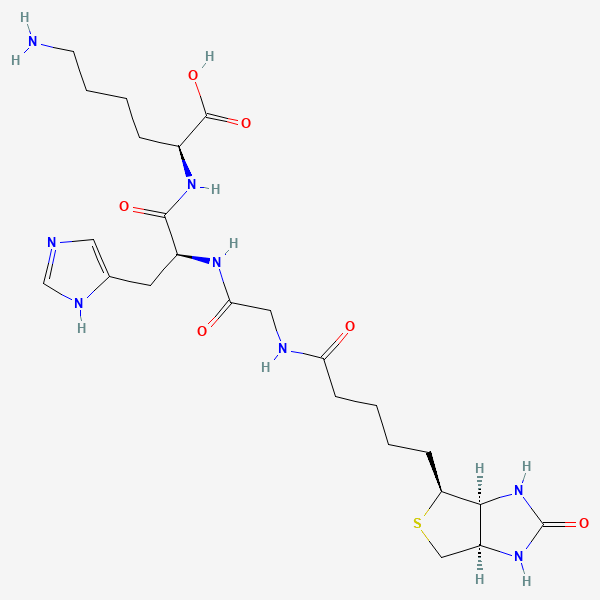
Biotinoyl tripeptide-1 is biotin chemically joined to GHK, the three-amino-acid sequence glycine-histidine-lysine. The PubChem record identifies the parent compound as CID 11534242 with formula C24H38N8O6S; the commonly cited CAS number is 299157-54-3. Another name, biotinyl-GHK, describes the same construction.
The biotin GHK peptide is synthetic even though both pieces are familiar biological molecules. Adding biotin creates a different conjugate with different properties; it does not mean topical biotin deficiency has been diagnosed or corrected.
Does biotinoyl tripeptide 1 hair research show regrowth?
Biotinoyl tripeptide 1 hair research does not yet show that the isolated peptide regrows hair in people. The direct case rests on cell work and ex-vivo follicles, meaning follicles removed from a person and kept alive in culture. That is closer to hair biology than a plastic dish of one cell type, but it is still not a treated scalp.
A 2025 human study did report changes after multi-ingredient treatment for androgenetic alopecia. The topical spray included a minoxidil-like compound, an absorption enhancer, and Procapil; one group also received a capsule containing amino acids, minerals, and vitamins. The authors state plainly that the design cannot attribute efficacy to an individual ingredient. Useful formula evidence, yes. Proof for biotinyl-GHK alone, no.
What do the 58% and 121% hair-growth figures mean?
The 58% and 121% figures describe a supplier-reported ex-vivo experiment, not percentage hair growth in people. Online ingredient pages repeatedly attach 58% growth at 2 ppm and 121% at 5 ppm to cultured human follicles. This research run did not locate a peer-reviewed primary paper with methods and raw results behind those numbers.
That missing paper matters. A follicle growing faster in culture does not tell us how many new hairs appear per square centimeter, whether shedding changes, how long an effect lasts, or whether a finished serum reaches the relevant tissue. The numbers are a laboratory lead, not a before-and-after promise.
Is Procapil the same as biotinoyl tripeptide-1?
Procapil is not biotinoyl tripeptide-1; Procapil is a three-part blend of biotinoyl tripeptide-1, apigenin, and oleanolic acid. Each component is assigned a different job in the formula: the peptide for matrix and anchoring signals, apigenin for vascular and inflammatory pathways, and oleanolic acid for androgen-related pathways.
That distinction blocks a common evidence shortcut. A Procapil trial tests the blend, and some products add still more actives. Any change could come from one component, several working together, the vehicle, or study bias. Calling the whole result “peptide evidence” gives one ingredient credit for a group project.
How might biotinoyl tripeptide-1 work?
Biotinoyl tripeptide-1 is proposed to support keratinocyte activity and the extracellular matrix that helps hold a hair follicle in place. Picture the matrix as the follicle’s mooring lines: stronger or better-organized proteins could make shedding less likely. Laboratory claims focus on proteins such as laminin and collagen around that junction.
The mechanism remains a hypothesis until isolated human testing connects those molecular changes to fewer shed hairs or higher density. GHK biology can help form the hypothesis, but evidence for another GHK conjugate cannot be copied across automatically.
Is biotinoyl tripeptide-1 safe?
Biotinoyl tripeptide-1 has too little isolated human research for a confident long-term safety estimate. In the 2025 multi-ingredient study, most participants rated tolerability good or very good; a minority reported scalp dryness, itching, increased sebum, or gastrointestinal discomfort. None of those effects can be assigned specifically to the peptide.
Finished formulas deserve their own ingredient check because preservatives, fragrance, solvents, and companion actives may drive irritation. Eye-area products add the practical risk of accidental eye exposure. Patch-testing guidance belongs to the finished product, not to an assumption that “peptide” means inert.
Is biotinoyl tripeptide-1 FDA-approved in 2026?
Biotinoyl tripeptide-1 is not FDA-approved as a drug for hair loss. FDA explains that it generally does not pre-approve cosmetic products or ingredients, apart from certain color additives. Cosmetic companies remain responsible for safety substantiation and proper labeling.
FDA also draws a sharp line around claims: saying a product restores hair growth can make that product a drug under U.S. law. DailyMed lists biotinoyl tripeptide-1 as an inactive ingredient in at least one topical serum, but a database listing is not an approval of this peptide as the active treatment.
How is it different from GHK-Cu?
Biotinoyl tripeptide-1 and GHK-Cu share the GHK sequence but carry different partners and lead with different uses. This peptide attaches biotin and is marketed mainly for hair anchoring. GHK-Cu binds copper and has a broader skin-repair and collagen research record. One is not a spelling variant of the other.
Readers comparing the wider field can use the cosmetic peptide hub and the evidence-based guide to peptides for hair growth. The clean verdict for biotinoyl tripeptide-1 remains in-vitro: a plausible follicle-targeted idea whose isolated human test has yet to be done.
Evidence by outcome
Each outcome Biotinoyl Tripeptide-1 has been studied for, with the honest evidence grade and what the studies actually found. A tier never stands alone — the verdict rides with it.
| Outcome | Evidence | What was found |
|---|---|---|
| Hair growth and anchoring | In-vitroUnclear⚠ none in humans | Cultured human follicles and laboratory cell claims provide the direct evidence for the isolated peptide. Human studies use multi-ingredient products, so they cannot show whether biotinoyl tripeptide-1 itself changes hair count, shedding, or thickness. |
FDA & legal status
- United States: unscheduled (as of Jul 2026)
Used as a cosmetic ingredient, not an FDA-approved hair-loss drug. FDA does not pre-approve cosmetic ingredients other than certain color additives; claims to restore hair growth can cause a finished product to be regulated as a drug. An ingredient appearing in a listed product is not FDA approval of the ingredient for hair growth.
Chemical identifiers