Also known as: ONO-7643 · RC-1291 · ST-1291 · anamorelin hydrochloride
Human RCTMixed
On this page
- What is anamorelin?
- How does anamorelin work?
- What did ROMANA 1 and ROMANA 2 find?
- Why does mass without function matter?
- Is anamorelin safe? Side effects
- What anamorelin dosage was studied?
- Is anamorelin FDA-approved in 2026?
- Anamorelin vs MK-677: what is the useful comparison?
- Is anamorelin banned in sport?
- Evidence by outcome
- FDA & legal status
- Reported side effects
- Chemical identifiers
- References
- Related compounds
Anamorelin is an oral ghrelin-receptor agonist studied for cancer cachexia. In two large human trials, anamorelin increased lean body mass but did not improve handgrip strength. Europe refused Adlumiz; Japan approved it in January 2021; and the United States still has no FDA-approved anamorelin product as of July 2026.
Key facts
- What it is: a synthetic, non-peptide oral ghrelin agonist, also called ONO-7643.
- Evidence: human RCTs show more lean mass, but no handgrip-strength gain.
- Studied use: cancer anorexia-cachexia, not bodybuilding.
- Anamorelin dosage studied: 100 mg by mouth once daily for 12 weeks in ROMANA 1 and 2; this is a trial dose, not a personal protocol.
- Main risks: higher blood sugar, oedema, cardiac-conduction changes, and drug interactions.
- 2026 status: approved in Japan as Adlumiz; refused in Europe; not FDA-approved; prohibited in sport under WADA S2.
What is anamorelin?
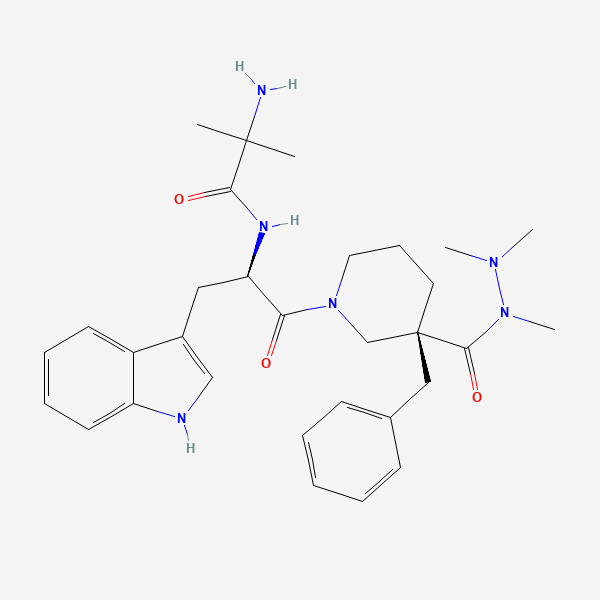
Anamorelin is a small-molecule drug that copies ghrelin’s signal without being a peptide itself. The active molecule has the formula C31H42N6O3, a molecular weight of 546.7 g/mol, and CAS number 249921-19-5 (PubChem). ONO-7643, RC-1291, and ST-1291 are development names; Adlumiz is the Japanese brand.
That chemistry matters. Calling anamorelin an “oral peptide” is convenient marketplace shorthand, but inaccurate. Anamorelin belongs beside other growth-hormone secretagogues because of what receptor it activates, not because it is made from a chain of amino acids.
How does anamorelin work?
Anamorelin activates GHS-R1a, the ghrelin receptor that links hunger with growth-hormone release. Think of ghrelin as the body’s “food is needed” signal. Anamorelin keeps pressing that button long enough to increase appetite and trigger pituitary growth hormone, which can raise insulin-like growth factor 1 (IGF-1).
The design fits anamorelin cachexia treatment: help a person with advanced cancer eat more while pushing body weight and lean mass upward. The receptor effect is real. The harder question is whether the extra mass becomes extra function.
What did ROMANA 1 and ROMANA 2 find?
Anamorelin increased lean body mass in both phase 3 trials, but neither trial found a handgrip-strength benefit. ROMANA 1 enrolled 484 patients and ROMANA 2 enrolled 495 patients with advanced non-small-cell lung cancer and cachexia. Participants received 100 mg orally once daily or placebo for 12 weeks (PubMed PMID 26906526).
Median lean mass rose 0.99 kg with anamorelin versus a 0.47 kg decline with placebo in ROMANA 1. In ROMANA 2, the corresponding changes were a 0.65 kg gain and a 0.98 kg decline. Handgrip results were not significantly different in either trial. Those are not failed studies, but they are split results: the scan moved; strength did not.
Why does mass without function matter?
Anamorelin shows why “more lean mass” cannot automatically be translated into “more useful muscle.” Lean body mass includes muscle, organs, glycogen, and water. A body-composition scan cannot tell a reader that someone lifts more, walks farther, or lives better.
The European Medicines Agency made that distinction regulatory, not academic. In 2017, its committee described the lean-mass effect as marginal, found no proven benefit for handgrip strength or quality of life, and also raised concerns about the completeness of safety recording. The Adlumiz application was refused. This is the reality check most summaries skip.
Is anamorelin safe? Side effects
Anamorelin has human safety data, but higher blood sugar and cardiac-conduction effects deserve more than a footnote. ROMANA reported few severe treatment-related events; hyperglycaemia was the most common severe treatment-related event. Japan’s fuller review also documented peripheral oedema, first-degree atrioventricular block, QRS widening, and clinically important CYP3A4 interactions (PMDA review).
The Japanese labeling contraindicates Adlumiz with moderate or severe liver impairment, myocardial infarction or angina, advanced conduction disorders, and strong CYP3A4 inhibitors. Those are prescribing restrictions for Japan’s approved cancer-cachexia drug, not proof that an unapproved product is safe in a healthy user.
What anamorelin dosage was studied?
The main anamorelin dosage in ROMANA was 100 mg by mouth once daily for 12 weeks. Japan’s approved Adlumiz regimen is also 100 mg once daily in a fasted state, with no food for at least one hour afterward, according to the PMDA review. These doses were studied in people with cancer cachexia under medical care; they are not a bodybuilding protocol.
Anamorelin is oral and does not require reconstitution. That separates it from injectable ghrelin-receptor agonists such as ipamorelin and GHRP-6.
Is anamorelin FDA-approved in 2026?
Anamorelin is not FDA-approved in the United States as of July 2026. FDA’s substance database has an identity record for anamorelin, but the agency warns that a UNII record does not imply regulatory review or approval. U.S. research continues through registered clinical studies; that is investigational status, not permission for routine prescribing.
Regulators have not agreed. Europe confirmed its refusal in September 2017. Japan approved Adlumiz on January 22, 2021—not December 2020—for cachexia associated with non-small-cell lung, gastric, pancreatic, or colorectal cancer. The site’s dated regulatory reference keeps approval and online availability in separate columns.
Anamorelin vs MK-677: what is the useful comparison?
Anamorelin vs MK-677 is a comparison of two oral, non-peptide ghrelin-receptor agonists, not two peptides. Anamorelin was developed for cancer cachexia and tested in roughly 1,000 patients across ROMANA 1 and 2. MK-677 (ibutamoren) has been studied in older adults and marketed far beyond its evidence.
The useful parallel is the endpoint gap. MK-677 increased fat-free mass in a randomized trial of healthy older adults without improving strength or physical function (PMCID PMC2757071). Anamorelin produced the same broad warning in a different population: more lean mass on paper does not guarantee stronger muscle in life. The evidence-grading guide calls those separate outcomes for a reason.
Is anamorelin banned in sport?
Anamorelin is prohibited at all times for athletes under the 2026 WADA rules. The list names anamorelin under S2 among growth hormone secretagogues and their mimetics. The ban applies in and out of competition; Japan’s medical approval does not create a sports exemption by itself.
Anamorelin earns interest because the human evidence is unusually large for this receptor class. The honest read is narrower than the marketing version: appetite and lean mass can move, while strength and proven quality-of-life benefit may not. That distinction is not anti-peptide. It is what makes the next trial worth reading.
Evidence by outcome
Each outcome Anamorelin has been studied for, with the honest evidence grade and what the studies actually found. A tier never stands alone — the verdict rides with it.
| Outcome | Evidence | What was found |
|---|---|---|
| Lean body mass in non-small-cell lung cancer cachexia | Human RCTHelped | ROMANA 1 and ROMANA 2 found that 100 mg of oral anamorelin once daily for 12 weeks increased lean body mass versus placebo in patients with advanced non-small-cell lung cancer and cachexia. |
| Handgrip strength and physical function | Human RCTNo effect | Neither ROMANA trial found a significant improvement in handgrip strength. The trials therefore showed a body-composition change without a matching functional benefit. |
| Patient-centered benefit in cancer cachexia | Human RCTMixed | Anamorelin improved lean mass, but the EMA concluded that no benefit on handgrip strength or quality of life had been proven. Regulators reached different benefit-risk decisions from the submitted evidence. |
FDA & legal status
- United States: investigational (as of Jul 2026)
No anamorelin product is FDA-approved. The FDA maintains a substance identity record for anamorelin, but that record explicitly does not imply regulatory review or approval. Anamorelin remains a clinical-research drug in the US.
Reported side effects
| Effect | Frequency | Severity |
|---|---|---|
| Hyperglycaemia or increased blood glucose | — | Can be clinically significant, especially with diabetes |
| Peripheral oedema | — | Usually mild in the Japanese trials |
| Electrocardiogram conduction changes, including first-degree atrioventricular block or QRS widening | — | Requires attention in people with cardiac conduction disease |
Chemical identifiers
References
- 1.Temel et al., 2016 — ROMANA 1 and ROMANA 2 (PubMed PMID 26906526)
- 2.ROMANA 1 — ClinicalTrials.gov NCT01387269
- 3.ROMANA 2 — ClinicalTrials.gov NCT01387282
- 4.EMA — refusal of marketing authorisation for Adlumiz
- 5.PMDA — Adlumiz Tablets 50 mg review report
- 6.PubChem — Anamorelin, CID 9828911
- 7.FDA GSRS — anamorelin substance record
- 8.WADA — 2026 Prohibited List