Also known as: Growth Hormone Releasing Peptide-6 · GHRP6 · SKF-110679 · His-D-Trp-Ala-Trp-D-Phe-Lys-NH2
Human RCTHelped
On this page
- What is GHRP-6?
- How does GHRP-6 work?
- What does the research show?
- What the community reports
- Is GHRP-6 safe? Side effects
- FDA & legal status (2026)
- Is GHRP-6 banned in sport?
- How is GHRP-6 used, and can it be mixed?
- GHRP-6 vs the other GH secretagogues
- Frequently asked questions
- Who is GHRP-6 for — and who should be cautious?
- Evidence by outcome
- FDA & legal status
- Reported side effects
- Chemical identifiers
- References
- Related compounds
- More on GHRP-6
GHRP-6 is a synthetic six-amino-acid peptide that switches on the ghrelin receptor, triggering a short, reliable pulse of growth hormone — and a famously strong wave of hunger. In humans that GH pulse is well documented; the muscle, fat-loss and anti-aging payoffs people actually want are not. GHRP-6 is not FDA-approved and is sold only as a research chemical.
What is GHRP-6?
GHRP-6 is a lab-made peptide — a chain of just six amino acids (sequence His-D-Trp-Ala-Trp-D-Phe-Lys-NH2, molecular formula C46H56N12O6, molecular weight ~873). It belongs to a family called growth-hormone-releasing peptides (GHRPs), and it holds a place in science history: GHRP-6 was one of the synthetic molecules that led researchers to the “ghrelin receptor” and, eventually, to the discovery of ghrelin itself, the body’s own hunger-and-GH hormone (GHRP-6 research on PubMed). GHRP-6 is not a medicine you can be prescribed and not a supplement you can legally buy as food — in the United States it exists only as a research chemical.
How does GHRP-6 work?
GHRP-6 works by plugging into the growth hormone secretagogue receptor (GHS-R1a) — the same receptor the natural hunger hormone ghrelin uses. Think of that receptor as a doorbell for two things at once: press it and the pituitary releases a pulse of growth hormone, while the hunger centers in the brain light up. GHRP-6 also pairs powerfully with GHRH (the body’s other GH signal), so the two together produce a bigger GH pulse than either alone. The same button-press transiently nudges cortisol and prolactin upward, which is why those two hormones show up in the side-effect conversation (Bowers et al., 1990).
What does the research show?
GHRP-6 has more human data behind it than most research peptides, but the data proves a narrower thing than the marketing implies. In controlled human studies — including randomized, placebo-controlled pharmacology work — a single dose of GHRP-6 reliably raises growth hormone, especially alongside GHRH (Bowers et al., 1990). That the GH pulse is real is about as settled as anything in this space. What is not settled is the leap most people care about: that a bigger GH pulse turns into visible muscle, fat loss, or a younger-feeling body. No human trial demonstrates GHRP-6 changing body composition — so on physique, GHRP-6 sits at mechanistic-hypothesis, none-in-humans, not “proven.” Separately, a smaller line of mostly animal and cell research has explored GHRP-6 as a tissue- and heart-protective agent; that work is early, preclinical, and does not translate to physique benefits.
What the community reports
Outside the lab, GHRP-6 has a long-running following among bodybuilders and people trying to eat more during a bulk, where its reputation is the “fridge raid” — a hunger wave strong enough to push through a suppressed appetite. The commonly reported pattern is a subcutaneous dose in the low hundreds of micrograms (around 100 mcg is the figure most often mentioned) taken before meals, sometimes paired with a GHRH peptide. These accounts are anecdotal — they aren’t controlled data, they suffer from survivorship bias, and they can’t tell you how often GHRP-6 does nothing or how the cortisol and prolactin bumps add up over time. They explain why people are interested; they don’t prove it works.
Is GHRP-6 safe? Side effects
GHRP-6’s honest safety answer is “the short-term effects are well mapped, the long-term ones aren’t.” The most reliable effect is a strong appetite surge — sometimes a benefit, sometimes exactly what someone dieting doesn’t want. GHRP-6 also transiently raises cortisol and prolactin, and those bumps grow with higher, more frequent dosing, which is the main reason people cap the dose and the duration. Other reported effects include water retention, tingling or numbness in the hands, flushing or a brief head-rush after injection, tiredness, and — because growth hormone itself does this — higher blood sugar and reduced insulin sensitivity. There is no long-term human safety trial. And the practical risk skews to the source: research-chemical vials are unregulated, so their purity, the accuracy of the dose, and their sterility depend entirely on the outfit selling them.
FDA & legal status (2026)
GHRP-6 is not FDA-approved, and it is not a legal dietary supplement either. In the United States it is sold strictly as a research chemical, labeled “not for human use,” and the FDA has taken action against products that market growth-hormone secretagogues for human consumption (FDA Drugs). Treat any status claim as dated and re-check it before relying on it — the full dated breakdown is in the FDA & legal status block below.
Is GHRP-6 banned in sport?
Yes. GHRP-6 is a growth hormone secretagogue, and WADA names that class explicitly under S2.2 of its Prohibited List, so GHRP-6 is banned at all times — in and out of competition — for any athlete under anti-doping rules (WADA/USADA Prohibited List). This is not a gray area: GH secretagogues are one of the more clearly named categories on the list, and they are detectable.
How is GHRP-6 used, and can it be mixed?
GHRP-6 comes as a lyophilized (freeze-dried) powder that has to be reconstituted with bacteriostatic water before use. Getting the concentration right is pure arithmetic — our reconstitution & dosing calculator turns “5 mg vial, 2 mL water, 100 mcg target” into the exact number of insulin-syringe units to draw, and the cost-per-dose tool shows what a vial actually works out to per shot. People also ask whether GHRP-6 can share a syringe with a GHRH peptide like CJC-1295 or with ipamorelin; our mixing compatibility reference covers what is commonly combined and where the honest answer is “not enough data.” Doses shown anywhere on the site are the ones reported by users and in cited studies, not a personalized protocol.
GHRP-6 vs the other GH secretagogues
GHRP-6 is one of a whole family of GH secretagogues, and the differences are mostly about side-effects and appetite. In plain terms: GHRP-6 gives the biggest hunger hit of the group; GHRP-2 raises GH a bit harder with somewhat less hunger; ipamorelin is the “clean” one, prized for a GH pulse with minimal cortisol, prolactin or appetite; and CJC-1295 is a different type (a GHRH analog) that pairs with any of them. None of these has human-trial proof for muscle or fat-loss outcomes. To see how a GHRH-plus-secretagogue pairing is framed, the CJC-1295 vs ipamorelin comparison and the CJC-1295 + ipamorelin stack walk through the same logic, and the growth-hormone hub maps the whole category. For a different GH-space compound, see AOD-9604, a GH fragment marketed for fat loss.
Frequently asked questions
Does GHRP-6 actually work?
It depends what you mean by “work.” GHRP-6 reliably raises growth hormone in humans — that part is well documented. What it has not been shown to do in any human trial is build muscle, strip fat, or reverse aging. So it works as a GH-releasing and appetite-boosting agent, and remains unproven as a physique drug.
Is GHRP-6 legal?
GHRP-6 is legal to buy and sell in the United States as a research chemical, but it is not an approved drug or a legal dietary supplement, and it cannot be sold for human consumption. That’s why every vendor labels it “for research use only.”
Does GHRP-6 raise cortisol and prolactin?
Yes, transiently. GHRP-6 nudges both cortisol and prolactin upward, and the bump tends to grow with higher and more frequent dosing. That’s the main reason people who use it keep the dose modest and the runs short, and why prolactin-sensitive users are especially cautious.
How do people take GHRP-6?
In the research and community literature GHRP-6 is almost always injected subcutaneously after being reconstituted with bacteriostatic water, in doses commonly reported around 100 mcg, often before a meal and sometimes alongside a GHRH peptide. This is reported use, not a recommended protocol.
Why does GHRP-6 make you so hungry?
Because GHRP-6 activates the ghrelin receptor (GHS-R1a), the same receptor the body’s natural hunger hormone uses. Pressing that receptor turns on appetite directly — which is why GHRP-6 has a reputation for a powerful “fridge raid” effect, stronger than most of the other GH peptides.
What’s the difference between GHRP-6 and ghrelin?
Ghrelin is the hormone your own stomach makes; GHRP-6 is a synthetic molecule that mimics part of what ghrelin does at the GHS-R1a receptor. Historically, GHRP-6 came first as a research tool, and chasing how it worked is part of what led scientists to discover ghrelin.
Who is GHRP-6 for — and who should be cautious?
GHRP-6 draws in two very different readers: the bodybuilder chasing a growth-hormone edge, and the person whose appetite has cratered — after illness, stress, or a hard cut — who just needs to eat. The honest framing: GHRP-6’s human proof is real but narrow — it raises GH and it raises hunger — and the muscle, fat-loss and anti-aging story people buy it for has no human trial behind it. The long-term safety data doesn’t exist, the cortisol and prolactin bumps are real, and the product you’d actually buy is unregulated. Anyone managing blood sugar, prolactin-sensitive conditions, or a complicated relationship with food — and anyone tested under anti-doping rules — has every reason to be cautious or to skip it.
Evidence by outcome
Each outcome GHRP-6 has been studied for, with the honest evidence grade and what the studies actually found. A tier never stands alone — the verdict rides with it.
| Outcome | Evidence | What was found |
|---|---|---|
| Growth hormone (GH) release | Human RCTHelped | Human pharmacology studies, including randomized and placebo-controlled designs, consistently show that a single dose of GHRP-6 triggers a real, repeatable pulse of growth hormone — and that it works synergistically with GHRH. This is the compound's best-established human effect. The catch: raising GH acutely is a hormonal response, not a body-composition result. |
| Appetite / hunger | Human observationalHelped | GHRP-6 activates the ghrelin receptor, and in people who use it a strong rise in hunger is one of the most consistently reported effects. There is no controlled GHRP-6 food-intake trial, though — the appetite case rests on ghrelin-receptor pharmacology plus uncontrolled human reports, so we grade it observational, not proven. For people who want to eat more it's a feature; for anyone watching calories it's the opposite. |
| Muscle gain, fat loss & body recomposition | MechanisticUnclear⚠ none in humans | No human trial shows GHRP-6 builds muscle, cuts fat, or "recomps" a body. The reasoning is a chain of hypotheses — GHRP-6 raises GH, GH influences body composition, therefore GHRP-6 should reshape you — and each link past the first is unproven for this peptide. Treat physique claims as a hypothesis, not a finding. |
FDA & legal status
- United States: research use only (as of Jul 2026)
Not an FDA-approved drug and not a legal dietary supplement — GHRP-6 is sold only as a research chemical labeled "not for human use." The FDA has acted against products that market growth-hormone secretagogues for human consumption. Re-verify this status before relying on it.
openFDA Drugs@FDA lists no approved product for GHRP-6 as of 2026-07-15.
Reported side effects
| Effect | Frequency | Severity |
|---|---|---|
| Intense hunger / appetite spike | — | Very common — often the most noticeable effect |
| Transient rise in cortisol and prolactin | — | Dose-dependent; more likely with higher or more frequent dosing |
| Water retention and mild swelling | — | — |
| Tingling or numbness in the hands (paresthesia) | — | — |
| Flushing, warmth or a brief head-rush shortly after injection | — | — |
| Tiredness or lethargy | — | — |
| Higher blood sugar / reduced insulin sensitivity (a growth-hormone effect) | — | — |
| Injection-site redness or irritation | — | — |
Chemical identifiers
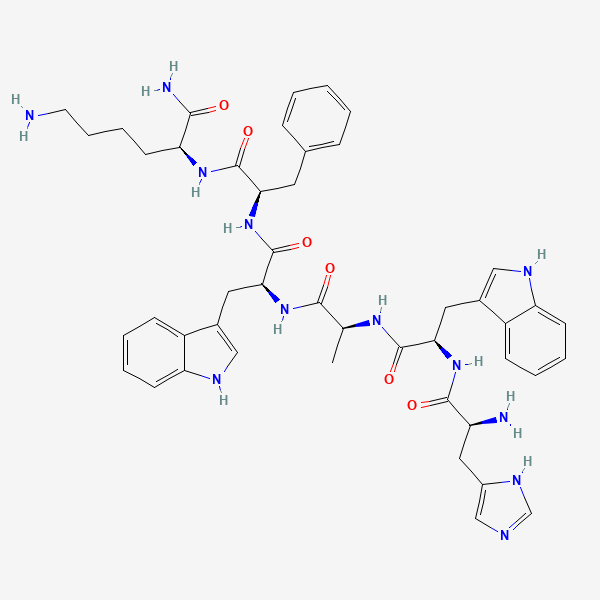
- Molecular formula
- C46H56N12O6
- Molecular weight
- 873 g/mol
- IUPAC name
- 6-amino-2-[[2-[[2-[2-[[2-[[2-amino-3-(1H-imidazol-5-yl)propanoyl]amino]-3-(1H-indol-3-yl)propanoyl]amino]propanoylamino]-3-(1H-indol-3-yl)propanoyl]amino]-3-phenylpropanoyl]amino]hexanamide
Verified external records:
References
More on GHRP-6
Everything else we've written about GHRP-6 — what the community reports, the explainers that cover it, and the terms it keeps running into.