Also known as: Pralmorelin · KP-102 · GPA-748 · Growth Hormone Releasing Peptide-2
Human RCTHelped
On this page
- What is GHRP-2?
- How does GHRP-2 work?
- What does the research show?
- What the community reports
- Is GHRP-2 safe? Side effects
- FDA & legal status (2026)
- How is GHRP-2 used, and can it be mixed?
- GHRP-2 vs GHRP-6, ipamorelin and CJC-1295
- Frequently asked questions
- Who is GHRP-2 for — and who should be cautious?
- Evidence by outcome
- FDA & legal status
- Reported side effects
- Chemical identifiers
- References
- Related compounds
- More on GHRP-2
GHRP-2 (pralmorelin) is a synthetic growth-hormone secretagogue — a ghrelin mimetic that reliably makes the human pituitary release a pulse of growth hormone and sharply boosts appetite. Those two effects are well documented in people. GHRP-2 is not FDA-approved, is sold only as a research chemical, and is banned in sport.
What is GHRP-2?
GHRP-2, also called pralmorelin, is a synthetic six-amino-acid peptide (molecular formula C45H55N9O6, molecular weight about 818) built to mimic ghrelin — the stomach hormone that drives both hunger and growth-hormone release. GHRP-2 is a growth-hormone secretagogue: rather than adding growth hormone from outside, it signals your own pituitary to release a pulse of it. People search GHRP-2 for muscle, recovery and fat loss, but the effects actually proven in humans are narrower — a dependable growth-hormone spike and a bigger appetite. In the United States GHRP-2 is neither a medicine nor a supplement; it is sold only as a research chemical.
How does GHRP-2 work?
GHRP-2 works by binding the growth-hormone secretagogue receptor (GHS-R1a) — the same receptor the hunger hormone ghrelin uses — in the pituitary and hypothalamus. Picture ghrelin as a key that unlocks a growth-hormone pulse and flips on the “I’m hungry” signal; GHRP-2 is a lab-made copy cut to fit the same lock. When GHRP-2 binds, the pituitary fires off a burst of growth hormone and appetite signaling ramps up. Because GHRP-2 triggers your body’s own pulsatile release instead of flooding you with outside growth hormone, users frame it as a more “natural” GH bump — but “natural” here describes the pathway, not the safety.
What does the research show?
GHRP-2’s research splits cleanly into what is proven in humans and what is not. The proven part is real and unusually solid for a research peptide: in controlled human studies GHRP-2 reliably triggers a sharp growth-hormone pulse — solid enough that it was developed into a clinical GH-stimulation test under the name pralmorelin — and a separate controlled study found GHRP-2 raised food intake by roughly a third versus placebo (Pihoker et al., 1995; Laferrère et al., 2005). The unproven part is everything the bodybuilding world actually wants: no human trial has shown GHRP-2 builds muscle, burns fat, or speeds recovery in healthy people. Those claims lean on the growth-hormone pulse as a mechanism, not on any measured body-composition outcome — so we grade muscle and physique effects mechanistic-hypothesis + none-in-humans while grading the GH-raising effect itself as human-tested. How we separate “proven pathway” from “proven result” is laid out on our evidence-grading page.
What the community reports
Outside the clinic, GHRP-2 has a devoted following among lifters, who reach for it mostly for appetite during a bulk and for the perceived recovery and sleep benefits of a nightly growth-hormone pulse. The commonly reported pattern is around 100 micrograms injected subcutaneously once or a few times a day, often before bed or about 20 minutes before a big meal. These accounts are anecdotal — there is no control group, heavy survivorship bias (people who feel nothing tend to go quiet), and no way to know how often GHRP-2 does nothing. They are useful for understanding why people are interested, not for proving it works.
Is GHRP-2 safe? Side effects
GHRP-2’s honest safety answer is “reasonably tolerated short-term in humans, with real unknowns for long-term use.” Because GHRP-2 was studied mostly as a one-off or short-course diagnostic, the human data covers acute dosing, not months of nightly injections. The most consistent effects are a transient rise in prolactin and cortisol (more pronounced at higher or more frequent doses), a strong appetite surge, water retention and puffiness, occasional numbness or tingling in the hands, and a brief flush after injection. Because GHRP-2 raises growth hormone, repeated use can nudge blood sugar up and blunt insulin sensitivity. The theoretical concern worth naming is the growth-signal question: anything that raises GH and IGF-1 is something people with a cancer history should be cautious about. And the practical risk is the vial itself — research-chemical GHRP-2 is unregulated, so purity, dose accuracy and sterility vary vendor to vendor.
FDA & legal status (2026)
GHRP-2 is not FDA-approved and is not a legal dietary supplement; in the United States it is sold strictly as a research chemical, “for research use only.” That status is current as of 2026 — see the dated FDA & legal block below. Internationally there is one exception: under the name pralmorelin, GHRP-2 has been used as a diagnostic agent to test the pituitary’s capacity to release growth hormone, which is where much of its solid human data comes from. As a growth-hormone secretagogue, GHRP-2 is also banned in sport at all times under WADA’s S2 category (USADA prohibited list). Nothing about GHRP-2’s popularity changes that it is not approved for human use in the US (Drugs@FDA).
How is GHRP-2 used, and can it be mixed?
GHRP-2 comes as a lyophilized (freeze-dried) powder that has to be reconstituted with bacteriostatic water before subcutaneous injection. Getting the concentration right is pure arithmetic — our reconstitution & dosing calculator turns “5 mg vial, 2 mL water, 100 mcg target” into the exact number of insulin-syringe units to draw. GHRP-2 is also frequently discussed alongside a GHRH analog such as CJC-1295 or sermorelin, on the theory that pairing a “pulse” peptide with a “baseline” one produces a bigger GH release than either alone — you can see how those combinations are framed on the CJC-1295 + ipamorelin stack and the sermorelin + ipamorelin stack pages. Whether any two peptides belong in the same syringe is a separate question; our mixing compatibility reference covers what people commonly combine and where the honest answer is “not enough data.”
GHRP-2 vs GHRP-6, ipamorelin and CJC-1295
GHRP-2 sits in a crowded family of growth-hormone peptides, and the differences are mostly about side effects, not proven results — none of them has a human trial showing it builds muscle. GHRP-2 gives a strong GH pulse with a moderate, “cleaner” appetite bump; GHRP-6 hits appetite far harder (the famous “fridge raid”); ipamorelin is the most selective of the three, raising GH with the least prolactin and cortisol; and CJC-1295 and sermorelin are a different mechanism (GHRH analogs that lift the baseline rather than firing a pulse), which is exactly why people pair a GHRP with a GHRH analog. There is no universal winner here — the right pick depends on whether you care most about appetite, minimizing prolactin, or convenience, and on the fact that the whole category is grounded in the GH pulse rather than measured physique outcomes. GHRP-2 belongs to the growth-hormone peptides hub, where the siblings are compared side by side.
Frequently asked questions
Does GHRP-2 build muscle?
Not provably. GHRP-2 reliably raises growth hormone in humans, and higher GH is the mechanism people bet on — but no human trial has measured whether GHRP-2 actually adds muscle, cuts fat, or improves recovery in healthy adults. Treat “GHRP-2 for gains” as a plausible mechanism, not a proven result.
Is GHRP-2 legal?
GHRP-2 is legal to buy and sell as a research chemical in the United States, but it is not an FDA-approved drug or a legal dietary supplement, and it cannot be sold for human consumption. That is why every vendor labels it “for research use only.”
Is GHRP-2 banned in sport?
Yes. GHRP-2 is a growth-hormone secretagogue, a class named explicitly in WADA’s S2 category, so it is prohibited at all times for athletes subject to anti-doping rules.
How is GHRP-2 taken?
In the research and community literature GHRP-2 is almost always injected subcutaneously after being reconstituted with bacteriostatic water, commonly around 100 micrograms, often before bed or shortly before a meal. Doses reported in studies and community logs are information, not a personalized protocol.
GHRP-2 vs GHRP-6 — what’s the difference?
Both raise growth hormone through the same receptor, but GHRP-6 produces a much stronger, sometimes overwhelming hunger response, while GHRP-2 gives a more moderate appetite bump alongside its GH pulse. Neither has human trial evidence for muscle or fat-loss outcomes.
Does GHRP-2 raise prolactin?
It can. GHRP-2 can cause a transient, dose-dependent rise in prolactin and cortisol, which is more likely at higher or more frequent doses — one reason people who use it tend to keep doses modest and cycles short.
Who is GHRP-2 for — and who should be cautious?
GHRP-2 draws in lifters and self-researchers chasing a growth-hormone bump — for appetite during a hard bulk, for sleep and recovery, or simply out of curiosity about raising their own GH. The honest framing: GHRP-2’s core effects (a reliable GH pulse and a bigger appetite) are among the better-documented human effects in the whole research-peptide space, so this is not a peptide running on hope. But the payoff people actually want — more muscle, less fat, faster recovery — has never been tested in a human trial, the long-term safety data doesn’t exist, and the product you’d actually buy is unregulated. Anyone with a cancer history, anyone pregnant or breastfeeding, and anyone unwilling to accept genuine unknowns has every reason to sit this one out.
Evidence by outcome
Each outcome GHRP-2 has been studied for, with the honest evidence grade and what the studies actually found. A tier never stands alone — the verdict rides with it.
| Outcome | Evidence | What was found |
|---|---|---|
| Raising growth-hormone secretion | Human RCTHelped | In controlled human studies GHRP-2 produced a sharp, dose-dependent spike in growth hormone within roughly 15–30 minutes of dosing — reliable enough that it was turned into a clinical GH-stimulation test (pralmorelin). This is one of the best-documented human effects of any research peptide, but it measures a hormone pulse, not a change in muscle or fat. |
| Appetite & food intake | Human (controlled)Helped | In a controlled human study, subcutaneous GHRP-2 raised food intake by about a third compared with placebo — exactly what its ghrelin-receptor activity predicts. That bigger appetite is a measured human result, which is why some people seek GHRP-2 out for bulking and others count it as a nuisance. |
| Muscle growth, fat loss & recovery in healthy adults | MechanisticUnclear⚠ none in humans | No human trial has tested whether GHRP-2 actually builds muscle, cuts fat, or speeds recovery in healthy adults. The popular case rests entirely on the fact that GHRP-2 raises growth hormone and IGF-1 — a plausible mechanism, not a measured outcome. Treat physique and performance claims as unproven in people. |
FDA & legal status
- United States: research use only (as of Jul 2026)
Not an FDA-approved drug and not a legal dietary supplement — sold only as a research chemical, "for research use only." As a growth-hormone secretagogue it is also prohibited in sport by WADA. Re-verify status periodically; the research-peptide category is regulatory-volatile.
openFDA Drugs@FDA lists no approved product for GHRP-2 as of 2026-07-15.
Reported side effects
| Effect | Frequency | Severity |
|---|---|---|
| Transient rise in prolactin and cortisol (more likely at higher or more frequent doses) | — | — |
| Surge in hunger and appetite | — | — |
| Water retention and mild puffiness | — | — |
| Numbness or tingling (paresthesia), often in the hands | — | — |
| Reduced insulin sensitivity / higher blood sugar with repeated use (a growth-hormone effect) | — | — |
| Head-rush or facial flushing shortly after injection | — | — |
Chemical identifiers
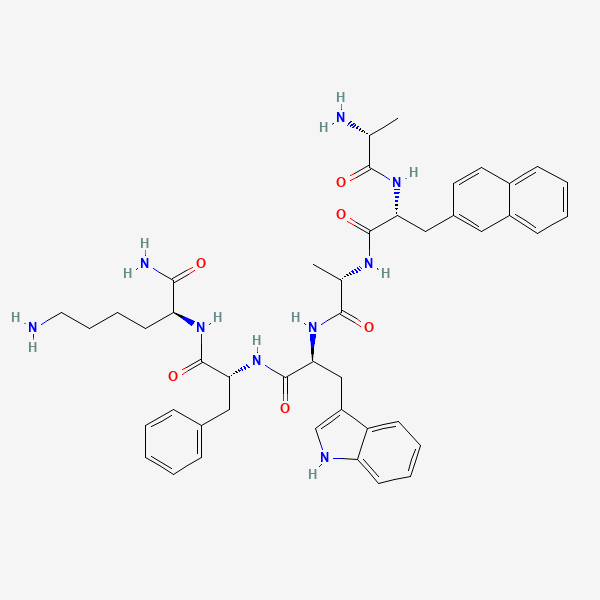
- Molecular formula
- C45H55N9O6
- Molecular weight
- 818 g/mol
- IUPAC name
- (2S)-6-amino-2-[[(2R)-2-[[(2S)-2-[[(2S)-2-[[(2R)-2-[[(2R)-2-aminopropanoyl]amino]-3-naphthalen-2-ylpropanoyl]amino]propanoyl]amino]-3-(1H-indol-3-yl)propanoyl]amino]-3-phenylpropanoyl]amino]hexanamide
Verified external records:
References
- 1.GHRP-2 (pralmorelin) — indexed research (PubMed, National Library of Medicine)
- 2.GHRP-2 and growth-hormone release — human pharmacology studies (PubMed)
- 3.GHRP-2 and food intake / appetite — human studies (PubMed)
- 4.Drugs@FDA — GHRP-2 is not an FDA-approved drug
- 5.USADA — growth-hormone secretagogues are prohibited in sport
More on GHRP-2
Everything else we've written about GHRP-2 — what the community reports, the explainers that cover it, and the terms it keeps running into.