Also known as: CJC-1295 with DAC · DAC:GRF · CJC-1295 DAC · CJC-1295 without DAC · Modified GRF 1-29 · Mod GRF 1-29
Human RCTHelped
On this page
- What people actually use CJC-1295 for — and what they report
- What is CJC-1295?
- How does CJC-1295 work?
- Does CJC-1295 actually work? What the science says
- Is CJC-1295 safe? Side effects
- FDA & legal status (2026)
- How people dose CJC-1295: what the studies used
- CJC-1295 vs ipamorelin, sermorelin and tesamorelin
- Hype vs reality
- Frequently asked questions
- Who is CJC-1295 for — and who should skip it?
- Evidence by outcome
- FDA & legal status
- Registered clinical trials
- Reported side effects
- Chemical identifiers
- References
- Related compounds
- More on CJC-1295
You probably didn’t come to CJC-1295 on its own. You came to it as half of a pair — “CJC-1295 and ipamorelin,” said in one breath on a podcast or a 1 a.m. forum thread — and then hit the wall everyone hits: with DAC, or without? Let’s untangle it honestly, starting right there.
CJC-1295 is a synthetic GHRH analog — a lab-made copy of the signal that tells your pituitary to release growth hormone — that people inject, almost always next to ipamorelin, for recovery, deeper sleep, and body composition. It comes in two forms, and the community mostly leans toward the short-acting “no-DAC” version (Modified GRF 1-29) over the week-long DAC one. The honest catch: the only solid human proof is that the DAC form durably raised GH and IGF-1 for days — not that either form builds muscle or strips fat, and the no-DAC version most people actually run has never had a human trial of its own.
| The quick version | Where CJC-1295 stands |
|---|---|
| What it is | Synthetic GHRH analog — presses your own pituitary to make more GH |
| Best-supported effect | Raises GH and IGF-1 in healthy adults (DAC form, human RCT) |
| Physique proof | None from a completed human trial — mechanism and anecdote only |
| Doses people run | no-DAC ~100 mcg at night, paired with ipamorelin (anecdotal) |
| Key risks | Water retention, tingling hands, facial flushing, higher blood sugar |
| US status (July 2026) | Not FDA-approved; flagged as a compounding safety risk |
| Banned in sport? | Yes — WADA S2, in and out of competition |
What people actually use CJC-1295 for — and what they report
CJC-1295 has a strikingly consistent street reputation, and it opens with that fork in the road: DAC or no-DAC. The community has a clear favorite — the short-acting no-DAC form (Modified GRF 1-29) — and the reasoning is the same everywhere you look, even though no trial has ever settled it head to head. No-DAC clears in well under an hour, so a bedtime shot gives your own nightly growth-hormone pulse a nudge and then gets out of the way, which people describe as feeling “more natural.” The DAC version clips onto a blood protein and holds the signal up for the better part of a week — genuinely convenient (a shot or two a week instead of nightly), but the recurring worry is that a round-the-clock GH “bleed” isn’t how the hormone is meant to pulse, and that it drags along more water retention and more of the puffy, tingly stuff. So when someone says “I’m running CJC,” they almost always mean the no-DAC one, pinned before bed.
Almost nobody runs it alone. The near-universal move is to pair CJC-1295 with ipamorelin and inject them together — often drawn into the same syringe — as the default “starter GH stack.” The appeal is that the two push the same system from different angles (the mechanism section below has the details), and you’ll also see the pair sold pre-mixed as a single “CJC/ipa” vial, commonly at 1 mg of each per milliliter. Worth keeping straight: a blend on a label is a convenience for the buyer, not evidence anyone tested the combination.
What people actually pin, and how (anecdotal — and nothing a trial ever signed off on): the common no-DAC pattern is around 100 mcg at night, five nights on and two off, next to 100–200 mcg of ipamorelin, in cycles of roughly eight to twelve weeks. Two habits show up almost every time. People pin it on an empty stomach, usually a couple of hours after eating, because food raises insulin and insulin blunts the GH release they’re chasing. And they aim for bedtime, to stack the peptide’s pulse on top of the big natural surge that comes with deep sleep. The 5-on/2-off rhythm is the crowd’s hedge against the pituitary tuning out a signal that never quits.
On the wins, the runaway most-common report is sleep: falling asleep faster, sleeping deeper, and having almost comically vivid dreams, often inside the first week or two (the dream carnival usually calms down after that). Behind sleep come the slower payoffs people credit to months of use — easier recovery between sessions, better-looking skin, a less puffy and “less tired” face. Body-composition change is where the reports get vaguer and more hopeful than hard: real for some, invisible for others, and slow either way — the timelines people describe run weeks for sleep and recovery, months before anything shows in the mirror.
The letdowns are just as real, and they’re the part the sales pages leave out. “Ran it eight weeks and felt nothing” is a genuine recurring theme, and it clusters in people who dosed low, ate too close to the shot, or came in expecting a physique the hormone data never promised. The side effects people mention are the classic growth-hormone ones: water-retaining, puffy hands and feet, achy or stiff joints, and pins-and-needles tingling in the fingers — that last one is fluid pressing on nerves, not damage, and it usually backs off when the dose comes down. A brief “head rush” or facial flush right after the injection comes up a lot too, and it passes in a few minutes. Most of the puffy, tingly stuff peaks in the first few weeks and settles as the body adjusts, though a fair number of people find it annoying enough to cut the dose or stop.
A caveat to staple onto all of this: the people who post are the people who felt something. A 2016 “netnography” — a study that reads and catalogs online communities — documented exactly this world of CJC-1295 practices and beliefs among women using it, useful precisely because it records what people do without pretending those habits are proof of anything (Van Hout & Hearne, 2016). Read “everyone reports better sleep” as “everyone who bothered to write it up reports better sleep” — a smaller, quieter claim than it first sounds, because the folks who felt nothing rarely start a thread about it.
What is CJC-1295?
CJC-1295 is a lab-made peptide built from GRF(1-29) — the business end of growth-hormone-releasing hormone — with four amino-acid swaps that slow the enzymes that would normally chew it up. Its molecular formula is C165H269N47O46, molecular weight about 3,647 g/mol, CAS 446262-90-4. It was designed to be a durable signal to the pituitary, not growth hormone itself — a nudge to the factory, not the product trucked in from outside.
The two forms are where the confusion (and the marketing) lives. The long-acting version adds a “drug affinity complex” (DAC), an albumin-binding tail that lets one dose linger for days. The short-acting version has no DAC and is more precisely called Modified GRF 1-29. FDA’s 2024 review flagged how loosely those names get used across the free base, acetate, DAC and non-DAC products; the market treats them as interchangeable, and the human research does not.
| Feature | With DAC | “No-DAC” / Modified GRF 1-29 |
|---|---|---|
| Albumin-binding tail | Yes | No |
| Measured human half-life | ~5.8–8.1 days | Not established in the CJC-1295 human trials |
| Direct published human studies | Yes, in healthy adults | None located |
| Hormone pattern | Higher baseline GH, pulses preserved on top | Brief pulse, marketed to mimic natural rhythm |
| Evidence for muscle or fat change | None from completed trials | None from completed trials |
How does CJC-1295 work?
CJC-1295 works by leaning on the pituitary’s own “release more growth hormone” button. It activates the GHRH receptor, which raises growth-hormone output; that GH then tells the liver and other tissues to make more IGF-1. So CJC-1295 turns up an existing hormone axis rather than pouring in growth hormone from outside — the difference between telling the factory to run another shift and importing the finished product.
The DAC is less a time-release capsule and more a way of clipping the peptide to a passing ferry. Albumin keeps carrying it long past the point where ordinary GHRH would have broken down and vanished. In one human study, researchers sampled men every 20 minutes overnight, a week after a single 60 or 90 mcg/kg injection: mean GH rose 46%, the trough — the low point between pulses — jumped 7.5-fold, IGF-1 rose 45%, and the underlying GH pulses were still there (Ionescu & Frohman, 2006). “Sustained” doesn’t mean pulse-free; it means the floor under the pulses moved up.
Does CJC-1295 actually work? What the science says
CJC-1295 has a real human result, and it’s narrower than the pitch. Two randomized, double-blind, placebo-controlled studies in healthy adults showed the DAC form raised GH and IGF-1 for days. What they measured was pharmacology and short-term safety — hormone levels and how long they stayed up — not muscle, fat, sleep, or recovery. That gap between “moves the hormones” and “changes your body” is the entire evidence story.
In the single-dose arm, people got 30, 60, 125 or 250 mcg/kg under the skin. GH climbed two- to ten-fold for at least six days; IGF-1 rose 0.5- to three-fold for 9–11 days; the estimated half-life landed at 5.8–8.1 days. Only the top 250 mcg/kg dose pushed average IGF-1 above the normal range for age and sex. A multi-dose arm used 20, 30 or 60 mcg/kg on weekly or two-week schedules, followed out to day 49 (Teichman et al., 2006). Those are study doses, not a personal protocol.
| The real question | Best direct evidence | Grade |
|---|---|---|
| Does DAC CJC-1295 raise GH and IGF-1? | Randomized studies in healthy adults | Human RCT — helped |
| Does it keep GH pulsing? | Overnight sampling after DAC CJC-1295 | Human clinical — helped |
| Does it build muscle or speed recovery? | No completed human outcome trial | Mechanism — unknown |
| Does it cut visceral fat? | One HIV-visceral-obesity trial, terminated | No result |
| Does no-DAC deliver the marketed results? | No direct human outcome trial located | Unknown |
| Does the ipamorelin stack work as a combo? | No controlled human trial located | Anecdotal / mechanism |
Everything past that first row is thinner. FDA’s own literature search turned up three published human reports, all of CJC-1295 DAC in healthy adults, and none in people with an actual disease. The one registered efficacy study — a Phase 2 trial for HIV-associated visceral fat — was terminated and posted no answer (NCT00267527). An 11-man proteomics substudy found five blood-protein spots shifted a week after a CJC-1295 dose, but that’s a biomarker breadcrumb, not a better physique (Sackmann-Sala et al., 2009). So the grade stays honestly split. My read: a human RCT for raising the hormones is more than most research peptides can show, and that’s a genuine point in CJC-1295’s favor — it just isn’t the physique proof the marketing implies, and the form doing the proving (DAC) isn’t the form most people run.
Is CJC-1295 safe? Side effects
CJC-1295 has short-term human safety observations, not a long-term safety record. Injection-site reactions were common in the healthy-adult studies, and flushing, headache, dizziness and low blood pressure showed up among reported reactions. FDA’s later compounding review named increased heart rate and systemic vasodilatory reactions as serious adverse-event signals, and said the available clinical data remain limited (FDA compounding safety summary).
The mechanism adds a second bucket of risk. Raising GH and IGF-1 can mean fluid retention, achy or swollen joints, tingling or numbness in the hands, and reduced insulin sensitivity — meaning higher blood sugar. The highest dose in the 2006 study pushed average IGF-1 above the age- and sex-adjusted normal range, a plain reminder that more hormone is not a free upgrade.
Immunogenicity is the third. FDA flagged aggregation, peptide impurities and problems characterizing the active ingredient — issues that can provoke an antibody response — and short trials can’t settle what repeated exposure does over time. That is why active or elevated-risk cancer (you would be deliberately raising IGF-1), diabetes or impaired glucose tolerance, and pregnancy or breastfeeding are all strong reasons to stay off it. And because research-market vials sit outside the approved-drug system, the label tells you nothing reliable about sterility, identity, or how much peptide is actually in the powder.
FDA & legal status (2026)
CJC-1295 is not FDA-approved for any use and is not a dietary supplement; as of July 2026 there is no approved CJC-1295 product in FDA’s Drugs@FDA database (Drugs@FDA). “Research use only” describes how sellers label an unapproved chemical — it is not permission to market it as a human treatment. The sharper 2026 issue is compounding: FDA keeps CJC-1295 on its list of bulk substances that may present significant safety risks.
In December 2024, FDA’s Pharmacy Compounding Advisory Committee reviewed five CJC-1295-related bulk substances and voted against adding them to the 503A Bulks List — 13–0 against the DAC free base, DAC acetate and DAC trifluoroacetate forms, with the non-DAC free base and acetate voted down as well (FDA PCAC review memorandum). Category 2 substances like these fall outside FDA’s interim non-enforcement policy for compounding. That also settles an older rumor that a CJC-specific advisory decision was still pending for 2026 — the vote already happened.
In sport, there is no gray area. The 2026 WADA Prohibited List names CJC-1295 under S2 (peptide hormones and growth factors), banned at all times, in and out of competition, and anti-doping labs have published methods to detect GHRH analogs like it (Memdouh et al., 2021). If you are tested, this one is a hard no.
How people dose CJC-1295: what the studies used
CJC-1295 dosing depends entirely on which molecule is in the vial. The published human work used weight-based injections of the long-acting DAC form: single doses of 30–250 mcg/kg and repeated doses of 20–60 mcg/kg on weekly or two-week schedules. Those experiments were built to measure hormones and half-life, not to validate the flat nightly amounts sold for Modified GRF 1-29.
Research-market CJC-1295 usually ships as a freeze-dried powder in 2 mg or 5 mg vials, meant to be reconstituted with bacteriostatic water and kept cold. Turning a vial into a concentration is just arithmetic — the reconstitution and dosing calculator handles that math without turning a study dose into a recommendation. Because no study shows CJC-1295 stays stable sharing a syringe with another peptide, the mixing compatibility reference leaves those pairings at “not enough data,” popular as the CJC/ipamorelin blend may be.
CJC-1295 vs ipamorelin, sermorelin and tesamorelin
CJC-1295 and ipamorelin flip different switches on the same growth-hormone system, which is exactly why they get paired. CJC-1295 works the GHRH receptor and pushes GH synthesis and release; ipamorelin works the ghrelin receptor and triggers release of stored GH — and it is prized in the community for being “clean,” with little of the hunger, cortisol or prolactin bump other secretagogues bring. Tidy on paper — but complementary mechanisms don’t prove the pair changes anyone’s body composition.
The rest of the growth-hormone peptide family gives useful yardsticks. Sermorelin is the shorter, native GHRH(1-29) analog with a prior FDA-approved history as a diagnostic. Tesamorelin is the genuinely FDA-approved GHRH analog for trimming excess belly fat in adults with HIV-associated lipodystrophy. CJC-1295 has the longest albumin-bound exposure of the three and the least direct human outcome evidence — so the honest comparison isn’t “which one raises GH the most?” but “which one has evidence for the thing you actually want?”
Hype vs reality
The loudest CJC-1295 claim is that it “builds muscle and burns fat.” Graded honestly: CJC-1295 is proven to raise GH and IGF-1 in a human trial, which is more than most research peptides can say — but “raises the hormones” and “changes your body” are two different claims, and only the first has been shown in people. The second rests on mechanism and anecdote, because the one efficacy trial was terminated before it could answer anything.
The other myth is that DAC and no-DAC are the same thing in different bottles. They aren’t. The DAC form keeps working for about a week; the no-DAC form for minutes — and that single difference drives everything about how they’re dosed, what they feel like, and which side effects turn up. Anyone selling them as interchangeable is glossing over the only part that matters.
Frequently asked questions
CJC-1295 with DAC or without — which do people use?
Most people run the no-DAC form (Modified GRF 1-29), pinned nightly, because its short action is meant to nudge the body’s own GH pulse rather than hold GH up around the clock. The DAC form is more convenient — one or two shots a week — but only the DAC form has direct published human pharmacology, and neither form has a completed trial showing it changes muscle or fat. Convenience and evidence point at different bottles here.
Does CJC-1295 actually work?
For raising growth hormone and IGF-1, yes — a randomized human trial showed the DAC form does exactly that, durably. For building muscle or losing fat, the honest answer is “unproven in humans”: no completed trial has tested those outcomes, so that part rests on mechanism and anecdote, not evidence.
Is CJC-1295 legal?
CJC-1295 is not an FDA-approved drug or a dietary supplement, and FDA has flagged significant safety risks for compounding it. A seller’s “research use only” label doesn’t make the vial an approved human treatment or clear a pharmacy to compound it under section 503A.
Is CJC-1295 banned in sport?
Yes. CJC-1295 is a GHRH analog, which WADA prohibits at all times under its S2 category, in and out of competition. Testing labs have published methods to detect it.
How do people take CJC-1295 and ipamorelin?
The published human studies gave the DAC form by subcutaneous injection. In the community, people usually inject the short-acting no-DAC form with ipamorelin before bed, on an empty stomach — frequently in the same syringe or as a pre-mixed blend. Those are market habits, not an FDA-approved route or dose.
Who is CJC-1295 for — and who should skip it?
CJC-1295 tends to pull in people who want to raise their own growth hormone for recovery, sleep and body composition, and who like that its DAC form has a randomized human result behind the hormonal effect — the molecule did what it was designed to do, and researchers measured the duration instead of guessing. That is a real point in its favor, and rarer than the peptide market usually admits.
It’s not for anyone who needs proven muscle, fat-loss or recovery outcomes before accepting injection risk, and it’s a firm no for tested athletes and for anyone pregnant, breastfeeding, managing cancer or elevated cancer risk, or living with diabetes or shaky glucose control. So — back to that “CJC and ipamorelin, DAC or not” question you probably walked in with. The hormone effect is real and, for the DAC form, genuinely proven; the physique payoff is still riding on mechanism and a lot of shared anecdote; and the version most people pin is the one with the least direct proof of its own. That’s not a reason to write it off — it’s a map of which claims are solid, which are still anecdote, and which form actually carries the evidence. The proof that exists is real; the proof people most want just hasn’t been run yet.
Evidence by outcome
Each outcome CJC-1295 has been studied for, with the honest evidence grade and what the studies actually found. A tier never stands alone — the verdict rides with it.
| Outcome | Evidence | What was found |
|---|---|---|
| Raising GH & IGF-1 levels | Human RCTHelped | A randomized, placebo-controlled trial in healthy adults found that CJC-1295 (with DAC) durably raised growth hormone and IGF-1 — a single injection kept IGF-1 elevated for roughly 11 days. This is the compound's one solid human result, and it is about hormone levels, not physique outcomes. |
| Muscle growth & body composition | MechanisticUnclear⚠ none in humans | CJC-1295 raising GH and IGF-1 is a plausible route to more muscle, because those hormones influence body composition — but no completed human trial has tested whether CJC-1295 actually changes muscle mass. Treat the muscle claim as a mechanism, not a demonstrated result. |
| Fat loss / visceral fat | MechanisticUnclear⚠ none in humans | The only registered efficacy study — a Phase 2 trial of CJC-1295 for visceral fat in HIV patients — was terminated, so it produced no answer. Higher GH can promote fat breakdown in theory, but CJC-1295's fat-loss effect has not been shown in a completed human trial. |
FDA & legal status
- United States: research use only (as of Jul 2026)
Not an FDA-approved drug or a dietary supplement. FDA lists CJC-1295 among Category 2 bulk substances that may present significant safety risks in compounding. In December 2024, the Pharmacy Compounding Advisory Committee voted against placing the reviewed CJC-1295-related forms on the 503A Bulks List; that advisory vote was not itself a drug-approval decision. Research-chemical products remain outside the approved-drug system.
openFDA Drugs@FDA lists no approved product for CJC-1295 as of 2026-07-15.
Registered clinical trials
One registered study mention CJC-1295 on ClinicalTrials.gov (latest update 2006-10-16). A registered trial means a study is planned or underway — not that CJC-1295 is approved or proven.
| Study | Status | Phase | Sponsor |
|---|---|---|---|
| A Study to Evaluate CJC 1295 in HIV Patients With Visceral ObesityNCT00267527 | terminated | Phase 2 | ConjuChem |
Reported side effects
| Effect | Frequency | Severity |
|---|---|---|
| Injection-site reactions (redness, itching, swelling) | Commonly reported in the human trial | — |
| Facial flushing / transient warmth | Reported in the human trial | — |
| Increased heart rate / systemic vasodilatory reaction | — | serious adverse-event signal identified by FDA |
| Water retention / mild swelling (a known effect of raising GH) | — | — |
| Numbness or tingling in the hands (a known effect of raising GH) | — | — |
| Reduced insulin sensitivity / higher blood sugar (a known effect of raising GH) | — | — |
Chemical identifiers
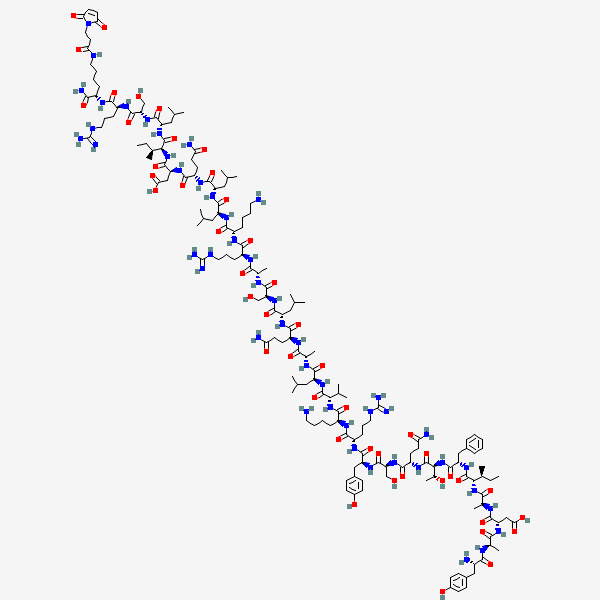
- Molecular formula
- C165H269N47O46
- Molecular weight
- 3647.2 g/mol
- IUPAC name
- (3S)-4-[[(2S)-1-[[(2S,3S)-1-[[(2S)-1-[[(2S,3R)-1-[[(2S)-5-amino-1-[[(2S)-1-[[(2S)-1-[[(2S)-1-[[(2S)-6-amino-1-[[(2S)-1-[[(2S)-1-[[(2S)-1-[[(2S)-5-amino-1-[[(2S)-1-[[(2S)-1-[[(2S)-1-[[(2S)-1-[[(2S)-6-amino-1-[[(2S)-1-[[(2S)-1-[[(2S)-5-amino-1-[[(2S)-1-[[(2S,3S)-1-[[(2S)-1-[[(2S)-1-[[(2S)-1-[[(2S)-1-amino-6-[3-(2,5-dioxopyrrol-1-yl)propanoylamino]-1-oxohexan-2-yl]amino]-5-carbamimidamido-1-oxopentan-2-yl]amino]-3-hydroxy-1-oxopropan-2-yl]amino]-4-methyl-1-oxopentan-2-yl]amino]-3-methyl-1-oxopentan-2-yl]amino]-3-carboxy-1-oxopropan-2-yl]amino]-1,5-dioxopentan-2-yl]amino]-4-methyl-1-oxopentan-2-yl]amino]-4-methyl-1-oxopentan-2-yl]amino]-1-oxohexan-2-yl]amino]-5-carbamimidamido-1-oxopentan-2-yl]amino]-1-oxopropan-2-yl]amino]-3-hydroxy-1-oxopropan-2-yl]amino]-4-methyl-1-oxopentan-2-yl]amino]-1,5-dioxopentan-2-yl]amino]-1-oxopropan-2-yl]amino]-4-methyl-1-oxopentan-2-yl]amino]-3-methyl-1-oxobutan-2-yl]amino]-1-oxohexan-2-yl]amino]-5-carbamimidamido-1-oxopentan-2-yl]amino]-3-(4-hydroxyphenyl)-1-oxopropan-2-yl]amino]-3-hydroxy-1-oxopropan-2-yl]amino]-1,5-dioxopentan-2-yl]amino]-3-hydroxy-1-oxobutan-2-yl]amino]-1-oxo-3-phenylpropan-2-yl]amino]-3-methyl-1-oxopentan-2-yl]amino]-1-oxopropan-2-yl]amino]-3-[[(2R)-2-[[(2S)-2-amino-3-(4-hydroxyphenyl)propanoyl]amino]propanoyl]amino]-4-oxobutanoic acid
Verified external records:
References
- 1.Teichman et al., 2006 — Prolonged stimulation of GH and IGF-I by CJC-1295 in healthy adults (JCEM, via PubMed)
- 2.CJC-1295 in HIV patients with visceral obesity — terminated Phase 2 trial (ClinicalTrials.gov, NCT00267527)
- 3.FDA — Drugs@FDA (no approved CJC-1295 product)
- 4.Van Hout & Hearne, 2016 — Netnography of female use of CJC-1295 (via PubMed)
- 5.Memdouh et al., 2021 — Advances in the detection of GHRH synthetic analogs (via PubMed)
- 6.WADA — The Prohibited List (peptide hormones, growth factors)
- 7.Ionescu & Frohman, 2006 — GH pulsatility during continuous CJC-1295 stimulation (via PubMed)
- 8.Sackmann-Sala et al., 2009 — serum protein changes after CJC-1295 (via PubMed)
- 9.FDA — CJC-1295-related bulk drug substances, PCAC review memorandum
- 10.FDA — CJC-1295 compounding safety-risk summary
- 11.Mendias CL et al. — Safety and Efficacy of Approved and Unapproved Peptide Therapies for Musculoskeletal Injuries and Athletic Performance.
- 12.Mayfield CK et al. — Injectable Peptide Therapy: A Primer for Orthopaedic and Sports Medicine Physicians.
- 13.Rahman OF et al. — Therapeutic Peptides in Orthopaedics: Applications, Challenges, and Future Directions.
More on CJC-1295
Everything else we've written about CJC-1295 — what the community reports, the explainers that cover it, and the terms it keeps running into.
- CJC-1295 Reddit: DAC debate, stacks & evidenceOn Reddit
- What Is DAC in Peptides? Albumin BindingExplainer
- Peptide Dosage by Body WeightExplainer
- Peptide cost per dose: How to CalculateExplainer
- Peptides Before and After: Results & TimelinesExplainer
- When to Take Peptides: Timing GuideExplainer
- Can You Mix Peptides in One Syringe?Explainer
- DAC peptideGlossary
- USADAGlossary
- SecretagogueGlossary
- Drug affinity complex (DAC)Glossary
- Primary endpointGlossary
- Pulsatile releaseGlossary