Also known as: AEZS-130 · ARD-07 · EP-1572 · JMV-1843
Human RCTHelped
On this page
- What is macimorelin?
- How does the macimorelin test work?
- What does the human evidence show?
- What is macimorelin approved for?
- What is the macimorelin dosage for the test?
- Is macimorelin safe? Side effects and limits
- Macimorelin vs MK-677: what is the real difference?
- Is macimorelin banned in sport?
- Evidence by outcome
- FDA & legal status
- Reported side effects
- Chemical identifiers
- References
- Related compounds
Macimorelin is the only FDA-approved oral ghrelin-receptor agonist for human use in the United States, but the approval is narrow: Macrilen is a one-time adult growth hormone deficiency test, not a treatment. A fasted oral dose triggers growth hormone, then four blood draws over 90 minutes show whether the pituitary responds.
What is macimorelin?
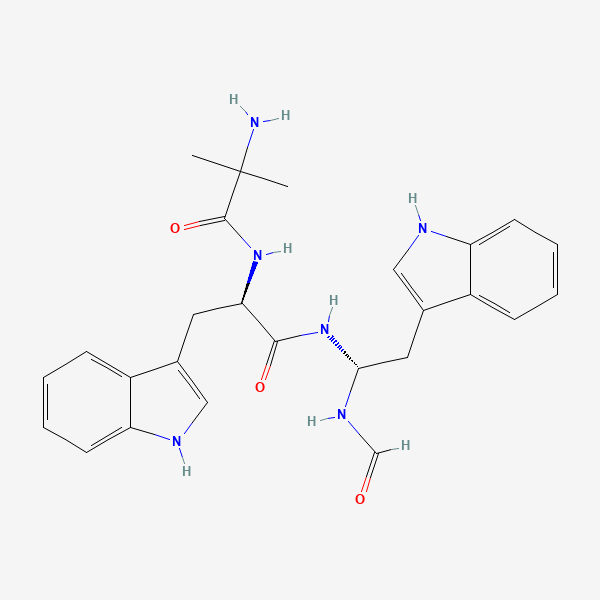
Macimorelin is a synthetic peptidomimetic: a compact, drug-like chain built to mimic ghrelin, the stomach hormone that can tell the pituitary to release growth hormone (GH). The free-base molecule has formula C26H30N6O3, molecular weight 474.6 g/mol, and CAS 381231-18-1 (PubChem). Macrilen is the FDA-approved macimorelin acetate product.
- Evidence tier: Human randomized crossover trial
- FDA status: Approved December 20, 2017, for adult diagnosis only; current label revised February 2026
- How it is used: One supervised oral dose after fasting, followed by four blood draws
- Key risks: QT prolongation, drug interactions, altered taste, dizziness, headache, fatigue, and nausea
- Sport: Prohibited at all times under WADA’s growth hormone secretagogue class
Macimorelin belongs in the growth-hormone compound hub, but the molecule exposes an awkward gap in the broader market: activating a receptor is not the same as proving a useful long-term treatment.
How does the macimorelin test work?
Macimorelin activates growth hormone secretagogue receptors in the hypothalamus and pituitary, briefly pressing the body’s GH-release button. Clinicians then measure serum GH at 30, 45, 60, and 90 minutes. A maximum value below the labeled 2.8 ng/mL cutoff counts as a positive adult growth hormone deficiency test (DailyMed).
The test asks whether the pituitary can respond on demand. That matters because a random GH measurement is unreliable: GH normally arrives in pulses, so one quiet moment does not prove deficiency. Macimorelin creates a timed challenge and turns the response into something measurable.
What does the human evidence show?
Macimorelin has human randomized evidence for diagnostic performance, not for muscle gain, recovery, anti-aging, or chronic GH elevation. In the pivotal open-label crossover study, researchers compared the macimorelin test with the insulin tolerance test (ITT), which provokes GH by deliberately lowering blood sugar.
At the labeled cutoffs, the published analysis reported 95.4% negative agreement and 74.3% positive agreement with ITT; estimated sensitivity was 87% and specificity 96% (Garcia et al., 2018). FDA’s review adds the useful restraint that no stimulation test perfectly proves or excludes adult GH deficiency. The evidence tier is still human RCT because the crossover comparison was randomized, but the verdict belongs to the diagnostic use alone.
What is macimorelin approved for?
Macimorelin is FDA-approved only to diagnose adult growth hormone deficiency. FDA approved Macrilen on December 20, 2017, and the February 2026 label still lists an active New Drug Application. FDA’s statistical review is unusually blunt: the drug was designed for diagnosis, not treatment (FDA review).
The adult-only boundary matters. The updated label says a randomized pediatric crossover study failed its primary diagnostic-accuracy endpoint, so pediatric safety and efficacy remain unestablished. A compounded macimorelin product would not inherit Macrilen’s approval, and FDA rules restrict routine compounding of copies of commercially available drugs.
What is the macimorelin dosage for the test?
Macimorelin dosage on the FDA label is a single 0.5 mg/kg oral dose after a fast of at least eight hours. A healthcare professional dissolves the pouch in water, calculates the volume from body weight, administers the solution, and collects four post-dose samples. This is a test procedure, not a daily or cycling protocol.
Food matters: the label reports that a liquid meal reduced peak exposure by 55% and total exposure by 49%. Strong CYP3A4 inducers can lower macimorelin levels and create a false-positive result, while GH products and several drugs that affect pituitary secretion can also muddy the answer. The macimorelin test is supervised because the preparation and the medication washouts are part of its validity.
Is macimorelin safe? Side effects and limits
Macimorelin was generally tolerated as a one-time test, but the safety case does not support chronic self-experimentation. In 154 adults given the labeled dose, altered taste occurred in 4.5%; dizziness, headache, and fatigue each occurred in 3.9%; nausea and hunger each occurred in 3.2%.
The serious warning is QT prolongation, an electrical timing change that can set up a dangerous heart rhythm. Macrilen should not be combined with drugs known to prolong QT, and strong CYP3A4 inducers can corrupt the result. The label lists no formal contraindications, but that does not erase those warnings. Long-term carcinogenicity and fertility studies have not been performed; chronic use was never the approved job.
Macimorelin vs MK-677: what is the real difference?
Macimorelin vs MK-677 is less a contest than a regulatory reality check. Both are oral growth hormone secretagogues that activate the ghrelin receptor, but Macrilen is FDA-approved for one diagnostic dose, while MK-677 (ibutamoren) is not FDA-approved for muscle, recovery, sleep, anti-aging, or any other human treatment.
That distinction cuts through the usual “oral GH secretagogue” pitch. FDA accepted a brief receptor challenge to measure pituitary reserve; FDA did not validate ongoing receptor stimulation as therapy. Ipamorelin reaches the same receptor by injection, while sermorelin works through the separate GHRH receptor. The growth hormone secretagogue guide maps those pathways without pretending that a GH rise settles the outcome people actually want.
Is macimorelin banned in sport?
Macimorelin is prohibited at all times for athletes governed by WADA rules. The 2026 Prohibited List places growth hormone secretagogues and their mimetics under S2.2.4, covering both in-competition and out-of-competition use (WADA). A diagnostic prescription does not make the anti-doping status disappear; an athlete may need the applicable therapeutic-use process before testing.
Macimorelin earns its place in the GH conversation precisely because its evidence is narrow and strong. The adult growth hormone deficiency test has randomized human validation and FDA approval. The leap from “this receptor releases GH” to “therefore chronic use improves muscle or recovery” remains a different claim, requiring different trials.
Evidence by outcome
Each outcome Macimorelin has been studied for, with the honest evidence grade and what the studies actually found. A tier never stands alone — the verdict rides with it.
| Outcome | Evidence | What was found |
|---|---|---|
| Diagnosis of adult growth hormone deficiency | Human RCTHelped | A randomized, open-label crossover trial compared a single oral macimorelin test with the insulin tolerance test in adults across different pre-test probabilities of growth hormone deficiency and matched healthy controls. Agreement was sufficient to support FDA approval, although neither test is a perfect reference standard. |
| Diagnosis of growth hormone deficiency in children | Human (controlled)No effect | The current label reports that a randomized pediatric crossover study failed its primary diagnostic-accuracy endpoint. Safety and efficacy for pediatric patients have not been established, so the approval remains adult-only. |
FDA & legal status
- United States: fda approved (as of Jul 2026) — approved for Diagnosis of adult growth hormone deficiency
FDA approved Macrilen on December 20, 2017. The current DailyMed label was revised in February 2026 and lists Macrilen as an NDA prescription product. Approval covers a single supervised diagnostic test, not chronic treatment, bodybuilding, recovery, anti-aging, or pediatric diagnosis.
Reported side effects
| Effect | Frequency | Severity |
|---|---|---|
| Dysgeusia (altered or unpleasant taste) | 4.5% in the adult label study | Usually mild |
| Dizziness, headache, or fatigue | 3.9% each in the adult label study | Usually mild |
| Nausea or hunger | 3.2% each in the adult label study | Usually mild |
| QT interval prolongation | Frequency not established | Potentially serious cardiac rhythm risk |
Chemical identifiers
References
- 1.MACRILEN (macimorelin) prescribing information
- 2.FDA approval record for macimorelin acetate
- 3.FDA Division Director Summary Review — NDA 205598
- 4.Garcia et al., 2018 — Macimorelin as a diagnostic test for adult GH deficiency (PMID 29860473)
- 5.Macimorelin — PubChem CID 9804938
- 6.Macimorelin — DrugBank DB13074
- 7.2026 WADA Prohibited List
- 8.FDA — bulk drug substances used in compounding