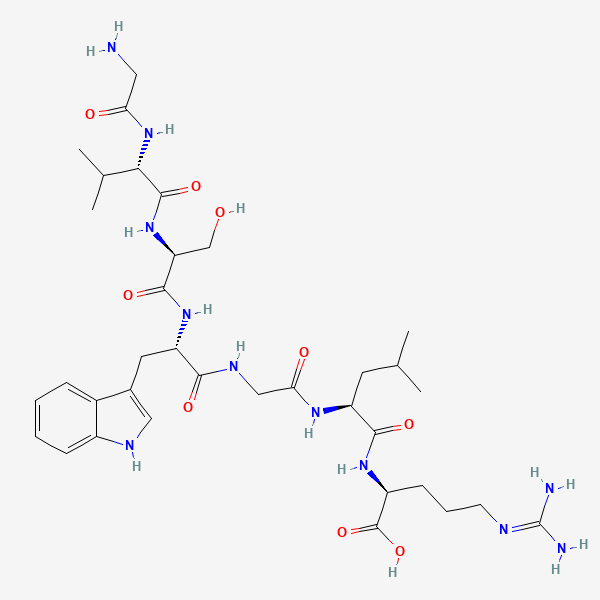
Also known as: PE 22-28 · mini-spadin
Animal-onlyUnclear⚠ none in humans
On this page
- What is PE-22-28?
- How does PE-22-28 work?
- What does the PE-22-28 research show?
- Does PE-22-28 treat depression in humans?
- Is PE-22-28 safe? Side effects and interactions
- What PE-22-28 dosage was used in research?
- Is PE-22-28 FDA-approved or legal in 2026?
- How does PE-22-28 compare with other nootropic peptides?
- Evidence by outcome
- FDA & legal status
- Chemical identifiers
- References
- Related compounds
PE-22-28 is a synthetic seven-amino-acid spadin analog that blocks the TREK-1 potassium channel. One research group found antidepressant-like behavior and increased neurogenesis in mice, but no human efficacy or safety trial has reported. PE-22-28 is not FDA-approved, and there is no established human dose.
Key facts
- Studied for: depression-like behavior, neurogenesis, and synapse markers
- Evidence tier: Animal-only; none in humans
- U.S. status (July 2026): research-use-only, with no FDA-approved product
- PE-22-28 dosage: no human dose; only cell and mouse regimens are published
- Main risks: human effects, adverse events, interactions, and long-term safety are unknown
- Sport: prohibited at all times under WADA’s S0 catch-all for non-approved substances
What is PE-22-28?
PE-22-28 is a synthetic heptapeptide, meaning a lab-made chain of seven amino acids, with the sequence GVSWGLR. PubChem identifies it as CID 165437303, with a molecular formula of C35H55N11O9, a molecular weight of 773.9 g/mol, and CAS number 1801959-12-5.
The PE 22-28 peptide was cut down from spadin, itself a fragment released when sortilin is processed. “22-28” describes the seven positions retained from the parent peptide. PE-22-28 is not a fragment of PACAP, galanin, collagen, or proenkephalin, despite conflicting storefront copy.
PE-22-28 sits in the site’s nootropic peptide category, although “nootropic” here describes the research interest, not a demonstrated cognitive benefit.
How does PE-22-28 work?
PE-22-28 blocks TREK-1, a two-pore potassium channel encoded by the KCNK2 gene. TREK-1 helps potassium leave neurons and acts a little like a brake on electrical activity. Blocking the channel changes how readily those cells respond, which is why researchers have explored a TREK-1 blocker as a different route into mood biology.
The 2017 primary paper measured an IC50 of 0.12 nanomolar in human TREK-1 channels expressed in HEK cells, versus 40 nanomolar for spadin in the same work. IC50 is the concentration that produces half the measured inhibition; it shows target potency in that assay, not an antidepressant dose or clinical effect.
The researchers also tested the peptide against TREK-2, TRAAK, TRESK, TASK-1, and the cardiac hERG channel in cells. Those assays help define its selectivity, but they cannot establish human safety.
What does the PE-22-28 research show?
PE-22-28 has one central preclinical paper combining cell work with mouse experiments. In mice, an acute injection reduced immobility in the forced-swim test. Four days of treatment also changed results in forced-swim, learned-helplessness, and novelty-suppressed-feeding tests, including a corticosterone-based model.
These tests screen for antidepressant-like activity; they are not tiny clinical trials. A mouse swimming longer does not establish that a person with major depressive disorder will feel or function better. The signal exists, but it remains animal-only.
The same paper found more BrdU-positive cells in the mouse hippocampus after four days, a marker of newly generated cells. Cultured mouse cortical neurons also showed higher PSD-95 expression, used as a synapse marker. Neither result demonstrates better memory, cognition, or mood in humans.
One detail often gets blurred in sales pages: the reported 14-to-23-hour half-effect experiments used G/A-PE-22-28 and biotinylated G/A-PE-22-28, not unmodified PE-22-28. Those numbers should not be presented as PE-22-28’s human half-life.
Does PE-22-28 treat depression in humans?
PE-22-28 has no completed human efficacy trial showing that it treats depression. A July 2026 ClinicalTrials.gov search returns no registered PE-22-28 study, and the published paper used cells and mice. The honest verdict for PE-22-28 depression claims is therefore unknown, with none in humans.
TREK-1 remains a real research target, and a short, potent blocker gives scientists something concrete to test. Human pharmacokinetics, dose-finding, tolerability, and controlled efficacy would need to arrive before “antidepressant” describes more than a preclinical lead. The peptides for anxiety guide applies the same boundary to related compounds.
Is PE-22-28 safe? Side effects and interactions
PE-22-28 has no human safety dataset, so a reliable side-effect list does not exist. There are no established rates for headache, nausea, mood changes, withdrawal effects, drug interactions, or serious adverse events. Filling that blank with confident guesses would make the page longer and the reader less informed.
The cell work cannot show what repeated exposure does across human organs, whether the peptide reaches the brain predictably, or how it interacts with psychoactive drugs. Online vials add another risk: a label and purity claim do not establish identity, dose accuracy, sterility, or clinical safety. The guide to what “research use only” means explains that gap.
What PE-22-28 dosage was used in research?
No PE-22-28 dosage has been established for humans. In the 2017 mouse experiments, the unmodified peptide was given by intraperitoneal injection at 3 micrograms per kilogram in acute and four-day tests; one forced-swim experiment also used oral gavage at 1 milligram per kilogram. Those are animal research conditions, not a conversion table for self-use.
The paper establishes no human route, bioavailability, half-life, starting dose, duration, or monitoring plan. Vendor “protocols” therefore sit outside the clinical evidence. A vial’s milligram amount says how much material is sold, not how much a person can safely take.
Is PE-22-28 FDA-approved or legal in 2026?
PE-22-28 is not FDA-approved for depression or any other use as of July 16, 2026. Searches of Drugs@FDA, the agency’s approved-drug database, return no PE-22-28 product, active ingredient, or label. No approval means no FDA-reviewed human dose, manufacturing standard, safety profile, or permitted medical indication.
PE-22-28 is sold online under “research use only” labeling, which does not turn a laboratory chemical into a medicine. Search results are dominated by stores selling vials while discussing antidepressant-like benefits; every efficacy result behind that pitch comes from cells or mice.
For tested athletes, the 2026 WADA Prohibited List creates a separate rule. PE-22-28 is not named individually, but S0 prohibits pharmacological substances without current human therapeutic approval at all times. Because PE-22-28 lacks that approval, it falls under the S0 catch-all.
How does PE-22-28 compare with other nootropic peptides?
PE-22-28 differs from better-known nootropic peptides because its public evidence rests on one concentrated preclinical program aimed at a potassium channel. Semax and Selank have different proposed targets and separate evidence histories; grouping them together does not make their evidence interchangeable.
The reason to watch PE-22-28 is specific: a seven-residue peptide blocked TREK-1 at low concentrations and moved several mouse endpoints. The verdict stays unknown for equally specific reasons: no registered human study, human safety record, clinical dose, or approval. This is an early research lead, not a finished depression treatment.
Evidence by outcome
Each outcome PE-22-28 has been studied for, with the honest evidence grade and what the studies actually found. A tier never stands alone — the verdict rides with it.
| Outcome | Evidence | What was found |
|---|---|---|
| Depression | Animal-onlyUnclear⚠ none in humans | PE-22-28 reduced immobility and changed feeding latency in mouse behavioral tests. No registered or completed human efficacy trial establishes an antidepressant effect. |
| Neurogenesis | Animal-onlyUnclear⚠ none in humans | Four days of treatment increased a marker of new hippocampal cells in mice. Whether PE-22-28 produces useful neurogenesis in people is unknown. |
| Synaptogenesis | In-vitroUnclear⚠ none in humans | PE-22-28 increased PSD-95 expression in cultured mouse cortical neurons. This cell result is not evidence of better cognition or mood in people. |
FDA & legal status
- United States: research use only (as of Jul 2026)
No PE-22-28 drug appears in Drugs@FDA, and no approved indication or human dosing label exists. Online vials are sold as laboratory research chemicals, not FDA-approved medicines.
Chemical identifiers