Also known as: Leuphasyl · (D-Ala2)leucine-enkephalin · [D-Ala2]-Leucine enkephalin · DADLE
In-vitroUnclear
On this page
- What is pentapeptide-18?
- Is pentapeptide-18 really DADLE?
- How is pentapeptide-18 supposed to affect wrinkles?
- What does the evidence show for pentapeptide-18 wrinkles?
- What did the 2026 study add?
- Is pentapeptide-18 safe? What are the risks?
- Is pentapeptide-18 FDA-approved or legal in 2026?
- How does pentapeptide 18 vs argireline compare?
- Evidence by outcome
- FDA & legal status
- Chemical identifiers
- References
- Related compounds
Pentapeptide-18 is a five-amino-acid cosmetic peptide sold as Leuphasyl, with a proposed enkephalin-receptor mechanism and only supplier-generated wrinkle data. Its chemistry overlaps opioid-receptor research, but the famous DADLE literature mostly studies a different position-5 stereoisomer. For wrinkles, the honest evidence tier is in-vitro; safety and skin penetration remain poorly mapped.
Key facts
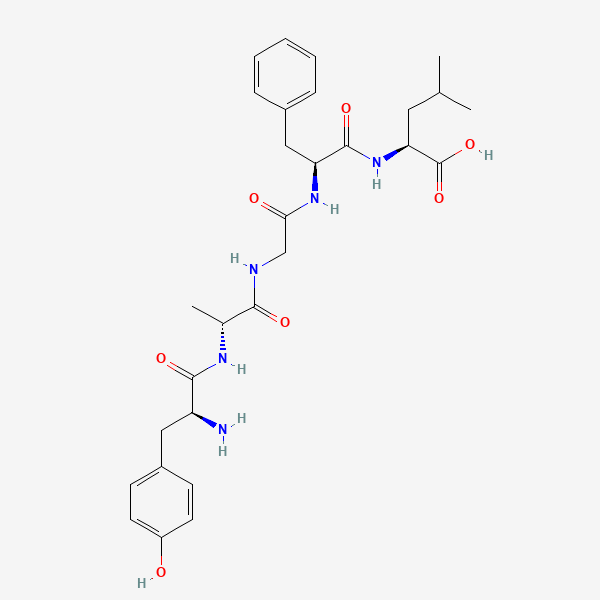
- What it is: Tyr-D-Ala-Gly-Phe-Leu, a 569.65-dalton synthetic enkephalin analogue (CAS 64963-01-5)
- Studied for: topical softening of facial expression lines
- Evidence tier: in-vitro; one small supplier-run human test does not upgrade the tier
- U.S. status (2026): unscheduled cosmetic ingredient, not an FDA-approved drug
- How it is used: as an ingredient in finished topical serums and creams, not as an injection
- Main unknowns: independent efficacy, skin penetration, and long-term ingredient-specific safety
What is pentapeptide-18?
Pentapeptide-18 is the cosmetic ingredient name for Tyr-D-Ala-Gly-Phe-Leu, a five-residue relative of the natural opioid peptide leucine-enkephalin. The position-2 D-alanine is the unusual bit. FDA’s substance registry identifies the same sequence, formula C29H39N5O7, and molecular weight 569.65; PubChem records it as CID 10099522. Leuphasyl is the trade name attached to the cosmetic solution, not a separate molecule.
Here is the part missing from most skincare summaries: this is enkephalin peptide skincare, not merely a generic “signal peptide.” Enkephalins are opioid-receptor ligands. That makes the pharmacology worth discussing, while saying nothing by itself about whether a serum reaches nerve endings through intact skin.
Is pentapeptide-18 really DADLE?
Pentapeptide-18 is often called DADLE in catalogues, but that label hides a stereochemistry problem. Pentapeptide-18 ends in ordinary L-leucine. The neuroscience compound most papers call DADLE is Tyr-D-Ala-Gly-Phe-D-Leu, with D-leucine at position 5. A delta-opioid receptor review describes that D-Leu version as a commonly used delta agonist with some mu-receptor affinity.
The distinction matters because mirror-image orientation can change receptor binding. Pentapeptide-18 belongs to the same enkephalin pharmacology family, and the exact L-Leu compound is widely described as a delta-opioid agonist, but decades of results from the D-Leu stereoisomer cannot simply be pasted onto Leuphasyl. Same letters on a casual ingredient page; not quite the same molecule under a stereochemical microscope.
How is pentapeptide-18 supposed to affect wrinkles?
Pentapeptide-18 is proposed to soften expression lines by reducing the nerve signal that triggers a facial-muscle contraction. The supplier model says enkephalin-receptor activation closes calcium channels at the nerve ending, which reduces vesicle fusion and release of acetylcholine, the “contract” messenger. Think of lowering the signal volume rather than freezing the speaker.
That mechanism is plausible at a nerve cell and supported by supplier cell-culture assays measuring neurotransmitter release. The missing step is topical delivery: a 569.65-dalton, water-soluble peptide still has to cross the skin barrier and reach the relevant nerve terminal in an active form. No opened human mechanism study demonstrated that chain in facial skin. Calling Leuphasyl “topical Botox” skips most of the journey.
What does the evidence show for pentapeptide-18 wrinkles?
Pentapeptide-18 wrinkles evidence is one supplier test plus laboratory work, not a body of independent clinical trials. The often-copied number is real but routinely mangled: a 5% Leuphasyl solution, delivering 0.05% active peptide, was applied twice daily around the eyes in 14 volunteers for 28 days. The supplier reported an 11.6% reduction in wrinkle depth from silicone imprints.
A later peer-reviewed cosmetic-serum paper repeats 11.64% and traces it to the 2005 supplier dossier. It was not an independently published randomized trial, and the supplier brochure explicitly says its material should not be presented as finished-product claim substantiation. No registered or peer-reviewed standalone human trial surfaced in this search. The figure can stay only with that provenance bolted to it.
What did the 2026 study add?
The 2026 paper added chemical characterization and computer-generated mechanism leads, not proof that pentapeptide-18 removes wrinkles. Akhan and colleagues used infrared and Raman spectroscopy, density-functional calculations, molecular docking, molecular-dynamics simulations, and predicted ADMET properties. The modeled targets included proteins involved in inflammation and extracellular-matrix signaling.
The ScienceDirect paper is useful for asking where the peptide might interact next. It did not randomize people, apply a Leuphasyl serum, measure wrinkle depth against placebo, or establish topical penetration. Docking means a computer found a compatible pose; it does not mean the peptide reached that protein in living skin. The evidence badge therefore stays in-vitro, not human-controlled.
Is pentapeptide-18 safe? What are the risks?
Pentapeptide-18 has no clear serious safety signal from cosmetic use, but ingredient-specific human safety data are too thin to calculate risk or frequency. The 14-person supplier test was short, while published serum studies combine several peptides and other ingredients. Those mixtures cannot tell us which ingredient caused an irritation—or which one did not.
For intact-skin use, the practical concerns are redness, stinging, or allergy to the finished formula, including its preservatives and solvents. The opioid connection is not evidence that a face serum causes opioid intoxication; systemic absorption has not been demonstrated. The reverse claim—zero systemic exposure—is also unproven. Microneedling or injecting a cosmetic formula changes the exposure and leaves the evidence reviewed here behind.
Is pentapeptide-18 FDA-approved or legal in 2026?
Pentapeptide-18 is not an FDA-approved drug, but that is not the normal gate for a cosmetic ingredient. FDA states that cosmetics and their ingredients, except color additives, generally do not receive premarket approval. Companies remain responsible for safety, labeling, and avoiding adulterated or misbranded products under U.S. cosmetic law.
As of July 16, 2026, pentapeptide-18 is best described as an unscheduled cosmetic ingredient with no approved medical indication. A serum can be sold to alter appearance; claims to treat disease or change body structure can push a product toward drug regulation. The wider cosmetic peptide hub keeps that distinction separate from efficacy.
How does pentapeptide 18 vs argireline compare?
Pentapeptide 18 vs argireline is mainly a comparison of proposed targets and evidence depth. Leuphasyl is pitched as an enkephalin-receptor signal that reduces calcium-dependent neurotransmitter release. Argireline, or acetyl hexapeptide-8, is proposed to interfere with the SNAP-25/SNARE machinery used to release that signal. SNAP-8 extends the same SNAP-25-inspired idea to eight residues.
Argireline has the stronger human record, including small controlled cosmetic studies; Leuphasyl has supplier testing and cell work. Combining them is marketed as an upstream-plus-downstream pairing, and the supplier test reported a larger wrinkle change for the blend. That is a hypothesis with in-house data, not proof of synergy from an independent head-to-head trial. For pentapeptide-18, the science is worth following; the serum claims have arrived well ahead of it.
Evidence by outcome
Each outcome Pentapeptide-18 has been studied for, with the honest evidence grade and what the studies actually found. A tier never stands alone — the verdict rides with it.
| Outcome | Evidence | What was found |
|---|---|---|
| Facial expression-wrinkle reduction (topical) | In-vitroUnclear | Supplier testing in 14 volunteers reported an 11.6% reduction in wrinkle depth after 28 days with a cream containing 0.05% active Pentapeptide-18. The result was not published as an independent controlled trial. Cell work supports a neurotransmitter-release hypothesis, but no peer-reviewed human trial isolates Pentapeptide-18 well enough to establish a wrinkle effect. |
FDA & legal status
- United States: unscheduled (as of Jul 2026)
Pentapeptide-18 appears in cosmetic skincare but is not an FDA-approved drug. Cosmetic ingredients other than color additives generally do not receive FDA premarket approval; marketers remain responsible for product safety and compliant labeling. Drug-like treatment claims can change how a product is regulated.
Chemical identifiers
References
- 1.Pentapeptide-18 compound record — PubChem CID 10099522
- 2.Pentapeptide-18 substance record — FDA Global Substance Registration System
- 3.Moy et al., 2023 — Peptide-pro complex serum (PMC10084013)
- 4.Akhan et al., 2026 — Pentapeptide-18 spectroscopic and molecular interaction analysis
- 5.Vicente-Sanchez et al., 2016 — The delta opioid receptor tool box (PMC5083241)
- 6.FDA — How cosmetics are regulated