Also known as: Acetyl octapeptide-3 · Acetyl glutamyl octapeptide-3 · Ac-EEMQRRAD-NH2 · SNAP8
MechanisticUnclear⚠ none in humans
On this page
- What is SNAP-8?
- How does SNAP-8 work?
- What does the research show?
- Is SNAP-8 safe? Side effects
- FDA & legal status (2026)
- How is SNAP-8 used in skincare?
- SNAP-8 vs Argireline
- Frequently asked questions
- Who is SNAP-8 for — and who should be cautious?
- Evidence by outcome
- FDA & legal status
- Chemical identifiers
- References
- Related compounds
- More on SNAP-8
SNAP-8 (acetyl octapeptide-3) is a synthetic 8-amino-acid peptide used topically in anti-aging skincare, marketed as a gentler, leave-on cousin of “Botox in a jar.” SNAP-8 is legal to sell as a cosmetic ingredient and is not an FDA-approved drug. The wrinkle-smoothing case is a plausible mechanism, not a proven human result.
What is SNAP-8?
SNAP-8 (acetyl octapeptide-3) is a lab-made peptide — a short chain of 8 amino acids (sequence Ac-EEMQRRAD-NH2, molecular formula C41H70N16O16S, molecular weight ~1075) sold as an ingredient in serums and creams (PubChem CID 76283482). SNAP-8’s name is a giveaway: it is the elongated version of Argireline (acetyl hexapeptide-8), with two extra amino acids added to the same core. Both belong to a family cosmetic chemists nickname “neuropeptides,” pitched at the fine lines that come from repeated facial expressions — the forehead furrows and crow’s feet you make every time you frown or squint. SNAP-8 is a skincare active you smooth on, not a medicine you take.
How does SNAP-8 work?
SNAP-8’s proposed mechanism borrows the idea behind botulinum toxin and turns the dial way down. When a nerve tells a muscle to contract, it uses a docking machine called the SNARE complex — and one of its parts is a protein named SNAP-25. SNAP-8 is a copy of the tip (the N-terminal end) of SNAP-25, so the theory is that SNAP-8 slots into the machinery in SNAP-25’s place, makes the complex a little less efficient, and softens the muscle pull that creases skin over time. Think of it as putting a slightly worn key in the lock so the door opens less crisply. The honest caveat, and it is a big one: this is a mechanism-level hypothesis extrapolated from nerve biology and lab studies, not something a published human trial has confirmed for topical SNAP-8. A peptide this size also has to survive being smeared on the skin surface and actually reach the nerve endings below — a real question mark for any large molecule applied to intact skin.
What does the research show?
SNAP-8’s evidence is thin and, importantly, not human-proven. A PubMed search for acetyl octapeptide-3 returns only a small handful of records, none of them a randomized controlled trial in people (PubMed), and ClinicalTrials.gov lists no registered clinical study of the compound (ClinicalTrials.gov). The wrinkle-reduction figures you see quoted around the internet trace back to in-house testing by the ingredient’s manufacturer — that is a commercial claim, not an independent peer-reviewed trial, and we grade it as such. So the most honest summary is: SNAP-8 has a coherent proposed mechanism and a marketing story, but the category that matters most for deciding whether to trust it — a controlled human study showing it works — is empty. Evidence tier: mechanistic-hypothesis; None-in-humans. Verdict: unknown. That is not a knock on the idea; it is where the evidence actually sits today.
Is SNAP-8 safe? Side effects
SNAP-8’s honest safety answer is “generally well tolerated at cosmetic concentrations, but not formally studied long-term in humans.” As a topical peptide, SNAP-8 doesn’t carry the systemic concerns injected peptides raise — the most commonly reported issue is mild application-site irritation or redness, the same thing any new serum can cause, and usually in people with sensitive or reactive skin. Because SNAP-8 is charged and fairly large, much of it likely stays near the skin surface, which cuts both ways: less absorption is reassuring for safety and unhelpful for a mechanism that needs to reach nerve endings. The practical risk usually lives in the finished product, not the molecule — preservatives, fragrance, and other actives in the same bottle are more likely to irritate than the peptide itself. Patch-test a new product, as you would with any active.
FDA & legal status (2026)
SNAP-8 is legal to sell in the United States as a cosmetic ingredient, and it is not an FDA-approved drug. US cosmetics and their ingredients (other than color additives) don’t go through FDA pre-market approval, so acetyl octapeptide-3 can be formulated into serums and creams without agency sign-off (FDA cosmetics). The line to watch is the marketing: a product sold to “moisturize and improve the look of fine lines” is a cosmetic, but one that claims to change how your muscles work is making a drug claim the FDA hasn’t approved. As a cosmetic peptide, SNAP-8 is not a controlled substance and is not the kind of performance agent anti-doping bodies list — it’s not a sport-doping concern. The full dated breakdown is in the regulatory-status block below; re-check it yearly, since cosmetic-claim enforcement shifts.
How is SNAP-8 used in skincare?
SNAP-8 is used topically — dissolved in the water phase of a serum, essence, or cream and applied to the skin, not reconstituted or injected. In finished products, acetyl octapeptide-3 is commonly formulated at low single-digit to roughly 10% of a peptide-solution ingredient (which is itself mostly water and carrier), so the actual peptide content is small — these numbers come from cosmetic formulation guidance, not clinical dosing, and there is no “correct dose” to report because no dosing trial exists. In practice people layer a SNAP-8 serum under moisturizer once or twice daily and judge it over weeks, the way any expression-line product is used. Because SNAP-8 is a leave-on cosmetic and not an injectable, our injection-focused reconstitution & dosing calculator and mixing compatibility reference don’t apply to it.
SNAP-8 vs Argireline
SNAP-8 and Argireline (acetyl hexapeptide-8) are the two peptides that anchor the “topical Botox-in-a-jar” category, and they are close relatives: SNAP-8 is essentially Argireline with two extra amino acids bolted on, and both are pitched at expression lines through the same proposed SNAP-25 mechanism. Argireline is the older, more-marketed of the two and has at least some published cosmetic testing behind it; SNAP-8 is positioned as a longer, theoretically stickier variant, but with even less independent human data. Neither has a randomized human trial proving wrinkle reduction, so the honest framing is “two versions of the same unproven-in-humans idea.” You can see the whole cosmetic-peptide family on the cosmetic peptides hub, and how we assign the mechanistic-hypothesis grade on our evidence-grading methodology page.
Frequently asked questions
Does SNAP-8 actually work on wrinkles?
SNAP-8 has a reasonable proposed mechanism and manufacturer testing, but no published, independent randomized human trial shows it measurably reduces wrinkles. That makes SNAP-8 an interesting idea with unproven results — we grade it mechanistic-hypothesis with a None-in-humans flag, not “proven.”
Is SNAP-8 the same as Botox?
No. Botox (botulinum toxin) is an injected prescription drug that cleaves SNAP-25 inside nerve endings; SNAP-8 is a topical cosmetic peptide that, in theory, gently competes with SNAP-25 from the outside. They share a target protein and nothing else — different potency, different route, different regulatory world.
Is SNAP-8 legal?
Yes — SNAP-8 (acetyl octapeptide-3) is legal to sell in the United States as a cosmetic ingredient. It is not an FDA-approved drug and doesn’t need to be to appear in a serum, as long as the product is marketed as a cosmetic rather than making unapproved drug claims.
How is SNAP-8 used?
SNAP-8 is applied topically in a serum or cream, typically once or twice daily under moisturizer. There is no reconstitution and no injection, and because no dosing trial exists, there is no clinically validated concentration — formulation levels are set by product makers, not by research.
Does SNAP-8 have side effects?
SNAP-8 is generally well tolerated as a topical, with mild irritation or redness the most commonly reported issue, mostly in sensitive skin. There’s no long-term human safety study specific to SNAP-8, and most reactions people report trace to the whole formula rather than the peptide alone.
Who is SNAP-8 for — and who should be cautious?
SNAP-8 draws in people chasing softer expression lines — the forehead creases and crow’s feet — who want a leave-on serum instead of needles and are curious about the “topical Botox” peptides. The honest framing: SNAP-8’s mechanism is a clever, plausible idea, and as a cosmetic it’s low-risk to try. But the wrinkle-smoothing claim isn’t backed by an independent human trial, a large peptide’s ability to reach its target through intact skin is far from certain, and the big before-and-after numbers online come from the seller, not from published research. If you go in treating SNAP-8 as a nice-to-have with modest, unproven upside — rather than a Botox replacement — you’ll have calibrated your expectations correctly. Anyone with reactive skin should patch-test first, and anyone expecting injectable-grade results should keep those expectations in check.
Evidence by outcome
Each outcome SNAP-8 has been studied for, with the honest evidence grade and what the studies actually found. A tier never stands alone — the verdict rides with it.
| Outcome | Evidence | What was found |
|---|---|---|
| Expression / facial wrinkle reduction (topical) | MechanisticUnclear⚠ none in humans | SNAP-8's anti-wrinkle case rests on a proposed mechanism — competing with SNAP-25 to dampen muscle-triggered creasing — plus in-house testing from the ingredient's maker. No published, independent, peer-reviewed human trial establishes that topical SNAP-8 measurably reduces wrinkles, and no controlled clinical study for this use is registered on ClinicalTrials.gov. Promising story, unproven result. |
FDA & legal status
- United States: unscheduled (as of Jul 2026)
Acetyl octapeptide-3 is used as a cosmetic ingredient, not an FDA-approved drug. In the US, cosmetic ingredients (other than color additives) don't require FDA pre-market approval, so SNAP-8 is legally sold in skincare — but the FDA has not evaluated it as a drug, and anti-wrinkle "changes your muscle" style claims can cross into unapproved-drug territory. Re-verify annually.
openFDA Drugs@FDA lists no approved product for Acetyl octapeptide-3 as of 2026-07-15.
Chemical identifiers
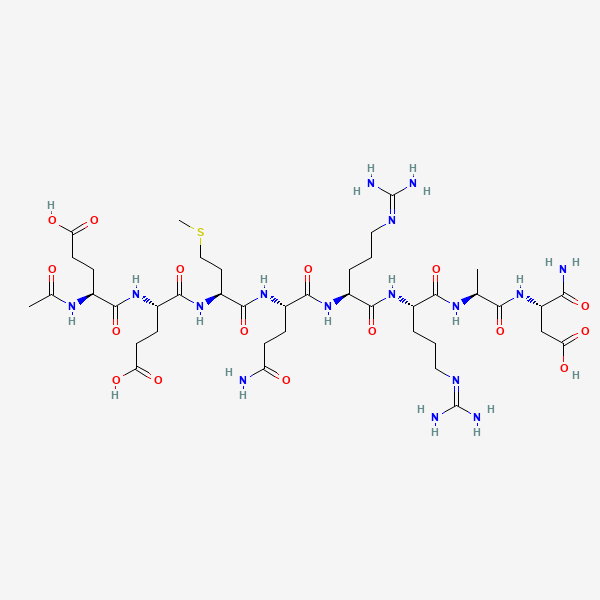
- Molecular formula
- C41H70N16O16S
- Molecular weight
- 1075.2 g/mol
- IUPAC name
- (4S)-4-acetamido-5-[[(2S)-1-[[(2S)-1-[[(2S)-5-amino-1-[[(2S)-1-[[(2S)-1-[[(2S)-1-[[(2S)-1-amino-3-carboxy-1-oxopropan-2-yl]amino]-1-oxopropan-2-yl]amino]-5-(diaminomethylideneamino)-1-oxopentan-2-yl]amino]-5-(diaminomethylideneamino)-1-oxopentan-2-yl]amino]-1,5-dioxopentan-2-yl]amino]-4-methylsulfanyl-1-oxobutan-2-yl]amino]-4-carboxy-1-oxobutan-2-yl]amino]-5-oxopentanoic acid
Verified external records:
References
More on SNAP-8
Everything else we've written about SNAP-8 — what the community reports, the explainers that cover it, and the terms it keeps running into.
- SNAP-8 peptide Reddit: wrinkle claims vs evidenceOn Reddit
- Peptide Alternatives to Botox: Do They Work?Explainer
- EfficacyGlossary
- acetylationGlossary
- N-terminus and C-terminusGlossary
- PotencyGlossary