Also known as: SBT-20 · Szeto-Schiller peptide 20 · SS-20 peptide
Animal-onlyHelped⚠ none in humans
On this page
- What is SS-20?
- How does SS-20 work in mitochondria?
- What does the SS-20 research actually show?
- What does SS-20 vs SS-31 tell us?
- Is SS-20 safe?
- What SS-20 dosage has been studied?
- Is SS-20 FDA-approved or banned in sport?
- Evidence by outcome
- FDA & legal status
- Chemical identifiers
- References
- Related compounds
SS-20 is a synthetic four-amino-acid Szeto-Schiller peptide that protects mitochondrial function in animal and cell studies without directly scavenging free radicals. That makes the mechanism scientifically useful, but not clinically proven: SS-20 has no published human trial, no FDA approval, and no validated human dose as of July 2026.
| Key fact | Answer |
|---|---|
| What it is | Synthetic mitochondria-targeting tetrapeptide |
| Evidence tier | Animal-only; none in humans |
| Studied for | Ischemic injury, chemotherapy neuropathy, and toxin-induced neurodegeneration |
| U.S. status | Research-use-only; not FDA-approved (July 2026) |
| Human dose | None established |
| Sport | Prohibited at all times under WADA S0 |
What is SS-20?
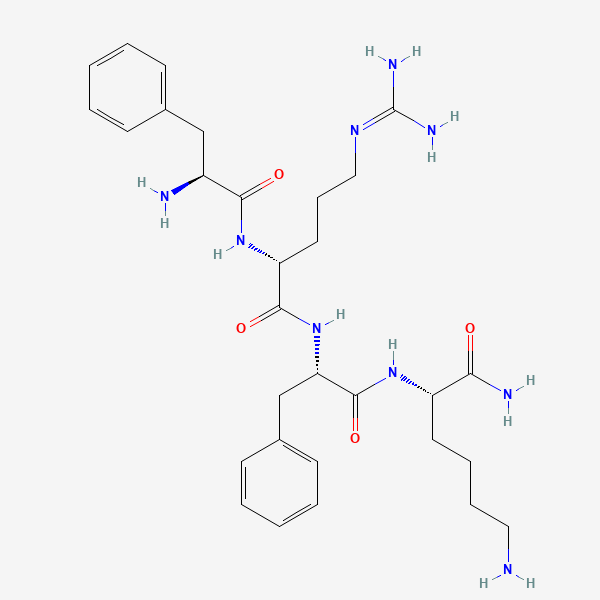
SS-20 is a lab-made tetrapeptide with the sequence Phe-D-Arg-Phe-Lys-NH2. PubChem lists the free peptide as CID 10008657, with molecular formula C30H45N9O4 and molecular weight 595.7 g/mol (PubChem). Researchers also call it SBT-20. It belongs to the same aromatic-cationic Szeto-Schiller family as SS-31 (elamipretide), but the two are separate molecules, not aliases.
SS-20 sits in the longevity and mitochondrial peptide hub because it targets failing cellular energy machinery. That category describes the research question, not a proven lifespan effect. No SS-20 experiment has shown longer life or slower aging in people.
How does SS-20 work in mitochondria?
SS-20 appears to protect mitochondrial energy production by binding cardiolipin, a lipid that helps organize the inner mitochondrial membrane, and by keeping cytochrome c working as an electron carrier. Think of cardiolipin as the workbench holding the cell’s power equipment in place. During ischemia, that arrangement can buckle; cytochrome c changes jobs from moving electrons to promoting oxidation.
In rat kidney experiments, SS-20 preserved cytochrome c structure, mitochondrial respiration, cristae membranes, and ATP production during ischemia (PMID 26071084). The useful twist is what SS-20 lacks: no dimethyltyrosine, the residue that gives SS-31 direct free-radical-scavenging activity. SS-20 still reduced oxidative damage, pointing toward less radical production and better membrane bioenergetics rather than simple chemical cleanup.
What does the SS-20 research actually show?
SS-20 has repeated preclinical signals across several injury models, but every therapeutic result remains animal-only. Rat heart studies found smaller infarcts after experimentally blocked and reopened coronary arteries (PMID 17429296). Another rat study found better kidney tolerance to 45 minutes of warm ischemia, plus less later fibrosis (PMID 25339695). These are tightly controlled injuries, not evidence of heart or kidney benefit in a person.
Mouse neuropathy studies tell a similar story. Continuous SS-20 reduced pain-like sensitivity and loss of skin nerve fibers after oxaliplatin (PMID 29660270) or paclitaxel (PMID 36513390). Toxin-based Parkinson’s models also reported protection of dopamine neurons. None tested cancer patients, people with Parkinson’s disease, healthy adults, or longevity users. The honest evidence grade is animal-only, not “early human.”
What does SS-20 vs SS-31 tell us?
The useful ss-20 vs ss-31 comparison is mechanistic and regulatory. SS-31 contains dimethyltyrosine and can directly scavenge reactive oxygen species; SS-20 replaces that chemistry with phenylalanine and cannot. Yet both protected mitochondria in several preclinical models. SS-20 therefore helped separate direct antioxidant chemistry from a broader effect on cardiolipin, cytochrome c, electron flow, and radical production.
The regulatory split is larger. FDA granted accelerated approval to SS-31’s drug form, Forzinity (elamipretide), for Barth syndrome patients weighing at least 30 kg on September 19, 2025, under NDA 215244 (FDA). SS-20 did not receive that approval and cannot borrow it by family resemblance. Same peptide series; very different evidence ledger.
Is SS-20 safe?
SS-20 has no established human safety profile. The published work does not provide reliable rates for injection reactions, immune responses, organ toxicity, drug interactions, reproductive effects, or long-term exposure. A mouse or rat tolerating an experimental schedule under laboratory supervision cannot settle those questions for a person.
Research-use-only products add another layer: a paper using a characterized research batch does not validate the identity, purity, concentration, or sterility of a vial sold online. SS-20’s lack of reported human adverse events means “not studied,” not “no side effects.”
What SS-20 dosage has been studied?
No ss-20 dosage has been validated for humans. The numbers in the literature are animal protocols tied to specific injury models: the oxaliplatin study used continuous 5 or 10 mg/kg/day delivery in mice and an acute 10 mg/kg subcutaneous test; the paclitaxel study used continuous 8.5 mg/kg/day in mice. A rat heart experiment used 3 mg/kg intraperitoneally before ischemia and again before reperfusion.
Those amounts describe experiments, not a conversion formula or personal protocol. Species, route, timing, and disease model all change what a dose means. There is no clinical SS-20 label, no pharmacokinetic study in people, and no evidence-based cycle to report.
Is SS-20 FDA-approved or banned in sport?
SS-20 is not FDA-approved and remains research-use-only in the United States as of July 16, 2026. Searches of the primary literature and ClinicalTrials.gov found no registered human SS-20 intervention study. Forzinity’s approval belongs to elamipretide/SS-31 alone; MOTS-c is another mitochondrial peptide with a separate molecule and evidence record.
WADA’s 2026 S0 rule prohibits pharmacological substances that lack current approval for human therapeutic use. SS-20 is not named separately, but its unapproved preclinical status places it under that catch-all at all times (WADA 2026 Prohibited List). For athletes, “obscure” is not the same as permitted.
Evidence by outcome
Each outcome SS-20 has been studied for, with the honest evidence grade and what the studies actually found. A tier never stands alone — the verdict rides with it.
| Outcome | Evidence | What was found |
|---|---|---|
| Mitochondrial protection during cardiac and kidney ischemia | Animal-onlyHelped⚠ none in humans | Rat studies found preserved mitochondrial respiration, less tissue injury, or both after experimental ischemia. No human trial has established a clinical benefit. |
| Chemotherapy-induced peripheral neuropathy | Animal-onlyHelped⚠ none in humans | SS-20 reduced pain-like behavior and protected nerve fibers in mouse models using oxaliplatin or paclitaxel. The result has not been tested in people. |
| Neuroprotection in Parkinson's disease models | Animal-onlyHelped⚠ none in humans | SS-20 protected dopamine neurons and mitochondrial energy production in toxin-based mouse and cell models. That is not evidence that SS-20 treats Parkinson's disease in humans. |
FDA & legal status
- United States: research use only (as of Jul 2026)
SS-20 has no FDA-approved indication or drug product and remains a preclinical research compound. FDA's 2025 approval of Forzinity applies to elamipretide (SS-31), not SS-20.
Chemical identifiers
References
- 1.SS-20 compound record (PubChem CID 10008657)
- 2.Birk et al., 2015 — SS-20, cardiolipin, and cytochrome c (PMID 26071084)
- 3.Toyama et al., 2018 — oxaliplatin neuropathy in mice (PMID 29660270)
- 4.Itoh et al., 2023 — paclitaxel neuropathy in mice (PMID 36513390)
- 5.Cho et al., 2007 — myocardial infarction in rats (PMID 17429296)
- 6.Szeto et al., 2015 — kidney ischemia in rats (PMID 25339695)
- 7.FDA — accelerated approval of Forzinity for Barth syndrome
- 8.WADA — 2026 Prohibited List