Also known as: Mitochondrial-derived peptide MOTS-c · MOTS-c (human) · Mitochondrial ORF of the twelve-S rRNA type-c
Animal-onlyUnclear⚠ none in humans
On this page
- What people actually use MOTS-c for — and what they report
- What is MOTS-c?
- How does MOTS-c work?
- Does MOTS-c actually work? What the science says
- Is MOTS-c safe? Side effects
- FDA & legal status (2026)
- MOTS-c dosage: what studies actually used
- How MOTS-c compares to other metabolic peptides
- Frequently asked questions
- Who is MOTS-c for — and who should skip it?
- Evidence by outcome
- FDA & legal status
- Registered clinical trials
- Chemical identifiers
- References
- Related compounds
- More on MOTS-c
You probably didn’t hear about MOTS-c from a journal. You heard it on a podcast, or from the guy at the gym who swears it fixed his 3 p.m. crash — maybe while he was dragging through the fatigue that tirzepatide can leave behind. So here’s the straight version, no sales pitch.
MOTS-c is a mitochondrial-derived peptide that people inject for energy, endurance, and fat loss. On the energy question specifically, the community verdict is fairly consistent: a real but subtle lift — a floor under your daily energy, not a stimulant jolt — and it seems to land best in people who are already training. The honest catch is that “the community verdict” is carrying that sentence. The hard proof is still mouse data and anecdote: no completed human trial has shown injected MOTS-c raises energy in people, it isn’t FDA-approved, and the first real treatment trial won’t read out until 2027.
What people actually use MOTS-c for — and what they report
Strip away the lab talk and MOTS-c has a pretty consistent street reputation. People run it for four things: daily energy, endurance and recovery in training, fat loss, and a fuzzy-but-popular “mitochondrial reset.” One use case keeps coming up lately — stacking it on top of a GLP-1 like tirzepatide or retatrutide to fight the wrung-out, low-energy feeling those drugs can bring on while you’re eating in a deep deficit. That’s the modern MOTS-c buyer in one sentence: already optimizing, hunting for the next lever.
What they report — the wins and the flat days. Energy is the single most common win people describe: a steadier baseline, less of an afternoon wall, sometimes noticeable inside the first week or two. Endurance and quicker recovery show up next. But the reports are honestly mixed, and that’s the useful part. “Felt nothing after one vial” is a recurring theme. A minority get the opposite of a boost — a flat, foggy, slightly hungover day some users have taken to calling the “MOTS-c hangover.” And nearly everyone converges on one pattern: MOTS-c rewards people who are actually training and eating in a deficit, and does very little for people who aren’t. The community’s own explanation is that it raises your capacity to make energy; it doesn’t create the demand for you. Couch plus MOTS-c is still couch.
The doses people actually run (anecdotal — not a validated human protocol): the common community range is 5–10 mg per week subcutaneously, once or twice weekly, in cycles of 8–12 weeks. Beginners usually open at 5 mg/week and hold there a couple of weeks before nudging up. A second popular pattern is a short “4-injection cycle” — 5 mg every five days, four shots over 20 days. None of these numbers come from a human trial; they’re crowd conventions passed peer to peer, and they carry exactly the reliability that implies.
One honest limit on any community read: the loudest reports come from people who felt something and came back to post about it. We have no idea how many quietly tried MOTS-c, felt nothing, and never mentioned it again — so read “most people report energy” as “most people who post report energy,” which is a smaller, softer claim than it first looks.
What is MOTS-c?
MOTS-c is a small peptide — a 16-amino-acid chain (sequence MRWQEMGYIFYPRKLR) — with an unusual home address: it’s encoded inside your mitochondrial DNA, the separate little genome tucked into the cell’s power plants. That makes it one of a newish class called mitochondrial-derived peptides: tiny signals the mitochondria fire off to the rest of the body (yes — your mitochondria write their own peptides). Your body already makes MOTS-c on its own. The version people buy is synthetic, and in the US it’s neither a medicine nor a supplement — it’s sold only as a research chemical.
How does MOTS-c work?
MOTS-c works mostly by flipping on AMPK — picture AMPK as your cell’s low-fuel warning light, the sensor that switches the body into “burn fuel, use glucose efficiently” mode when energy runs short. In mice and cells, MOTS-c lights up that pathway, which is the plausible throughline for its effects on blood sugar and body fat. Under metabolic stress it also travels into the cell nucleus and helps switch on stress-defense and antioxidant genes. The catch worth repeating: this mechanism is mapped almost entirely in animals and cells. Exactly how it behaves inside a human body hasn’t been established.
Does MOTS-c actually work? What the science says
Here’s the part the sales pages skip: MOTS-c’s evidence only makes sense if you keep two piles separate — what mice did on injected MOTS-c, and what humans do with the MOTS-c they make themselves. The mouse pile is genuinely strong. The human-treatment pile is nearly empty.
The headline mouse result is the 2021 exercise study: daily MOTS-c improved treadmill performance across young, middle-aged, and old mice — the old ones (think 65+ in human years) roughly doubled their running capacity and could outrun untreated middle-aged mice (2021 study). That single experiment is where the “exercise mimetic” reputation comes from. The same paper’s human arm is where people get overexcited: cycling raised the men’s own skeletal-muscle MOTS-c roughly 12-fold. That shows exercise produces MOTS-c in people — not that injecting MOTS-c reproduces exercise. Different claim entirely.
Rewind to the 2015 discovery paper and the mechanism holds together: MOTS-c activated AMPK and protected mice against diet- and age-related insulin resistance (PMID 25738459). There’s a whole stack of other animal work too — bone-loss, heart-failure, and inflammation models — but those are disease models in mice, not evidence MOTS-c treats anything in a person.
So what about humans? Exactly one completed trial sits nearby, and it comes with an asterisk. CohBar’s CB4211 is a MOTS-c analog — an engineered look-alike, not native MOTS-c — because native MOTS-c is expected to break down too fast in the body to make a practical drug. Its small Phase 1b (20 adults with obesity and fatty liver, four weeks) met its safety endpoint and showed exploratory drops in liver enzymes and glucose, but weight barely moved, and CohBar later shelved the program when the formulation didn’t pan out (NCT03998514). Useful signal, wrong molecule.
The trial that actually matters is running now: MOTS-MET, a randomized, double-blind Phase 2 of 120 adults with prediabetes, testing 12 weeks of subcutaneous native MOTS-c against placebo. It started February 2026, with results expected in 2027 (NCT07505745). Until it reads out, the energy and metabolic claims stay exactly where they are: strong in mice, plausible in theory, unproven in people. The upside is that’s a temporary state with a date on it — this is a question about to get its first real answer, not one that already came back empty.
Is MOTS-c safe? Side effects
The honest safety answer is: we barely know, in humans. The reassuring line you’ll see everywhere — “your body already makes it” — is true and also beside the point. Your body makes plenty of things you wouldn’t want to inject extra of; producing a peptide naturally tells you nothing about the safety of dosing more of it. The safety record that actually exists is short mouse studies. There is no long-term human safety data at all.
What people report anecdotally is mostly mild: irritation at the injection site (the most common complaint), and less often some nausea, headache, flushing, or the flat “off” day a minority describe. None of that is established in controlled data — it’s the same anecdote pile as the benefits, and it earns the same caution.
FDA’s 2026 review is blunt about the gap: it found no published human exposure to a MOTS-c drug product and none of the standard safety studies — no pharmacokinetics, toxicity, reproductive, genotoxicity, or carcinogenicity data — for the bulk substances people are selling. It also flagged possible immune reactions from peptide impurities. FDA didn’t say those harms have been proven; it said the information needed to rule them out simply isn’t there.
The most concrete real-world risk isn’t exotic at all — it’s what’s in the vial. Because MOTS-c is sold as an unregulated research chemical, the real purity, the true amount of peptide, and the sterility all ride on a vendor you’re mostly trusting on faith. Treat “for research use only” as a legal shield for the seller, not a promise about what you’re injecting.
FDA & legal status (2026)
MOTS-c is not FDA-approved, is not an approved dietary ingredient, and is not part of any approved drug as of July 17, 2026. FDA staff also proposed not adding MOTS-c free base or acetate to the 503A compounding list, with an advisory committee meeting set for July 23 — so that staff proposal shouldn’t be misread as a final decision (FDA briefing document).
| Question | Status on July 17, 2026 | What that means |
|---|---|---|
| FDA approval | Not approved | No FDA-reviewed MOTS-c indication, label, or commercial drug product exists |
| Compounding | FDA staff proposal weighs against 503A listing; committee meeting pending | A clinic offering it is not evidence it’s FDA-approved or lawfully compoundable |
| Research-chemical sales | Sold online with “research use only” labels | Being available doesn’t make it legal for human use, or safe, or effective |
| Elite sport | Prohibited at all times under WADA S4.4.1 | Treated as an AMPK-activating metabolic modulator, not just the S0 catch-all |
USADA specifically files MOTS-c under WADA S4.4.1 (activators of AMPK) and says no therapeutic use exemption is possible, because it has no approved therapeutic use. If you’re a tested athlete, this one isn’t a gray area — it’s a hard no.
MOTS-c dosage: what studies actually used
There is no validated human MOTS-c dose for energy — full stop. Every published dose number comes from intraperitoneal mouse experiments, and the one active human trial that could establish a real dose doesn’t publicly disclose its amount. A mouse’s milligrams-per-kilogram figure is not a human dosing chart, and converting one with body-weight math just manufactures a protocol nobody has tested.
| Source and question | Subjects | Reported MOTS-c exposure | What it can tell us |
|---|---|---|---|
| 2015 metabolic study | Mice on high-fat or control diets | 0.5 mg/kg/day, intraperitoneal, up to 8 weeks | Mouse insulin resistance, fat gain, fuel use |
| 2021 performance study | Young, middle-aged, old mice | 5–15 mg/kg/day IP in the key experiments | Mouse running capacity and adaptation |
| Phase 1b CB4211 (analog) | 20 adults, obesity + fatty liver | 25 mg CB4211 subcutaneously daily, 4 weeks | Small human safety test of an analog — not a native MOTS-c dose |
| Phase 2 MOTS-MET | 120 adults, prediabetes | Subcutaneous, 12 weeks; amount not posted | The first controlled human dose — results pending |
The community doses higher up this page (5–10 mg/week) are what people actually run; they’re just not the same thing as a clinical dose, no matter how confident the decimal points look on a vendor’s chart. If you’re doing the concentration math, the reconstitution & dosing calculator handles the arithmetic without pretending to recommend a dose — and since no study shows MOTS-c stays stable mixed in one syringe with another peptide, the mixing compatibility reference keeps those pairs at “not enough data.”
How MOTS-c compares to other metabolic peptides
MOTS-c lives in the longevity and mitochondrial peptide family next to SS-31, Epitalon, and humanin — the group aimed at the machinery of aging, where the claims are big and the human data is thin. But because its clearest effects are metabolic, the comparison people actually want is against the drugs that already work in humans, and that’s not a fair fight. Tirzepatide and retatrutide have large human trials behind their weight-loss and blood-sugar numbers; MOTS-c has mouse data and one trial in progress. A fat-loss fragment like AOD-9604 is a closer conceptual cousin — and also far less proven in people than the GLP-1s. MOTS-c’s honest pitch isn’t “beats tirzepatide.” It’s “does a different job, and might pair with it.”
Frequently asked questions
Does MOTS-c actually give you energy?
In mice, and in a lot of anecdotal human reports, yes — a steadier energy baseline is the most commonly described effect. In controlled human trials? Unproven so far. No completed study has tested whether injecting MOTS-c raises energy in people; the mouse endurance data is strong, but it’s still mouse data. Set expectations at “subtle floor-raiser,” not “pre-workout.”
Has MOTS-c worked in human treatment trials?
Not yet. Native MOTS-c has strong, repeated mouse evidence and human observational data (your own MOTS-c falls with age), but no completed trial has tested it as a therapy in people. A small Phase 1a/1b tested CB4211, an analog — acceptable short-term tolerability and exploratory signals — which doesn’t establish that native MOTS-c works or is safe.
What dose of MOTS-c do people use?
Community regimens cluster around 5–10 mg per week subcutaneously, in 8–12 week cycles, often starting at 5 mg/week. Those are crowd conventions, not clinically validated doses — the human trial hasn’t published one.
Is MOTS-c legal?
It’s sold online as a research chemical, but “available” isn’t “approved.” It’s not an FDA-approved drug or a dietary supplement, and FDA staff proposed against adding its bulk forms to the 503A list ahead of a July 23, 2026 meeting.
Is MOTS-c banned in sport?
Yes — prohibited at all times under WADA S4.4.1 as an AMPK activator. USADA says no therapeutic use exemption is available.
Who is MOTS-c for — and who should skip it?
MOTS-c tends to pull in frontier people: someone already training hard and eating well, chasing a little more endurance or metabolic edge, who read that a peptide from inside their own mitochondria might help. The mouse case for that is specific, repeatable, and now strong enough to have earned a real human trial — which is genuinely worth being excited about, as long as you hold it at its true weight.
It’s not for pregnant or breastfeeding people, tested athletes, anyone hoping for a stimulant-style jolt, or anyone who isn’t comfortable accepting an unknown human dose and unknown long-term risk. If you’re managing diabetes, prediabetes, or anything serious, MOTS-c is not a substitute for care that actually has evidence behind it. The Phase 2 trial is studying a narrow, closely monitored group — it isn’t a green light for the whole internet, and it doesn’t pretend to be.
Evidence by outcome
Each outcome MOTS-c has been studied for, with the honest evidence grade and what the studies actually found. A tier never stands alone — the verdict rides with it.
| Outcome | Evidence | What was found |
|---|---|---|
| Insulin sensitivity & metabolic health | Animal-onlyHelped⚠ none in humans | In mice, MOTS-c improved insulin sensitivity and protected against diet-induced obesity and metabolic disease, largely by activating AMPK. No completed human trial has shown whether injecting MOTS-c does the same in people. A 120-person Phase 2 trial in prediabetes began in 2026, so this use remains animal-only until results are reported. |
| Exercise capacity / physical performance | Animal-onlyHelped⚠ none in humans | In mice, MOTS-c improved running capacity and is described as an "exercise mimetic." In people, exercise raises the body's own MOTS-c levels (observational), but no trial has shown that taking MOTS-c improves human performance. Promising in rodents, unproven in people. |
| Healthy aging / longevity | MechanisticUnclear⚠ none in humans | MOTS-c's longevity claim rests on reasoning, not a lifespan trial: the body's own MOTS-c falls with age and lower levels track with metabolic disease in observational human data, and mouse metabolic-aging studies look encouraging. No study has shown MOTS-c extends healthspan or lifespan in humans. |
FDA & legal status
- United States: research use only (as of Jul 2026)
MOTS-c is not an FDA-approved drug and is not a dietary supplement — it is sold only as a research chemical ("for research use only"). No approved MOTS-c product exists in FDA's records as of 2026. FDA staff proposed not adding MOTS-c free base or acetate to the 503A Bulks List in advance of a July 23, 2026 advisory meeting; that proposal was not yet a final post-meeting decision on this review date.
openFDA Drugs@FDA lists no approved product for MOTS-c as of 2026-07-15.
Registered clinical trials
5 registered studies mention MOTS-c on ClinicalTrials.gov (latest update 2026-07-08). A registered trial means a study is planned or underway — not that MOTS-c is approved or proven.
| Study | Status | Phase | Sponsor |
|---|---|---|---|
| MOTS-c for Improving Insulin Sensitivity in Adults With Prediabetes and Overweight/ObesityNCT07505745 | recruiting | Phase 2 | Hudson Biotech |
| Comparison of the Effects of General Anesthesia and Combined Spinal-Epidural Anesthesia on Ferroptosis, Humanin and MOTS-c Levels in Renal TransplantationNCT07678073 | recruiting | NA | University of Gaziantep |
| The Cardiovascular Effect of GLP-1 Agonist, SGLT2 Inhibitor and Their CombinationNCT03878706 | recruiting | — | University of Athens |
| Cohort Of DEafness-gene ScreeningNCT06133946 | active not recruiting | — | Affiliated Hospital of Nantong University |
| Platelet Reactivity, B-amyloid, MOTS-c and Mortality of Type II Diabetics With CADNCT04027712 | unknown | — | University of Athens |
Chemical identifiers
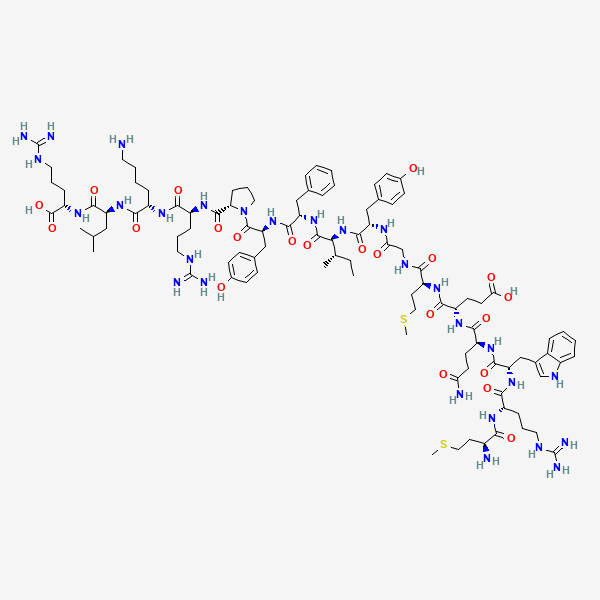
- Molecular formula
- C101H152N28O22S2
- Molecular weight
- 2174.6 g/mol
- IUPAC name
- (4S)-4-[[(2S)-5-amino-2-[[(2S)-2-[[(2S)-2-[[(2S)-2-amino-4-methylsulfanylbutanoyl]amino]-5-carbamimidamidopentanoyl]amino]-3-(1H-indol-3-yl)propanoyl]amino]-5-oxopentanoyl]amino]-5-[[(2S)-1-[[2-[[(2S)-1-[[(2S,3S)-1-[[(2S)-1-[[(2S)-1-[(2S)-2-[[(2S)-1-[[(2S)-6-amino-1-[[(2S)-1-[[(1S)-4-carbamimidamido-1-carboxybutyl]amino]-4-methyl-1-oxopentan-2-yl]amino]-1-oxohexan-2-yl]amino]-5-carbamimidamido-1-oxopentan-2-yl]carbamoyl]pyrrolidin-1-yl]-3-(4-hydroxyphenyl)-1-oxopropan-2-yl]amino]-1-oxo-3-phenylpropan-2-yl]amino]-3-methyl-1-oxopentan-2-yl]amino]-3-(4-hydroxyphenyl)-1-oxopropan-2-yl]amino]-2-oxoethyl]amino]-4-methylsulfanyl-1-oxobutan-2-yl]amino]-5-oxopentanoic acid
Verified external records:
References
- 1.MOTS-c — indexed research (PubMed, National Library of Medicine)
- 2.MOTS-c — registered clinical studies (ClinicalTrials.gov)
- 3.MOTS-c for improving insulin sensitivity in prediabetes — Phase 2 trial (NCT07505745)
- 4.Phase 1a/1b study of CB4211 in healthy adults and adults with nonalcoholic fatty liver disease (NCT03998514)
- 5.CohBar topline results from the Phase 1a/1b study of the MOTS-c analog CB4211
- 6.Alzheimer's Drug Discovery Foundation — MOTS-c evidence review
- 7.CohBar 2023 SEC filing — CB4211 formulation and development status
- 8.MOTS-c compound record (PubChem CID 146675088)
- 9.FDA — drug approval information
- 10.The mitochondrial-derived peptide MOTS-c promotes metabolic homeostasis and reduces obesity and insulin resistance (PMID 25738459)
- 11.MOTS-c translocates to the nucleus to regulate nuclear gene expression in response to metabolic stress (PMID 29983246)
- 12.MOTS-c is an exercise-induced regulator of age-dependent physical decline and muscle homeostasis (PMID 33473109)
- 13.MOTS-c improves intrinsic muscle mitochondrial bioenergetic health and efficiency (PMID 41520850)
- 14.MOTS-c suppresses ovariectomy-induced bone loss via AMPK activation (PMID 27237975)
- 15.MOTS-c prevents pressure-overload heart failure in mice (PMID 36156853)
- 16.MOTS-c in a mouse model of cancer-induced bone pain and inflammation (PMID 38716540)
- 17.FDA evaluation of MOTS-c-related bulk drug substances for the 503A Bulks List
- 18.USADA — What is the MOTS-c peptide?
- 19.WADA 2026 Prohibited List
More on MOTS-c
Everything else we've written about MOTS-c — what the community reports, the explainers that cover it, and the terms it keeps running into.