Also known as: Elamipretide · MTP-131 · Bendavia · Szeto-Schiller peptide 31 · SS-31 peptide · RX-31
Human (controlled)Mixed
On this page
- What is SS-31 (elamipretide)?
- How does SS-31 work?
- What does the research show?
- Is SS-31 safe? Side effects
- FDA & legal status (2026)
- How is SS-31 used and dosed?
- SS-31 and the longevity landscape
- Hype vs. reality
- Frequently asked questions
- Who SS-31 is for — and who should wait
- Evidence by outcome
- FDA & legal status
- Registered clinical trials
- Reported side effects
- Chemical identifiers
- References
- Related compounds
- More on SS-31 (elamipretide)
SS-31 (elamipretide) is a synthetic mitochondria-targeting peptide that the longevity field pays attention to because it protects the cell’s power plants — and it is now FDA-approved as Forzinity for a rare mitochondrial disease. For everyday anti-aging, though, the human evidence is early and mixed, not settled.
If you’re here, you probably ran into SS-31 in a longevity thread — pitched as a mitochondrial “anti-aging” peptide — and want to know whether the science backs the hype. The short version: SS-31 is further down the clinical road than almost any other compound in this corner of the site, which makes its story unusually concrete. It also means the honest gaps are specific, not hand-wavy.
What is SS-31 (elamipretide)?
SS-31 (elamipretide) is a lab-made peptide — a short chain of just four amino acids (D-Arg-Dmt-Lys-Phe-NH2) — designed to concentrate inside mitochondria, the tiny structures that generate almost all of a cell’s energy. It was invented in an academic lab (the “SS” stands for its inventors, Szeto and Schiller), and picked up a string of names along the way: MTP-131 and Bendavia during drug development, and finally Forzinity (elamipretide) as an approved medicine. It is small (molecular weight ≈ 639.8) and water-soluble, and it is given by injection. One thing to keep straight from the start: SS-31 the drug and “SS-31” the research-chemical powder are chemically the same molecule but are not the same regulated product — only the drug went through FDA review.
How does SS-31 work?
SS-31 works by parking itself in the inner membrane of the mitochondrion and binding a lipid there called cardiolipin — the surface the cell’s energy machinery (the electron transport chain) is mounted on. Think of an aging power plant with frayed wiring: energy leaks out as heat and sparks, and less electricity reaches the outlets. By stabilizing cardiolipin, SS-31 acts a bit like re-insulating that wiring, so studies report the machinery runs cleaner — more usable energy (ATP, the molecule cells run on) and fewer leaked reactive-oxygen byproducts (the “sparks” that damage cells over time) (mechanism research on PubMed). That is the whole reason SS-31 lands in the longevity conversation: failing mitochondria are one of the recognized hallmarks of aging, and SS-31 targets them directly. The honest caveat is that “protects mitochondria in a study” is a mechanism, not a promise that it slows human aging.
What does the research show?
SS-31 stands apart from most longevity peptides because it has been through the clinical wringer. A PubMed search returns hundreds of records — over 140 tagged as human research and more than a dozen randomized controlled trials — plus roughly 20 registered clinical studies (PubMed; ClinicalTrials.gov). The catch for a longevity reader: almost all of that testing was for specific diseases, not for slowing aging in healthy people. Here is the honest split, use by use.
| Use | Best evidence so far | What it showed |
|---|---|---|
| Age-related muscle & mitochondrial energy (the longevity use) | Human (controlled), small early trials + a new one recruiting | Mixed and inconclusive so far; no proven anti-aging benefit |
| Barth syndrome (rare disease) | Human RCT — led to FDA approval | Approved as Forzinity; pivotal data was small and debated |
| Primary mitochondrial myopathy (broad) | Human RCT (Phase 3) | Did not meet its primary endpoint |
| Dry AMD (geographic atrophy) | Human RCT — Phase 3 ongoing | Still being tested; not established |
| Heart failure | Human RCT (Phase 2) | No clear benefit shown so far |
For the longevity use specifically, SS-31 has been tested on skeletal-muscle function and mitochondrial energy in older adults in a Phase 2 study (NCT02245620), and a dedicated “Study of Healthy Aging and Physical Function With Elamipretide” began recruiting in late 2025 (NCT07275424). That is real human evidence — which is more than most anti-aging peptides can say — but it is small and mixed, so SS-31’s anti-aging case is still being written, not finished.
On the disease side, the story is two-sided, and we won’t sand off either edge. SS-31 (as elamipretide) earned FDA approval for Barth syndrome, a rare inherited mitochondrial disorder, under the brand Forzinity (Barth trial NCT03098797; a Phase 4 confirmatory study, NCT07531251, is now underway). But its biggest swing at broad mitochondrial disease — the Phase 3 MMPOWER-3 trial in primary mitochondrial myopathy — did not meet its primary endpoint (NCT03323749). SS-31 is also in a Phase 3 eye trial for dry age-related macular degeneration (ReNEW, NCT06373731) and has been tested in heart failure without a clear win yet. The pattern that matters for a longevity reader: SS-31 is a real, approved drug for one rare condition, and an open question for everything the biohacker crowd actually wants it for.
Is SS-31 safe? Side effects
SS-31’s safety is better understood than almost any other peptide on this site, for a simple reason: elamipretide was studied in thousands of patient-exposures and reviewed by the FDA before approval. Across its trials, the most commonly reported problem was injection-site reactions — redness, itching, or irritation where the shot goes in — which were usually mild (Forzinity label via DailyMed). That is a reassuring short-term picture. Two honest limits remain. First, that safety record was built in sick populations under medical supervision, not in healthy adults microdosing for longevity. Second, there is no long-term data on years of anti-aging use, because nobody has run that study. And the research-grade “SS-31” powder carries the usual research-chemical risks — quality control over its purity, dosing accuracy, and sterility is left entirely to whoever sells it, and it isn’t the FDA-reviewed product.
FDA & legal status (2026)
SS-31 (elamipretide) is FDA-approved — but only in a narrow lane. As of 2026, the FDA has approved elamipretide as the prescription drug Forzinity (NDA 215244, Stealth BioTherapeutics) for Barth syndrome, a rare inherited mitochondrial disorder (Drugs@FDA / DailyMed). It is not approved for anti-aging, “mitochondrial support,” athletic recovery, or general longevity. That gap is the crux of the whole page: the “SS-31” powder sold online for those purposes is an unapproved research chemical, legally separate from Forzinity even though it’s the same molecule. Regulatory status can move — approvals expand, labels change — so treat this as dated to 2026 and re-check the FDA record for anything newer.
How is SS-31 used and dosed?
In its clinical trials, SS-31 (elamipretide) was given as a daily subcutaneous injection — a shot into the fat just under the skin — often after being reconstituted from a freeze-dried powder (mixing the powder with sterile liquid to turn it back into an injectable solution). We’re describing how it was studied, not writing you a protocol: for the approved drug, the exact dose and schedule are set by the FDA label, not by us (Forzinity label). For anyone working out concentrations from a research-grade vial, the arithmetic of “how many units to draw” is exactly what our reconstitution & dosing calculator handles, and if you’re wondering whether SS-31 shares a syringe with other compounds, our mixing compatibility reference covers what’s commonly combined and where the honest answer is “not enough data.” Neither is a recommendation to use it — they’re reference tools.
SS-31 and the longevity landscape
SS-31 sits in the longevity & mitochondrial peptides cluster — the most speculative corner of the field, alongside compounds like MOTS-c, humanin, and Epitalon that target the machinery of aging itself. Within that landscape, SS-31 is the rare one with a real FDA approval behind it, which makes it a useful anchor for the whole category. The same longevity-and-recovery audience often looks at growth-hormone-axis compounds too — the FDA-approved tesamorelin, the muscle-preservation candidate follistatin, and the oral GH-secretagogue MK-677 — though those work on completely different pathways and shouldn’t be treated as interchangeable with a mitochondrial peptide.
Hype vs. reality
The biggest SS-31 claim floating around is that it “reverses aging” or “repairs your mitochondria.” Here’s the honest grading. That SS-31 stabilizes cardiolipin and improves mitochondrial energy output in lab and animal work is well-supported — but that’s a mechanism, not a proven human outcome. That SS-31 treats a specific mitochondrial disease is now true and FDA-backed, for Barth syndrome only. That SS-31 slows aging or extends healthspan in healthy people is the part everyone actually wants, and it remains a hypothesis with early, mixed human data — closer to “worth testing” than “proven.” The exciting, true thing is that the testing is happening, in people, right now.
Frequently asked questions
Does SS-31 actually work for anti-aging?
Not proven — yet. SS-31 has a strong mechanistic case (it protects mitochondria) and, unusually, real early human trials in older adults, but the anti-aging results so far are small and mixed. A dedicated healthy-aging trial only started recruiting in late 2025. We grade the longevity use Human (controlled) with a mixed verdict: promising and actively being tested, not settled.
Is SS-31 legal?
SS-31 is legal as an FDA-approved prescription drug — Forzinity (elamipretide) — but only for its approved use, Barth syndrome. The “SS-31” powder sold online for longevity is an unapproved research chemical, marketed “for research use only,” which is a liability label, not a safety guarantee.
Is SS-31 the same as elamipretide and Forzinity?
Yes — SS-31, elamipretide, MTP-131, and Bendavia are all names for the same molecule, and Forzinity is the FDA-approved brand of it. The difference that matters is regulatory, not chemical: Forzinity is a reviewed medicine, while research-grade “SS-31” powder is not.
How do people take SS-31?
In trials, SS-31 was given as a daily subcutaneous injection. That’s background on how it was studied, not a how-to — the approved drug’s dosing is defined by its FDA label and a prescriber, and community “anti-aging” dosing is not clinically validated.
Is SS-31 banned in sport?
SS-31’s anti-doping status isn’t clearly defined on the WADA Prohibited List by name as of 2026, and now that elamipretide is an approved drug the old “non-approved substance” catch-all doesn’t cleanly apply. That ambiguity is exactly why any athlete subject to testing should confirm with USADA or their anti-doping authority before assuming anything.
Who SS-31 is for — and who should wait
SS-31 draws in the longevity-minded self-researcher — the person who’s read that failing mitochondria drive aging and wants a compound that targets them directly. The honest framing: SS-31 is one of the very few peptides in this space with a real FDA approval and a solid short-term human safety record, which is a genuine point in its favor. But that approval is for a rare disease, its biggest broad trial missed, and the anti-aging benefit people actually want is still early and mixed. The strongest reason for optimism isn’t hype — it’s that the human trials are running now, not absent. Anyone expecting a proven age-reversal shot, or unwilling to accept that the longevity use is unapproved and under-tested, has every reason to watch the trials read out first.
Evidence by outcome
Each outcome SS-31 (elamipretide) has been studied for, with the honest evidence grade and what the studies actually found. A tier never stands alone — the verdict rides with it.
| Outcome | Evidence | What was found |
|---|---|---|
| Age-related muscle & mitochondrial energy (the longevity use) | Human (controlled)Mixed | SS-31 has actually been tested in older adults — a Phase 2 trial looked at its effect on skeletal-muscle function and mitochondrial energy, and a fresh healthy-aging trial began recruiting in late 2025. The early human results are mixed and small, so a real anti-aging benefit in healthy people is not established yet. The good news: unlike most "longevity peptides," this one is being studied in people right now. |
| Barth syndrome (rare mitochondrial disease) | Human RCTHelped | Barth syndrome is the one use that carried SS-31 (as elamipretide) all the way to FDA approval under the brand Forzinity. The pivotal trial was small and its results were debated, but the FDA judged the overall package strong enough to approve — Human RCT evidence for a very specific, rare population. |
| Primary mitochondrial myopathy (broad) | Human RCTNo effect | The largest test of SS-31 outside Barth syndrome was a Phase 3 trial in primary mitochondrial myopathy (MMPOWER-3), and it did not meet its primary endpoint. That is Human RCT evidence pointing the other way — an honest miss, and the reason we don't treat "mitochondrial disease" as a solved case. |
| Dry AMD (geographic atrophy) | Human RCTUnclear | SS-31 is in a Phase 3 eye trial (ReNEW) for dry age-related macular degeneration, an age-driven retinal disease. Because that trial is still running, the verdict here is open — the answer is being generated, not missing. |
| Heart failure | Human RCTMixed | Several Phase 2 heart-failure trials tested short courses of SS-31 on heart function. They have not shown a clear benefit so far, which is why this line of research has stayed early rather than advancing to approval. |
FDA & legal status
- United States: fda approved (as of Jul 2026) — approved for Barth syndrome (as Forzinity / elamipretide)
The FDA has approved elamipretide as the prescription drug Forzinity (NDA 215244, Stealth BioTherapeutics) for Barth syndrome, a rare inherited mitochondrial disorder. It is NOT approved for anti-aging, general "mitochondrial support," or longevity. The "SS-31" powder sold online as a research chemical for those uses is unapproved and is not the same regulated product as Forzinity.
openFDA Drugs@FDA lists 1 approved product as of 2026-07-15.
Registered clinical trials
21 registered studies mention SS-31 (elamipretide) on ClinicalTrials.gov (latest update 2026-10-16). A registered trial means a study is planned or underway — not that SS-31 (elamipretide) is approved or proven.
Reported side effects
| Effect | Frequency | Severity |
|---|---|---|
| Injection-site reactions (redness, itching, irritation) | Most commonly reported effect in trials | Usually mild |
Chemical identifiers
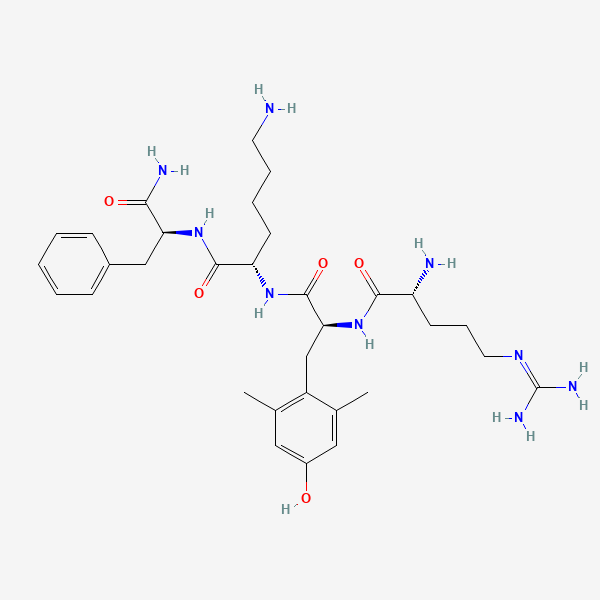
- Molecular formula
- C32H49N9O5
- Molecular weight
- 639.8 g/mol
- IUPAC name
- (2S)-6-amino-2-[[(2S)-2-[[(2R)-2-amino-5-(diaminomethylideneamino)pentanoyl]amino]-3-(4-hydroxy-2,6-dimethylphenyl)propanoyl]amino]-N-[(2S)-1-amino-1-oxo-3-phenylpropan-2-yl]hexanamide
Verified external records:
References
More on SS-31 (elamipretide)
Everything else we've written about SS-31 (elamipretide) — what the community reports, the explainers that cover it, and the terms it keeps running into.