Also known as: NS-2330 · NS 2330 · NS2330 · tesofensina
Note: tesofensine is not a peptide — it's covered here because people research it right alongside peptides.
Human RCTHelped
On this page
- What is tesofensine?
- How does tesofensine work?
- What does the research show?
- What the community reports
- Is tesofensine safe? Side effects
- FDA & legal status (2026)
- How is tesofensine taken?
- Tesofensine vs the GLP-1 weight-loss drugs
- Frequently asked questions
- Who is tesofensine for — and who should be cautious?
- Evidence by outcome
- FDA & legal status
- Registered clinical trials
- Reported side effects
- Chemical identifiers
- References
- Related compounds
- More on Tesofensine
Tesofensine is a non-peptide weight-loss compound — a small-molecule triple reuptake inhibitor, not a peptide — that produced some of the largest weight loss ever recorded in a Phase 2 obesity trial. Tesofensine is not FDA-approved; its development stalled over its effect on heart rate and blood pressure, not over whether it worked.
What is tesofensine?
Tesofensine (originally coded NS-2330) is a lab-made small molecule, not a peptide — a point worth stating up front, because it usually gets filed next to peptide weight-loss drugs online. Chemically it is a tropane derivative, the same structural family as several classic stimulant-type molecules, with the formula C17H23Cl2NO and a molecular weight around 328. Tesofensine was first developed as a brain drug for Parkinson’s and Alzheimer’s disease. When patients in those early trials kept losing weight, the developers (NeuroSearch in Denmark) turned it into an obesity candidate — which is the story that made tesofensine one of the most-searched experimental diet compounds on the internet.
How does tesofensine work?
Tesofensine works as a triple monoamine-reuptake inhibitor: it blocks the transporters that normally clear noradrenaline, dopamine and serotonin out of the gaps between brain cells, so the levels of all three rise and stay up. Higher noradrenaline and dopamine tone tends to blunt appetite and increase the feeling of fullness, which is the leading explanation for tesofensine’s weight-loss effect. That same monoamine boost is also the double edge of the drug: pushing noradrenaline up throughout the body is exactly what nudges heart rate and blood pressure upward. The appetite mechanism is well characterised; think of tesofensine less as a metabolism drug and more as an appetite-and-satiety drug that works from the brain outward.
What does the research show?
Tesofensine has real human evidence — including randomized controlled trials — which sets it apart from most compounds on this site, and the honest reading depends entirely on which use you mean. For weight loss, a Phase 2 randomized, placebo-controlled obesity trial reported dose-dependent weight loss well beyond placebo over 24 weeks, with the top dose (up to 1 mg once daily) reaching roughly 10% of body weight — larger than the approved weight-loss drugs of that era (NCT00394667; long-term obesity safety, NCT00481104). That is a genuine positive result. For Parkinson’s disease and Alzheimer’s disease, the story flips: Phase 2 randomized, placebo-controlled trials did not show the hoped-for benefit (Parkinson’s, NCT00148512; early Parkinson’s, NCT00148486; Alzheimer’s dementia, NCT00153010), and those programs were dropped. Later work paired tesofensine with the beta-blocker metoprolol — a combination called Tesomet — to counter the heart-rate problem, and tested it in rarer conditions like Prader-Willi syndrome and hypothalamic obesity (NCT03149445), but several of those studies were withdrawn before completion.
The clean summary: tesofensine’s weight-loss evidence is Human RCT and the verdict is it helped — a rare thing to be able to say. What it lacks is not a positive efficacy signal but a finished safety and approval path.
What the community reports
Outside the clinic, tesofensine has a following among people chasing the “10% weight loss” headline from its obesity trial, usually bought as a research chemical and taken as a daily oral dose. The commonly reported pattern mirrors the trial doses — a fraction of a milligram once a day — often stacked mentally against semaglutide or tirzepatide as a “pill instead of an injection.” These accounts are anecdotal: they are not controlled data, they skew toward people who felt something and posted about it, and they can’t tell you how often the cardiovascular side effects turn up in the real world. Useful for understanding the interest, not for proving safety.
Is tesofensine safe? Side effects
Tesofensine’s honest safety headline is that its biggest liability is cardiovascular, not a lack of effect. Because tesofensine raises noradrenaline and dopamine everywhere — not just in the appetite centers — it tends to increase heart rate and blood pressure, and that dose-limiting problem is the main reason its obesity development stalled and why the later Tesomet program bolted on a beta-blocker to try to cancel it out (heart-rate study, NCT03488719). The human trials also reported dry mouth, insomnia, nausea, constipation, and mood or agitation changes — the profile you’d expect from a stimulant-like monoamine drug. Two things the trials cannot tell you: there is no long-term human safety record, and the research-market product you’d actually buy is unregulated, so its purity and dose accuracy aren’t guaranteed by anyone. Anyone with high blood pressure, a heart condition, an anxiety or mood disorder, or who takes other serotonergic or stimulant drugs has specific reason for caution.
FDA & legal status (2026)
Tesofensine is not FDA-approved, and it is not a legal dietary supplement. In the United States it was only ever an investigational drug — studied for obesity, Parkinson’s and Alzheimer’s under programs that never reached approval — and the Drugs@FDA database lists no approved tesofensine product. Today tesofensine circulates only as a gray-market research chemical. The European Medicines Agency has likewise never authorised it. The full dated breakdown is in the FDA & legal status block below; treat any regulatory claim as dated and re-verify it, since this is exactly the kind of shelved compound whose status can shift if a developer revives it.
How is tesofensine taken?
Tesofensine is taken as an oral pill, once a day — which is another way it differs from the injectable peptides it gets compared to. In the trials the doses were small, in the range of 0.125 mg to 1.0 mg once daily, with the 1 mg dose driving the largest weight loss and also the most side effects (dose-ranging detail, NCT00148512). Because tesofensine is an oral small molecule, there is no reconstitution and no mixing to think about — the peptide-injection tools on this site (the reconstitution calculator and the mixing-compatibility reference) don’t apply to it. Doses here are reported as information from the studies, not as a protocol; the gap between “a trial used up to 1 mg” and “you should take 1 mg” is the unmonitored blood pressure the trial staff were watching and you wouldn’t be.
Tesofensine vs the GLP-1 weight-loss drugs
Tesofensine gets constantly compared to the GLP-1 drugs like semaglutide and tirzepatide, and the contrast is sharp. Tesofensine is a non-peptide oral pill that works in the brain by raising noradrenaline, dopamine and serotonin; the GLP-1 and dual-agonist drugs are injectable peptides that mimic gut hormones. The GLP-1 class has crossed the finish line — large Phase 3 trials, FDA approval, an established (mostly gastrointestinal) side-effect profile — while tesofensine has a strong Phase 2 weight-loss signal but stalled at the cardiovascular hurdle and never got approved. For most people asking, that difference — approved-and-monitored versus promising-but-shelved — is the whole comparison. You can browse the rest of the metabolic-weight-loss compounds on the incretin & metabolic hub.
Frequently asked questions
Is tesofensine a peptide?
No. Tesofensine is a small-molecule drug — a triple monoamine-reuptake inhibitor in the tropane chemical family — not a peptide. It sits in our metabolic section because people compare it to the peptide weight-loss drugs, but chemically it has nothing in common with them, and it is swallowed as a pill rather than injected.
Does tesofensine work for weight loss?
In the strict evidence sense, tesofensine’s weight-loss result is one of the better ones on this site: a Phase 2 randomized, placebo-controlled trial showed dose-dependent weight loss beyond placebo, reaching roughly 10% of body weight at the top dose over 24 weeks. The catch is not efficacy — it’s that tesofensine never completed the safety and approval path, largely because of its effect on heart rate and blood pressure.
Is tesofensine FDA-approved or legal?
Tesofensine is not FDA-approved and is not a legal dietary supplement. It exists in the US only as a research chemical, sold “for research use only.” It was never approved in the EU either. This status could change if a company revives its development, so re-check it rather than trusting an old claim.
Is tesofensine banned in sport?
Treat it as prohibited. With no approval from a stringent regulator, tesofensine falls under WADA’s S0 “non-approved substances” rule (prohibited at all times), and as a monoaminergic stimulant it also touches the S6 stimulant category. Any athlete under anti-doping rules should verify it against the current WADA prohibited list before going near it.
Who is tesofensine for — and who should be cautious?
Tesofensine draws in people who saw the “10% weight loss in a pill” headline and want to understand what happened to it. The honest framing: tesofensine is one of the few compounds here with a real, positive human weight-loss trial behind it — that part is genuine and worth respecting. But it stalled for a real reason, its higher noradrenaline tone reliably raises heart rate and blood pressure, there is no long-term human safety data, and the research-market product is unregulated. Anyone with high blood pressure, heart disease, an anxiety or mood disorder, or who is already on serotonergic or stimulant medication has specific reason to steer clear and wait for a version that made it through a full safety review.
Evidence by outcome
Each outcome Tesofensine has been studied for, with the honest evidence grade and what the studies actually found. A tier never stands alone — the verdict rides with it.
| Outcome | Evidence | What was found |
|---|---|---|
| Weight loss / obesity | Human RCTHelped | A Phase 2 randomized, placebo-controlled obesity trial reported dose-dependent weight loss well beyond placebo over 24 weeks — the finding that made tesofensine famous. It never advanced to approval: development stalled over its effect on heart rate and blood pressure, not over whether it worked. |
| Parkinson's disease | Human RCTNo effect | Tesofensine was first tested as a Parkinson's drug. Phase 2 randomized, placebo-controlled trials did not show the hoped-for benefit, and that program was dropped. A high-quality trial with a negative result — strong evidence against this use. |
| Alzheimer's disease / cognition | Human RCTNo effect | A Phase 2 trial in mild-to-moderate Alzheimer's dementia did not deliver a meaningful cognitive benefit, and tesofensine was not pursued for dementia. The appetite and weight-loss signal noticed in these early neurology trials is what redirected it toward obesity. |
| Hypothalamic obesity / Prader-Willi (as Tesomet) | Human (controlled)Mixed | Later work paired tesofensine with the beta-blocker metoprolol ("Tesomet") to blunt its cardiovascular effects, and tested it in hypothalamic obesity and Prader-Willi syndrome. Several of those trials were withdrawn before completion, so the picture for these rarer conditions is unsettled. |
FDA & legal status
- United States: research use only (as of Jul 2026)
Not an FDA-approved drug and not a dietary supplement. Tesofensine was studied under investigational programs (obesity, Parkinson's, Alzheimer's) that never led to approval; the Drugs@FDA database lists no approved tesofensine product. Today it circulates only as a gray-market research chemical in the US.
- European Union: research use only (as of Jul 2026)
Not authorised by the European Medicines Agency for any use. Its European development (obesity, and later the Tesomet combination) did not reach marketing approval.
openFDA Drugs@FDA lists no approved product for tesofensine as of 2026-07-15.
Registered clinical trials
13 registered studies mention Tesofensine on ClinicalTrials.gov (latest update 2024-02-26). A registered trial means a study is planned or underway — not that Tesofensine is approved or proven.
Reported side effects
| Effect | Frequency | Severity |
|---|---|---|
| Increased heart rate and blood pressure | — | The key dose-limiting concern; the main reason obesity development stalled |
| Dry mouth | — | — |
| Insomnia / disturbed sleep | — | — |
| Nausea | — | — |
| Constipation | — | — |
| Mood changes, irritability or agitation | — | — |
Chemical identifiers
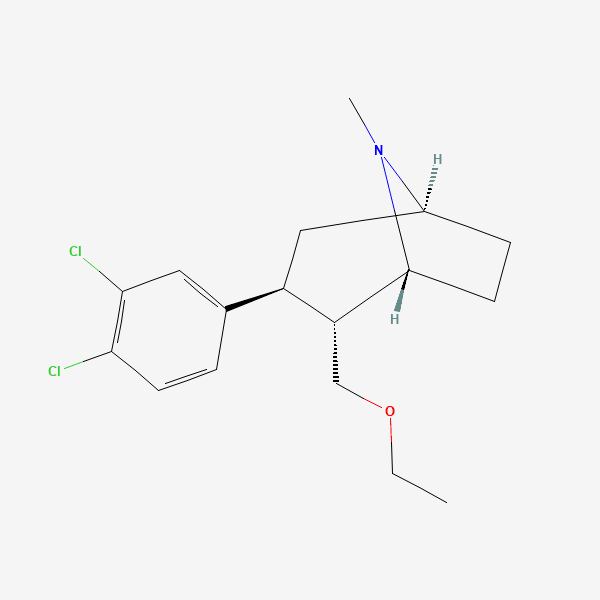
- Molecular formula
- C17H23Cl2NO
- Molecular weight
- 328.3 g/mol
- IUPAC name
- (1R,2R,3S,5S)-3-(3,4-dichlorophenyl)-2-(ethoxymethyl)-8-methyl-8-azabicyclo[3.2.1]octane
Verified external records:
References
More on Tesofensine
Everything else we've written about Tesofensine — what the community reports, the explainers that cover it, and the terms it keeps running into.