Human RCTHelped
On this page
L-DOPA (levodopa) is the compound your brain turns into dopamine, and that matters because dopamine itself can’t get into the brain from the bloodstream while L-DOPA can. That single border-crossing trick made it the cornerstone Parkinson’s-disease medicine for more than fifty years. The same molecule is also the active ingredient in velvet-bean (Mucuna) supplements.
What is L-DOPA?
L-DOPA is a non-proteinogenic amino acid, which means the body uses it as a chemical stepping-stone rather than a building block for proteins. Its formal name, 3,4-dihydroxy-L-phenylalanine, is where the short “DOPA” comes from. On the assembly line that builds dopamine, L-DOPA sits one step past the amino acid tyrosine and one step before dopamine itself. It is to dopamine roughly what 5-HTP is to serotonin: the immediate precursor you can actually supply from outside. What sets L-DOPA apart is a delivery advantage — the blood-brain barrier, the filter that guards the brain, blocks dopamine but lets L-DOPA through. In tablet form, that same molecule is an FDA-approved prescription drug.
How does L-DOPA turn into dopamine?
L-DOPA becomes dopamine in a single enzyme step. An enzyme called DOPA decarboxylase clips a small piece off L-DOPA and, just like that, you have dopamine. The full pathway runs tyrosine to L-DOPA to dopamine, and because the first step is the slow one, the body treats L-DOPA as a brief middle stage rather than something to store. This is also why doctors give L-DOPA instead of dopamine directly: swallowed dopamine never reaches the brain, but swallowed L-DOPA does, and the brain finishes the conversion on arrival.
There is a catch, and it explains why the pill is rarely levodopa alone. DOPA decarboxylase isn’t only in the brain; it’s spread all over the body, so much of a plain L-DOPA dose gets converted to dopamine out in the bloodstream before it arrives, which wastes the dose and causes nausea. A partner drug called carbidopa blocks that enzyme everywhere except the brain (carbidopa can’t cross the barrier itself), so more L-DOPA survives the trip and far less nausea results. That combination, levodopa plus carbidopa, is the familiar Parkinson’s tablet sold as Sinemet.
Why L-DOPA is the main Parkinson’s medicine
Parkinson’s disease is, at its root, a dopamine shortage: the brain cells that manufacture dopamine slowly die off, and their loss produces the classic tremor, muscle stiffness and slowed movement. L-DOPA refills the tank by handing the surviving cells the raw material they need. It remains the most effective symptom treatment ever found for Parkinson’s, backed by decades of randomized controlled trials and everyday clinical use, and nearly everyone responds to it at first.
The honest limitation isn’t whether L-DOPA works, it’s how the benefit ages. L-DOPA treats the symptoms; it does not stop the underlying disease from advancing. After several years the smooth, all-day relief tends to break up into “wearing-off” (the dose fading before the next one is due) and dyskinesias (involuntary, often writhing movements). Smoothing out those fluctuations is much of what long-term Parkinson’s care is about.
Is L-DOPA the same as Mucuna (velvet bean)?
Same molecule, very different product. Velvet bean (Mucuna pruriens) is naturally loaded with L-DOPA, so supplement makers sell velvet-bean extracts as a “natural” way to raise dopamine, marketed for mood, motivation and libido, and in some circles as a plant-based Parkinson’s option. Here is the honest read on the evidence. For Parkinson’s motor symptoms, small controlled human studies suggest Mucuna can work about as well as standard levodopa, sometimes with a faster onset. That’s a real signal, but the trials are small and the L-DOPA content per product varies, so it isn’t a validated stand-in for a dose-controlled prescription.
For the mood, motivation and libido claims, the human evidence is thin: mostly the reasonable logic that more dopamine should help, plus a handful of small studies (several on male fertility) rather than proof in healthy people. One practical warning matters here. If you already take prescription levodopa, adding velvet bean stacks two servings of the same active compound, which is a conversation to have with a doctor, not a DIY experiment.
Where does L-DOPA come from?
You don’t need to eat L-DOPA, because the body makes its own from tyrosine, which it builds in turn from the essential amino acid phenylalanine. It does occur in food, though: velvet beans are by far the richest natural source, and fava (broad) beans contain enough that they have long been floated as a folk approach to Parkinson’s. As a medicine, L-DOPA is manufactured and dosed to the milligram, which is exactly the precision a food or a loosely standardized supplement can’t promise.
Is L-DOPA safe?
L-DOPA has a long, well-mapped safety record, precisely because it has been a prescription medicine for so long. Taken under a doctor’s care, its short-term downsides are mostly nausea (which carbidopa blunts), lightheadedness when standing up, and sometimes vivid dreams. The better-known long-term issues appear after years of use: the dyskinesias and wearing-off already described, and, because it is a dopamine drug, occasional impulse-control problems such as compulsive gambling or shopping. Those are better known with the related dopamine-agonist drugs, but possible here too, and they tend to ease when the dose is adjusted.
The velvet-bean supplement route carries all the same dopamine effects, plus one extra hazard the prescription doesn’t have: you often can’t be sure how much L-DOPA is actually in the capsule, which makes reliable dosing hard and raises the odds of clashing with real Parkinson’s medication. Anyone weighing Mucuna, especially alongside prescription levodopa or an MAO inhibitor, should bring a doctor into the decision rather than freelancing it.
Evidence by outcome
Each outcome L-DOPA has been studied for, with the honest evidence grade and what the studies actually found. A tier never stands alone — the verdict rides with it.
| Outcome | Evidence | What was found |
|---|---|---|
| Parkinson's motor symptoms | Human RCTHelped | L-DOPA is the most effective drug ever found for the movement symptoms of Parkinson's — tremor, stiffness and slowness — backed by decades of randomized controlled trials and everyday clinical use, and nearly everyone responds early on. The honest caveat is durability, not whether it works: after years the smooth benefit tends to break up into "on-off" fluctuations and dyskinesias. |
| Mucuna pruriens as a natural levodopa source for Parkinson's | Human (controlled)Mixed | Because velvet bean is naturally rich in L-DOPA, small controlled human studies have tested it as a natural levodopa source, and some report it works about as well as the drug, occasionally with a faster onset. But the L-DOPA content varies between products, purity isn't guaranteed, and the trials are small — promising, not a validated substitute for a standardized prescription. |
| Mucuna supplements for mood, motivation and libido | Human observationalMixed | Velvet-bean extracts are sold for mood, drive and libido on the logic that more dopamine should help. Direct human evidence for those specific benefits is thin: mostly the mechanism plus a handful of small studies (several on male fertility) and long traditional use, rather than solid proof in otherwise healthy people. |
FDA & legal status
- United States: fda approved (as of Jul 2026)
This amino acid is also an FDA-approved prescription medicine (e.g. Carbidopa And Levodopa; Rytary). That approved drug is prescription-only; any version sold as a plant-extract "supplement" is a separate, unapproved product.
Chemical identifiers
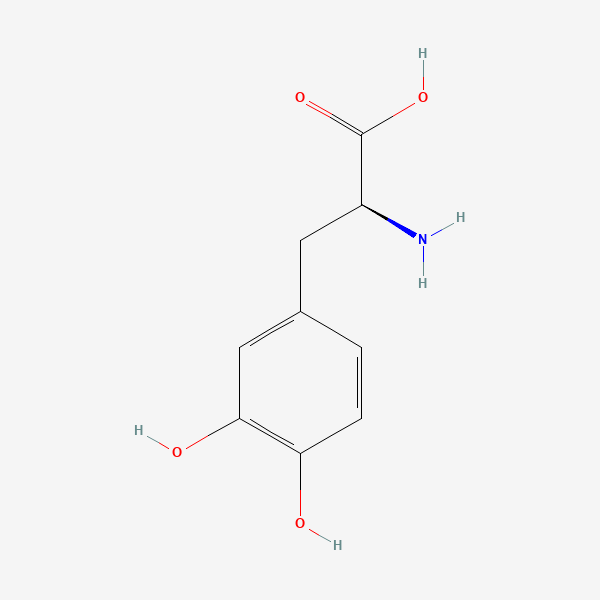
- Molecular formula
- C9H11NO4
- Molecular weight
- 197.19 g/mol
- IUPAC name
- (2S)-2-amino-3-(3,4-dihydroxyphenyl)propanoic acid
Verified external records:
References
- 1.L-DOPA (levodopa) — PubChem compound record (CID 6047), National Library of Medicine
- 2.Carbidopa and levodopa — FDA prescribing label (DailyMed, National Library of Medicine)
- 3.Levodopa for Parkinson's disease — indexed human research (PubMed, National Library of Medicine)
- 4.Mucuna pruriens (velvet bean) and Parkinson's — indexed human research (PubMed, National Library of Medicine)