In-vitroUnclear⚠ none in humans
On this page
Pyrrolysine is the 22nd amino acid — the last one to join the list, and the rarest. Only a handful of microbes use it, humans never touch it, and cells that do build it into proteins pull off a neat trick: they read a genetic “stop” signal as “keep going, add pyrrolysine here.” It’s a cousin of lysine with an extra ring attached, and today its main fame is as a tool that lets scientists rewrite the genetic code on purpose.
What is pyrrolysine?
Pyrrolysine is encoded by a codon and built into proteins by the ribosome — which is what makes it proteinogenic and earns it a spot on the amino acid roster — but it lives almost entirely outside the world most people know. It’s found only in certain methane-producing archaea (single-celled microbes, the best-studied being Methanosarcina) and a few bacteria. Structurally it’s straightforward to picture: take lysine, and attach a small nitrogen-containing ring (a pyrroline) to the end of its side chain. That ring is the business end, and it does its work inside a narrow set of microbial enzymes. Chemists give it the codes Pyl and the single letter O.
Why is pyrrolysine called the 22nd amino acid?
Pyrrolysine gets the “22nd” title because of how it’s coded: it hijacks a stop sign. The genetic code has three codons that normally mean “stop the protein here,” and one of them, UAG (nicknamed “amber”), is the one pyrrolysine borrows. In the microbes that use it, UAG can mean “insert pyrrolysine” instead of “stop,” thanks to a dedicated transfer RNA and a matching enzyme that charges that tRNA with pyrrolysine. This is the same category of trick that makes selenocysteine the 21st amino acid — a stop codon quietly repurposed — though the two use different codons and different machinery. Pyrrolysine was only pinned down in 2002, which is why it’s the newest full member of the amino-acid family and still feels like a footnote most textbooks are only starting to add.
What does pyrrolysine actually do?
Pyrrolysine’s day job is helping certain microbes make a living from methylamines. In methane-producing archaea, it sits in the active site of a group of enzymes called methylamine methyltransferases — the tools these organisms use to break down compounds like methylamine and, in the process, generate methane for energy. The pyrrolysine ring is positioned right where the chemistry happens, which is why the microbes go to the trouble of recoding a stop codon just to place it there. It’s a small but real part of the planet’s methane cycle — and, again, a process with no equivalent in human biology.
Do humans use pyrrolysine?
No — and that’s worth stating plainly, because it’s the honest answer to the obvious question. Humans don’t build pyrrolysine, don’t carry the machinery to insert it, and have no biological use for it. You won’t find it in a meaningful amount in food, it isn’t a nutrient, and it isn’t sold as a supplement. If a product ever claimed a health benefit from pyrrolysine, that would be a red flag rather than a selling point, since there’s no human pathway for it to act on. This page exists to complete the set — the 20 standard amino acids plus selenocysteine and pyrrolysine — not because it’s something to take.
Pyrrolysine in the lab
Pyrrolysine’s real modern relevance is as a borrowed tool for engineering proteins. The tRNA-and-enzyme pair that microbes use to install pyrrolysine turns out to be “orthogonal” — it does its own thing without interfering with a host cell’s normal protein-building. That makes it a favorite of synthetic biologists, who repurpose the system to insert custom, non-natural amino acids into a protein at a precise spot, adding chemical handles that nature never put there. It’s one of the most-used methods in the growing field of genetic code expansion. So the curiosity that hijacks a stop codon in a methane-making microbe has become a standard instrument on the protein-engineering bench — a nice reminder that basic biochemistry has a habit of turning into useful technology.
Evidence by outcome
Each outcome Pyrrolysine has been studied for, with the honest evidence grade and what the studies actually found. A tier never stands alone — the verdict rides with it.
| Outcome | Evidence | What was found |
|---|---|---|
| Role in microbial methane metabolism | In-vitroUnclear⚠ none in humans | In the archaea that use it, pyrrolysine sits in the active site of methylamine methyltransferases — the enzymes that let these microbes turn methylamines into methane for energy. This is established microbial biochemistry, first worked out when the amino acid was discovered in 2002. It has no counterpart or effect in humans. |
| Use as a synthetic-biology tool (genetic code expansion) | In-vitroUnclear⚠ none in humans | Pyrrolysine's dedicated tRNA-and-enzyme pair is prized in the lab because it works independently of a cell's normal protein-building machinery. Researchers borrow it to slot custom, non-natural amino acids into proteins at a chosen spot — a widely used technique, but a research tool, not a health intervention. |
FDA & legal status
- United States: dietary supplement / food (as of Jul 2026)
A proteinogenic amino acid found in dietary protein and sold as a supplement. Not an FDA-approved drug; supplements are regulated as food, not medicine.
Chemical identifiers
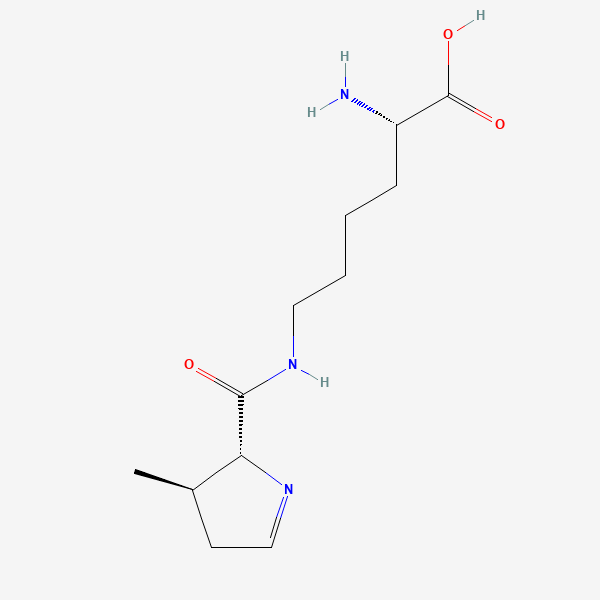
- Molecular formula
- C12H21N3O3
- Molecular weight
- 255.31 g/mol
- IUPAC name
- 2-amino-6-[(3-methyl-3,4-dihydro-2H-pyrrole-2-carbonyl)amino]hexanoic acid
Verified external records:
References
More on Pyrrolysine
Everything else we've written about Pyrrolysine — what the community reports, the explainers that cover it, and the terms it keeps running into.